Job Resume Title: How to Write It, With 12 Examples
By Mustafa Tarabya, founder of CVBooster · Published · Updated
7 min read
A job resume title is the short line under your name that names the job you are applying for, ideally in the same words as the posting, followed by one or two facts that prove you fit it. It is the first thing a recruiter reads after your name, and it tells them in two seconds which pile your resume belongs in. The second place titles matter is your experience section, where every job you list carries the title you actually held. Below: how to write the title line, how to handle job titles in your work history when your official title was odd or lower than the work you did, and 12 examples in six blocks from a first job to a senior role. Written by Mustafa Tarabya, who hired for his own company, read every application himself and now writes CVBooster's guides.
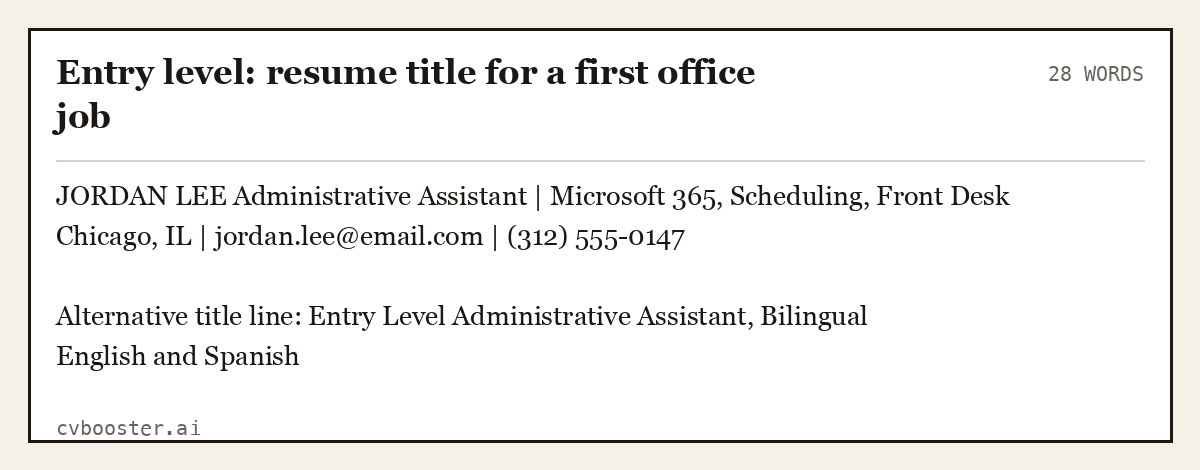
Entry level: resume title for a first office job (28 words)
JORDAN LEE Administrative Assistant | Microsoft 365, Scheduling, Front Desk Chicago, IL | jordan.lee@email.com | (312) 555-0147
Alternative title line: Entry Level Administrative Assistant, Bilingual English and Spanish
What a job resume title is, and what it is not
A resume title, sometimes called a resume headline or professional title, is one line. It sits directly under your name, above or beside your contact details, and it names a job. It is not a sentence about your passion, not a list of adjectives, and not your summary. The summary comes next and can run to three lines. If you want help with that part, our resume summary examples cover it step by step.
CareerOneStop, the job search site of the U.S. Department of Labor, puts the reason plainly: "Your resume should focus on a specific job title and use essential keywords that show how you meet the minimum qualifications for the role." The title line is the most direct way to do that. The CareerOneStop resume guide also advises scanning several postings for the same job title to find the requirements they repeat.
There is a practical reason too. Many employers use applicant tracking software, and recruiters search it by job title. MIT's career office says: "Employers may use keyword scanning on resumes, so know what words are relevant to the industry and position and ensure they appear in your resume." The MIT resume guide has more on wording for each section.
How to write the title line in three steps
- Copy the job title from the posting. If the ad says Customer Service Representative, write Customer Service Representative, not Client Experience Specialist. Use the exact words.
- Add one or two qualifiers that prove fit. A license, a specialty, years of experience, a key tool or a language. Separate them with a vertical bar or a comma.
- Change it for every application. The title is the cheapest line on the page to tailor and the one that matters most for the first read.
Keep it under about twelve words. If you need more, the extra detail belongs in your summary.
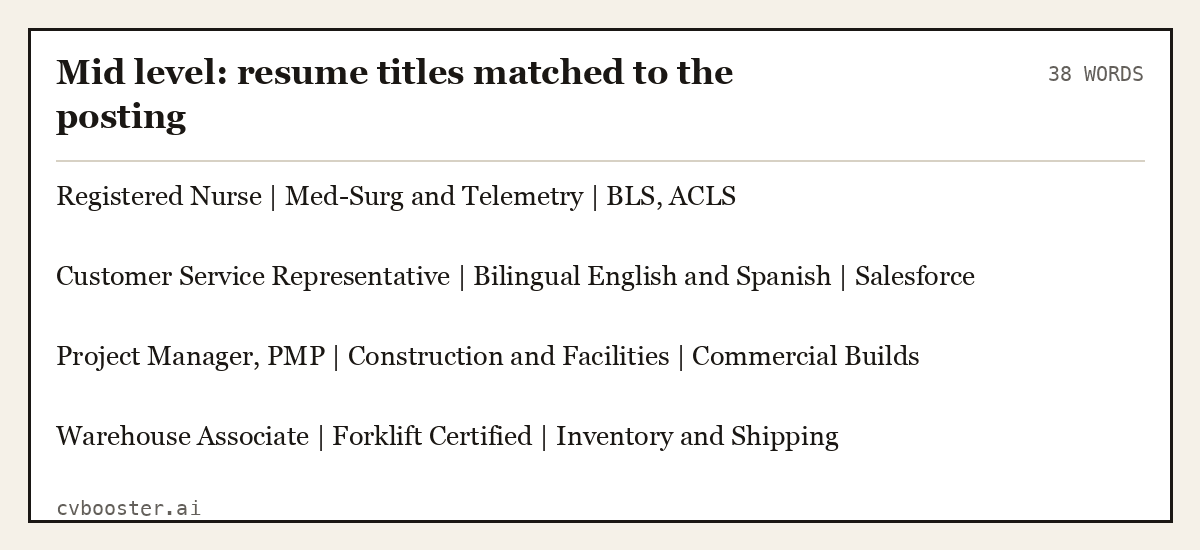
Mid level: resume titles matched to the posting (38 words)
Registered Nurse | Med-Surg and Telemetry | BLS, ACLS
Customer Service Representative | Bilingual English and Spanish | Salesforce
Project Manager, PMP | Construction and Facilities | Commercial Builds
Warehouse Associate | Forklift Certified | Inventory and Shipping
Resume title examples for senior and specialist roles
At senior level the title still names the job, and the qualifiers show scope: the function, the industry, the size of the team or the kind of organization. Avoid stacking three titles in one line, such as Director, Strategist and Coach, because the reader cannot tell which job you want.
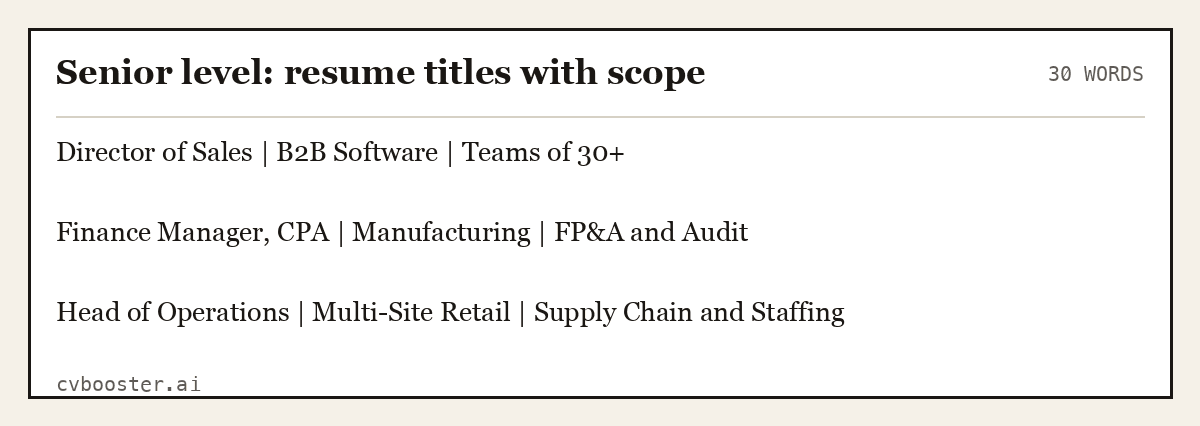
Senior level: resume titles with scope (30 words)
Director of Sales | B2B Software | Teams of 30+
Finance Manager, CPA | Manufacturing | FP&A and Audit
Head of Operations | Multi-Site Retail | Supply Chain and Staffing
Job titles in your experience section
Each job in your work history needs a title, and the rule is simple: use the title you actually held. Employers can confirm job titles with your references or through employment verification, and a title that does not match their records raises questions you do not want in a final interview.
What you can do is make an odd internal title readable. Many companies use creative or internal titles that mean nothing outside the building. Add the standard equivalent in parentheses so a recruiter and the software both understand it. O*NET, the U.S. Department of Labor occupation database, shows how many titles one job can carry: for servers alone it lists "Banquet Server, Busser, Cocktail Server, Food Runner, Food Server, Restaurant Server, Room Service Server, Server, Waiter, Waitress" among the reported job titles for waiters and waitresses. Pick the standard one closest to your work for the parentheses.
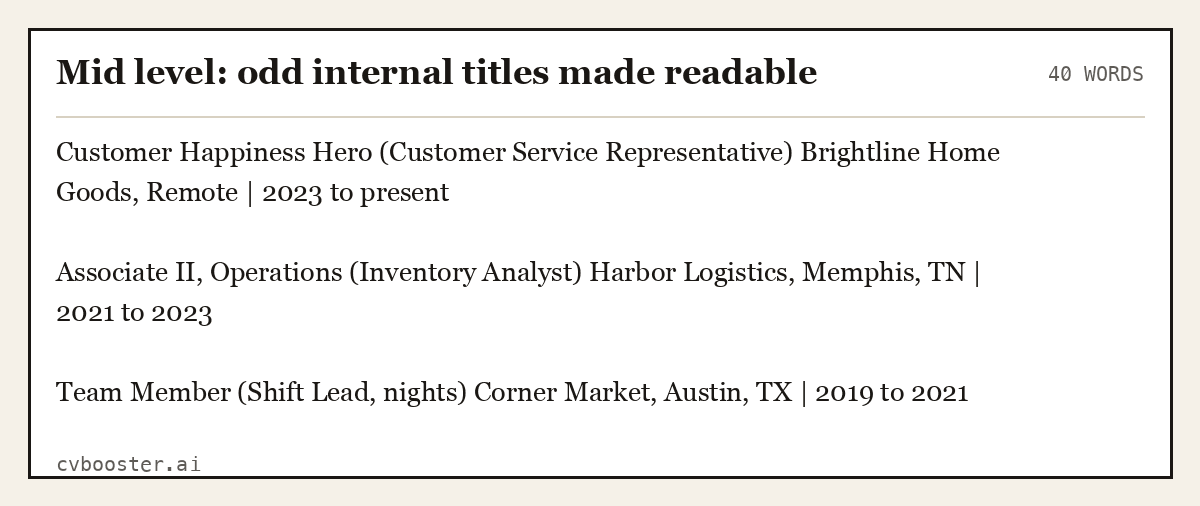
Mid level: odd internal titles made readable (40 words)
Customer Happiness Hero (Customer Service Representative) Brightline Home Goods, Remote | 2023 to present
Associate II, Operations (Inventory Analyst) Harbor Logistics, Memphis, TN | 2021 to 2023
Team Member (Shift Lead, nights) Corner Market, Austin, TX | 2019 to 2021
When your title was lower than the work you did
This is the most common question about job titles: you were called assistant but ran the office, or you were a coordinator doing a manager's job. Keep the official title, then let the first bullet show the real scope. If the role grew while you held it, a line such as "Acting Office Manager, covering for six months" is fine when it is true and your employer would confirm it.
If you are moving to a lower position on purpose, for example from manager back to a hands-on role, keep your real title and write the bullets about the hands-on work. Your title line at the top should still name the job you are applying for, so the reader sees the target first and the history second.
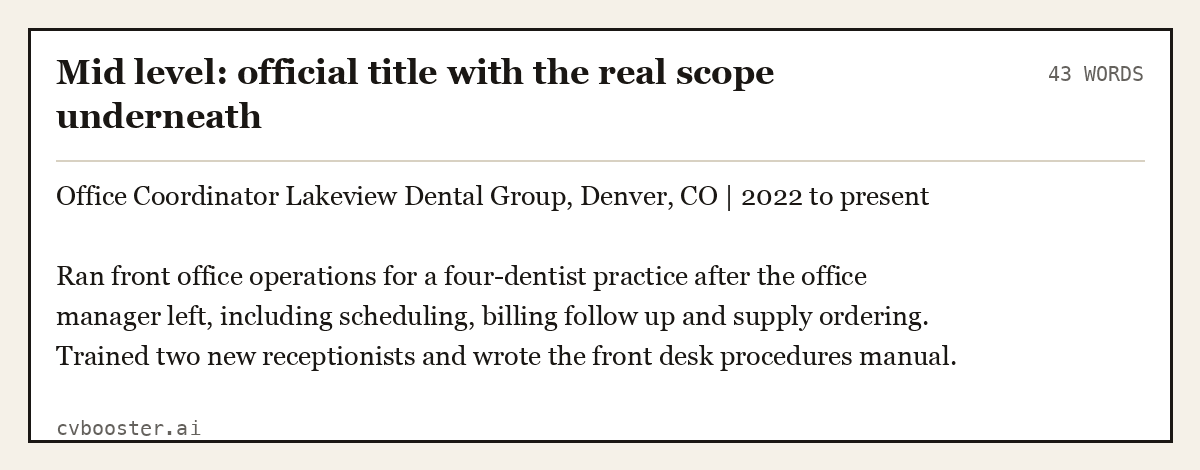
Mid level: official title with the real scope underneath (43 words)
Office Coordinator Lakeview Dental Group, Denver, CO | 2022 to present
Ran front office operations for a four-dentist practice after the office manager left, including scheduling, billing follow up and supply ordering. Trained two new receptionists and wrote the front desk procedures manual.
Resume titles for career changers and students
If you are changing careers, title the resume for the job you want, then use a qualifier to connect it to your past. If you are a student or recent graduate, the target job plus your degree or field works well. The career change resume guide shows how to carry the rest of the page.
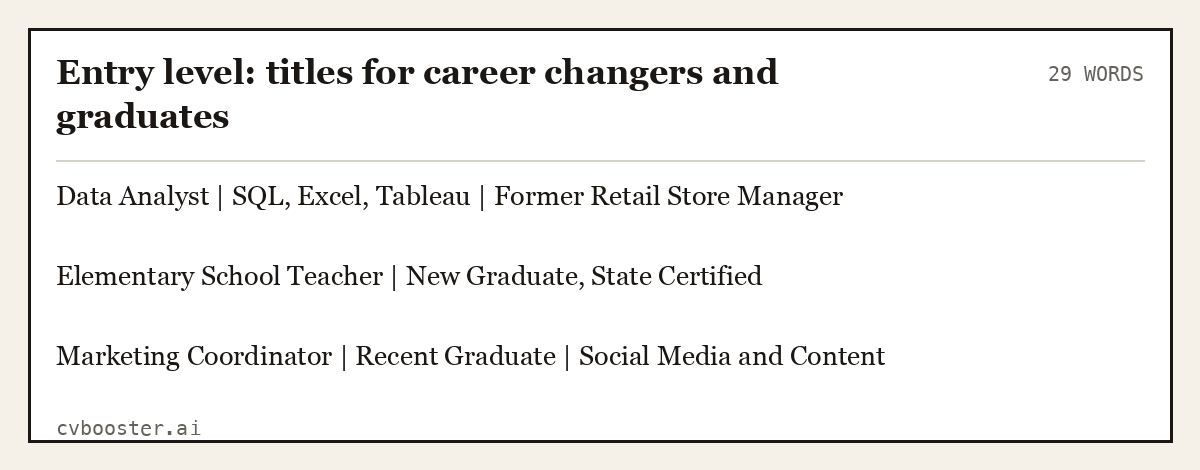
Entry level: titles for career changers and graduates (29 words)
Data Analyst | SQL, Excel, Tableau | Former Retail Store Manager
Elementary School Teacher | New Graduate, State Certified
Marketing Coordinator | Recent Graduate | Social Media and Content
Mistakes that weaken a resume title
- Writing a vague label such as Hardworking Professional or Experienced Leader, which names no job.
- Using a different title from the posting when you could use theirs, which can hide you from a keyword search.
- Listing three different jobs in one line because you are applying to all of them. Make three versions instead.
- Inflating a past job title in your experience section. Explain scope in the bullets instead.
- Making the title longer than the summary underneath it.
A clear title also makes the rest of the page easier to write, because every bullet now has one target. If your skills section needs the same attention, the resume skills section guide follows on naturally.
Frequently asked questions
What is a job title on a resume?
It means two things. The resume title is the line under your name naming the job you want, such as Registered Nurse or Customer Service Representative. The job titles in your experience section are the titles you held at each employer. Both should be clear, standard and, for the top line, matched to the posting.
What should I put as my resume title?
The exact job title from the posting you are applying to, plus one or two qualifiers that prove fit: a license, a specialty, a key tool, a language or years of experience. Keep it to one line and change it for each application.
Is a resume title the same as a resume headline?
Yes, in most advice they mean the same line under your name. Some writers use headline for a slightly longer phrase, such as a title with a specialty and a result, but both sit at the top and both should name the job you want before anything else.
Can I change my job title on my resume?
Keep the title you actually held, because employers can confirm it. You can add the standard equivalent in parentheses when the internal title was unusual, and you can show bigger responsibilities in the bullets. Writing a higher title than your employer would confirm is a risk that is not worth taking.
Should a resume title match the job posting exactly?
As closely as your experience honestly allows. Using the posting's exact title helps a recruiter place you quickly and helps keyword searches in applicant tracking software find you. If the posting title is more senior than your experience, use the closest true version, such as Junior or Associate.
Related articles
- Accounting Executive Resume: 5 Examples by Career Level
- Administration Resume Examples: 8 Samples, Entry to Manager
- Another Word for Resume: CV, Bio and 10 More Options
- Apple Pages Resume Template: 6 Examples Built for ATS
More articles
- Top 10 Job Search Strategies: the ones that get replies
- Jobscan Alternatives for UK and Public Sector Applications
- KSA Examples: Six Federal Statements in CCAR Format
Looking for a worked example for your job title? Browse the resume examples by job title.