Letter of Introduction for a Job: When to Send One
By Mustafa Tarabya, founder of CVBooster · Published · Updated
12 min read
A letter of introduction introduces you to someone who was not expecting to hear from you. There is no vacancy to answer and no application to submit. Its job is to open a conversation, and the thing it asks for is a reply, not a decision.
That single change, asking for a conversation instead of a job, is what separates it from every other document in a job hunt, and it is the reason people write bad ones. They take a cover letter, remove the reference number, and send a formal application to someone who never opened a vacancy.
What is a letter of introduction?
The phrase covers two related documents, and it saves confusion to name both before going further.
- The one you write about yourself. You approach a person directly: a hiring manager, a department head, a founder, a colleague in another part of your own organisation, to introduce who you are and what you do.
- The one somebody writes about you. A colleague, a former manager or a contact forwards you on to a person in their network: "You two should talk, here is why." You are the subject, not the author, and the letter arrives with borrowed credibility.
Both are covered here, because they come as a pair. The most effective version of the second is one you wrote yourself and handed to the person introducing you.
It is also worth separating two neighbours it gets confused with. A letter of recommendation vouches for your past performance and is aimed at a decision that is already being made. A letter of interest is a specific type of introduction, sent cold to a company with nothing advertised, that case has its own article, so this page treats it briefly and spends its length on the two cases that article does not cover.
Letter of introduction vs cover letter: how they differ
In almost every dimension, and the differences all descend from one fact: a cover letter is read by someone who asked for it, and an introduction is read by someone who did not.
- The trigger. A cover letter exists because a job was posted. An introduction exists because you decided it should.
- The reader's state of mind. A cover letter reader is assessing you against a specification. An introduction reader is deciding, in about four seconds, whether this email is worth the next thirty.
- The ask. A cover letter asks to be considered for a named role. An introduction asks for something much smaller: a short call, a pointer to the right person, a note kept on file.
- The length. A cover letter can run most of a page because the reader has committed to reading it. An introduction gets roughly two hundred words before it is being skimmed.
- The evidence. A cover letter proves you meet listed requirements. An introduction has no requirements to meet, so it proves you are worth a conversation instead, usually with one concrete thing you have done that is relevant to something they are visibly dealing with.
- The close. A cover letter closes by looking forward to hearing about the process. An introduction closes with a specific, easy next step and a date.
So the letter of introduction vs cover letter choice comes down to one question: is there an open job you are applying for? If yes, send a cover letter with the application, even when a contact referred you, and name that contact in the first line. If no, send an introduction and ask for a short conversation. Never send both to the same person for the same opening, because the second one reads as the first one again.
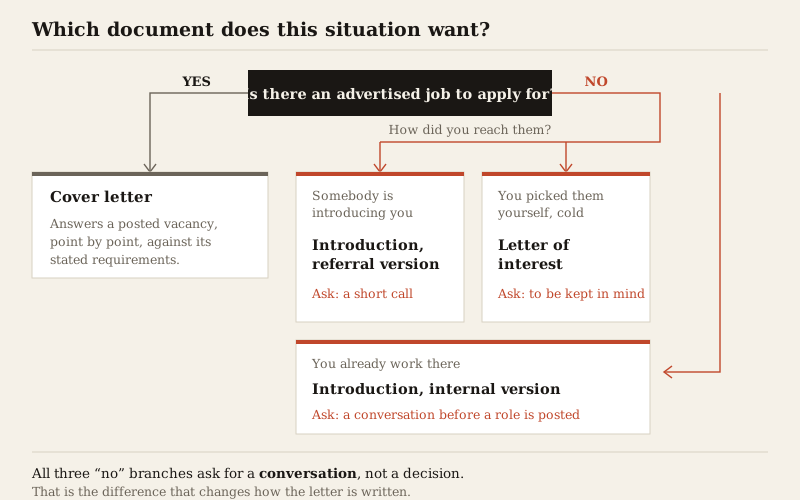
When is a letter of introduction the right document?
Four situations, and you can tell them apart by asking who put you in front of this reader.
- Somebody referred you. A contact has offered to connect you, or has already mentioned you. This is the strongest case and the one most often wasted, because people follow a warm referral with a cold, formal application.
- You approached the company yourself, and nothing is advertised. The speculative case. It is the hardest, because you have no borrowed credibility at all.
- You are moving inside your own organisation. A different department, a different site, a different function. There may or may not be a role. The reader knows the company but does not know you.
- You are introducing yourself into a new market or country. Someone who has just relocated, writing to the professional body or to the three firms that do your work in that city.
And one situation where it is the wrong document: a job has been posted and you write an introduction instead of applying. That reads as an attempt to skip the queue, and it usually ends with somebody politely sending you the link to the advert.
What goes in it, and why?
Six parts. Each one exists to survive a specific objection the reader is forming as they read.
- A subject line that is a description, not a pitch. "Introduction from Priya Raman, customs compliance" survives an inbox. "An opportunity you won't want to miss" does not.
- The connection, in the first sentence. Who sent you, or how you found them. This answers the reader's actual first question, which is not who are you but why is this in my inbox.
- Who you are, in one line. Role, field, and the one detail that makes you relevant to this reader specifically.
- Why them and not twenty other people. The paragraph that proves the letter was not a template. One concrete, checkable thing about their organisation that connects to your work.
- One piece of evidence. Not a career summary, one thing you did, with enough detail that a follow-up question is possible.
- A small, specific ask, with a date. Twenty minutes on a call in the next two weeks. Not "any opportunities you may have".
The mechanism behind the last one is worth being explicit about. Every ask has a cost to the reader, and they will compare that cost against the cost of doing nothing. "Please consider me for a position" is expensive: it requires them to think about headcount, budget and process. "Could I ask you two questions about how your team handles customs holds?" is cheap, and can be answered in the reply itself. Cheap asks get answered, and an answered email is a relationship.
A referral introduction, written out
The strongest case. Everything invented below is an example.
Subject: Introduction from Priya Raman, customs and EU road freight
"Dear Mr Bakker, Priya Raman suggested I write to you. She and I worked together at Meerkade Forwarding for three years, and she mentioned that Havenlijn has been building out its customs side since the spring. I am a logistics coordinator in Rotterdam, six years in, and customs is the part of the job I have specialised in. At Meerkade I rebuilt the declaration checklist after a run of border holds on our German lanes; the holds stopped, and the checklist is still the one the team uses. What I noticed about Havenlijn is that you are running your own declarations rather than outsourcing them, which is unusual at your size and is exactly the setup I would want to work in. I am not writing to ask about a vacancy. I would like twenty minutes on a call in the next two weeks, mostly to understand how you have structured the customs team and whether that is a direction I should be building towards. If it is easier, I am happy to send two questions by email instead. Either way, thank you for reading. Best regards, Sarah Okonkwo, s.okonkwo@example.com, +31 6 12 34 56 78"
Around two hundred words. The referral is the first sentence, not a postscript. There is one piece of evidence with a result attached to it. The observation about the company is something you could only know by having looked. And the ask is twenty minutes, with a fallback that costs the reader even less.
The letter you write for the person introducing you
When a contact says "I'll introduce you", they usually mean it and then get busy. The reason nothing happens is not indifference, it is that writing an introduction is work: they have to remember what you do, decide what to say about you, and take responsibility for the recommendation.
So remove the work. Send them a short, forwardable note they can paste, edit or ignore. Make it easy to edit by keeping it plain and unflattering; a person will not forward a paragraph that praises you more than they would.
"Hi Priya, thank you for offering to introduce me to Joost Bakker. So it is not extra work for you, here is something you could paste and change however you like: 'Joost, Sarah Okonkwo worked with me at Meerkade, coordinating EU road freight and running our customs declarations. She is the person who fixed our German lane holds. She is looking at where to take the customs side of her career next, and I thought a twenty-minute conversation with you would be useful to her. Introducing you both here.' Obviously say whatever you actually think. And if the timing is bad, no problem at all."
Tip: The last sentence is not politeness. An introduction offered under mild social pressure is a worse introduction, because the person making it hedges. Giving a real exit makes the ones you get more enthusiastic.
A speculative introduction, written out
No referral, nothing advertised, so the letter has to earn attention on its own. The full treatment of this case is in the letter of interest; the short version is that everything rests on the paragraph proving you chose them specifically.
Subject: Coordinator with customs experience, Rotterdam
"Dear Ms de Vries, I am writing to introduce myself rather than to apply for anything, since I cannot see that you are hiring. I coordinate EU road freight for a mid-sized forwarder in Rotterdam and I handle our customs declarations in-house. Two things brought me to Kaaipoort. You publish your delay figures by lane, which almost nobody does, and your growth over the last two years has been in the direction I want to be working, perishables, where a hold is not just an inconvenience. The most useful thing I have done in my current job is unglamorous: I rebuilt our declaration checklist after a run of border holds, and the holds stopped. Perishables is where that work is worth the most. If it is useful, I would welcome twenty minutes on a call to hear how you handle declarations, and I am glad to be kept on file if there is nothing now. My CV is attached in case it is easier to read. Thank you for your time. Best regards, Sarah Okonkwo"
The opening line is doing something specific. Saying plainly that this is not an application defuses the reader's first defence, which is the assumption that they are about to be asked for a job they do not have.
An internal introduction, written out
The internal case has a different risk profile from the other two, and this is what people get wrong. Externally, the worst outcome is silence. Internally, the worst outcome is your current manager hearing about it from somebody else.
So handle the sequence before you handle the letter. If your organisation expects you to tell your manager before approaching another department, tell them. If it does not, decide anyway whether you would rather they heard it from you. And keep the letter free of anything that reads as a complaint about your current role, because it will be forwarded. When the internal role is advertised and you are applying formally, use an internal cover letter instead.
Subject: Introducing myself, interested in the customs side
"Hi Tomas, we have not met, I am in the road freight coordination team on the second floor, three years in, and I report to Elena Sandberg. I wanted to introduce myself because the part of my job I have specialised in has drifted towards yours. I run the customs declarations for our German and Polish lanes, and I rebuilt the checklist last year after the run of holds we had in March. Elena knows I am writing to you. I am not asking about a vacancy and I know there may not be one. What I would find genuinely useful is half an hour to understand how your team is structured and what you would want to see from somebody moving across from operations, including if the honest answer is a qualification I do not have yet. Any time that suits you in the next couple of weeks. Thanks, Sarah"
Three things are doing the work. Naming her manager and stating that the manager knows removes the political question from the reader's mind. Asking what would be wanted from her, rather than announcing that she is ready, makes it a conversation the other person can win. And inviting the discouraging answer is what makes the flattering one believable.
Weak lines and their rewrites
Openings. Weak: "My name is Sarah Okonkwo and I am writing to express my keen interest in your esteemed organisation." The reader has learned nothing and the sentence is about you. Rewritten: "Priya Raman suggested I write to you." Or, with no referral: "You publish your delay figures by lane, which is why I am writing."
Relevance. Weak: "I have always admired your company's commitment to excellence and innovation." This is true of every company and therefore says nothing. Rewritten: "You are running your own declarations rather than outsourcing them, which is unusual at your size."
Evidence. Weak: "I am a hard-working team player with excellent communication skills and strong attention to detail." Four claims, none checkable. Rewritten: "I rebuilt our declaration checklist after a run of border holds, and the holds stopped." One claim, and an interviewer can ask about it.
The ask. Weak: "Please do not hesitate to contact me should any suitable opportunities arise." This asks the reader to remember you indefinitely, which nobody does. Rewritten: "Could I ask for twenty minutes on a call in the next two weeks? If email is easier, I have two questions."
How should you send it?
- Email, in the body, to a named person. An introduction as an attachment asks the reader to open a file before they know why, and many will not.
- Attach the CV rather than pasting it, and say in one clause that it is attached. The letter is the argument; the CV is the appendix.
- A LinkedIn message works when you have no email address, but write it shorter still. Same six parts, roughly half the words.
- Send it to the person who would manage you, not to a general recruitment address, unless the organisation is large enough that this would be a breach of process.
- Follow up once, after a week or two, in three sentences. Then stop. A second follow-up converts a neutral non-answer into a negative impression.
The check before you send it
- The first sentence says how you got here, a name, or something specific about them.
- There is exactly one piece of evidence, and it has an outcome attached.
- One paragraph could not have been sent to any other organisation.
- The ask is small, specific, and has a timeframe.
- It is under about two hundred and fifty words.
- For an internal letter, the sequencing with your current manager is handled and nothing in the text criticises your current role.
- The reader's name is spelled correctly, and it is the name of a real person.
An introduction that gets a twenty-minute call has done its whole job, even if the call produces nothing that month. Vacancies arrive later; being someone the reader has already spoken to is what makes the difference when one does. If a role does get posted, the document changes and the cover letter format guide covers what to write then, with the resume format guide for the CV you attach.
Related articles
- Job Offer Letter: What to Check Before Signing
- Skills to Put on a Job Application Form
- Top 10 Job Search Strategies: the ones that get replies
- Professional Resume Writing Services: Worth Paying?
More articles
- Licensed Practical Nurse Resume: 6 Examples in Canada
- Life Coach Certification on a CV: 6 Worked Examples
- LinkedIn Resume Format: Profile vs Resume, Line by Line
Looking for a worked example for your job title? Browse the resume examples by job title.