Professional Resume Writing Services: Worth Paying?
By Mustafa Tarabya, founder of CVBooster · Published · Updated
13 min read
Pay for a resume writer when your problem is positioning: you cannot decide which version of your career to lead with, and you have applied repeatedly with nothing coming back. Do not pay when the problem is presentation, because presentation is the cheapest thing in this market and you can fix it in an evening.
A disclosure first, because it changes how you should read the rest. This site sells a resume builder, which gives us an obvious interest in telling you that software is always enough. It is not. There are real cases where hiring a writer is the right call, and they are set out below alongside the cases where it plainly is not.
What is actually wrong with your resume?
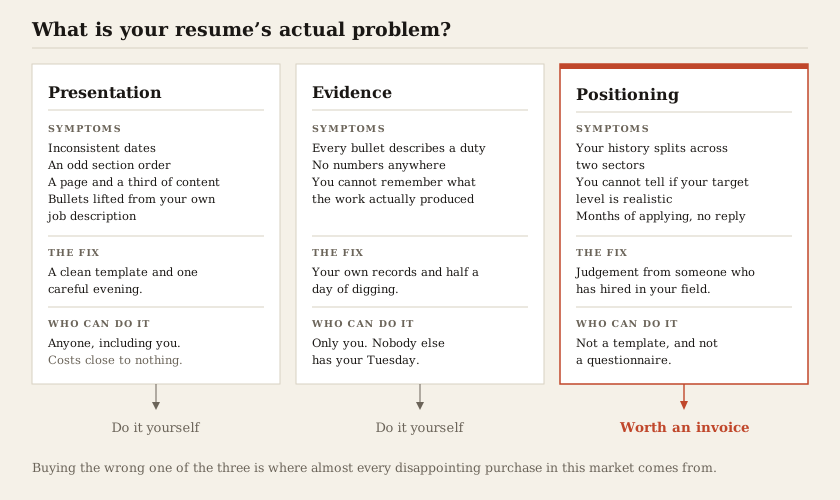
Almost every disappointing purchase in this market comes from buying the wrong one of three separate things. They are sold as one product and they are not one product. Work out which you have before you look at a single price.
Presentation is the first. Sections in an odd order, inconsistent dates, a layout that reflows badly, a document that runs to a page and a third, bullets that describe your job description rather than your work. It looks like a serious problem and it is the shallowest one. It is fully solved by a clean template and one careful evening, and the reason it feels unsolvable is that you have read your own document forty times and can no longer see it.
Evidence is the second. Your bullets describe duties because you wrote them from memory of the job rather than from a record of the work, and no number appears anywhere because you never counted anything. This is a research problem, not a writing problem: somebody else can shape the sentences, but nobody else has your Tuesday. If you cannot supply the facts, a writer will either leave the bullets thin or invent something, and both are worse than an honest thin bullet.
Positioning is the third, and it is the only one worth an invoice. It shows up as questions with no obvious right answer: your history splits across two sectors and you do not know which to lead with, you are targeting a level and cannot tell whether it is realistic, you have a qualification that might read as an asset or as a sign you will be bored, you have been applying for four months to silence and cannot see what the pattern is. These are judgement calls about a market, and judgement about a market is the one thing you can buy that you cannot download.
What does a good writer do that a template cannot?
Four things, and it is worth being precise because the marketing tends to claim all four for every package at every price.
- They choose an identity for you. When your last decade contains teaching, operations and a stint running your own business, a document that includes all three reads as unfocused and a document that includes one reads as a career. Deciding which one, for this specific market, is a call you cannot easily make about yourself because you are attached to all of it.
- They know what a specific market rewards. A good writer working in your sector knows which qualifications open doors and which are noise, what a hiring manager at your target level is actually screening for, and which of your accomplishments is the one to put first. This knowledge is local and perishable and it is not in any template.
- They interview you properly. The most useful hour in a good engagement is the one where somebody asks you what you actually did until you produce facts you had forgotten you had. Most people cannot do this to themselves; a questionnaire cannot do it at all.
- They tell you something you do not want to hear. That your target level is a stretch, that the gap needs explaining rather than hiding, that the thing you are proudest of is not what this market buys. A tool will never do this, and a bad service will not either, because it is bad for conversion.
What does the market charge?
Prices move and no two services bundle the same package, so treat what follows as the shape of the market rather than a quote. These are figures published on the services' own pricing pages, checked in August 2026.
TopResume lists four packages: Professional Growth at $179, Career Evolution at $229, Career Confidence at $349 and Executive Priority at $599. The lower tiers are a resume alone; the higher ones add a cover letter, a LinkedIn rewrite and interview coaching, and describe the writer as drawn from the top twenty or top ten per cent of the network. All four are advertised with a 60-day interview guarantee.
Let's Eat, Grandma lists Starter at $439, Premium at $689, Transform at $889 and an Executive Concierge service at $1,899, with each package including a resume, a cover letter, a LinkedIn rewrite and a consultation period with revisions.
Those two bracket most of the mainstream market. Below them sit freelance marketplaces, where you are buying an individual rather than a process, with all the variance that implies. Above them sit independent executive specialists who quote per engagement rather than per package, often into four figures. UK prices sit in their own band, covered separately in what a professional CV writer costs in the UK.
One structural detail worth knowing before you shop. ZipJob, long presented as a distinct service with its own reviews and comparison articles, now redirects to TopResume. A meaningful share of the brands in this category share ownership, writer networks and process, which is why comparison articles listing eight independent services frequently describe three. Check where a brand's checkout actually takes you.
What does the bad end of the market look like?
Not fraud, mostly. The failures here are ordinary commercial ones and they are recognisable in advance.
- The free review as a sales instrument. You upload your document, a critique comes back listing genuine faults, and the fix costs a fee. The findings are usually real. The incentive is also real: a company that earns money only when you buy a rewrite will always find enough wrong to justify one. Read it as free diagnostics, then separate the findings you could fix in an evening from the ones you could not.
- The questionnaire-only engagement. You fill in a form, a document comes back in four days, and nobody ever speaks to you. Whatever that produces, it cannot be positioning, because positioning requires somebody to understand your career well enough to overrule your own instinct about it. You have paid for typing.
- A blanket claim that your resume is not ATS compatible. Often overstated. Copy your PDF into a plain text editor: if your name, titles and dates come out in order, the structural crisis you were quoted for does not exist.
- Invented achievements. If a draft comes back containing a number you cannot evidence or a claim about a project you did not lead, delete it, and treat it as information about the service. This is the one failure mode with a cost that lands after you have been hired.
- PDF-only delivery. If you do not receive an editable file, you will pay again for every future change, and you will need changes, because a resume is tailored per application and not written once.
- Guarantees that are conditions in disguise. An interview guarantee is a normal marketing device and not automatically dishonest, but the wording is where it lives. Before it matters to you, find the actual terms and read what counts as an interview, what you have to do to qualify, how long the window is, and whether the remedy is a rewrite or a refund. Those four answers determine whether the guarantee is worth anything.
What should you ask before you pay?
Six questions. They take ten minutes and they filter out most of the section above.
- Who writes it, and what have they hired for? A writer who has recruited in your sector is worth several times a generalist with a good template. Ask for the person, not the network.
- Can I see a full anonymised sample at my level, in my field? Not a screenshot of a header. A whole document. A service that cannot produce one is telling you something.
- Is there a conversation, how long is it, and is it with the person writing? This is the single strongest predictor of whether you get positioning or typing.
- How many revision rounds, and how long do I have to claim them? A short claim window is how a refund quietly becomes impossible.
- Do I get an editable file? Yes is the only acceptable answer.
- What credentials do the writers hold, if any? Resume writing is not a licensed occupation. What exists is voluntary certification: the National Résumé Writers' Association, which describes itself as the only national nonprofit organisation for professional résumé writers and career service professionals, awards the Nationally Certified Resume Writer credential, and Career Directors International offers a set including Certified Advanced Resume Writer and Certified Master Resume Writer. Plenty of excellent writers hold none of these, so absence is not disqualifying. It is simply one of the few things you can verify from the outside.
Tip: Pay by card rather than by bank transfer, and pay per stage where a service allows it. A chargeback is the only leverage you have if the document never arrives, and it stops being available the further you get from the transaction date.
When is doing it yourself the better call?
More often than this industry's marketing suggests, and for reasons that are about outcomes rather than money.
If your career line is straight, hiring a writer is close to pointless. Ten years of nursing applying for a nursing job needs a clean document and honest evidence, and neither is scarce. The positioning question that justifies a fee does not arise, because there is only one version of you to present.
If your budget is tight and your search may run months, the arithmetic is worse than it first looks. You are buying one document, not one per application, and tailoring each application stays your job afterwards. A fee spent on a resume you then send unchanged to thirty employers buys less than the same evening spent tailoring three applications properly, which is a process rather than a purchase and is set out in tailoring a resume to a job application.
If you are applying into a public-sector process, look at what the employer scores before you buy anything. Many such applications are assessed on a structured form against published criteria, and the resume is a supporting document nobody grades. Paying for prose while a panel marks a specification is the most expensive mistake in this market.
And if you have never done a proper review of your own document, do that first. It is free, it takes an hour, and it resolves the presentation and evidence problems entirely, which means whatever remains is the part you might genuinely need to buy. The resume review is a six-pass read-through built for exactly that.
When is hiring a writer clearly right?
Five situations. If you are in one of them, this is a sensible purchase and the rest of this article should not talk you out of it.
- You are at executive level, where the document is a positioning exercise, the audience is small, and the difference between a good and a mediocre version is measured in a salary band rather than in an interview slot.
- You have been applying steadily for months with no replies and you genuinely cannot see why. That pattern is information, and you are buying somebody's ability to read it. This is the case where an outside eye is worth the most, because the problem is by definition invisible to you.
- Your history splits across sectors or countries and you do not know which career to present. Choosing is the work, and it is easier for someone who is not attached to any of it.
- You are moving into a regulated or credential-heavy field where the conventions are specific and unforgiving, and a writer who knows that field will save you a mistake you would not have known you made.
- You are dealing with something that needs handling rather than describing: a dismissal, a long absence, a company failure, a sequence of short roles. There is a right way to write each of those and it is not obvious from the outside.
What all five share is that the difficulty is judgement, not typing. If you can say what the document should argue and simply cannot make the sentences work, that is a writing problem with cheaper fixes. If you cannot say what it should argue, that is what you are buying.
What you still have to do afterwards
This is the part that disappoints people, and it is nobody's fault but it is rarely explained at checkout.
You receive one document. A resume that goes out unchanged to thirty employers is untailored regardless of who wrote it, so the tailoring, the reordering of bullets for a particular posting, and every future update as your job changes all remain yours. Insist on the editable file, and budget an evening to learn how to edit what you were given.
You also have to defend it. Read the draft as though you were being interviewed on it and challenge anything you could not talk about for two minutes. A skilled writer will have made your work sound better than you would have, which is what you paid for, but they cannot know where better stops and untrue starts. Only you can, and it is your name on the file.
How to get most of the benefit for nothing
Before you spend anything, spend an hour on this. For a meaningful number of people it removes the reason to buy.
- Send your resume to two people who currently hire for the role you want and ask one question: would you shortlist this, and what stopped you? This is the same market judgement a writer sells, from someone with no incentive to find a problem.
- Have a friend interview you about your last two jobs for thirty minutes, writing down every number you say out loud. This reproduces the most valuable part of a good engagement.
- Copy your PDF into a plain text editor and read what comes out. That is the parsing test, done, for free.
- Run a six-pass review of your own document with fresh eyes and a printed copy.
The short answer
If your resume is untidy, repetitive or badly ordered, do not pay a person for it. A builder and one careful evening fixes it, you keep the ability to change it, and you will need to change it. If you do not know which version of yourself to present, or you are at executive level, or you have applied repeatedly into silence, then you are buying judgement rather than prose, and judgement from someone who knows your market is worth what it costs. Check the person exists, check they have that background, and get the editable file.
If cost is the deciding factor, the subscription end of this market has arithmetic worth understanding before you commit to anything, and it is set out in the real cost of resume builders.
Related articles
- Job Offer Letter: What to Check Before Signing
- Letter of Introduction for a Job: When to Send One
- Skills to Put on a Job Application Form
- Letter of Interest: How to Approach a Company With No Job Posted
More articles
- Professional Summary Example for a Resume: 8 Samples
- Program Manager Interview Questions and Answers: 8 Samples
- Project Management Keywords for a Resume: 6 Examples
Looking for a worked example for your job title? Browse the resume examples by job title.