KSA Examples: Six Federal Statements in CCAR Format
By Mustafa Tarabya, founder of CVBooster · Published · Updated
17 min read
A KSA is a short narrative that proves one knowledge, skill or ability with a single accomplishment, and the format the Office of Personnel Management publishes for it is CCAR: Challenge, Context, Action, Result. The constraint is length. Most agencies cap a narrative at roughly 300 words per factor, and in September 2026 that still buys you about six sentences of your own actions. The four headings and their definitions below are quoted from the OPM Guide to Senior Executive Service Qualifications and the Qualifications Review Board, dated August 2025. Six finished statements follow, at GS-7 through GS-13, each annotated against the wording that earns the point. Written by Mustafa Tarabya, who hired for his own company, read every application himself and now writes CVBooster's guides.
The four headings, in OPM's own words
The OPM guide to Senior Executive Service qualifications introduces the model like this: "A method used to facilitate this is the Challenge-Context-Action-Result (CCAR) Model." Its definitions run as follows.
Challenge: "Describe a specific problem or goal that YOU needed to overcome or accomplish." Context: "Describe the situation, environment, external drives that created the challenge or problem." Action: "Discuss the specific actions YOU took to address the challenge. This should be described in a linear fashion." Result: "Give specific examples of measures/outcomes that had an impact on the effort/program/organization. The results described should align with the challenge highlighted."
Two of those definitions put YOU in capital letters. That is the whole grading problem in one typographic choice. Panels reject statements where the reader cannot tell which decisions belonged to the writer.
OPM adds one more instruction that decides how a statement ends: "Quantify your accomplishments using metrics where possible."
KSA at GS-7: written communication
KSA at GS-7, skill in written communication (290 words)
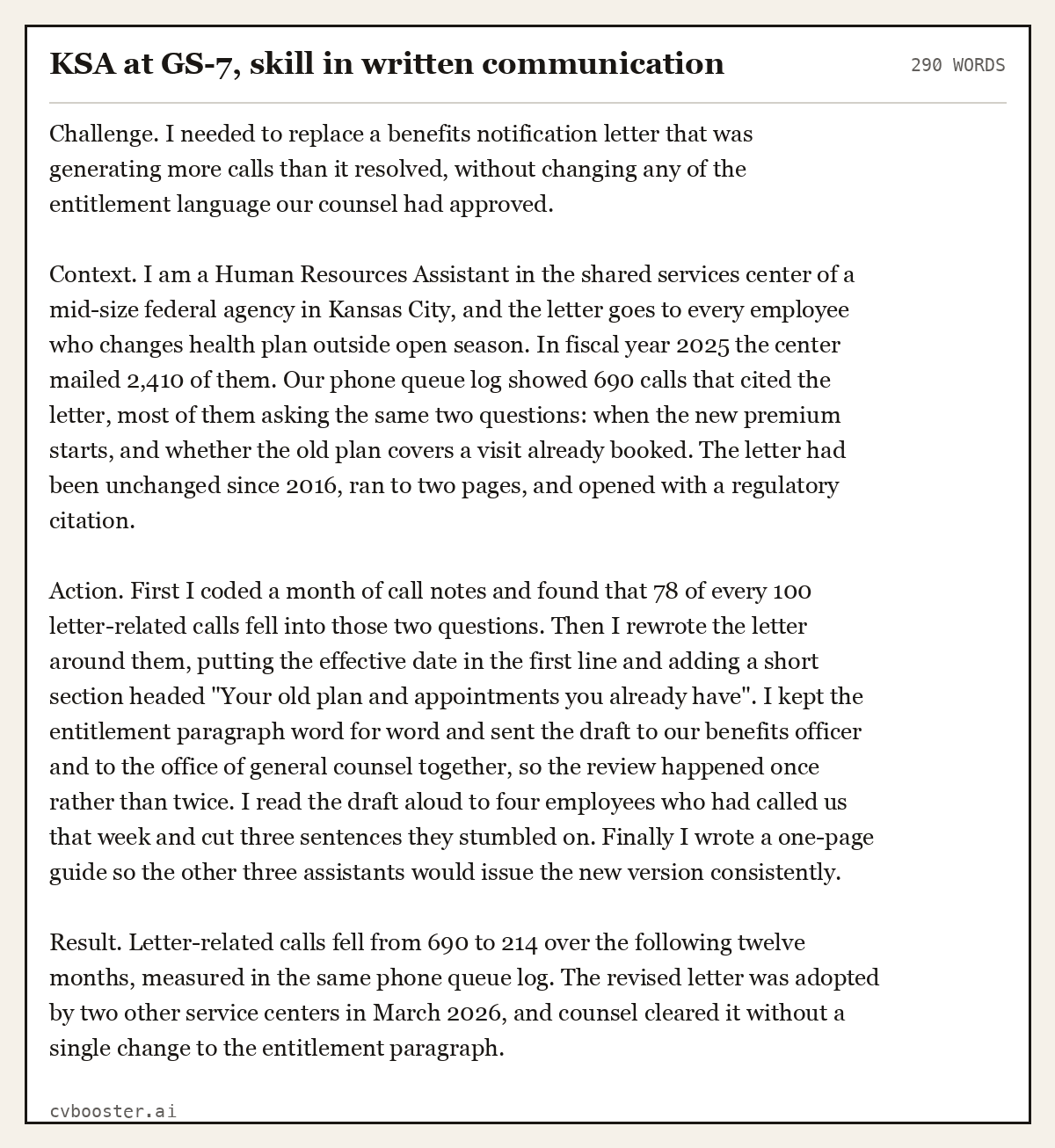
Challenge. I needed to replace a benefits notification letter that was generating more calls than it resolved, without changing any of the entitlement language our counsel had approved.
Context. I am a Human Resources Assistant in the shared services center of a mid-size federal agency in Kansas City, and the letter goes to every employee who changes health plan outside open season. In fiscal year 2025 the center mailed 2,410 of them. Our phone queue log showed 690 calls that cited the letter, most of them asking the same two questions: when the new premium starts, and whether the old plan covers a visit already booked. The letter had been unchanged since 2016, ran to two pages, and opened with a regulatory citation.
Action. First I coded a month of call notes and found that 78 of every 100 letter-related calls fell into those two questions. Then I rewrote the letter around them, putting the effective date in the first line and adding a short section headed "Your old plan and appointments you already have". I kept the entitlement paragraph word for word and sent the draft to our benefits officer and to the office of general counsel together, so the review happened once rather than twice. I read the draft aloud to four employees who had called us that week and cut three sentences they stumbled on. Finally I wrote a one-page guide so the other three assistants would issue the new version consistently.
Result. Letter-related calls fell from 690 to 214 over the following twelve months, measured in the same phone queue log. The revised letter was adopted by two other service centers in March 2026, and counsel cleared it without a single change to the entitlement paragraph.
What the sifter is scoring
- The challenge is a goal, not a duty. OPM asks you to "Describe a specific problem or goal that YOU needed to overcome or accomplish", and a rewritten letter with a fixed constraint attached is exactly that.
- The context carries the numbers that set the level. Volume, the age of the document and the call log make the scale visible without the writer claiming it.
- Actions run in order. OPM wants the action "described in a linear fashion. (ex. First I did this, then I did that, etc...)", which is why the paragraph begins with First and Then.
- Plain language is the product here. USAJOBS asks applicants to "Use plain language. Avoid using acronyms and terms that are not easily understood", and this statement contains no acronym a reader outside the agency would miss.
- The result is measured in the same instrument as the problem. The phone queue log opens the statement and closes it.
KSA at GS-9: ability to analyze data and draw conclusions
KSA at GS-9, ability to analyze data and draw conclusions (296 words)
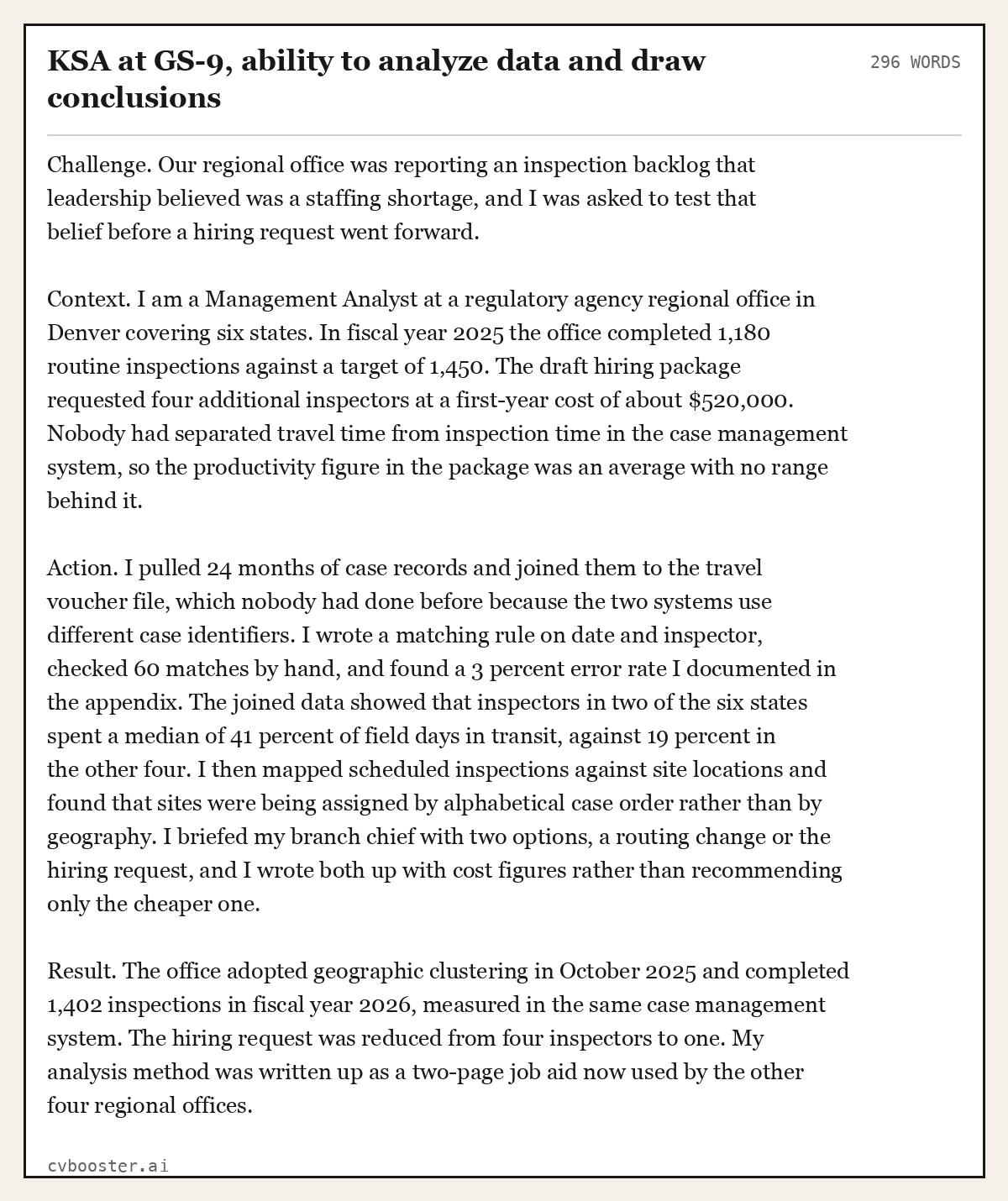
Challenge. Our regional office was reporting an inspection backlog that leadership believed was a staffing shortage, and I was asked to test that belief before a hiring request went forward.
Context. I am a Management Analyst at a regulatory agency regional office in Denver covering six states. In fiscal year 2025 the office completed 1,180 routine inspections against a target of 1,450. The draft hiring package requested four additional inspectors at a first-year cost of about $520,000. Nobody had separated travel time from inspection time in the case management system, so the productivity figure in the package was an average with no range behind it.
Action. I pulled 24 months of case records and joined them to the travel voucher file, which nobody had done before because the two systems use different case identifiers. I wrote a matching rule on date and inspector, checked 60 matches by hand, and found a 3 percent error rate I documented in the appendix. The joined data showed that inspectors in two of the six states spent a median of 41 percent of field days in transit, against 19 percent in the other four. I then mapped scheduled inspections against site locations and found that sites were being assigned by alphabetical case order rather than by geography. I briefed my branch chief with two options, a routing change or the hiring request, and I wrote both up with cost figures rather than recommending only the cheaper one.
Result. The office adopted geographic clustering in October 2025 and completed 1,402 inspections in fiscal year 2026, measured in the same case management system. The hiring request was reduced from four inspectors to one. My analysis method was written up as a two-page job aid now used by the other four regional offices.
What the sifter is scoring
- The analysis is the accomplishment, not the conclusion. The joining rule, the hand check and the documented error rate are what a GS-9 analytical KSA is asking for.
- The writer shows where their authority stopped. Presenting two costed options and letting the branch chief decide is a level marker, and OPM warns against statements where you "simply carry out a decision or strategy determined by a higher-level official".
- Tools are named. NIH asks for "Tools, software, or systems you used", and the case management system and voucher file are both named.
- Dollar figures follow NIH's own instruction. Instead of a claim about budgets, the statement gives the number, which is the pattern NIH sets out with its "$450,000" example.
- A before and after runs through it. OPM recommends that candidates "contrast the "before" and "after" to fully illustrate the impact", and 1,180 against 1,402 does that in one line.
KSA at GS-9: skill in customer service
KSA at GS-9, skill in providing customer service (276 words)
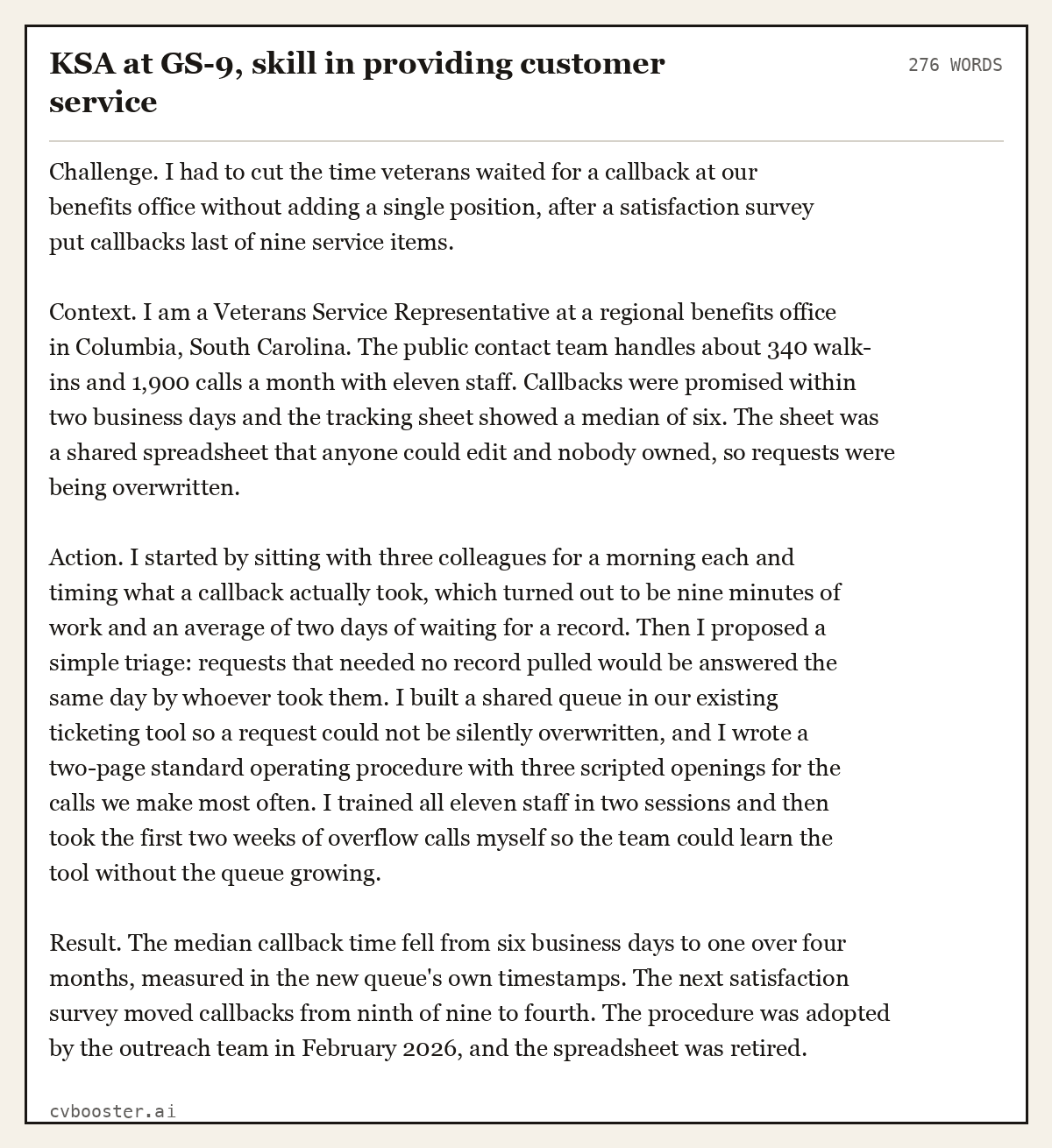
Challenge. I had to cut the time veterans waited for a callback at our benefits office without adding a single position, after a satisfaction survey put callbacks last of nine service items.
Context. I am a Veterans Service Representative at a regional benefits office in Columbia, South Carolina. The public contact team handles about 340 walk-ins and 1,900 calls a month with eleven staff. Callbacks were promised within two business days and the tracking sheet showed a median of six. The sheet was a shared spreadsheet that anyone could edit and nobody owned, so requests were being overwritten.
Action. I started by sitting with three colleagues for a morning each and timing what a callback actually took, which turned out to be nine minutes of work and an average of two days of waiting for a record. Then I proposed a simple triage: requests that needed no record pulled would be answered the same day by whoever took them. I built a shared queue in our existing ticketing tool so a request could not be silently overwritten, and I wrote a two-page standard operating procedure with three scripted openings for the calls we make most often. I trained all eleven staff in two sessions and then took the first two weeks of overflow calls myself so the team could learn the tool without the queue growing.
Result. The median callback time fell from six business days to one over four months, measured in the new queue's own timestamps. The next satisfaction survey moved callbacks from ninth of nine to fourth. The procedure was adopted by the outreach team in February 2026, and the spreadsheet was retired.
What the sifter is scoring
- Customer service KSAs need a named customer. Veterans at a named office, with monthly volumes, beats any sentence about being approachable.
- The writer measured before changing anything. Timing the work is the action a panel can picture, and it explains the triage rule that follows.
- Taking the overflow calls is deliberate. OPM asks candidates to "Emphasize the degree of initiative shown", and personally absorbing the cost of a transition shows it.
- Two measures close the statement. The queue timestamps and the survey rank answer the challenge on its own terms.
- No acronyms are left unexplained, which is the USAJOBS rule: "The hiring agency will not make assumptions about what's in your resume."
KSA at GS-11: ability to manage a program
KSA at GS-11, ability to plan and manage a program (287 words)
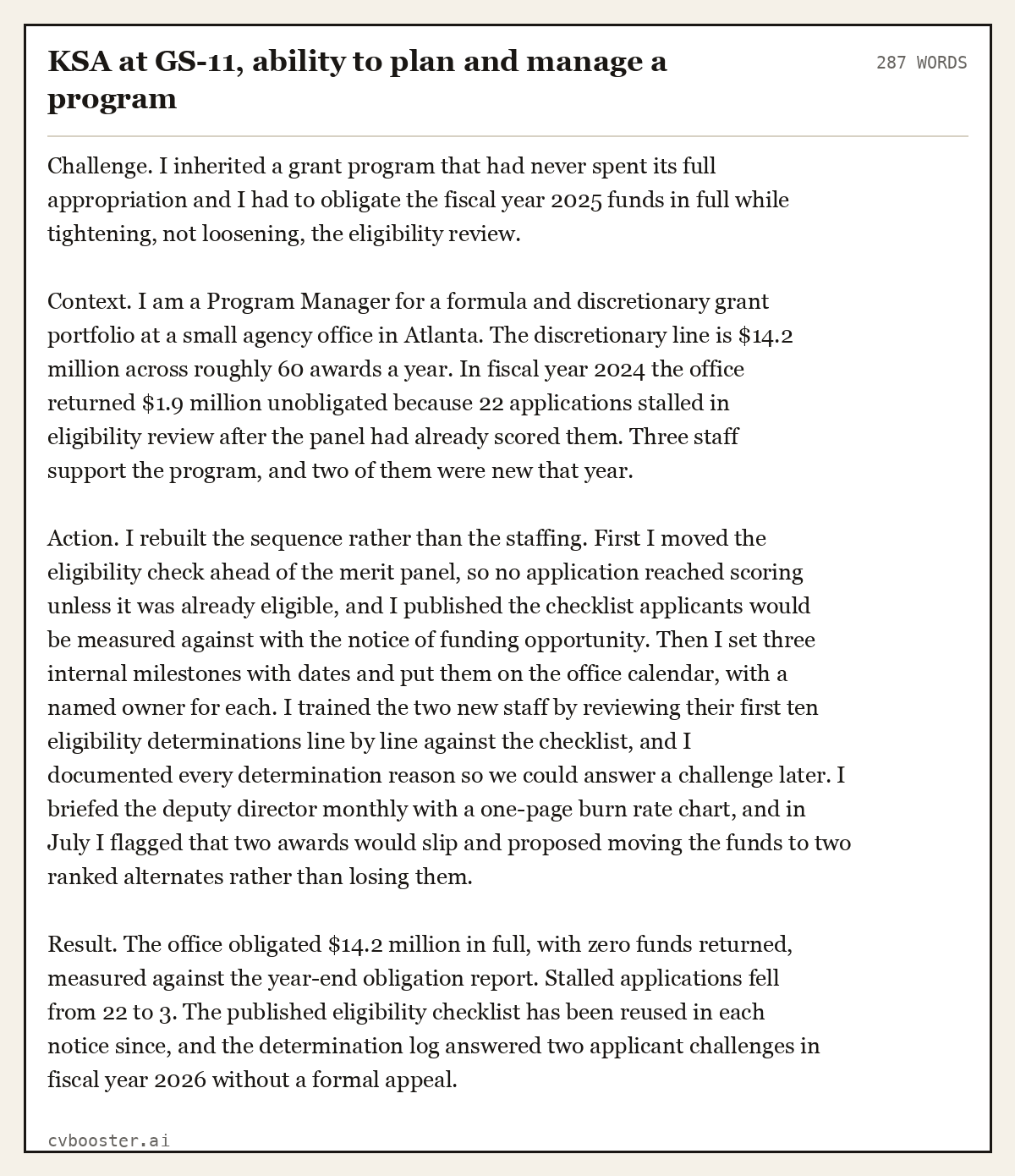
Challenge. I inherited a grant program that had never spent its full appropriation and I had to obligate the fiscal year 2025 funds in full while tightening, not loosening, the eligibility review.
Context. I am a Program Manager for a formula and discretionary grant portfolio at a small agency office in Atlanta. The discretionary line is $14.2 million across roughly 60 awards a year. In fiscal year 2024 the office returned $1.9 million unobligated because 22 applications stalled in eligibility review after the panel had already scored them. Three staff support the program, and two of them were new that year.
Action. I rebuilt the sequence rather than the staffing. First I moved the eligibility check ahead of the merit panel, so no application reached scoring unless it was already eligible, and I published the checklist applicants would be measured against with the notice of funding opportunity. Then I set three internal milestones with dates and put them on the office calendar, with a named owner for each. I trained the two new staff by reviewing their first ten eligibility determinations line by line against the checklist, and I documented every determination reason so we could answer a challenge later. I briefed the deputy director monthly with a one-page burn rate chart, and in July I flagged that two awards would slip and proposed moving the funds to two ranked alternates rather than losing them.
Result. The office obligated $14.2 million in full, with zero funds returned, measured against the year-end obligation report. Stalled applications fell from 22 to 3. The published eligibility checklist has been reused in each notice since, and the determination log answered two applicant challenges in fiscal year 2026 without a formal appeal.
What the sifter is scoring
- The result is stated against a named report. A year-end obligation report is checkable inside the agency, which is what USAJOBS means by showing you perform tasks at the required level.
- Process design is the level marker at GS-11. Reordering eligibility ahead of scoring is a decision about the program, not a task inside it.
- Training is shown as work, not as a claim. Ten determinations reviewed line by line is a fact a reference can confirm.
- The escalation in July is the strongest sentence. It shows the writer managing risk before the deadline rather than reporting it afterwards.
- Nothing in the statement is a duty. Every sentence is something that happened once, on a date, which is how a KSA differs from a position description.
KSA at GS-11: knowledge of information technology systems
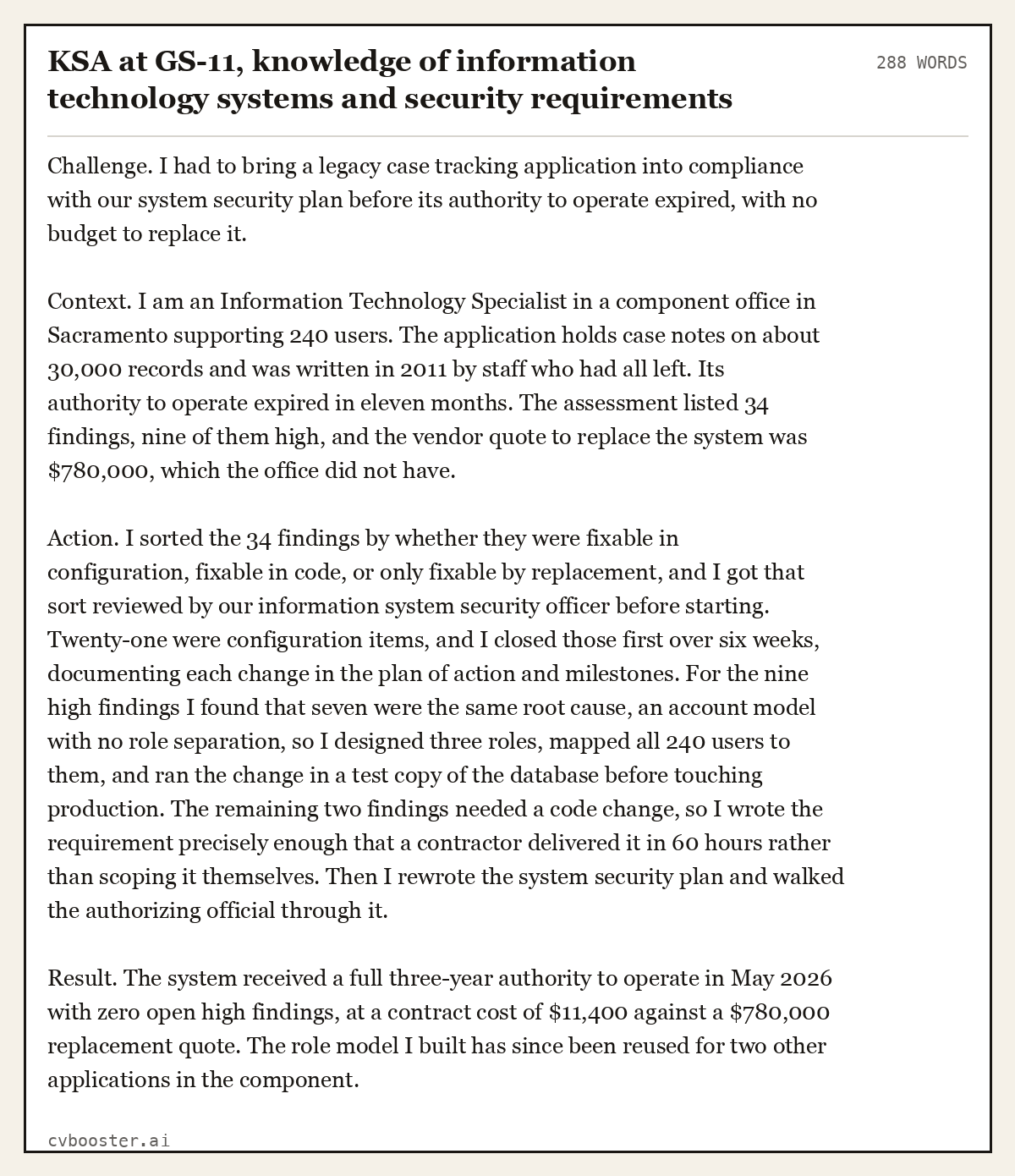
KSA at GS-11, knowledge of information technology systems and security requirements (288 words)
Challenge. I had to bring a legacy case tracking application into compliance with our system security plan before its authority to operate expired, with no budget to replace it.
Context. I am an Information Technology Specialist in a component office in Sacramento supporting 240 users. The application holds case notes on about 30,000 records and was written in 2011 by staff who had all left. Its authority to operate expired in eleven months. The assessment listed 34 findings, nine of them high, and the vendor quote to replace the system was $780,000, which the office did not have.
Action. I sorted the 34 findings by whether they were fixable in configuration, fixable in code, or only fixable by replacement, and I got that sort reviewed by our information system security officer before starting. Twenty-one were configuration items, and I closed those first over six weeks, documenting each change in the plan of action and milestones. For the nine high findings I found that seven were the same root cause, an account model with no role separation, so I designed three roles, mapped all 240 users to them, and ran the change in a test copy of the database before touching production. The remaining two findings needed a code change, so I wrote the requirement precisely enough that a contractor delivered it in 60 hours rather than scoping it themselves. Then I rewrote the system security plan and walked the authorizing official through it.
Result. The system received a full three-year authority to operate in May 2026 with zero open high findings, at a contract cost of $11,400 against a $780,000 replacement quote. The role model I built has since been reused for two other applications in the component.
What the sifter is scoring
- Technical KSAs still need the CCAR shape. The findings count, the deadline and the quote make the challenge concrete before any technical detail appears.
- The sort before the fix is the analytical move. It also shows the writer getting a second opinion, which reads as judgement rather than caution.
- The comparison closes the loop. OPM's recommendation to contrast before and after is met by the two dollar figures in one sentence.
- Specialized experience is visible. A GS-11 announcement asks for one year equivalent to GS-9, and authority to operate work is the kind of evidence a human resources specialist can grade directly.
- The reuse sentence matters. Impact beyond your own office is what separates a good statement from a very good one.
KSA at GS-13: ability to work as a team member and lead teams
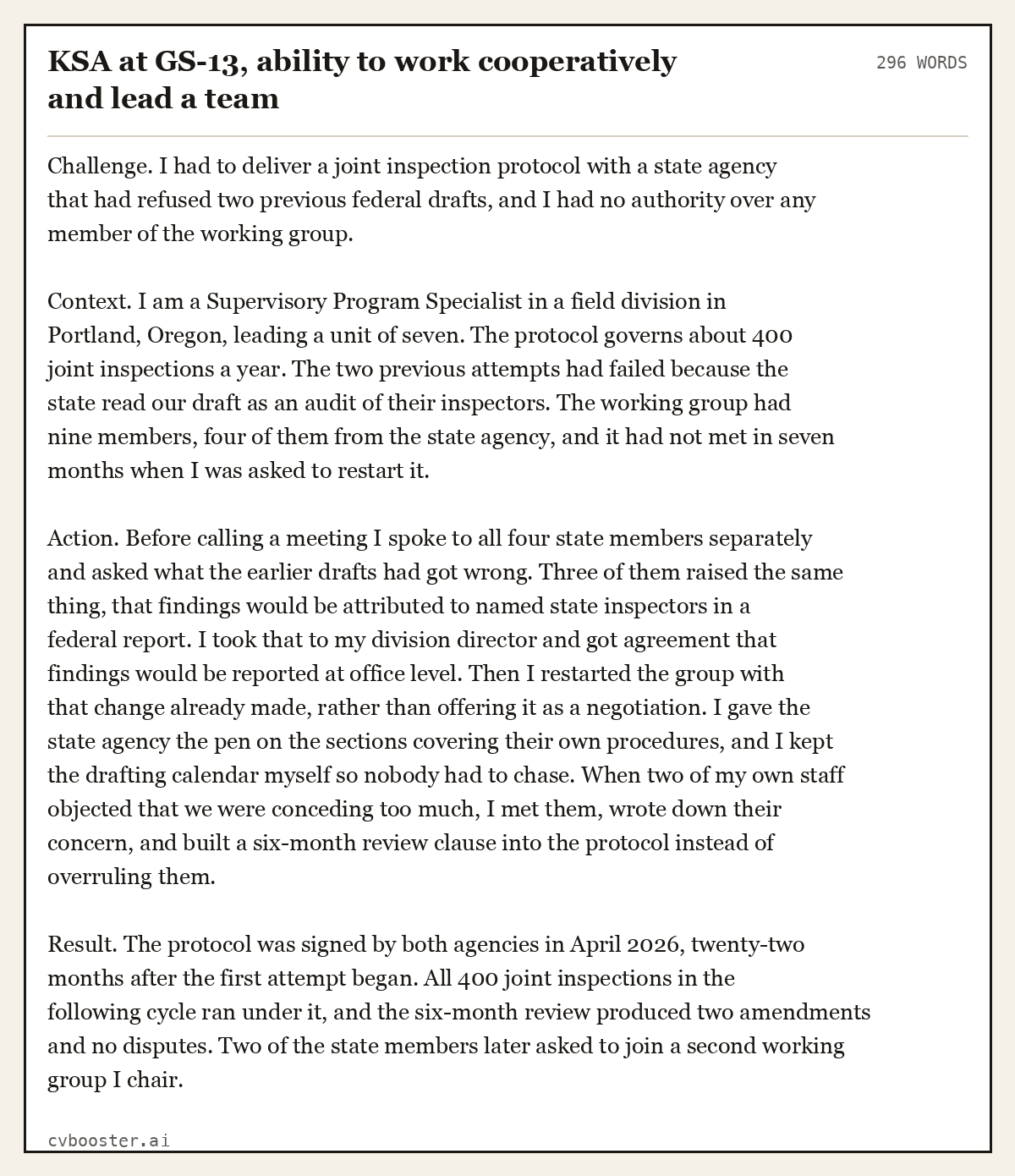
KSA at GS-13, ability to work cooperatively and lead a team (296 words)
Challenge. I had to deliver a joint inspection protocol with a state agency that had refused two previous federal drafts, and I had no authority over any member of the working group.
Context. I am a Supervisory Program Specialist in a field division in Portland, Oregon, leading a unit of seven. The protocol governs about 400 joint inspections a year. The two previous attempts had failed because the state read our draft as an audit of their inspectors. The working group had nine members, four of them from the state agency, and it had not met in seven months when I was asked to restart it.
Action. Before calling a meeting I spoke to all four state members separately and asked what the earlier drafts had got wrong. Three of them raised the same thing, that findings would be attributed to named state inspectors in a federal report. I took that to my division director and got agreement that findings would be reported at office level. Then I restarted the group with that change already made, rather than offering it as a negotiation. I gave the state agency the pen on the sections covering their own procedures, and I kept the drafting calendar myself so nobody had to chase. When two of my own staff objected that we were conceding too much, I met them, wrote down their concern, and built a six-month review clause into the protocol instead of overruling them.
Result. The protocol was signed by both agencies in April 2026, twenty-two months after the first attempt began. All 400 joint inspections in the following cycle ran under it, and the six-month review produced two amendments and no disputes. Two of the state members later asked to join a second working group I chair.
What the sifter is scoring
- Leadership without authority is the point of this KSA. Every action is influence, and none of it is an instruction.
- The listening is specific. Four separate conversations and one recurring objection is evidence; a sentence about valuing input is not.
- Handling internal dissent is included on purpose. A statement where everyone agrees with the writer reads as edited.
- The result has three measures. A signature with a date, the volume it governs, and a follow-on behaviour from the other side.
- It stays inside the word budget. Roughly 300 words is the working ceiling for a KSA narrative, and the context paragraph is the one to cut first when a form gives you less.
What makes a KSA fail
| Weak | Rewritten |
|---|---|
| I have excellent written communication skills. | I rewrote a benefits notification letter issued 2,410 times a year, and letter-related calls fell from 690 to 214. |
| I was part of a team that reduced the backlog. | I joined 24 months of case records to the travel voucher file, found 41 percent of field days in transit, and proposed geographic clustering. |
| Responsible for managing a grant program. | I moved eligibility review ahead of the merit panel, cutting stalled applications from 22 to 3 and returning zero unobligated funds. |
| Worked with stakeholders to achieve consensus. | I asked four state members separately what previous drafts got wrong, changed the reporting level before restarting the group, and the protocol was signed. |
The move is always the same. Delete the adjective, keep the event underneath it, and attach the number the event produced. OPM lists "Excessive descriptions of challenges and context versus specific leadership actions and results" among its common pitfalls, so when a form cuts your word count, cut the context and keep the action.
Where KSAs still appear, and where they do not
Separate KSA narratives are far less common than they were. Many announcements now test the same ground through an assessment questionnaire, and the USAJOBS Help Center sets the rule that follows from that: your resume "must support and match your answers in the assessment questionnaire". A KSA you have written in full is the fastest way to make that match true.
Three places the narratives survive. Senior Executive Service applications, where the five executive core qualifications are assessed against published competency definitions. Agency-specific promotion panels. And structured interviews, where the question is spoken and your prepared statement becomes the spine of the answer.
The National Institutes of Health Office of Human Resources gives the same underlying instruction for the resume itself: "Include metrics with numbers and data to show your achievements."
Before you submit
- Check each statement has all four headings and that the result answers the challenge you opened with.
- Count the words. Trim the context first, never the action.
- Replace every unexplained acronym, including your own office's.
- Make sure each statement is a single event with a date, not a summary of a year.
- Check your statements against your questionnaire answers item by item.
- Read the announcement's evaluation section to see whether narratives are wanted at all this time.
Applying across several systems? The evidence carries even when the form changes. See the federal resume example, the competency examples written to published definitions, and STAR method answers for the spoken version of the same story.
Frequently asked questions
What is an example of a KSA?
The six statements on this page are examples, each proving one knowledge, skill or ability with one accomplishment. A KSA names the factor, then tells a single story in the Challenge, Context, Action, Result order that OPM publishes, ending with a measured outcome. The written communication statement above is typical: a letter rewritten, a call log before and after, and a date the change spread to other offices.
How do you write a KSA statement?
Pick one event that proves the factor, then write it in four parts. OPM defines them as a "specific problem or goal that YOU needed to overcome or accomplish", the "situation, environment, external drives that created the challenge", the "specific actions YOU took", and "measures/outcomes that had an impact". Keep the actions first person and in order, and finish with a number taken from a system or report you can name.
What does KSA stand for?
Knowledge, skills and abilities. Knowledge is what you know, such as a regulation or a system. A skill is something practised and observable, such as writing or data analysis. An ability is capacity demonstrated in conditions, such as working cooperatively without authority. Announcements often mix the three in one list, and the distinction matters less than the evidence you attach to each item.
What are examples of knowledge-based skills?
Knowledge-based skills are the ones you acquired by study or by doing the job, and they are checkable. Federal announcements phrase them as knowledge of a body of rules or a system: knowledge of federal grants administration, knowledge of a system security plan, knowledge of a method detection limit. They differ from abilities, which are capacities shown under conditions. Prove a knowledge item by naming the regulation, system or standard and the volume of work you applied it to.
How long should a KSA response be?
Follow the form. Where no limit is given, aim for 250 to 350 words, which is roughly what the statements on this page run to, and keep about half of it in the action paragraph. OPM's list of common pitfalls includes "Excessive descriptions of challenges and context versus specific leadership actions and results", so when space is short the context is the first thing to lose.
Is CCAR the same as STAR?
They cover the same ground with a different first move. STAR opens with the situation, while CCAR opens with the challenge, which forces the problem into the first sentence rather than the third. Federal panels are used to CCAR because OPM publishes it, so use CCAR on federal applications and keep STAR for interviews where the interviewer names it. The evidence underneath is identical.
Related articles
- Federal Resume Example: A Complete GS-9 Program Analyst
- Acting Resume: A Credits Sheet, Not a CV
- Customer Service Resume: Metrics That Are Real
- Customer Service Skills for a Resume
More articles
- Leadership Civil Service Example: 4 Statements, EO to G7
- Letter of Interest: How to Approach a Company With No Job Posted
- Letter of Introduction for a Job: When to Send One
Looking for a worked example for your job title? Browse the resume examples by job title.