Lab Skills Resume: Skills to List and 6 Section Examples
By Mustafa Tarabya, founder of CVBooster · Published · Updated
7 min read
A lab skills resume lists the techniques, instruments and quality habits you can run without supervision, grouped by type, and then proves the most important ones inside your experience bullets. The constraint is precision: "laboratory experience" says nothing, while "ELISA, qPCR and cell culture in a BSL-2 lab" tells a hiring manager exactly which bench you can take. O*NET, the US Department of Labor's occupation database, describes biological technicians with tasks such as "Isolate, identify and prepare specimens for examination." Below are the skill groups that matter, how to write them, and six complete lab skills sections from student to supervisor. Written by Mustafa Tarabya, who hired for his own company, read every application himself and now writes CVBooster's guides.
Every lab resume claims "strong attention to detail". The pipette has never once been impressed.
Which lab skills to put on a resume
Lab work splits into four groups, and a good skills section uses all four:
- Techniques: what you can do with your hands, such as PCR, gel electrophoresis, Western blot, titration, chromatography, aseptic technique or venipuncture.
- Instruments: named equipment you can set up, calibrate and troubleshoot, such as HPLC, GC-MS, flow cytometers, spectrophotometers or automated chemistry analyzers.
- Quality and safety: GLP, GMP, CLIA or ISO 17025 work, standard operating procedures, chain of custody, biosafety level, chemical hygiene and waste handling.
- Data and documentation: lab notebooks, LIMS, Excel, GraphPad Prism, R or Python, and the reports you write.
The O*NET summary for medical and clinical laboratory technologists lists the instrument side plainly: "Operate, calibrate, or maintain equipment used in quantitative or qualitative analysis, such as spectrophotometers, calorimeters, flame photometers, or computer-controlled analyzers." If your posting reads like that, your skills section should name the analyzers you have actually run.
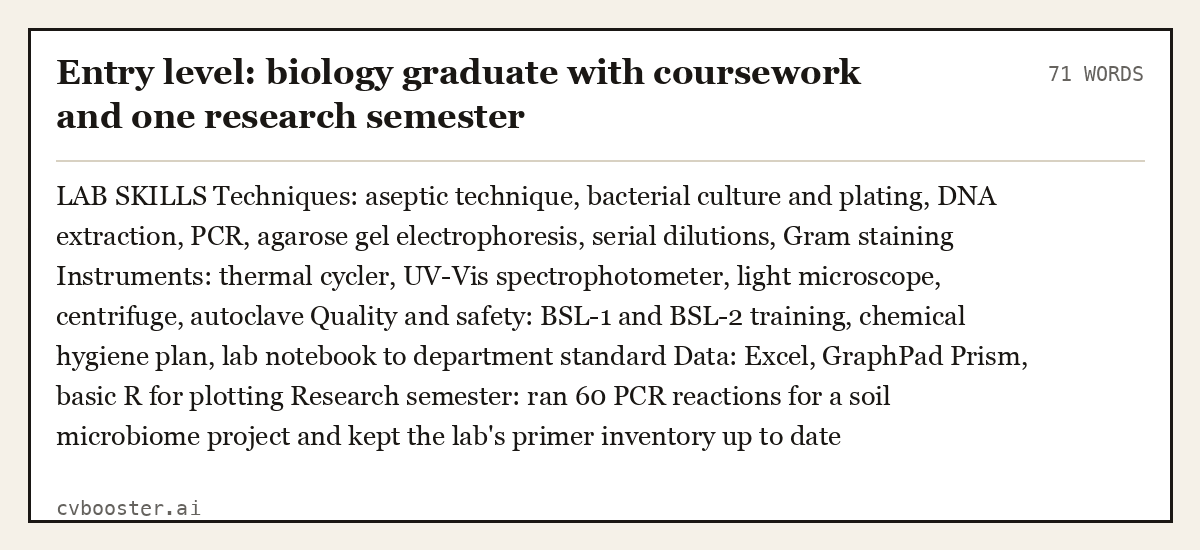
Entry level: biology graduate with coursework and one research semester (71 words)
LAB SKILLS Techniques: aseptic technique, bacterial culture and plating, DNA extraction, PCR, agarose gel electrophoresis, serial dilutions, Gram staining Instruments: thermal cycler, UV-Vis spectrophotometer, light microscope, centrifuge, autoclave Quality and safety: BSL-1 and BSL-2 training, chemical hygiene plan, lab notebook to department standard Data: Excel, GraphPad Prism, basic R for plotting Research semester: ran 60 PCR reactions for a soil microbiome project and kept the lab's primer inventory up to date
How to prove lab skills in your experience bullets
A skills list gets you past the keyword filter. The bullets get you the interview. For each job, pick the two or three techniques the posting cares about most and show them with volume, accuracy or a problem you solved.
The CareerOneStop resume guide, run by the US Department of Labor, gives the rule for technical roles: "If Technical Skills are key to your job, include a section for them here." In a lab they always are, so the section goes high on the page, directly under your summary.
Weak and strong versions of the same lab bullet:
- Weak: "Performed lab tests." Strong: "Ran 40 to 60 qPCR plates a week for a gene expression study, with repeat rates under the lab's acceptance limit."
- Weak: "Maintained equipment." Strong: "Calibrated two HPLC systems weekly and traced a drifting baseline to a worn pump seal before it cost a batch."
- Weak: "Followed safety rules." Strong: "Updated 12 SOPs for the move to a BSL-2 suite and trained four new technicians on them."
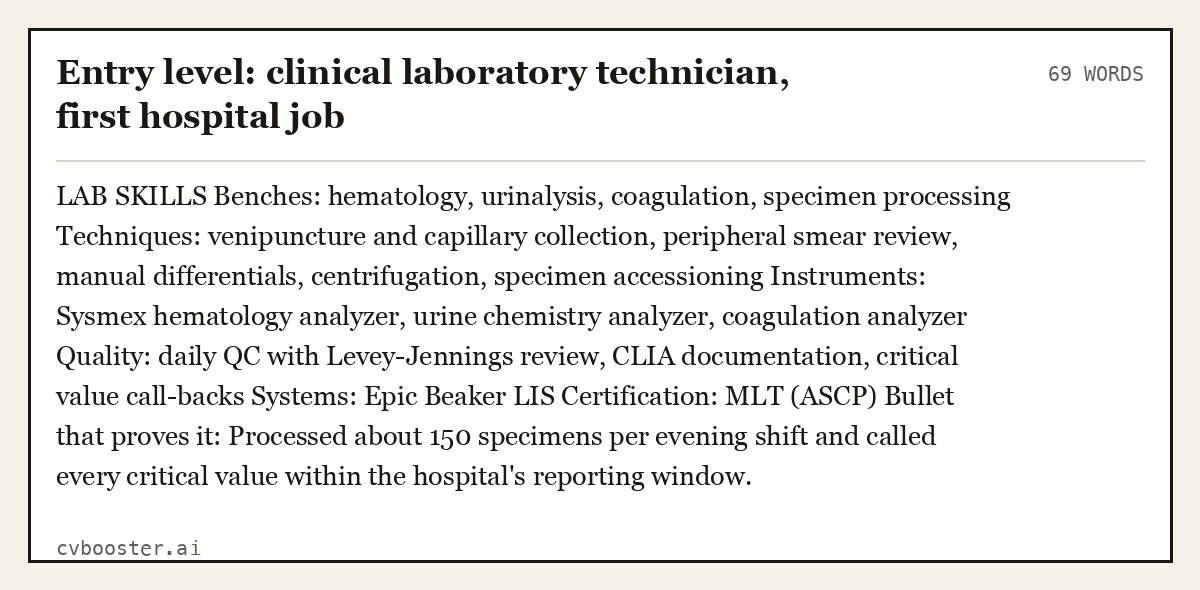
Entry level: clinical laboratory technician, first hospital job (69 words)
LAB SKILLS Benches: hematology, urinalysis, coagulation, specimen processing Techniques: venipuncture and capillary collection, peripheral smear review, manual differentials, centrifugation, specimen accessioning Instruments: Sysmex hematology analyzer, urine chemistry analyzer, coagulation analyzer Quality: daily QC with Levey-Jennings review, CLIA documentation, critical value call-backs Systems: Epic Beaker LIS Certification: MLT (ASCP) Bullet that proves it: Processed about 150 specimens per evening shift and called every critical value within the hospital's reporting window.
Research lab skills versus clinical lab skills
Research and clinical labs hire for different things, even when the techniques overlap.
A research lab wants to know that you can design and troubleshoot. Name the assays you optimized, the cell lines or model organisms you handled, and the data analysis you did yourself. A clinical lab wants to know that you can produce accurate results on a schedule under regulation. The Bureau of Labor Statistics occupation profile puts that job in one line: "Clinical laboratory technologists and technicians perform medical laboratory tests for the diagnosis, treatment, and prevention of disease." It also notes that "Some states require technologists and technicians to be licensed," so a clinical resume puts the license or certification next to the skills.
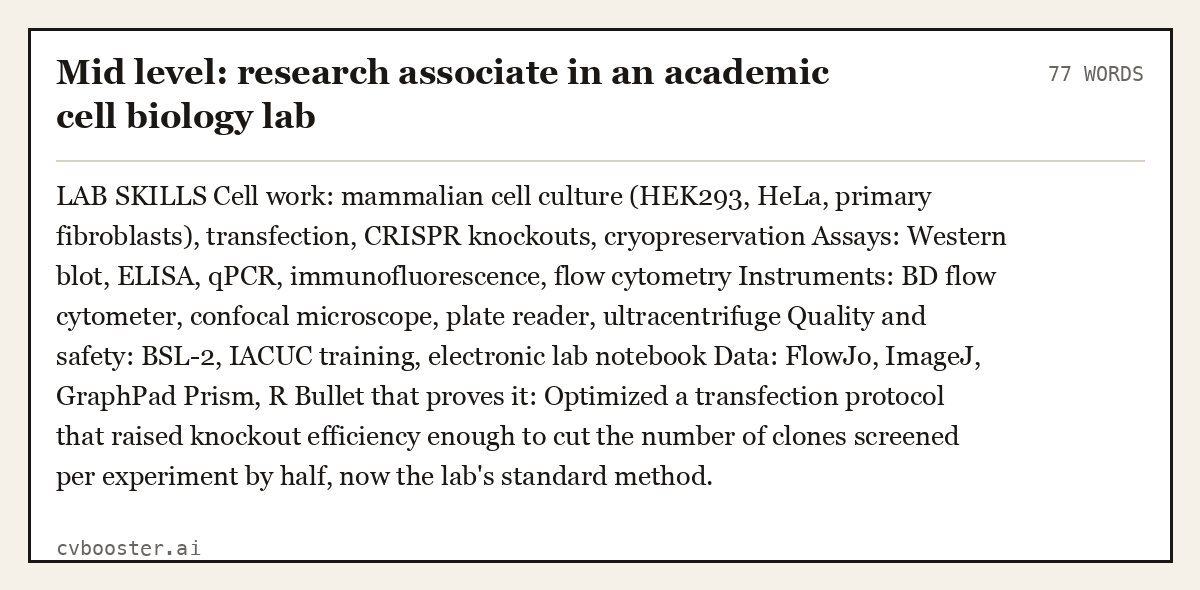
Mid level: research associate in an academic cell biology lab (77 words)
LAB SKILLS Cell work: mammalian cell culture (HEK293, HeLa, primary fibroblasts), transfection, CRISPR knockouts, cryopreservation Assays: Western blot, ELISA, qPCR, immunofluorescence, flow cytometry Instruments: BD flow cytometer, confocal microscope, plate reader, ultracentrifuge Quality and safety: BSL-2, IACUC training, electronic lab notebook Data: FlowJo, ImageJ, GraphPad Prism, R Bullet that proves it: Optimized a transfection protocol that raised knockout efficiency enough to cut the number of clones screened per experiment by half, now the lab's standard method.
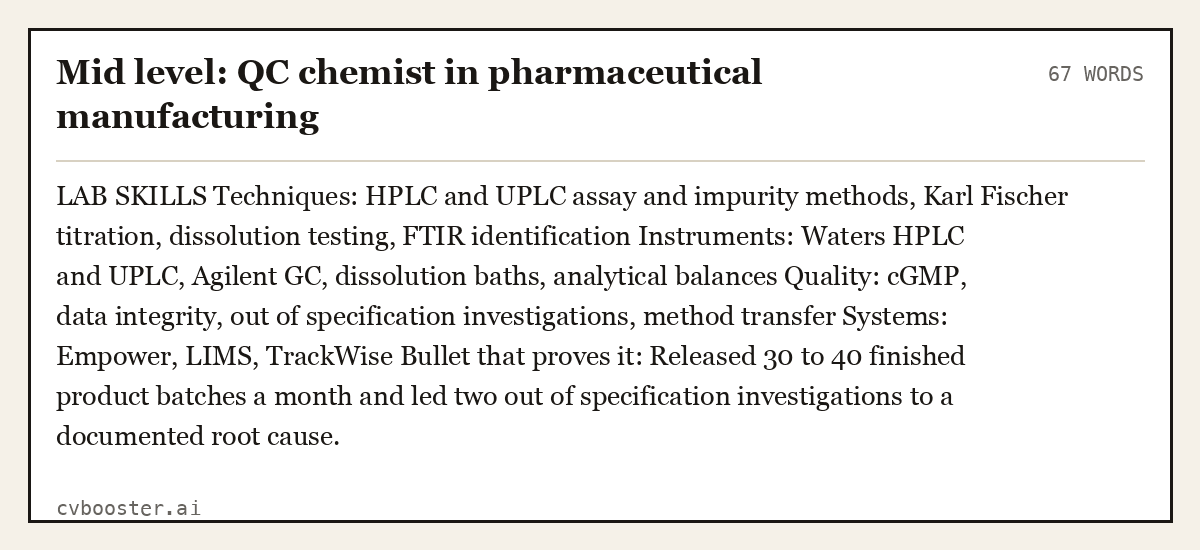
Mid level: QC chemist in pharmaceutical manufacturing (67 words)
LAB SKILLS Techniques: HPLC and UPLC assay and impurity methods, Karl Fischer titration, dissolution testing, FTIR identification Instruments: Waters HPLC and UPLC, Agilent GC, dissolution baths, analytical balances Quality: cGMP, data integrity, out of specification investigations, method transfer Systems: Empower, LIMS, TrackWise Bullet that proves it: Released 30 to 40 finished product batches a month and led two out of specification investigations to a documented root cause.
Lab skills for a supervisor or lab manager resume
At senior level the skills section shifts from what you run to what you keep running. Add validation, inspection readiness, scheduling, budgets and training. O*NET's medical technologist summary includes "May train or supervise staff," and a supervisor's resume should show exactly that with numbers.
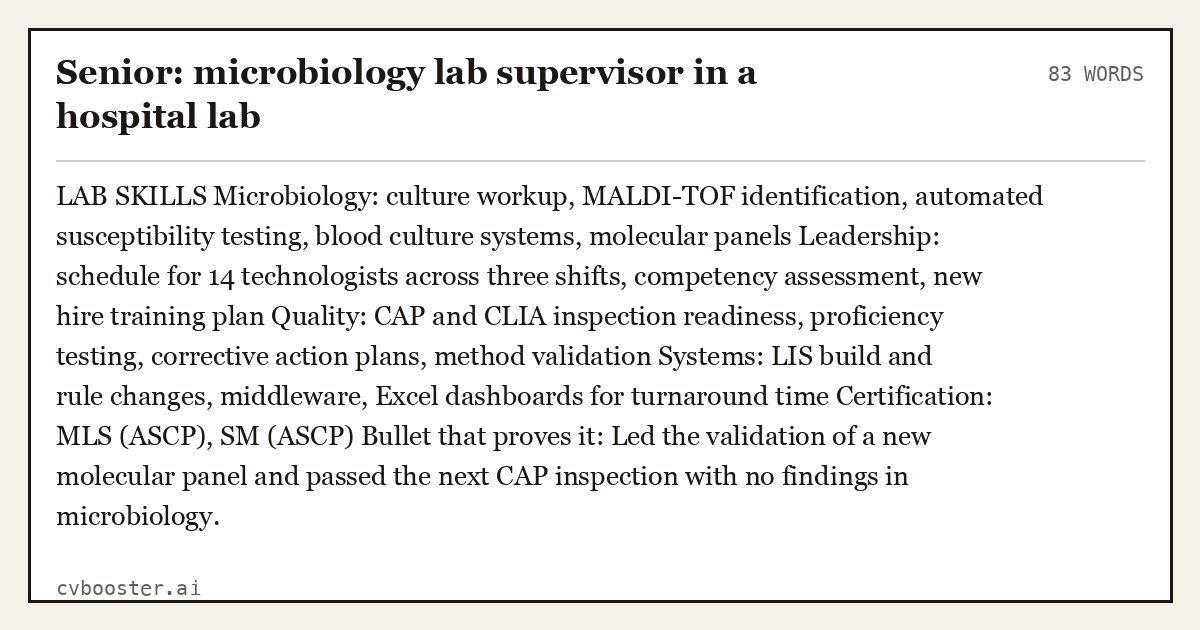
Senior: microbiology lab supervisor in a hospital lab (83 words)
LAB SKILLS Microbiology: culture workup, MALDI-TOF identification, automated susceptibility testing, blood culture systems, molecular panels Leadership: schedule for 14 technologists across three shifts, competency assessment, new hire training plan Quality: CAP and CLIA inspection readiness, proficiency testing, corrective action plans, method validation Systems: LIS build and rule changes, middleware, Excel dashboards for turnaround time Certification: MLS (ASCP), SM (ASCP) Bullet that proves it: Led the validation of a new molecular panel and passed the next CAP inspection with no findings in microbiology.
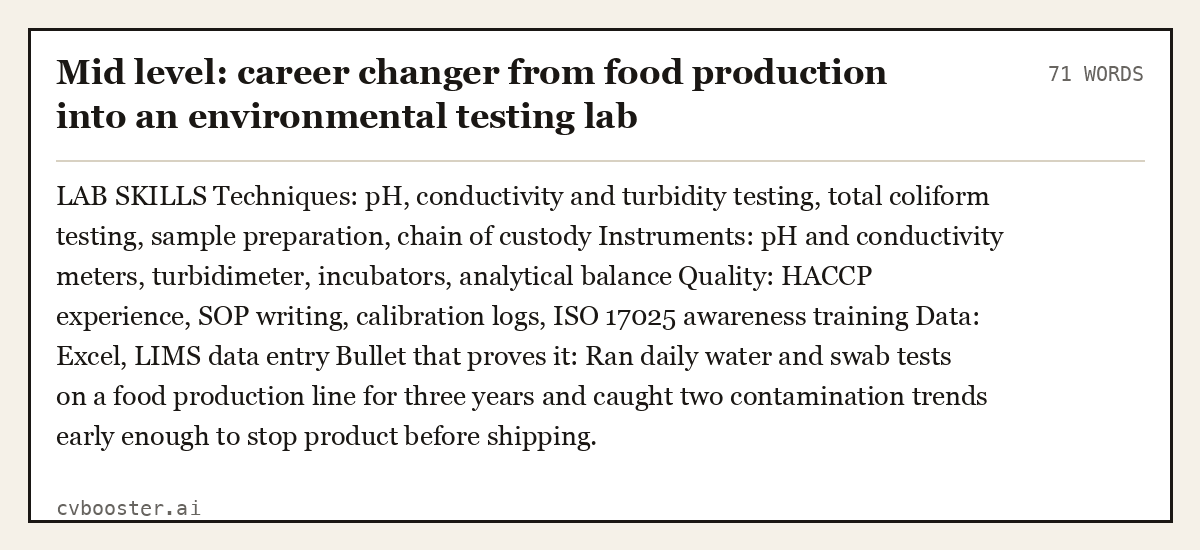
Mid level: career changer from food production into an environmental testing lab (71 words)
LAB SKILLS Techniques: pH, conductivity and turbidity testing, total coliform testing, sample preparation, chain of custody Instruments: pH and conductivity meters, turbidimeter, incubators, analytical balance Quality: HACCP experience, SOP writing, calibration logs, ISO 17025 awareness training Data: Excel, LIMS data entry Bullet that proves it: Ran daily water and swab tests on a food production line for three years and caught two contamination trends early enough to stop product before shipping.
Lab skills to leave off
- Skills every lab worker has, such as "pipetting" on a senior resume or "wearing PPE". Put them on a student resume only.
- Instruments you saw once in a demonstration. You will be asked to describe the last time you troubleshot one.
- Soft skills on their own. "Teamwork" proves nothing. "Covered the evening bench for two colleagues during a staffing gap" proves it.
- Rating bars and stars. A hiring manager cannot tell what four out of five in chromatography means.
For a full resume built around these skills, see the lab technician resume, the medical technologist resume and the biologist resume. For skills beyond the bench, our hard skills for a resume guide covers how to group them, and resume skills shows where the section sits on the page. CVBooster checks your resume against the posting: you need an account, the free plan lets you fill in your resume by hand and see your ATS score and missing keywords, and the AI tailoring, templates and the finished file are Pro.
Frequently asked questions
What lab skills should I put on my resume?
List the techniques you can run alone, the instruments you can set up and troubleshoot, your quality and safety training, and the software you use for data. Group them under those four headings, then copy the exact wording of the posting for the skills you really have. Prove the top three in your bullets.
How do I list lab skills with no experience?
Use your coursework labs, research semesters, capstone projects and internships. Name each technique and the instrument you used, and add one line on volume or results, such as the number of reactions you ran. Safety training and a clean lab notebook also count, because they shorten your training time.
Where do lab skills go on a resume?
Put a lab skills section directly under your summary, before experience, because hiring managers in labs screen for techniques first. Then repeat the most important skills inside your experience bullets with numbers. A skill that appears only in the list and never in a bullet looks borrowed.
What is the difference between lab skills and lab techniques?
Techniques are one part of lab skills. Lab skills also include instruments, quality systems such as GLP or CLIA, safety training, documentation and data analysis. A strong resume lists all of them, because a lab hires people who can produce reliable results, not only people who know a method.
Should I list every instrument I have used?
No. List the instruments you can set up, calibrate and troubleshoot without help, plus any named in the posting that you have run regularly. Leave out anything you used once, because a technical interviewer will ask what you do when it fails, and that is a hard question to bluff.
Related articles
- Accounting Executive Resume: 5 Examples by Career Level
- Administration Resume Examples: 8 Samples, Entry to Manager
- Aged Care Resume: 6 Australian Examples and a Template
- Another Word for Resume: CV, Bio and 10 More Options
More articles
- Law CV Example: 6 Legal CVs from Student to Solicitor
- Leadership Civil Service Example: 4 Statements, EO to G7
- Less Stress Jobs That Pay Well in the UK: 8 With CV Lines
Looking for a worked example for your job title? Browse the resume examples by job title.