Leadership Civil Service Example: 4 Statements, EO to G7
By Mustafa Tarabya, founder of CVBooster · Published · Updated
14 min read
A leadership civil service example does not need a team reporting to you, and candidates who wait for a management job to apply lose marks they already own. The 250-word cap that most adverts set leaves roughly 120 words for what you personally did. Every bullet quoted below comes from the Cabinet Office framework Success Profiles: Civil Service behaviours, read on 12 September 2026. Four finished statements sit under the H2s that follow, at EO, HEO, SEO and Grade 7, each broken down against its own grade band. Written by Mustafa Tarabya, who hired for his own company, read every application himself and now writes CVBooster's guides.
What the scoring actually rewards
The framework gives this behaviour three jobs in three sentences.
The behaviour, quoted: "Show pride and passion for public service. Create and engage others in delivering a shared vision. Value difference, diversity and inclusion, ensuring fairness and opportunity for all" (gov.uk, Leadership).
Three separate ticks, then. Pride in the public purpose. Other people pulled into something. Fairness that you personally protected.
Most drafts carry the first, gesture at the second and skip the third entirely. The inclusion bullets are the ones almost nobody evidences, and at EO the wording is unusually blunt: it asks for "promptly dealing with inappropriate language and behaviours when they arise". A sifter who reads twenty statements and finds one that names such a moment remembers it.
Nothing here requires line management. Two of the four statements below are written by people with no direct reports.
The word budget: 40 / 40 / 120 / 50
At 250 words the arithmetic is fixed. Roughly forty words place you somewhere real, forty more set up what had to happen, one hundred and twenty carry your own verbs, and fifty close it with something checkable.
For this behaviour the middle block has to hold two things at once: the thing you moved, and the fairness call you made while moving it. Draft them as separate sentences before you join anything up.
Tip: put a named person in the result. "The team felt supported" scores nothing. "The two part-time staff kept their Friday hours" is evidence.
Example at EO, annotated
Written for an EO post in a magistrates' court. No direct reports.
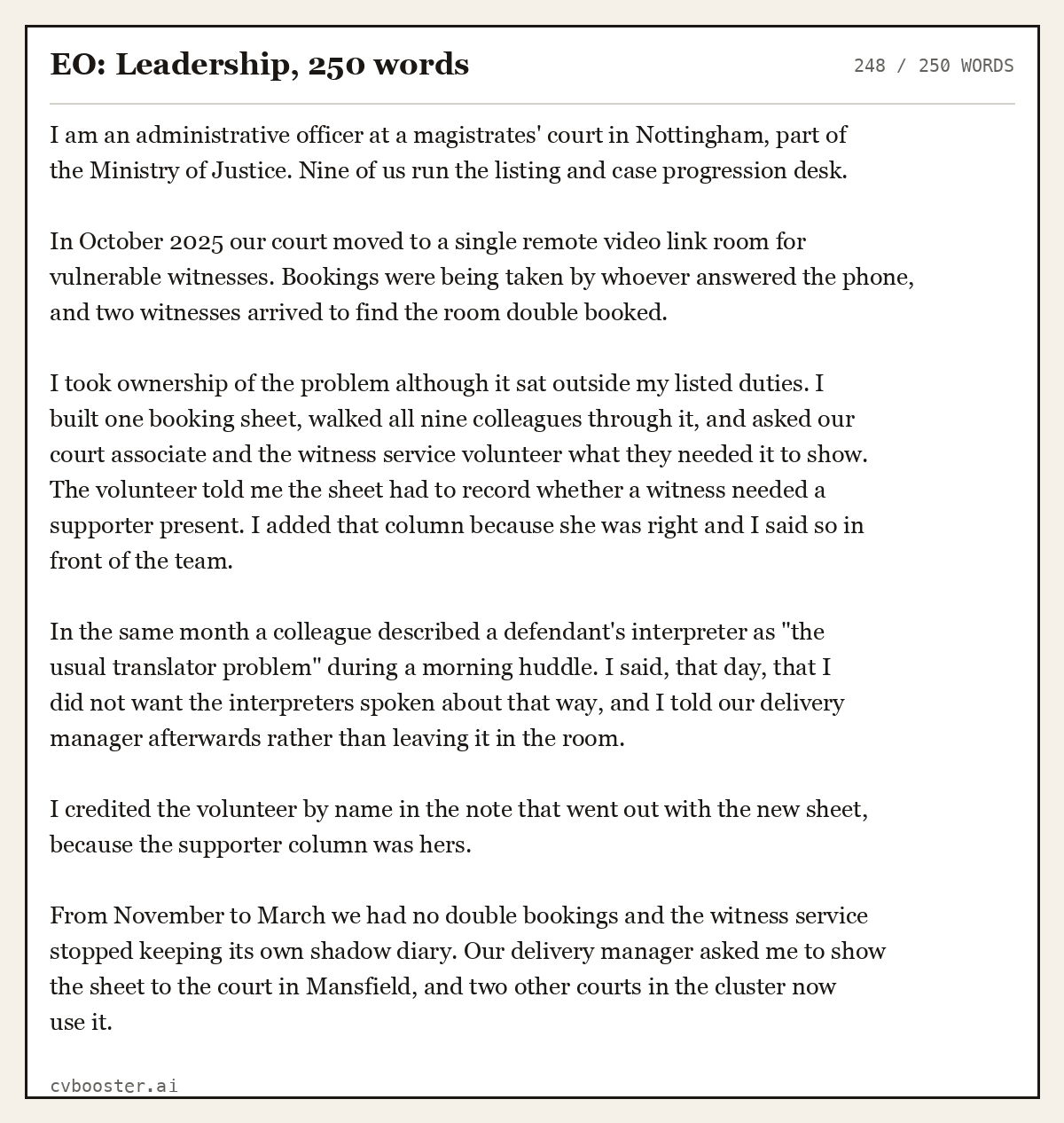
EO: Leadership, 250 words (248 words)
I am an administrative officer at a magistrates' court in Nottingham, part of the Ministry of Justice. Nine of us run the listing and case progression desk.
In October 2025 our court moved to a single remote video link room for vulnerable witnesses. Bookings were being taken by whoever answered the phone, and two witnesses arrived to find the room double booked.
I took ownership of the problem although it sat outside my listed duties. I built one booking sheet, walked all nine colleagues through it, and asked our court associate and the witness service volunteer what they needed it to show. The volunteer told me the sheet had to record whether a witness needed a supporter present. I added that column because she was right and I said so in front of the team.
In the same month a colleague described a defendant's interpreter as "the usual translator problem" during a morning huddle. I said, that day, that I did not want the interpreters spoken about that way, and I told our delivery manager afterwards rather than leaving it in the room.
I credited the volunteer by name in the note that went out with the new sheet, because the supporter column was hers.
From November to March we had no double bookings and the witness service stopped keeping its own shadow diary. Our delivery manager asked me to show the sheet to the court in Mansfield, and two other courts in the cluster now use it.
What the sifter is scoring
- Indicator quoted: "show pride and passion for your work and positive, inclusive engagement with your team" (gov.uk, EO). Where it shows: taking a problem outside the job description and walking all nine colleagues through the fix.
- Indicator quoted: "proactively role model and promote an inclusive workplace, promptly dealing with inappropriate language and behaviours when they arise - including any instances of discrimination or misconduct" (gov.uk, EO). Where it shows: the remark about the interpreter, challenged the same day and escalated.
- Indicator quoted: "give praise and credit to colleagues and stakeholders where appropriate" (gov.uk, EO). Where it shows: the volunteer named in the note.
- Indicator quoted: "understand your areas of responsibility and display awareness of the wider impact of your actions" (gov.uk, EO). Where it shows: the sheet being handed to two other courts.
Example at HEO, annotated
At HEO the framework starts asking about clarity for other people and about conflict you handled yourself.
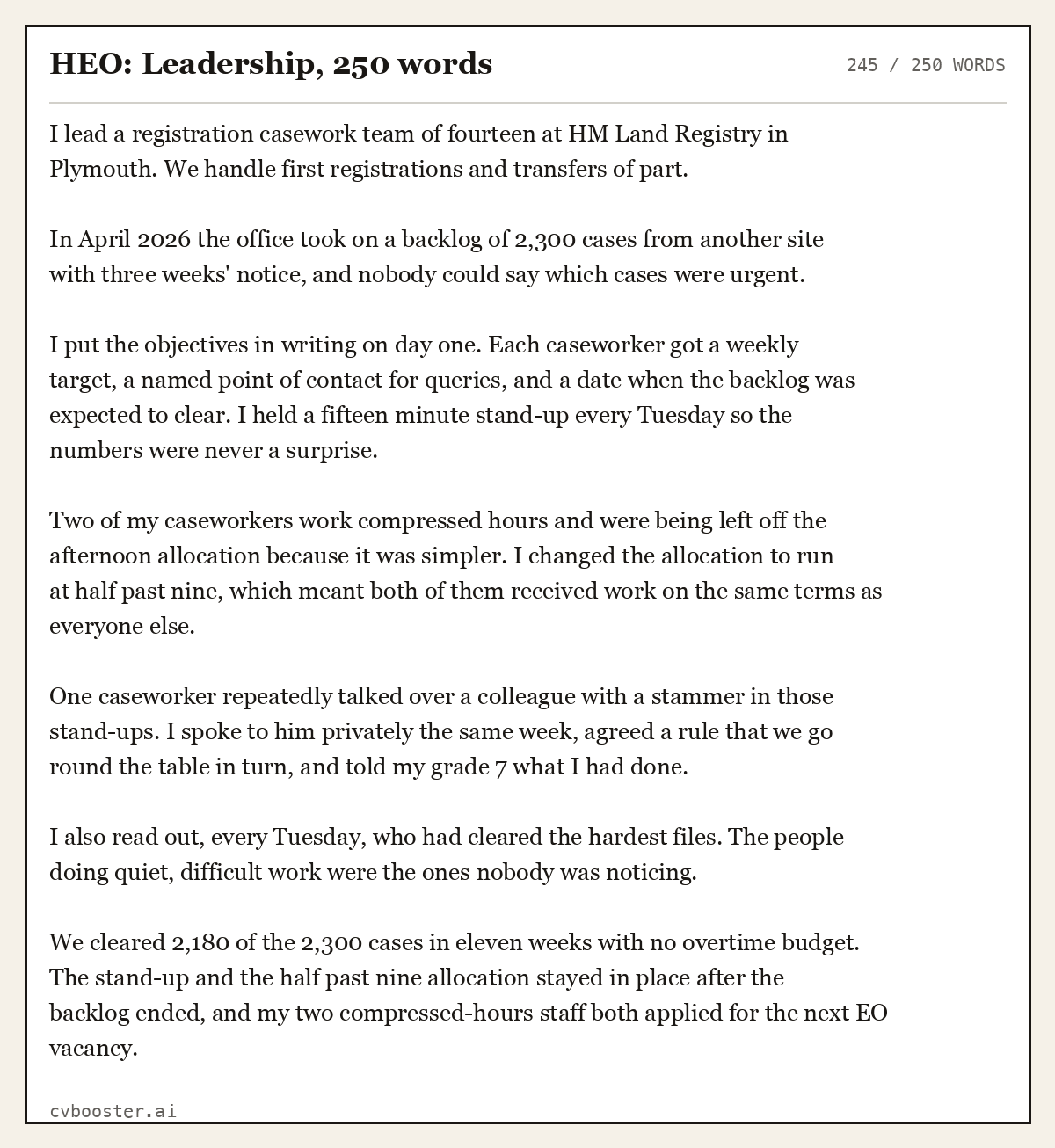
HEO: Leadership, 250 words (245 words)
I lead a registration casework team of fourteen at HM Land Registry in Plymouth. We handle first registrations and transfers of part.
In April 2026 the office took on a backlog of 2,300 cases from another site with three weeks' notice, and nobody could say which cases were urgent.
I put the objectives in writing on day one. Each caseworker got a weekly target, a named point of contact for queries, and a date when the backlog was expected to clear. I held a fifteen minute stand-up every Tuesday so the numbers were never a surprise.
Two of my caseworkers work compressed hours and were being left off the afternoon allocation because it was simpler. I changed the allocation to run at half past nine, which meant both of them received work on the same terms as everyone else.
One caseworker repeatedly talked over a colleague with a stammer in those stand-ups. I spoke to him privately the same week, agreed a rule that we go round the table in turn, and told my grade 7 what I had done.
I also read out, every Tuesday, who had cleared the hardest files. The people doing quiet, difficult work were the ones nobody was noticing.
We cleared 2,180 of the 2,300 cases in eleven weeks with no overtime budget. The stand-up and the half past nine allocation stayed in place after the backlog ended, and my two compressed-hours staff both applied for the next EO vacancy.
What the sifter is scoring
- Indicator quoted: "ensure colleagues and stakeholders have a clear understanding of objectives, activities and time-frames" (gov.uk, HEO and SEO). Where it shows: written targets, a named contact and a clear date on day one.
- Indicator quoted: "take into account different individual needs, views, and ideas, championing inclusion and equality of opportunity for all" (gov.uk, HEO and SEO). Where it shows: moving allocation to half past nine for the compressed-hours staff.
- Indicator quoted: "effectively manage conflict, misconduct and non-inclusive behaviour, raising with senior managers where appropriate" (gov.uk, HEO and SEO). Where it shows: the private conversation, the turn-taking rule, the grade 7 told.
- Indicator quoted: "recognise and praise the achievements of others to drive positivity within the team" (gov.uk, HEO and SEO). Where it shows: naming who cleared the hardest files each week.
Example at SEO, annotated
SEO shares its bullets with HEO, so the difference has to be scope and the number of people bound by what you decided.
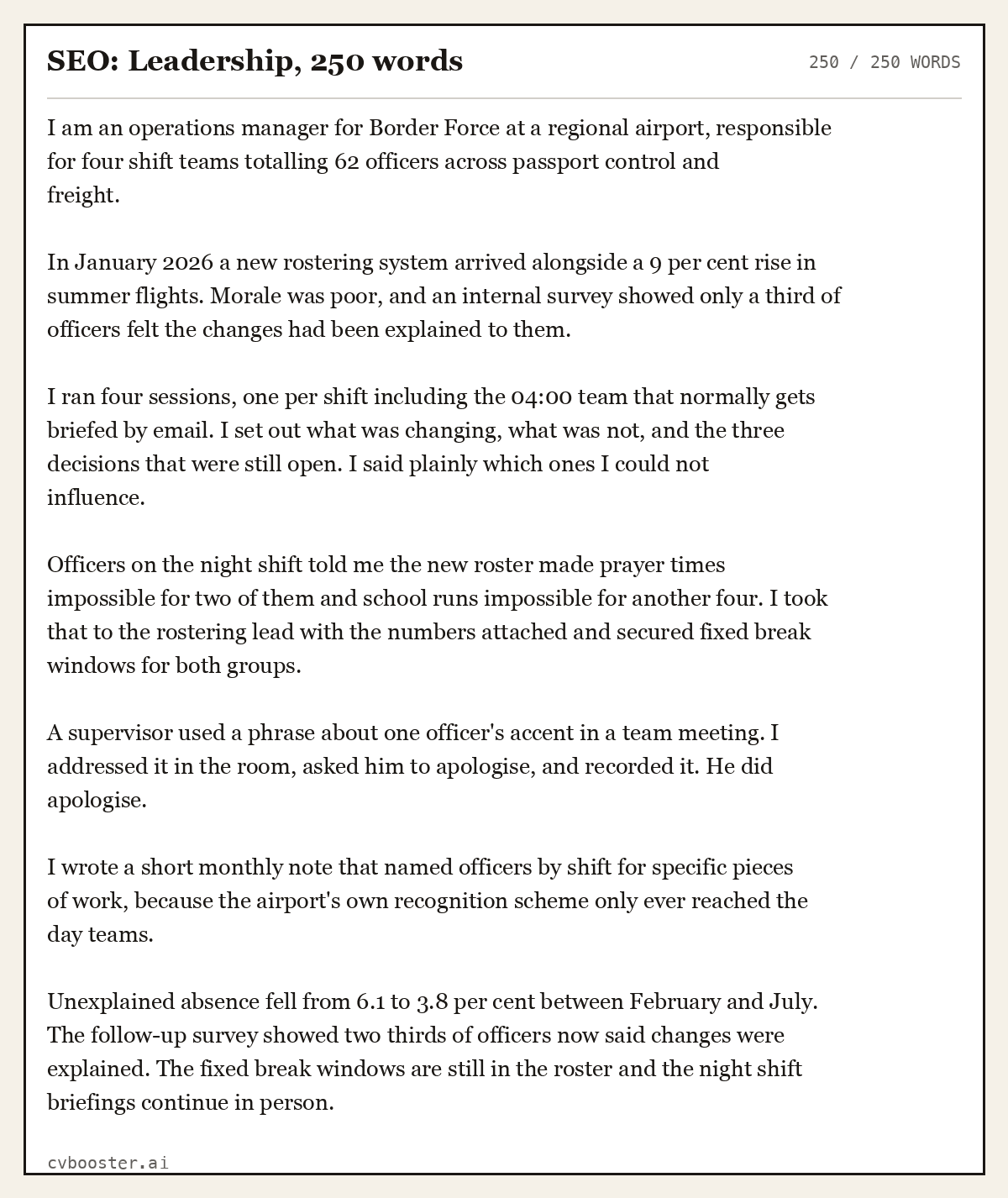
SEO: Leadership, 250 words (250 words)
I am an operations manager for Border Force at a regional airport, responsible for four shift teams totalling 62 officers across passport control and freight.
In January 2026 a new rostering system arrived alongside a 9 per cent rise in summer flights. Morale was poor, and an internal survey showed only a third of officers felt the changes had been explained to them.
I ran four sessions, one per shift including the 04:00 team that normally gets briefed by email. I set out what was changing, what was not, and the three decisions that were still open. I said plainly which ones I could not influence.
Officers on the night shift told me the new roster made prayer times impossible for two of them and school runs impossible for another four. I took that to the rostering lead with the numbers attached and secured fixed break windows for both groups.
A supervisor used a phrase about one officer's accent in a team meeting. I addressed it in the room, asked him to apologise, and recorded it. He did apologise.
I wrote a short monthly note that named officers by shift for specific pieces of work, because the airport's own recognition scheme only ever reached the day teams.
Unexplained absence fell from 6.1 to 3.8 per cent between February and July. The follow-up survey showed two thirds of officers now said changes were explained. The fixed break windows are still in the roster and the night shift briefings continue in person.
What the sifter is scoring
- Indicator quoted: "consider the impacts of own and team's activities on stakeholders and end users" (gov.uk, HEO and SEO). Where it shows: the roster tested against prayer times and school runs before it was locked.
- Indicator quoted: "role-model commitment and satisfaction with role" (gov.uk, HEO and SEO). Where it shows: briefing the 04:00 shift in person rather than by email.
- Indicator quoted: "take into account different individual needs, views, and ideas, championing inclusion and equality of opportunity for all" (gov.uk, HEO and SEO). Where it shows: fixed break windows won for six named officers.
- Indicator quoted: "effectively manage conflict, misconduct and non-inclusive behaviour, raising with senior managers where appropriate" (gov.uk, HEO and SEO). Where it shows: the comment about an accent, dealt with in the room and recorded.
Example at Grade 7, annotated
Grade 7 has its own list. Two bullets are about holding a position under pressure, which is what most promotion statements leave out.
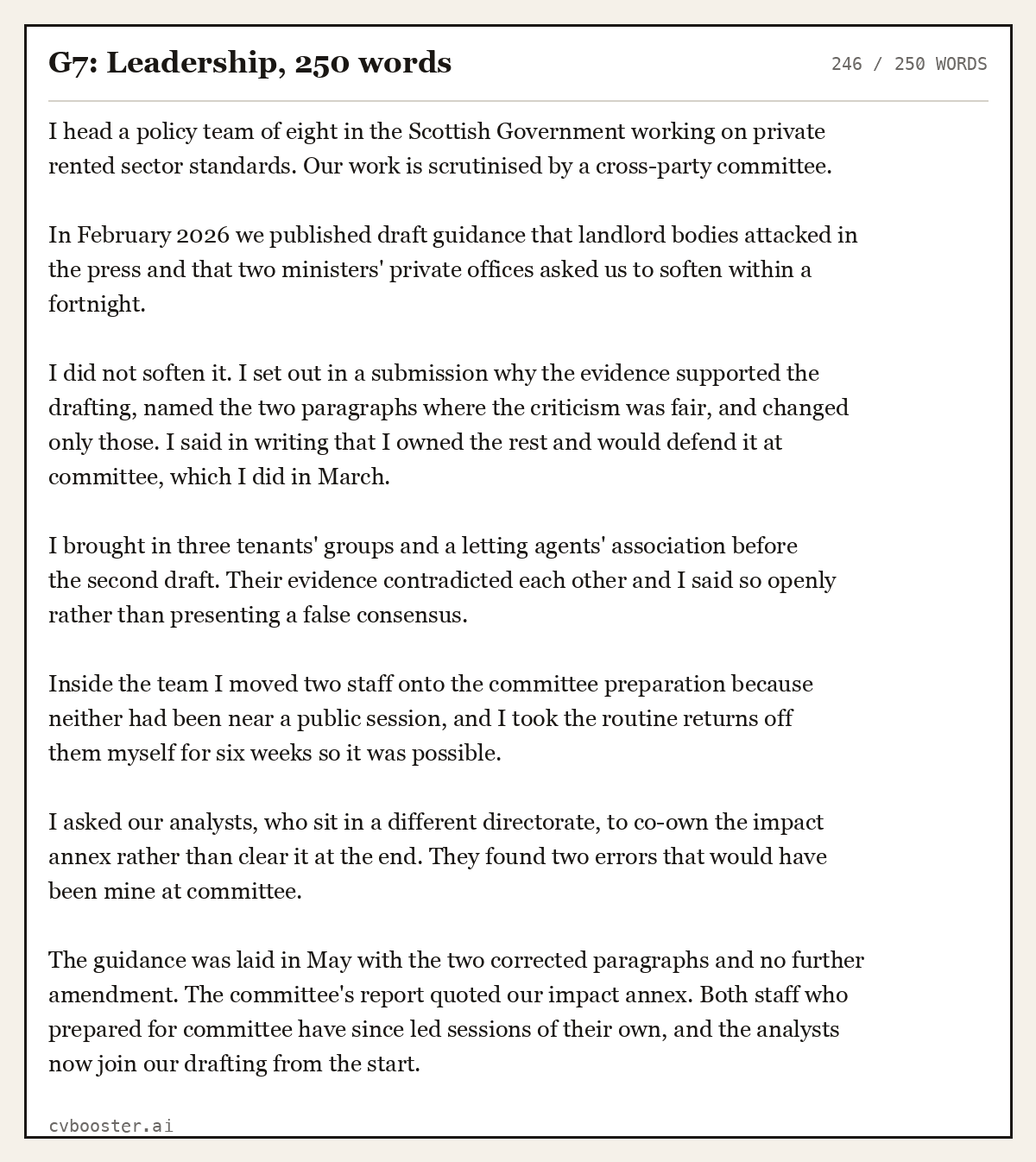
G7: Leadership, 250 words (246 words)
I head a policy team of eight in the Scottish Government working on private rented sector standards. Our work is scrutinised by a cross-party committee.
In February 2026 we published draft guidance that landlord bodies attacked in the press and that two ministers' private offices asked us to soften within a fortnight.
I did not soften it. I set out in a submission why the evidence supported the drafting, named the two paragraphs where the criticism was fair, and changed only those. I said in writing that I owned the rest and would defend it at committee, which I did in March.
I brought in three tenants' groups and a letting agents' association before the second draft. Their evidence contradicted each other and I said so openly rather than presenting a false consensus.
Inside the team I moved two staff onto the committee preparation because neither had been near a public session, and I took the routine returns off them myself for six weeks so it was possible.
I asked our analysts, who sit in a different directorate, to co-own the impact annex rather than clear it at the end. They found two errors that would have been mine at committee.
The guidance was laid in May with the two corrected paragraphs and no further amendment. The committee's report quoted our impact annex. Both staff who prepared for committee have since led sessions of their own, and the analysts now join our drafting from the start.
What the sifter is scoring
- Indicator quoted: "stand by, promote or defend your own and your team's actions and decisions where needed" (gov.uk, Grade 6 and Grade 7). Where it shows: refusing to soften the draft and defending it at committee.
- Indicator quoted: "welcome and respond to views and challenges from others, despite any conflicting pressures to ignore or give in to them" (gov.uk, Grade 6 and Grade 7). Where it shows: conceding two paragraphs where the criticism was fair.
- Indicator quoted: "seek out shared interests beyond your own area of responsibility, understanding the extent of the impact actions have on the organisation" (gov.uk, Grade 6 and Grade 7). Where it shows: analysts in another directorate co-owning the annex.
- Indicator quoted: "inspire and motivate teams to be fully engaged in their work and dedicated to their role" (gov.uk, Grade 6 and Grade 7). Where it shows: clearing six weeks of routine work so two staff could take a committee session.
What changed between the four
The shape of the story is identical at all four grades. What moves is the number of people affected and the cost of the fairness call.
| Level | People engaged | The inclusion move | What held afterwards |
|---|---|---|---|
| EO | Nine colleagues and a volunteer | Challenged a remark about interpreters the same day | Two other courts adopted the sheet |
| HEO | Fourteen caseworkers | Reset allocation so compressed-hours staff got equal work | Stand-up and allocation time kept |
| SEO | 62 officers across four shifts | Fixed break windows for prayer and school runs | Absence down, briefings still in person |
| G7 | Eight staff, three external groups, a committee | Named the genuine criticism instead of a false consensus | Guidance laid, annex quoted, staff promoted |
At EO you take responsibility for something nobody asked you to own. At HEO you make objectives legible. At SEO you change a system for people whose needs it ignored. At Grade 7 you carry a position that is costing you something. If your Grade 7 draft has no pressure in it, you have written an HEO statement.
The sentences that cost marks
Each pair holds the same fact. The first version is unmarkable because there is no person, no moment and no cost in it.
- Before: I am a natural leader who inspires those around me. After: I briefed the 04:00 shift in person because email was how they had always been told.
- Before: I promote equality, diversity and inclusion at all times. After: I moved allocation to half past nine so both compressed-hours caseworkers got the same work.
- Before: I dealt with a difficult member of staff appropriately. After: I asked the supervisor to apologise for the remark about the officer's accent, and recorded it.
- Before: I engaged stakeholders and built consensus. After: The tenants' groups and the agents contradicted each other, and I said so in the submission.
- Before: I motivated my team to deliver under significant pressure. After: I took the routine returns off two staff for six weeks so they could prepare for committee.
- Before: Senior leaders were very happy with the outcome. After: The committee report quoted our impact annex and the guidance was laid unamended.
Before you submit
- Read the grade in the advert and write to that band's bullets, not the one above.
- Check you have a fairness or inclusion moment with a named consequence. Most statements do not.
- Check something survived you: a rule, a rota, a person who got promoted.
- Delete the word "inspire" unless you can follow it with what somebody then did.
- Keep one sentence on a view you disagreed with. Leadership without friction reads as a project summary.
- civil-service-careers.gov.uk asks you to "include specific facts and figures that demonstrate the tangible results of your work". Put one number in the final fifty words.
- The seven-point marking scale used at sift is published by the Crown Office and Procurator Fiscal Service, which calls a 5 "Substantial positive evidence of the behaviour".
- Sibling statements worked in full: Changing and Improving and Developing Self and Others.
- Also written out at four grades: Making Effective Decisions and Working Together.
- The other elements of the framework sit in the Success Profiles guide, and all nine behaviours in the behaviours framework guide.
Frequently asked questions
What is a good example of leadership in the civil service?
A good example shows three things: something you took responsibility for, other people you pulled into it, and a fairness call you personally made. Line management is optional. The EO statement above is written by an administrative officer with no direct reports, and it still hits four indicators, because the booking sheet, the challenged remark and the credited volunteer are all his own actions.
Do you need to manage people to evidence leadership?
No. The gov.uk bullets at AA, AO and EO grade are about your own accountability, your fairness towards others and your awareness of wider impact. None of them mentions direct reports. Line management language appears only from HEO upwards, and even there the behaviour is about clarity, inclusion and recognition rather than about having a team.
How do you demonstrate leadership in a 250-word statement?
Spend about forty words placing the reader, forty on what had to happen, one hundred and twenty on your own verbs, and fifty on the result. Inside the middle block, put one sentence on the fairness or inclusion decision you made. That single sentence is what separates a 4 from a 6, because almost nobody writes it.
What are the leadership behaviours in the civil service?
Leadership is one of the nine behaviours in Success Profiles. gov.uk defines it as showing pride and passion for public service, creating and engaging others in a shared vision, and valuing difference, diversity and inclusion. The published bullets differ by grade band: AA and AO, EO, HEO and SEO together, Grade 6 and Grade 7 together, Deputy Director, then Director and Director General.
Is leadership assessed at interview as well as at sift?
Usually yes. The same behaviour is commonly scored twice, once on the written statement and once on a question at interview, with one seven-point scale used at both stages. Write the statement so you can tell it aloud in about ninety seconds, and keep the fairness moment in the spoken version, because panels almost always ask a follow-up about it.
More in this series: Civil Service applications
- Changing and Improving Civil Service Example: AO to G7
- Civil Service Behaviours Framework: All 9, Level by Level
- Civil Service Behaviours: 9 Examples, One Per Behaviour
- Civil Service Interview Questions and 15 Full Answers
- Civil Service Judgement Test: 8 Questions and Answers
- Civil Service Strengths Examples: 10 Worked Answers
- Civil Service Success Profiles: the Five Elements, Explained
- Communicating and Influencing: 4 Civil Service Examples
- Delivering at Pace: 4 Civil Service Examples, EO to G7
- Developing Self and Others: 4 Civil Service Examples
- Making Effective Decisions: 4 Civil Service Examples
- Managing a Quality Service: 4 Worked Examples, EO to G7
- Seeing the Big Picture Civil Service Example: AO to G7
- Statement of Suitability Civil Service Example: EO and HEO
- Working Together Civil Service Example: AO to Grade 7
Related articles
- Changing and Improving Civil Service Example: AO to G7
- Civil Service Behaviours Framework: All 9, Level by Level
- Civil Service Judgement Test: 8 Questions and Answers
- Civil Service Success Profiles: the Five Elements, Explained
More articles
- Letter of Interest: How to Approach a Company With No Job Posted
- Letter of Introduction for a Job: When to Send One
- LinkedIn Profile vs Resume: What Changes
Looking for a worked example for your job title? Browse the resume examples by job title.