Quant Job Interview Questions and Answers: 5 Full Samples
By Mustafa Tarabya, founder of CVBooster · Published · Updated
9 min read
Quant job interview questions come in five families, and the answers that pass all do the same thing: they think out loud, state every assumption, check the result, and only then give a number. The constraint is speed, because a quant interviewer gives you a few minutes per problem and watches your reasoning more than your final digit. O*NET describes the job as one where you "Apply mathematical or statistical techniques to address practical issues in finance, such as derivative valuation, securities trading, risk management, or financial market regulation." Below are quant interview questions in each family, checked in October 2026, five full sample answers tagged by level, a list of fast questions with one line answers, and what interviewers score. Written by Mustafa Tarabya, who hired for his own company, read every application himself and now writes CVBooster's guides.
You will know the answer to the dice question. You knew it in college. The problem is that someone with a whiteboard marker is now watching you know it, and that is a different test.
1. Probability: the dice game
Almost every quant interview opens with a dice or coin problem. It looks easy on purpose. The interviewer wants the clean setup, the expected value, and then the decision.
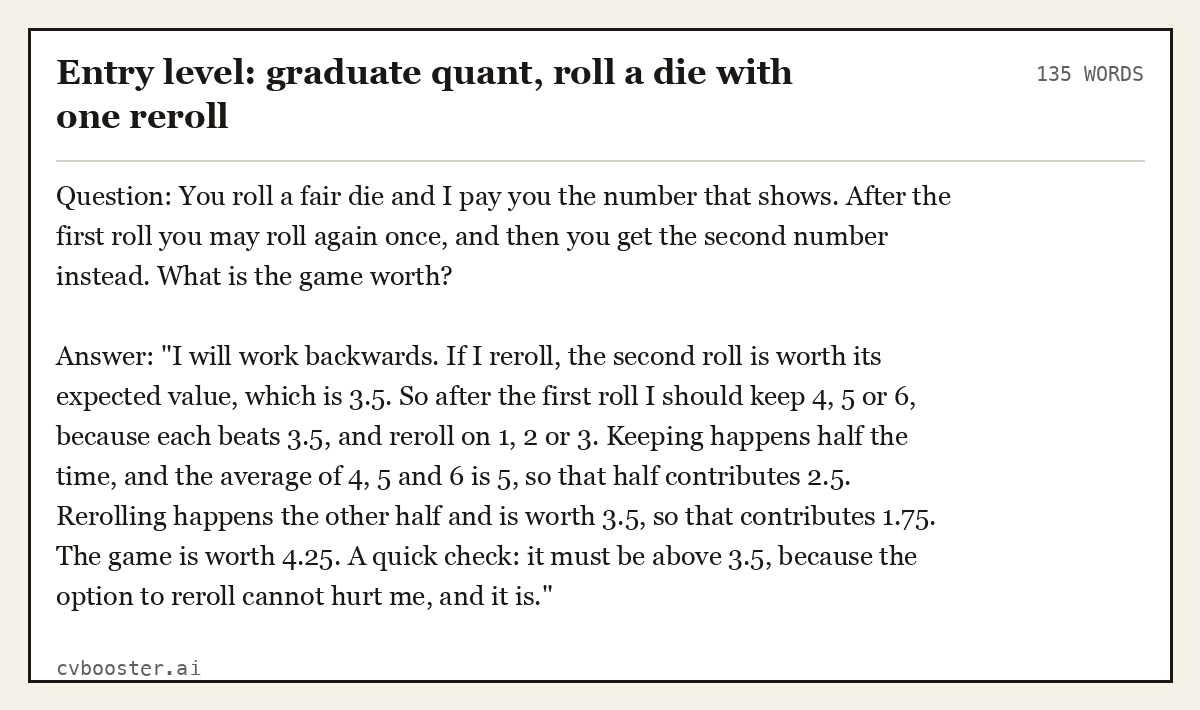
Entry level: graduate quant, roll a die with one reroll (135 words)
Question: You roll a fair die and I pay you the number that shows. After the first roll you may roll again once, and then you get the second number instead. What is the game worth?
Answer: "I will work backwards. If I reroll, the second roll is worth its expected value, which is 3.5. So after the first roll I should keep 4, 5 or 6, because each beats 3.5, and reroll on 1, 2 or 3. Keeping happens half the time, and the average of 4, 5 and 6 is 5, so that half contributes 2.5. Rerolling happens the other half and is worth 3.5, so that contributes 1.75. The game is worth 4.25. A quick check: it must be above 3.5, because the option to reroll cannot hurt me, and it is."
The last sentence is the habit interviewers look for. A sanity check costs five seconds and shows you would catch your own mistake before it reached a trading book.
2. Expected value with a recursion
The second family asks for an expected number of steps. The trick is to define states and write one equation per state.
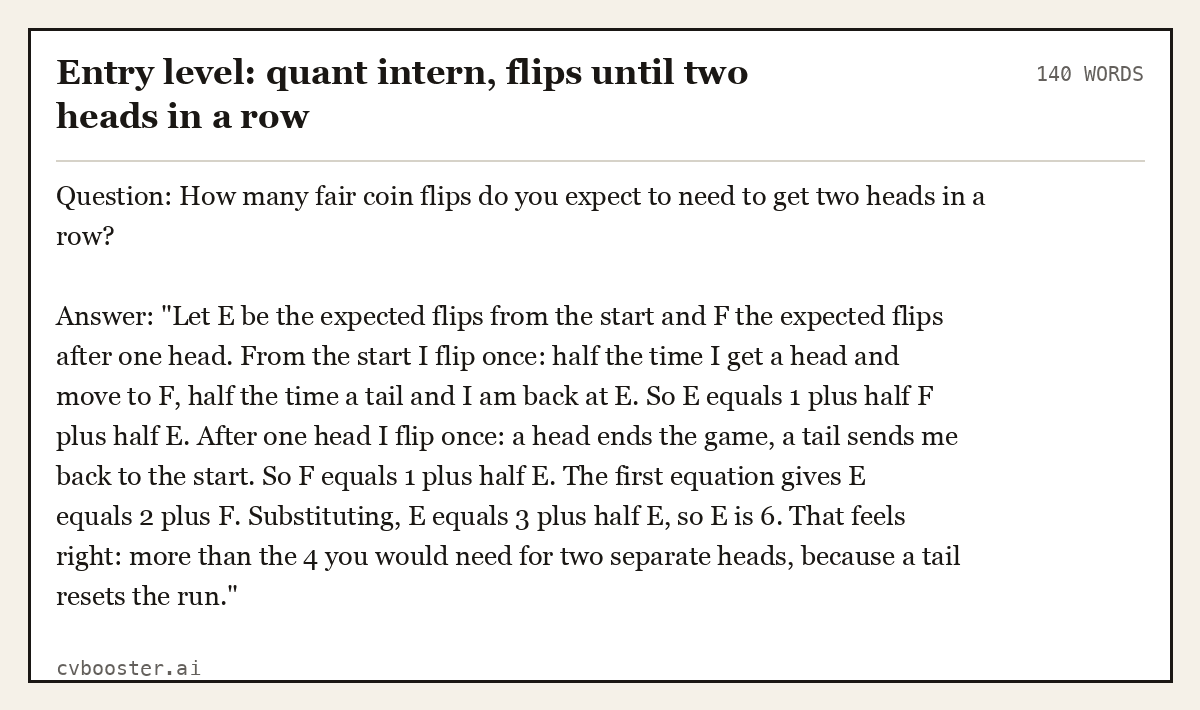
Entry level: quant intern, flips until two heads in a row (140 words)
Question: How many fair coin flips do you expect to need to get two heads in a row?
Answer: "Let E be the expected flips from the start and F the expected flips after one head. From the start I flip once: half the time I get a head and move to F, half the time a tail and I am back at E. So E equals 1 plus half F plus half E. After one head I flip once: a head ends the game, a tail sends me back to the start. So F equals 1 plus half E. The first equation gives E equals 2 plus F. Substituting, E equals 3 plus half E, so E is 6. That feels right: more than the 4 you would need for two separate heads, because a tail resets the run."
3. Statistics: correlation and a signal that looks too good
Mid level candidates get statistics questions with a market flavor. The interviewer is checking that you know the limits of a number, not just how to compute it.
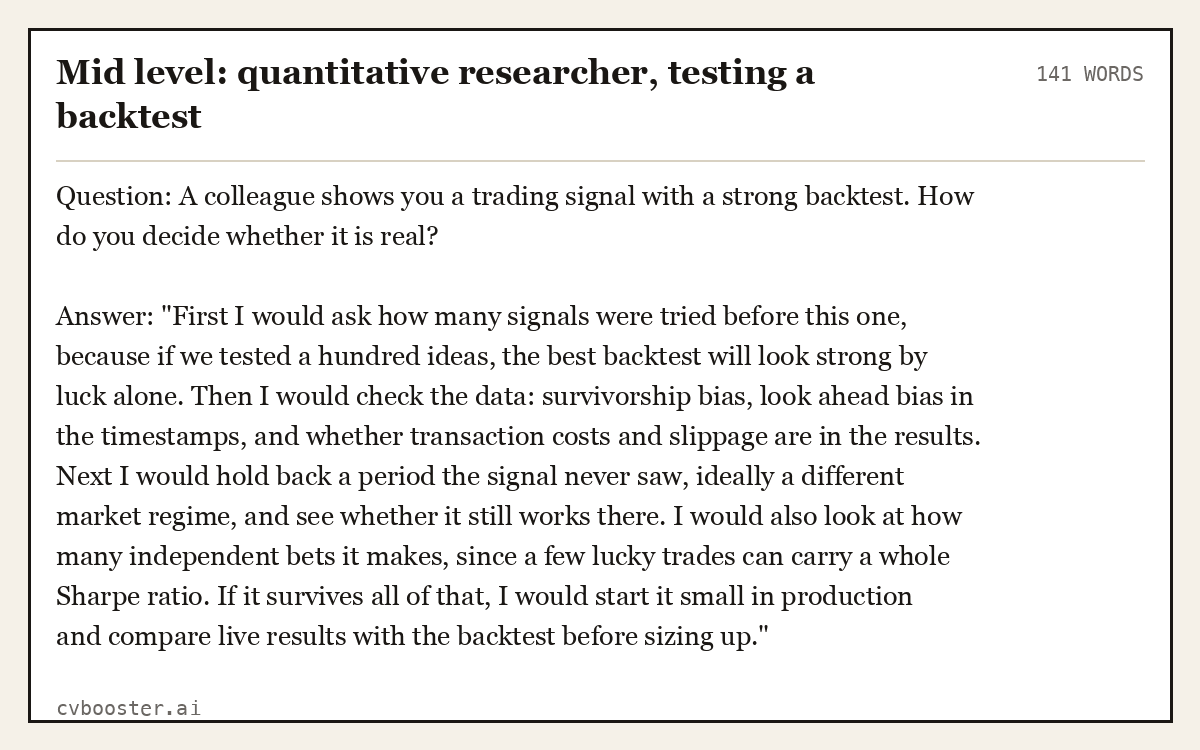
Mid level: quantitative researcher, testing a backtest (141 words)
Question: A colleague shows you a trading signal with a strong backtest. How do you decide whether it is real?
Answer: "First I would ask how many signals were tried before this one, because if we tested a hundred ideas, the best backtest will look strong by luck alone. Then I would check the data: survivorship bias, look ahead bias in the timestamps, and whether transaction costs and slippage are in the results. Next I would hold back a period the signal never saw, ideally a different market regime, and see whether it still works there. I would also look at how many independent bets it makes, since a few lucky trades can carry a whole Sharpe ratio. If it survives all of that, I would start it small in production and compare live results with the backtest before sizing up."
A shorter statistics favorite: if X and Y each have a correlation of 0.9 with Z, how low can the correlation between X and Y be? The lowest value is 0.9 times 0.9 minus the square root of 0.19 times 0.19, so 0.81 minus 0.19, which is 0.62. Say why: any lower and the three correlations could not exist together, because the correlation matrix has to stay positive semidefinite.
4. Options and finance questions
For desk facing roles, expect pricing questions. The BLS describes the wider field plainly: "Financial analysts use mathematics and financial modeling to determine the value of financial securities, assess risks, and forecast future growth." Quant interviews push that into derivatives.
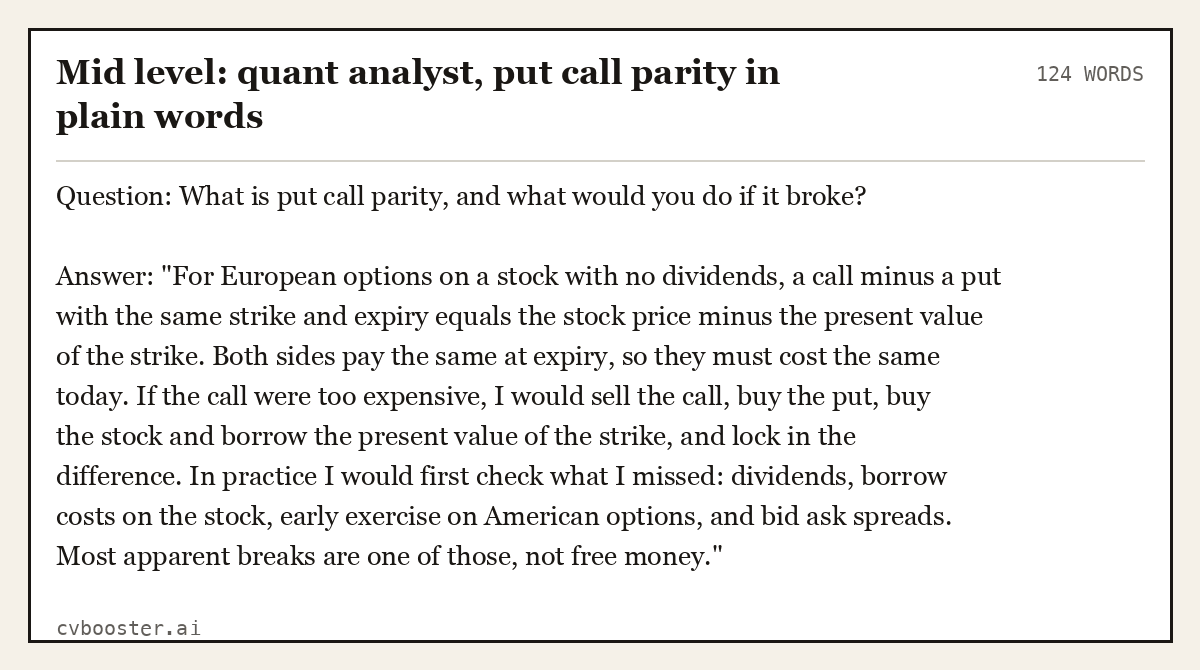
Mid level: quant analyst, put call parity in plain words (124 words)
Question: What is put call parity, and what would you do if it broke?
Answer: "For European options on a stock with no dividends, a call minus a put with the same strike and expiry equals the stock price minus the present value of the strike. Both sides pay the same at expiry, so they must cost the same today. If the call were too expensive, I would sell the call, buy the put, buy the stock and borrow the present value of the strike, and lock in the difference. In practice I would first check what I missed: dividends, borrow costs on the stock, early exercise on American options, and bid ask spreads. Most apparent breaks are one of those, not free money."
5. Fit, motivation and the model that failed
Every quant loop has one conversation that is not math. Interviewers want to know why this desk, and whether you can admit a model was wrong.
Senior level: quant lead, a model you built that failed (136 words)
Question: Tell me about a model you built that did not work.
Answer: "At my last firm I built a volatility forecast for our options book that beat the old one on every backtest we ran. In live trading it underperformed for two months. When I dug in, the reason was the training window: it was almost entirely calm markets, so the model had learned that volatility mean reverts fast, and it kept selling volatility too early when markets turned. I took it out of production, retrained it across a full cycle, and added a check that compares live forecast errors with the backtest errors every week. The new version has been in use since. The lesson I kept is that a backtest tells you how a model did, not what regime it was trained for."
Quant interview questions with one line answers
Phone screens and online tests move fast. These are the openers that keep you moving; the full working follows if the interviewer asks.
- Expected value of one fair die roll? 3.5, the average of 1 to 6.
- Probability of at least one six in four rolls? One minus five sixths to the fourth, about 0.52.
- Two children, at least one is a boy. Probability both are boys? One third, if you know only that at least one is a boy.
- What is a p value? The chance of a result at least this extreme if the null hypothesis were true, not the chance the hypothesis is true.
- Why do implied volatilities differ by strike? Markets price fatter tails and skew than the lognormal model assumes.
- Bias or variance: which do you fight in a noisy financial dataset? Usually variance, so prefer simpler models and more regularization.
- Write a function to sample k items uniformly from a stream of unknown length. Reservoir sampling: keep the first k, then replace a random slot with probability k over n.
Quant interview questions by type and role
Questions change with the seat. A quant researcher at a systematic fund gets more statistics; a quant trader gets mental math and market making games; a quant in a bank's model team gets pricing and validation.
| Role | Most common question families | What a strong answer shows |
|---|---|---|
| Quant trader | Mental math, dice and card games, market making | Fast, calm decisions under uncertainty |
| Quant researcher | Statistics, regression, backtest design | Skepticism about your own results |
| Quant analyst in a bank | Options pricing, stochastic calculus, model validation | Clear assumptions and limits of a model |
| Quant with a coding focus | Algorithms, data structures, Python or C++ | Clean, tested code and complexity awareness |
O*NET's task list explains why coding comes up even for research roles: quants "Develop core analytical capabilities or model libraries, using advanced statistical, quantitative, or econometric techniques." Read the full O*NET entry for financial quantitative analysts before the interview and you will recognize half the questions.
How to prepare in the last two weeks
- Drill probability out loud. Do three problems a day and speak every step, because that is what the interview grades. CareerOneStop's interview preparation advice puts it well: "Practicing your answers to typical interview questions will help you think through how to respond clearly and intentionally."
- Rebuild one project from your resume. Be ready to explain every choice in it, including what you would do differently.
- Do mental math daily. Multiplication of two digit numbers and quick fractions, without paper.
- Read one market story a day and ask what a quant would model in it.
- Prepare two questions about the desk. How research reaches production, and how the team decides when a model is retired.
On licenses, do not panic if you hold none yet. The BLS notes that for securities licenses "companies do not expect individuals to have these licenses before starting a job." The BLS financial analysts profile covers the wider career path.
For the coding round, our technical interview questions guide covers the general format, and the STAR interview questions guide is the method for the fit conversation. Brain teasers that are not about markets at all are in our creative interview questions list. For the application itself, the financial analyst resume and data scientist resume pages show how to write quant projects as results, and our questions to ask in an interview list helps with the last five minutes.
Frequently asked questions
What questions are asked in a quant interview?
Expect probability puzzles with dice, coins and cards, expected value problems, statistics and regression questions, options pricing for desk roles, and coding in Python or C++. Most loops also include a fit conversation about why quant finance and a project from your resume. Interviewers score your reasoning out loud as much as your final answer.
How do I prepare for quant job interview questions and answers?
Practice probability and expected value problems out loud every day, rebuild one project from your resume so you can defend every choice, and drill mental math without paper. Review put call parity, basic stochastic processes and backtest pitfalls. Prepare one honest story about a model that failed and what you changed afterwards.
Are quant interviews hard?
They are demanding because the questions come quickly and the interviewer watches your method. Most problems use undergraduate probability, statistics and calculus, so the difficulty is clear thinking under time pressure rather than obscure math. State assumptions, solve step by step and sanity check the answer, and a hard question becomes manageable.
What is a good answer to "why do you want to be a quant"?
Name what you enjoy in the work itself, such as turning a messy market question into a model you can test, then give a reason specific to the firm, such as its research process or asset class. Back it with one project. Avoid answers about pay or prestige, which every interviewer has heard.
Do I need a PhD for a quant job?
Not always. O*NET places the occupation in a job zone where most roles require graduate school, and research seats often prefer a PhD. Trader and quant analyst roles regularly hire strong master's and bachelor's graduates with good probability, statistics and coding skills. The interview tests those skills directly, whatever your degree.
Related articles
- Case Manager Interview Questions: 7 Answers That Score
- Creative Interview Questions With 6 Sample Answers
- Critical Care Nursing Interview Questions and 9 Answers
- ED Nurse Interview Questions With 9 Full Sample Answers
More articles
- Questions for a Recruiter Interview: What to Ask and Say
- Great Questions to Ask an Interviewee: 6 Ready Sets
- Questions to Ask in an Interview: Final Round, HR and Sales
Looking for a worked example for your job title? Browse the resume examples by job title.