Creative Interview Questions With 6 Sample Answers
By Mustafa Tarabya, founder of CVBooster · Published · Updated
9 min read
Creative questions for an interview, such as "If you were a kitchen tool, which one would you be?", are not trick questions: they test how you think when there is no right answer, and the best reply is a quick choice, one reason tied to the job, and a short example. The one thing that sinks people is freezing while hunting for the clever answer. CareerOneStop, the U.S. Department of Labor career site, says practicing out loud helps you "respond clearly and intentionally", and that applies twice over to odd questions. Below are the creative questions interviewers ask most, what each one is really measuring, six worked sample answers by career level, and creative questions you can ask back. Written by Mustafa Tarabya, who hired for his own company, read every application himself and now writes CVBooster's guides.
Entry level: retail associate asked which kitchen tool they would be (84 words)
Question: If you were a kitchen tool, which one would you be?
Answer: "Probably a whisk. It is not the fanciest thing in the drawer, but it gets used every day and it is good at bringing things together. At the shoe store where I worked last summer, I was the one who kept the stockroom and the sales floor talking to each other, so when we got a delivery during a busy Saturday, the shelves were full before customers noticed anything was missing."
What interviewers test with creative questions
A creative question looks playful, but the interviewer is scoring three ordinary things: how fast you can organize a thought, whether you can stay calm with no script, and whether your answer still says something about the job. The content of the answer matters less than its shape.
- Thinking under uncertainty. Questions like "How many tennis balls fit in this room?" check whether you can break a problem into steps and state your assumptions out loud.
- Self awareness. "What animal would you be?" is a strengths question in costume. It asks you to name a trait and back it up.
- Values and fit. "Who would you invite to dinner?" shows what you admire and how you talk about people.
- Communication. Every creative question tests whether you can keep an answer short, clear and friendly when you are surprised.
CareerOneStop's guide to types of interviews gives advice for behavioral questions that works just as well here: "Use stories from your background that demonstrate your skills and positive qualities." A creative answer without a story is a joke. A creative answer with a story is evidence.
A three step formula for any creative question
You do not need a prepared answer for every odd question, because there are too many. You need one method that works on all of them.
- Choose fast. Pick an answer within two or three seconds. A slightly ordinary choice delivered with confidence beats a brilliant one after a long silence.
- Give one reason that matches the job. Link the choice to a trait the posting asks for: reliability, curiosity, care, speed, accuracy.
- Prove it with ten seconds of real life. One sentence from a job, a class, a team or volunteer work.
If you need a moment, say so: "Good question, let me think about that for a second." That sentence buys time and shows composure. For the standard questions that usually come before and after, our list of common interview questions and answers uses the same short, evidence first approach.
Creative interview questions by type
These are the creative questions that come up again and again, grouped by what they measure.
Personality and self image
- If you were an animal, which would you be and why?
- What would the title of your autobiography be?
- If your friends described you in three words, what would they say?
- What superpower would make you better at this job?
Problem solving and estimation
- How many gas stations are there in this city?
- How would you sell ice to someone who lives in a cold place?
- You have a pencil. Sell it to me.
- How would you fit an elephant into a refrigerator?
Values and imagination
- If you could have dinner with anyone, living or dead, who would it be?
- You are stranded on a desert island. What three things do you bring?
- If you ran this company for a day, what would you change first?
- What is something you believe that most people disagree with?
Work style in disguise
- If you were a color, which would you be?
- What would your perfect workday look like from start to finish?
- What is the most interesting thing you have taught yourself?
Sample answers for mid level and senior candidates
The more senior the role, the more the interviewer expects the creative answer to land on judgment and leadership rather than on effort alone. The method stays the same.
Mid level: marketing coordinator asked to sell a pencil (87 words)
Question: Sell me this pencil.
Answer: "Before I sell it, can I ask how you take notes in meetings? You use a laptop, but you said earlier that you sketch ideas for your team. Then this pencil is for the five minutes when the laptop is closed and the idea is still rough. It never runs out of battery, it erases when the idea changes, and it costs less than the coffee you are drinking. Shall I put you down for a box for the whole team?"
The strong move in this answer is the question at the start. Selling begins with what the buyer needs, and asking first shows the interviewer you know that.
Mid level: nurse asked which superpower would help at work (82 words)
Question: What superpower would make you better at your job?
Answer: "Being in two rooms at once. On a busy medical floor, the hardest moments are when two call lights go on together and both patients need me. I cannot clone myself, so I do the next best thing: I round on every patient early, I ask what they will need in the next hour, and I tell them when I will be back. Most call lights after that are planned visits."
Senior level: operations manager asked what they would change running the company for a day (95 words)
Question: If you ran this company for a day, what would you change?
Answer: "I would not change anything on the first day, because one day is long enough to break something and too short to understand it. What I would do is spend the day on the floor and in customer service, and ask every team one question: what slows you down that leadership does not see? In my last role that question found a returns process that took nine handoffs. We cut it to four, and complaints about refunds dropped within a quarter."
Estimation and brain teaser questions
Estimation questions, sometimes called guesstimates, are common for analyst, consulting, finance and technical roles. The interviewer does not know the true number either. They want to see you break the problem into pieces, choose reasonable assumptions, say them out loud and do simple math.
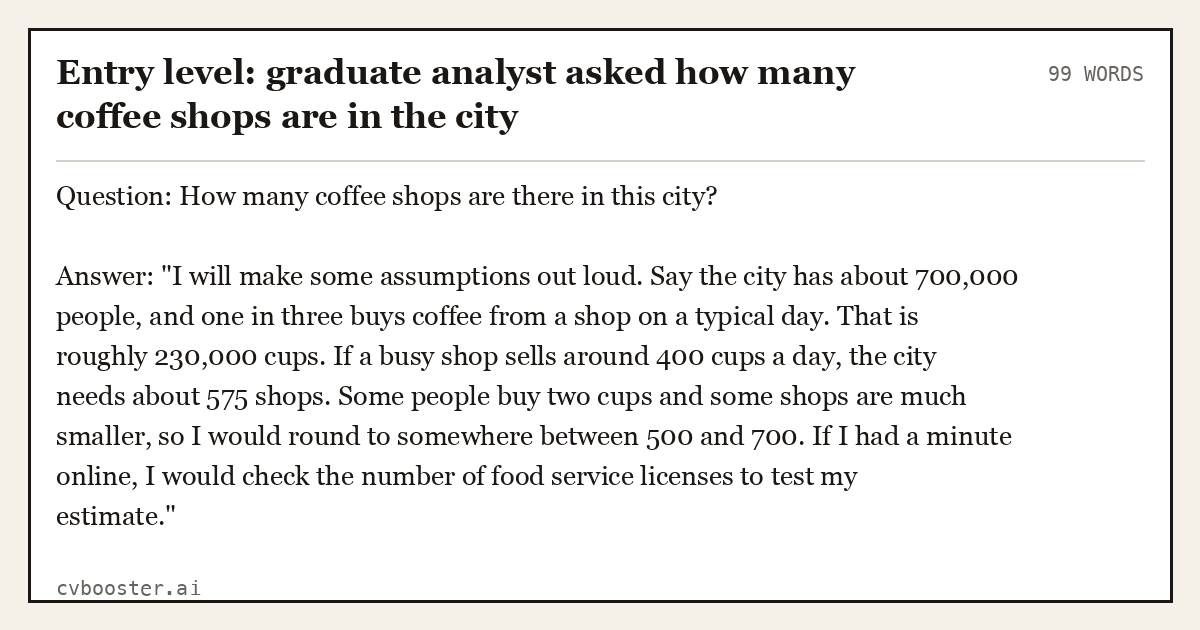
Entry level: graduate analyst asked how many coffee shops are in the city (99 words)
Question: How many coffee shops are there in this city?
Answer: "I will make some assumptions out loud. Say the city has about 700,000 people, and one in three buys coffee from a shop on a typical day. That is roughly 230,000 cups. If a busy shop sells around 400 cups a day, the city needs about 575 shops. Some people buy two cups and some shops are much smaller, so I would round to somewhere between 500 and 700. If I had a minute online, I would check the number of food service licenses to test my estimate."
The final sentence matters as much as the math. Offering a way to check the answer shows that you know an estimate is a starting point, not a fact.
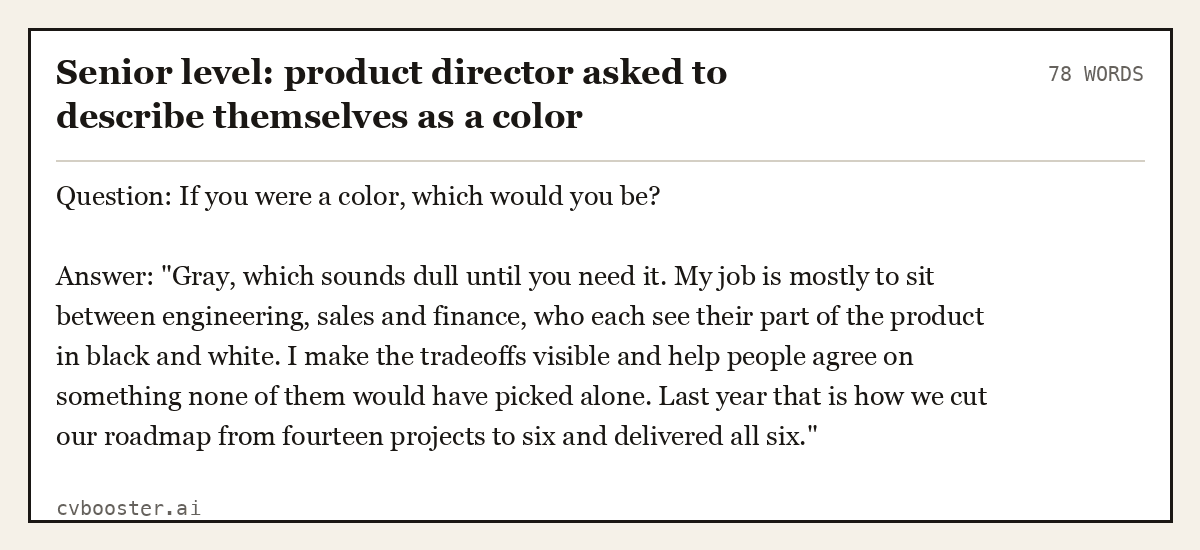
Senior level: product director asked to describe themselves as a color (78 words)
Question: If you were a color, which would you be?
Answer: "Gray, which sounds dull until you need it. My job is mostly to sit between engineering, sales and finance, who each see their part of the product in black and white. I make the tradeoffs visible and help people agree on something none of them would have picked alone. Last year that is how we cut our roadmap from fourteen projects to six and delivered all six."
Creative questions to ask the interviewer
At the end, the interviewer almost always turns it around. CareerOneStop's page on common interview questions puts it simply: "Most interviewers ask if you have any questions. Have some ready to show your interest in the role and company." A creative question here makes you memorable, as long as it is still about the job.
- What would make you say, a year from now, that hiring me was a great decision?
- What is something about this team that only people who work here know?
- What is the most useful thing the last person in this role did that was not in the job description?
- If you could fix one problem in this department tomorrow, what would it be?
- What surprised you most when you joined the company?
Pick two that fit the conversation. Our full guide to questions to ask in an interview has more by stage and role.
When a creative question crosses a line
Some questions that sound creative are really attempts to learn personal details, such as "What would your family say about you working late?" or "Where would you go for a holiday you celebrate?" The U.S. Equal Employment Opportunity Commission says the information requested in the pre-employment process "should be limited to those essential for determining if a person is qualified for the job". You can steer back politely: "I keep my schedule flexible for work, and I am happy to talk about how I handle late deadlines."
Preparation is the real secret behind answers that sound spontaneous. Practice the three step formula on five questions from the list above, out loud, the day before. Our guide on how to prepare for an interview walks through the rest of the evening before, and the STAR interview questions guide covers the behavioral questions that usually follow a creative one. Treat the odd question as a gift: it is the one moment where nobody else in the waiting room has a rehearsed answer either.
Frequently asked questions
Why do interviewers ask creative questions?
They want to see how you think when there is no prepared answer. A creative question shows whether you can stay calm, organize a thought quickly and connect a playful idea to real work. Your choice matters less than your reasoning and the short example you give to back it up.
How do you answer a creative interview question you did not expect?
Use three steps: choose an answer quickly, give one reason that matches a skill the job needs, and back it up with a short real example. If you need a moment, say you would like to think for a second. A calm pause is far better than rushing into a confused answer.
Are there wrong answers to creative interview questions?
The choice itself is rarely wrong, but some answers hurt you: refusing to play along, giving a long answer with no point, picking something negative about yourself, or sharing personal details you would rather keep private. Keep it short, positive and linked to the job, and you will be fine.
What are good creative questions to ask an interviewer?
Ask questions that are memorable but still about the job, such as what would make hiring you a great decision a year from now, what the last person in the role did beyond the description, or what surprised the interviewer most when they joined. Choose two that fit the conversation.
Do creative interview questions come up in every industry?
They are more common in sales, marketing, consulting, tech and customer facing roles, but any interviewer may use one to break the ice. Estimation questions are typical for analyst, finance and consulting jobs. Preparing a few answers with the three step method covers you for almost every industry.
Related articles
- ED Nurse Interview Questions With 9 Full Sample Answers
- Female Job Interview Attire: Six UK Outfits by Job Type
- Interview Questions for an LPN: 9 Full Sample Answers
- Great Questions to Ask an Interviewee: 6 Ready Sets
More articles
- Customer Service Resume: Metrics That Are Real
- Customer Service Skills on a Resume: What to List and Prove
- CV Example No Experience: 6 Full UK CVs for a First Job
Looking for a worked example for your job title? Browse the resume examples by job title.