Data Scientist Resume Examples: the lines they read
Create a Data Scientist Resume That Stands Out
By Mustafa Tarabya, founder of CVBooster · Published · Updated
Design a data scientist resume with the right mix of technical depth, business impact, and ATS-friendly formatting to win interviews.
Sample resumes for a data scientist
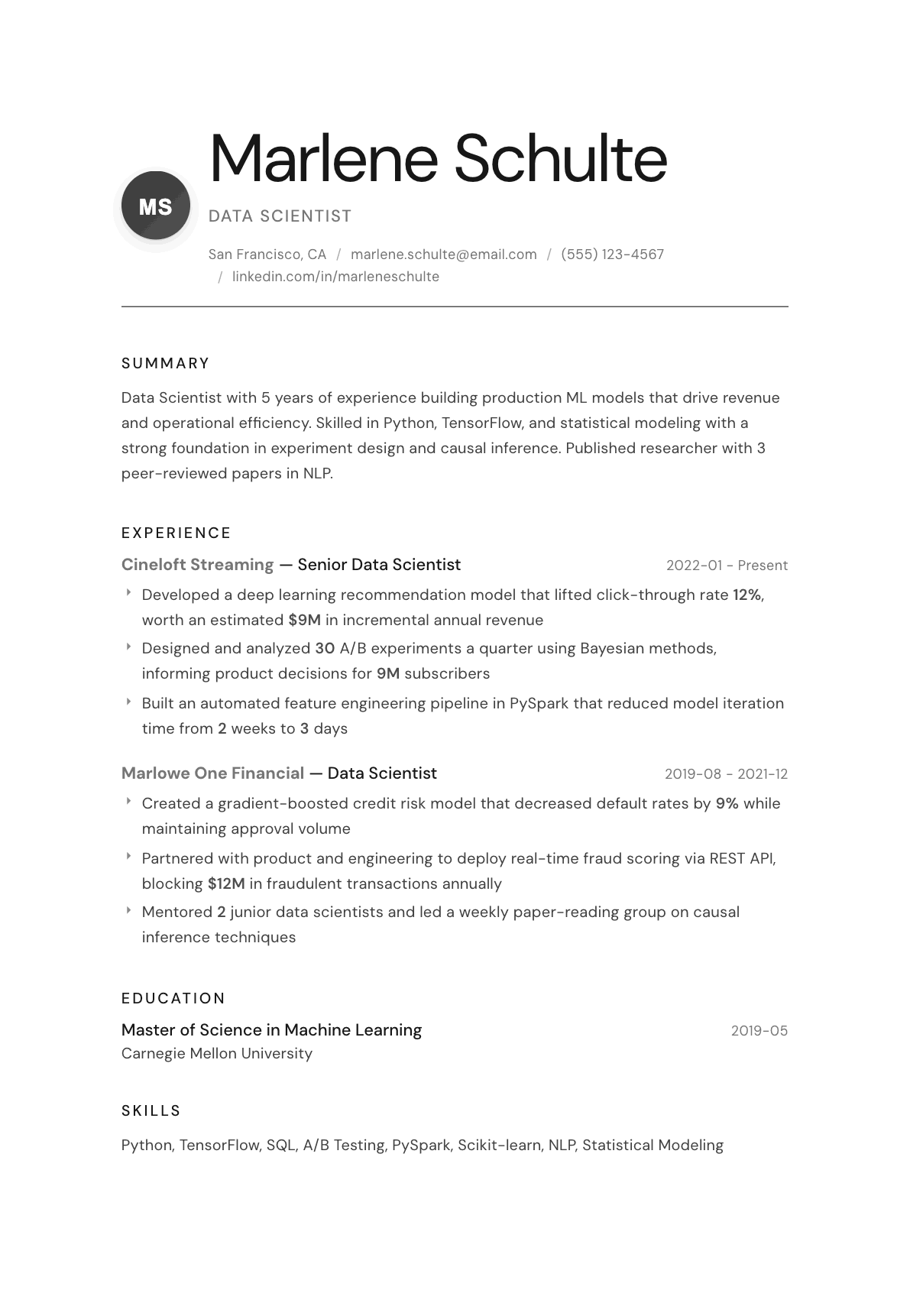
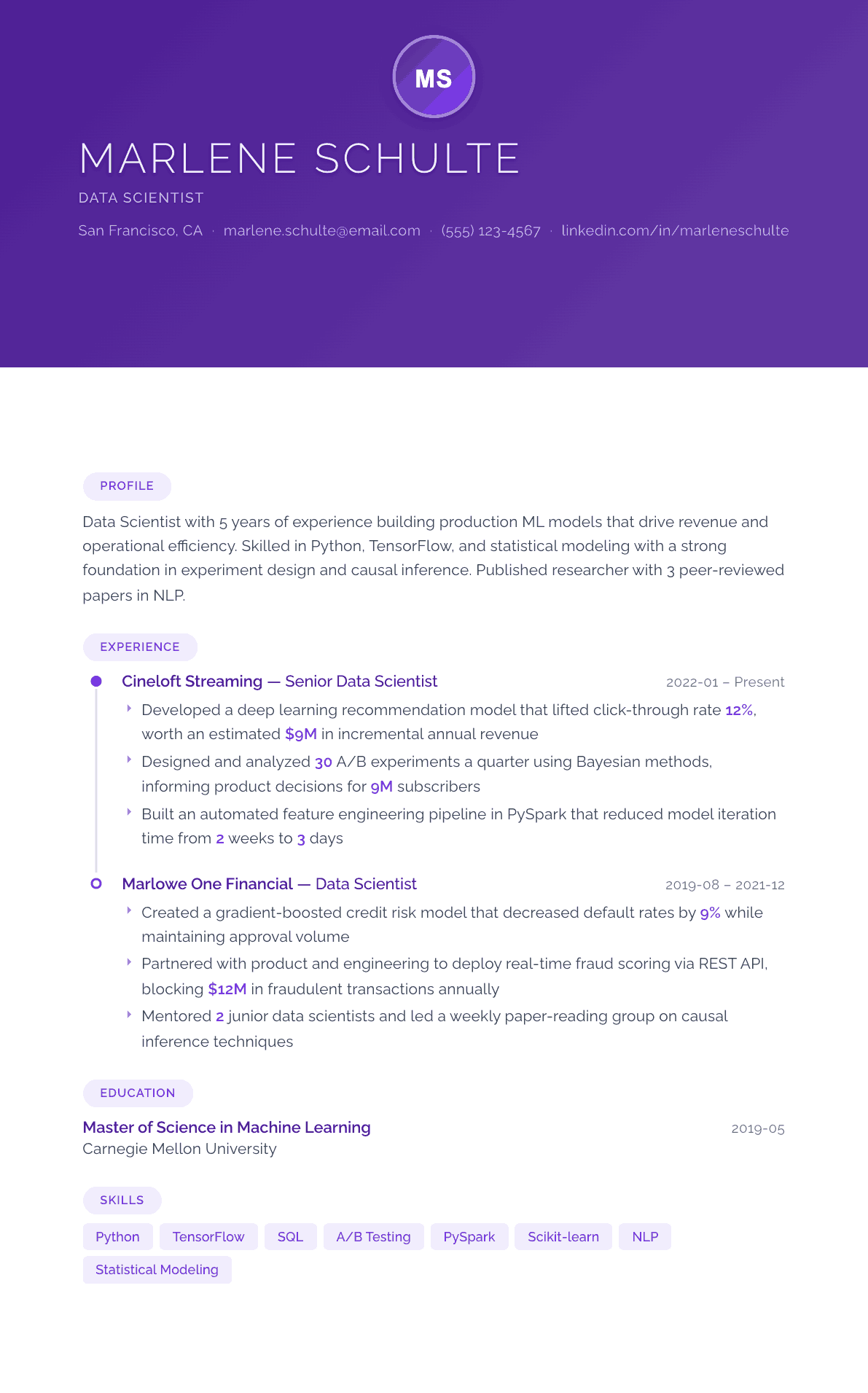
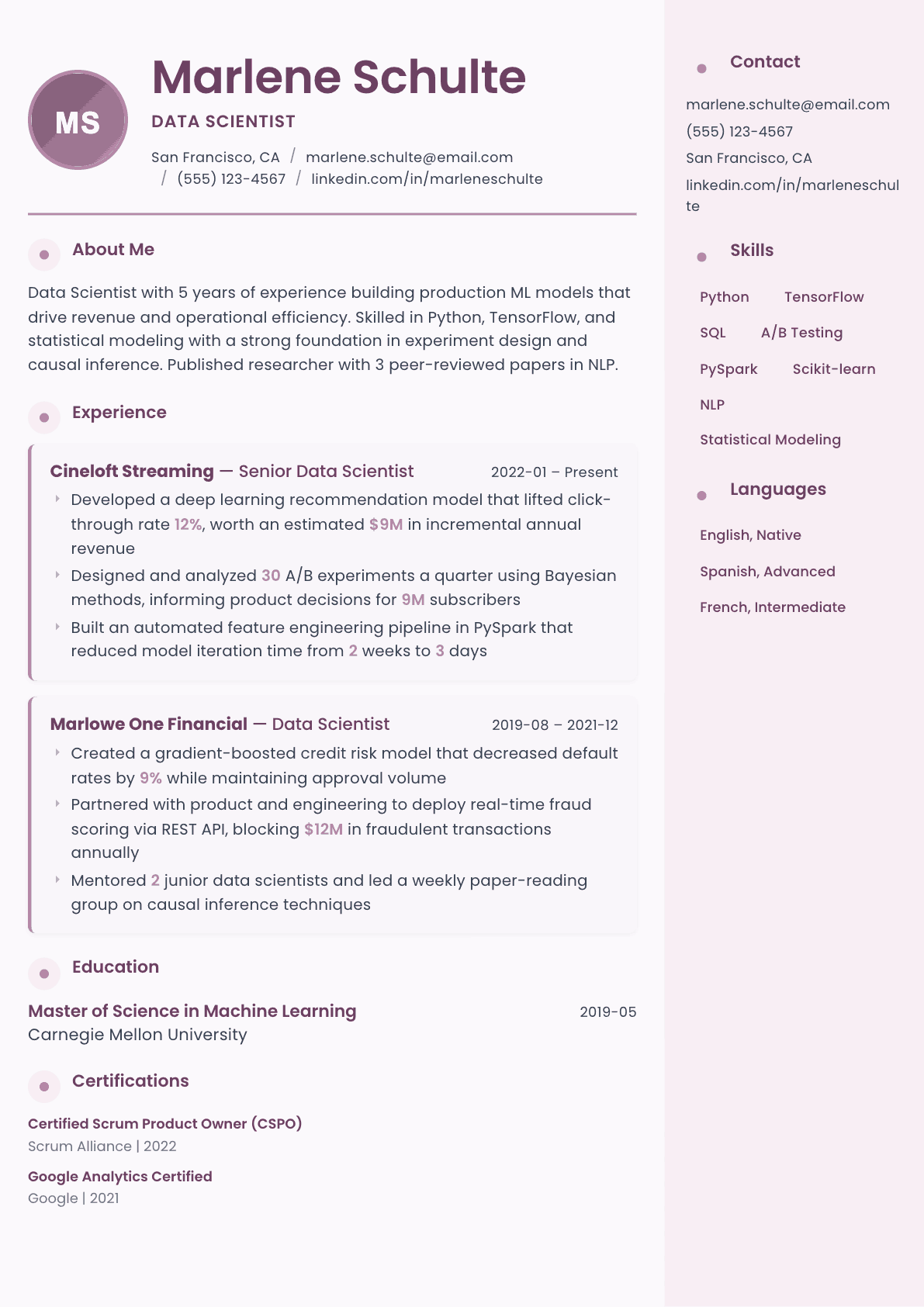
The same data scientist content laid out in three CVBooster templates, so you can see what the finished document looks like before you write a word.
Example Data Scientist summary
Data scientist, 5 years across streaming and consumer lending, building models that reach production rather than slide decks. Recommendation work lifted click-through 12%, a gradient-boosted credit model cut default rates 9% at the same approval volume, and real-time fraud scoring blocks $12M of transactions a year. Runs 30 experiments a quarter and writes the analysis the product team acts on.
Skills to list on a Data Scientist resume
- Python
- R
- SQL
- TensorFlow
- PyTorch
- Scikit-learn
- PySpark
- NLP
- Computer Vision
- A/B Testing
- Statistical Modeling
- Deep Learning
- Feature Engineering
- Data Visualization
- MLOps
What actually gets this resume read
- Quantify business impact for every model: revenue generated, costs saved, accuracy improvements, or time reduced.
- List both your technical stack (Python, TensorFlow, SQL) and your methodological expertise (causal inference, Bayesian stats).
- Include links to published papers, Kaggle profiles, or open-source contributions to demonstrate credibility.
- Describe the full ML lifecycle you have touched: data collection, feature engineering, training, evaluation, deployment, monitoring.
- Mention experiment design skills explicitly; companies value scientists who can design and analyze A/B tests rigorously.
- Keep jargon accessible: briefly explain what the model does in business terms before diving into technical details.
How to write a data scientist resume
A data scientist resume has to survive a reader who has seen hundreds of pages describing models that were never used by anyone. The hiring manager is scanning for two proofs. First, that you can pick the right method for a messy business problem and defend the choice. Second, that at least some of your work reached a product, a policy or a decision rather than ending in a notebook and a slide.
The title is also the least standardized in technology. At one company a data scientist runs experiments and writes causal analyses; at another the same title trains and deploys models; at a third it is a senior analyst with a different pay band. Your page has to declare which version of the job you do, or the reader guesses wrong and moves on.
This guide covers the sections in the order a science hiring panel reads them, with three summaries at recognizable levels, before-and-after bullets that replace accuracy claims with real evidence, and the questions scientists ask when their applications stall.
Format: one to two pages, method visible before tools
One page for early career, two once you have several years of production work or a publication record. Reverse chronological, single column. If you have public work, one link in the header for GitHub and one for a paper list or competition profile is enough.
Resist the urge to open with a wall of libraries. A panel infers pandas from the rest of the page. What they cannot infer is whether you know when a difference-in-differences design is appropriate and when it is not.
- Header: name, title, location, email, GitHub, and a publication or competition link if relevant.
- Order: summary, technical skills, experience, selected projects, publications and talks, education.
- Advanced degrees stay near the top only for research-heavy postings; otherwise education goes last.
Summary: the problem class you solve, and where the work lands
Three lines. Name the problem class you are strongest in: forecasting, causal inference and experimentation, ranking and recommendation, risk scoring, natural language work, or optimization. Then the industry, then where your output goes, whether that is a deployed service, a batch scoring job or a decision memo that leadership acts on.
One sentence of methodological identity is worth more than a paragraph of adjectives. A scientist who says they specialize in causal measurement where experiments are impossible has told a panel exactly which interviews to schedule.
Experience: the problem, the method, the validation, the impact
Every strong bullet contains those four. Start with the business problem in plain language, name the method and why it fit, state how you validated it against something honest, and finish with the effect on the decision or the metric.
Validation is where credibility is won or lost. A holdout that respects time ordering, a baseline that was not a straw man, calibration when probabilities are used for decisions, and a sensitivity check on the assumption that mattered. A scientist who reports a single test-set number and stops reads as someone who has not been challenged yet.
Say what happened after the model existed. Who consumes the output, how often it retrains, what monitoring exists, and whether anything changed as a result. If a model was built and never adopted, write the reason instead of hiding it. Panels respect a candidate who can say the recommendation was overtaken by a pricing change.
Experimentation and causal work: the part that separates the pile
Give this its own space if you have it. The mechanics matter: unit of randomization, power calculation before launch, primary metric and guardrails agreed up front, treatment of interference between units, and what you did about peeking. Then the observational side when experiments were not possible: matching, instrumental variables, synthetic control, regression discontinuity, and the assumption each one rests on.
This is the most common gap in otherwise strong resumes. Many candidates can train a gradient boosted model; far fewer can tell a product director that the observed lift is confounded and design the analysis that resolves it.
Skills: methods first, libraries second, platform third
Three groups. Methods: the statistical and machine learning techniques you can defend. Tools: Python, R, SQL, the modeling libraries and the deep learning framework if you use one. Platform: the warehouse, the notebook and orchestration environment, experiment tracking, model serving and monitoring.
Keep the list honest and short enough to defend line by line. Every item on a data scientist skills block is an invitation to a question, and a panel will pick the one you look least comfortable with.
Data Scientist resume summary examples
First industry role after graduate study
Statistics graduate moving into industry, with a thesis on hierarchical models for sparse count data. Built a demand forecast for a university retail pilot that beat the seasonal naive baseline 18% on rolling backtests, and writes production-quality Python and SQL.
Four years in industry
Data scientist with 4 years in consumer subscription products. Owns the churn scoring model in production, retrained monthly and calibrated for the retention team offer budget, and ran 20 experiments last year including the pricing test that changed the annual plan structure.
Senior or staff scientist
Staff data scientist with 9 years in marketplace and pricing problems. Built the causal measurement framework the growth organization uses when experiments are not feasible, mentors 5 scientists, and led the ranking work that lifted booking conversion 6% in a held-out region.
Work experience bullets: before and after
Before: Built a machine learning model with 95% accuracy.
After: Built a churn model on 2 years of behavioral data, chose recall at the top decile as the target metric because the retention budget covers only that group, and beat the tenure-based heuristic by 22% on a time-ordered holdout.
Choosing the metric for a business reason and naming the honest baseline is what a panel is actually testing for.
Before: Performed A/B testing to improve product features.
After: Designed the checkout experiment: user-level randomization, a power calculation that set the 3-week runtime, revenue per session as primary and refund rate as a guardrail, then recommended a partial rollout when the effect held only for new users.
Pre-registration details and a nuanced recommendation show experimental discipline rather than result reporting.
Before: Worked with stakeholders to understand requirements.
After: Reframed a request for a propensity model into a measurement question after finding the sales team already contacted every high-value account, and delivered an uplift analysis that redirected outreach to the undecided segment.
Redefining the problem is a senior behavior, and the outcome shows the reframing was correct.
Before: Deployed models into production.
After: Packaged the scoring model as a batch job in the orchestrator with feature parity tests against the training pipeline, added drift monitoring on the top 10 features, and set a retraining trigger on calibration decay.
Training and serving parity plus calibration monitoring are the details that show a model survives beyond launch week.
Before: Analyzed large datasets to generate insights.
After: Estimated the effect of the loyalty program launch with a synthetic control built from 40 comparable markets, showing the raw lift was 60% attributable to a concurrent seasonal promotion.
A named causal method and a finding that contradicts the naive number demonstrate real analytical judgment.
Hard skills
- Statistical inference and hypothesis testing
- Experiment design and analysis
- Causal inference methods
- Regression and generalized linear models
- Gradient boosted trees
- Time series forecasting
- Natural language processing
- Deep learning with PyTorch or TensorFlow
- Python with pandas and scikit-learn
- SQL on a cloud warehouse
- Feature engineering and leakage prevention
- Model monitoring and calibration
Soft skills
- Framing an ambiguous business problem
- Defending a method under challenge
- Writing a readable analysis memo
- Saying when the evidence is too weak
- Partnering with engineering on deployment
- Teaching statistics to product partners
Certifications worth listing
- Professional Machine Learning Engineer (Google Cloud)
- AWS Certified Machine Learning Specialty (Amazon Web Services)
- Databricks Certified Machine Learning Professional (Databricks)
- Microsoft Certified: Azure Data Scientist Associate (Microsoft)
Mistakes that cost data scientist candidates the interview
- Reporting accuracy on an imbalanced problem, which tells a panel the metric was never chosen deliberately.
- Listing every algorithm ever studied. A panel will ask about the least familiar one on the line.
- Omitting the baseline, so an impressive-sounding result has nothing to be impressive against.
- Describing models that were never used without saying why, which reads as a portfolio of unfinished work.
- Blurring the line between analysis and engineering until the reader cannot tell what you personally built.
- Leading with a doctorate and a publication list when applying to a product team that measures adoption.
- Skipping experimentation entirely, which is the most common reason a technically strong page loses to a weaker one.
Data Scientist resume questions
Do I need a PhD to work as a data scientist?
No for most product and analytics-facing roles, where experience with real decisions matters more. A doctorate helps for research positions and for teams doing novel modeling. If you have one, show applied impact so it does not read as purely academic.
How do I show impact when the model was never deployed?
Describe the decision it informed instead. An analysis that stopped an expensive rollout, changed a targeting rule or resolved a disagreement between teams is a legitimate outcome, and stating it honestly is better than implying production use.
Should I include Kaggle rankings on a data scientist resume?
A strong placement is worth one line, especially early in a career. Avoid making it the centerpiece, because competition work skips problem framing, data collection and deployment, which is most of what an employer is hiring you to do.
How do I position myself when data scientist means different things at different companies?
Read the posting for the tell: experimentation and metrics language means an analytics-leaning role, deployment and latency language means a machine learning engineering one. Reorder your bullets and rewrite the summary for that version rather than sending one page everywhere.
How much software engineering should a data scientist resume show?
Enough to be trusted with production code: version control, tests, code review and packaging your work so someone else can run it. Full platform ownership belongs to machine learning engineers, but a scientist who cannot ship reproducible code is a harder hire.
Related resume examples
- Software Engineer Resume example
- Business Analyst Resume example
- Mechanical Engineer Resume example
- Machine Learning Engineer Resume example
- AI Research Scientist Resume example
- Bioinformatics Scientist Resume example