Case Manager Interview Questions: 7 Answers That Score
By Mustafa Tarabya, founder of CVBooster · Published · Updated
9 min read
Case manager interview questions test whether you can run a full caseload without losing anyone: how you assess a new client, build a plan, connect them to services, keep your notes current and stay steady when a client is angry or in crisis. Expect behavioral questions that start with tell me about a time, one or two scenarios, and questions on documentation and boundaries. The Case Management Society of America defines the work in words a panel will recognize. Below are the questions for case manager interviews in the order panels usually ask them, with seven full answers tagged by level. Written by Mustafa Tarabya, who hired for his own company, read every application himself and now writes CVBooster's guides.
You have kept forty clients housed, fed and on their medication with a phone, a shared drive and a printer that only works on Thursdays. Then the panel asks how you prioritize, as if there were a choice. There is always a choice. The interview is where you explain how you make it.
What the panel is scoring
A case management panel is usually a program supervisor, a senior case manager and sometimes someone from HR. They score each answer against the job description, and most job descriptions are built on the same definition. CMSA puts it this way: "Case management is a collaborative process of assessment, planning facilitation, care coordination, evaluation, and advocacy for options and services to meet an individual’s and family’s comprehensive health needs through communication and available resources".
Map every answer to one of those words. A question about a new client is about assessment and planning. A question about a client who missed three appointments is about coordination and advocacy. A question about your notes is about evaluation. If your answer shows the step, the panel can score it.
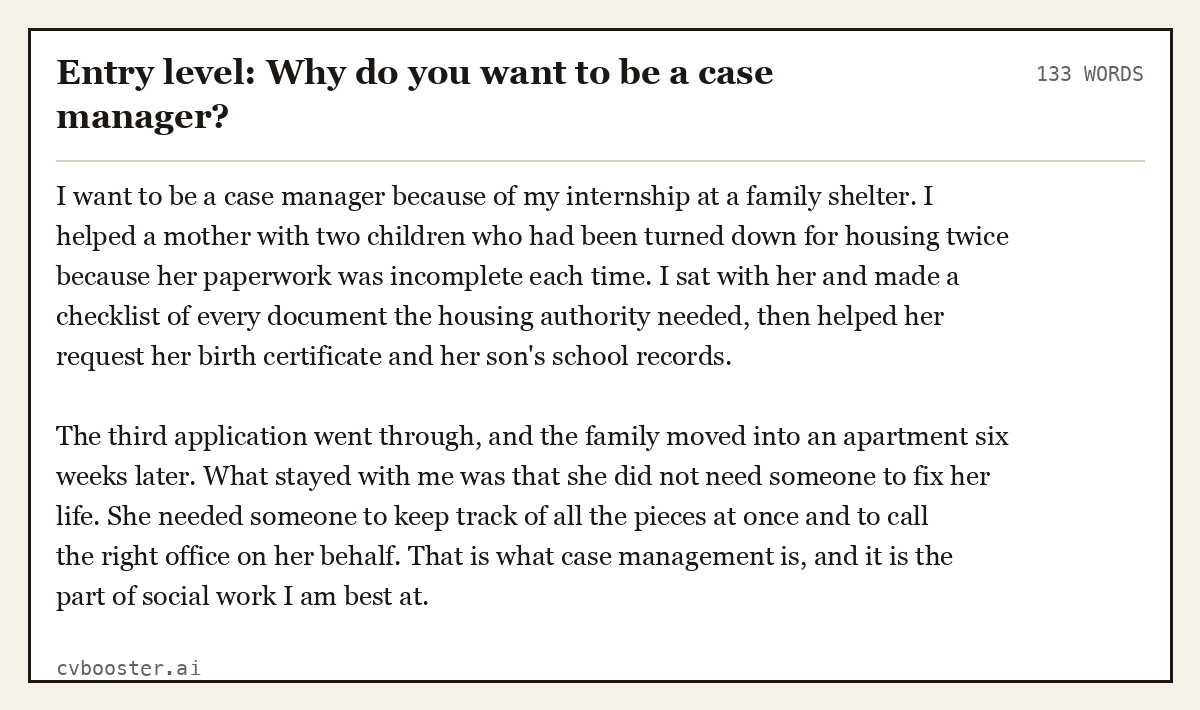
Entry level: Why do you want to be a case manager? (133 words)
I want to be a case manager because of my internship at a family shelter. I helped a mother with two children who had been turned down for housing twice because her paperwork was incomplete each time. I sat with her and made a checklist of every document the housing authority needed, then helped her request her birth certificate and her son's school records.
The third application went through, and the family moved into an apartment six weeks later. What stayed with me was that she did not need someone to fix her life. She needed someone to keep track of all the pieces at once and to call the right office on her behalf. That is what case management is, and it is the part of social work I am best at.
Questions for case manager interviews on caseload and priorities
Every panel asks how you manage volume. They are looking for a system, not a promise to work hard. The BLS describes the skill as "Organizational skills. Social workers must help and manage multiple clients, often assisting with their paperwork or documenting their treatment."
- How many clients have you managed at once, and how do you keep track of them?
- How do you decide who you see first on a busy day?
- Tell me about a time you had to drop a planned task for an emergency.
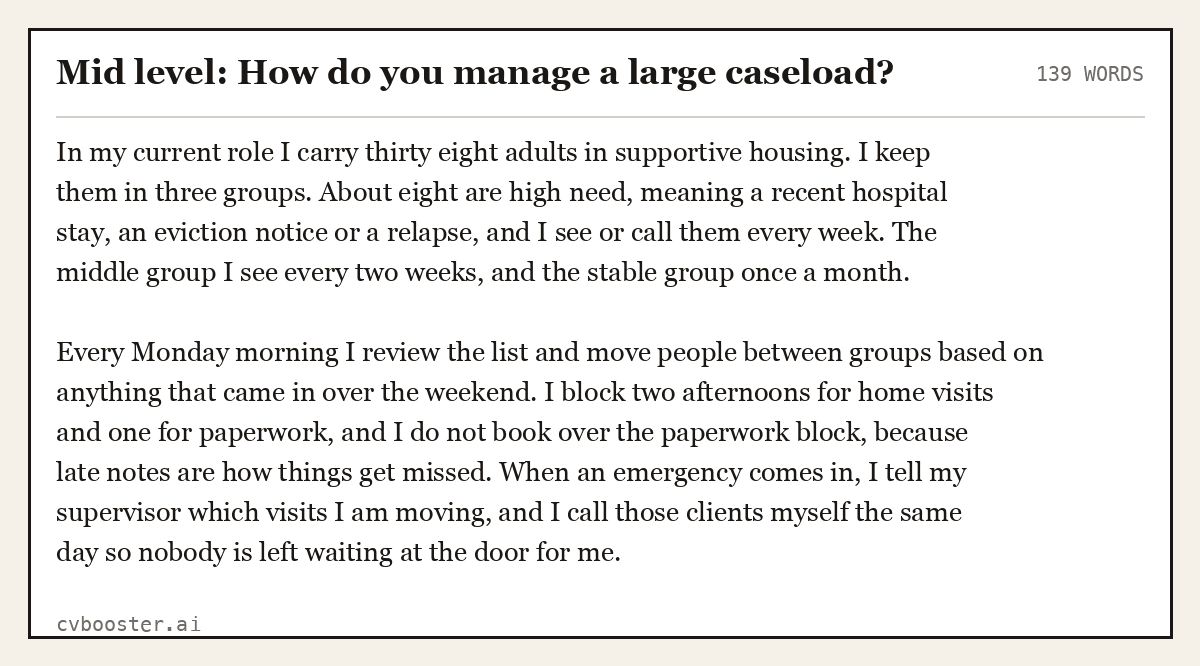
Mid level: How do you manage a large caseload? (139 words)
In my current role I carry thirty eight adults in supportive housing. I keep them in three groups. About eight are high need, meaning a recent hospital stay, an eviction notice or a relapse, and I see or call them every week. The middle group I see every two weeks, and the stable group once a month.
Every Monday morning I review the list and move people between groups based on anything that came in over the weekend. I block two afternoons for home visits and one for paperwork, and I do not book over the paperwork block, because late notes are how things get missed. When an emergency comes in, I tell my supervisor which visits I am moving, and I call those clients myself the same day so nobody is left waiting at the door for me.
Assessment and service planning questions
These questions check the core of the job: can you work out what a client actually needs and turn it into a plan they agree with. O*NET's profile for social and human service assistants describes part of the work as to "assist clients in identifying and obtaining available benefits and social and community services."
- Walk me through your first meeting with a new client.
- How do you set goals with a client who does not think they need help?
- What community resources do you know in this county?
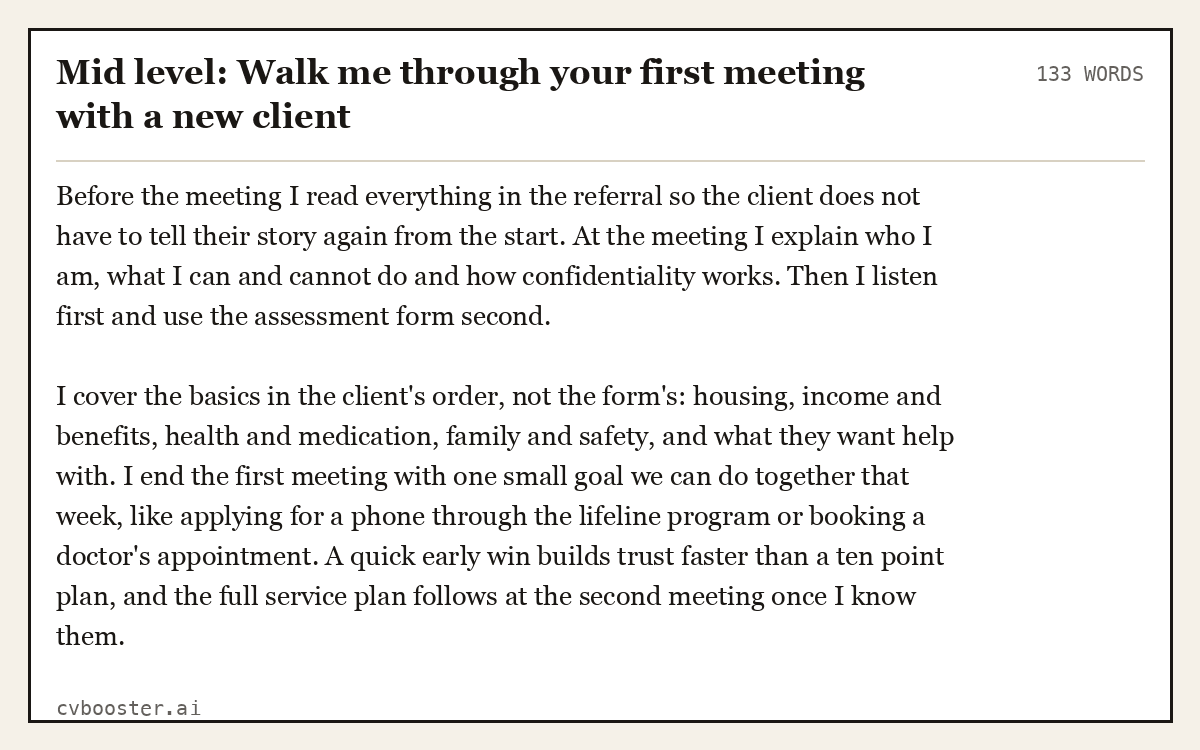
Mid level: Walk me through your first meeting with a new client (133 words)
Before the meeting I read everything in the referral so the client does not have to tell their story again from the start. At the meeting I explain who I am, what I can and cannot do and how confidentiality works. Then I listen first and use the assessment form second.
I cover the basics in the client's order, not the form's: housing, income and benefits, health and medication, family and safety, and what they want help with. I end the first meeting with one small goal we can do together that week, like applying for a phone through the lifeline program or booking a doctor's appointment. A quick early win builds trust faster than a ten point plan, and the full service plan follows at the second meeting once I know them.
Difficult clients and crisis questions
Panels ask these because the job includes angry clients, threats and clients who disappear. The BLS lists the quality they want: "Compassion. Social workers often work with people who are in stressful and difficult situations. To develop strong relationships, they must have patience and empathy for their clients."
- Tell me about a time a client became angry or aggressive with you.
- What do you do if a client tells you they are thinking of harming themselves?
- How do you handle a client who keeps missing appointments?
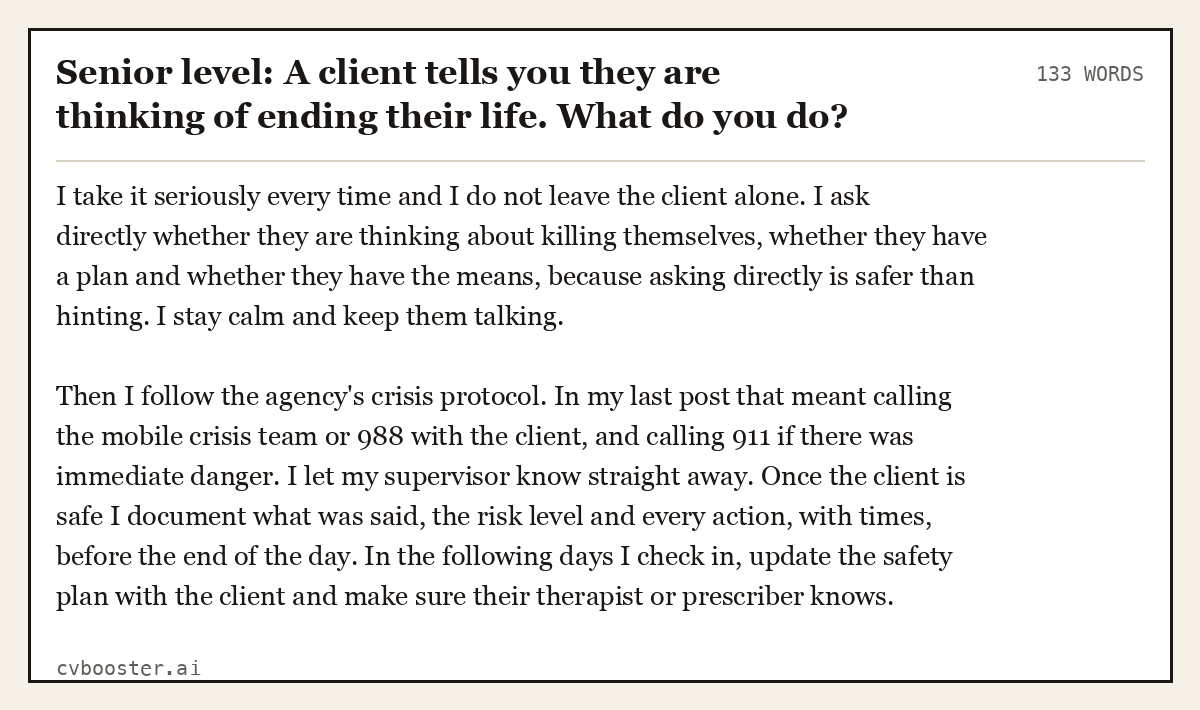
Senior level: A client tells you they are thinking of ending their life. What do you do? (133 words)
I take it seriously every time and I do not leave the client alone. I ask directly whether they are thinking about killing themselves, whether they have a plan and whether they have the means, because asking directly is safer than hinting. I stay calm and keep them talking.
Then I follow the agency's crisis protocol. In my last post that meant calling the mobile crisis team or 988 with the client, and calling 911 if there was immediate danger. I let my supervisor know straight away. Once the client is safe I document what was said, the risk level and every action, with times, before the end of the day. In the following days I check in, update the safety plan with the client and make sure their therapist or prescriber knows.
Entry level: How do you handle a client who keeps missing appointments? (108 words)
I start by finding out why, not by closing the case. With one client at my internship, she had missed three meetings in a row. When I finally reached her by text, it turned out she had lost her bus pass and was embarrassed to say so.
I moved our meetings to the library near her apartment and helped her apply for a reduced fare card. She did not miss another appointment that month. Now, when someone misses twice, I try a different way to contact them, ask about transport, childcare and work hours, and only then talk to my supervisor about the agency's policy for inactive cases.
Documentation, boundaries and teamwork questions
Case notes are evidence for funders, auditors and courts. Panels also ask about boundaries, because case managers spend so much time with clients that lines can blur.
- How do you keep your case notes current?
- A client offers you a gift. What do you do?
- Tell me about a disagreement with another provider about a client's care.
Mid level: How do you keep your documentation up to date? (121 words)
I write a note the same day as every contact, even if it is only three lines, because a note written a week later is a guess. I use the same order each time: who, what happened, what the client said, what I did and the next step with a date.
I keep a running list of open referrals and check it every Friday, so I can see what is waiting on another agency. Before an audit at my current program, our supervisor pulled ten random files from each case manager, and mine had no missing notes or unsigned plans. Good notes also protect the client, because whoever covers my caseload when I am off can pick up without starting over.
Questions for senior and lead case managers
Senior roles add supervision, training and program questions. Expect to be asked how you would support a new case manager, how you handle a team member who is behind on notes and how you work with partner agencies.
Senior level: How would you support a new case manager on your team? (119 words)
In the first two weeks I would have them shadow me on visits and read three of my closed files, so they see what a full case looks like from intake to discharge. Then I would give them a small caseload, about ten clients, and build it up over two months.
We would meet weekly for supervision, and I would ask them to bring one case they are unsure about. I would read a sample of their notes each week at first and give feedback the same day. When I trained two new staff last year, both carried a full caseload by month three, and one of them now trains our interns. The goal is confidence, not just compliance.
Before the interview
Have one real case ready for each group above, with the client details changed, and know the main services in the county you would cover. Use the STAR method from our STAR interview questions guide so every story has an end. Prepare two questions of your own from our list of questions to ask in an interview, such as the average caseload and how supervision works. If you also need the resume, our case manager resume guide shows how to write your caseload and outcomes, and our social work interview questions cover statutory roles in the UK. CVBooster needs an account: the free plan lets you fill in your resume by hand and see your ATS score and the keywords you are missing, and the AI writing, templates and the finished file are Pro.
Frequently asked questions
What questions are asked in a case manager interview?
Expect questions about managing a caseload, your first meeting with a new client, building a service plan, handling angry or suicidal clients, missed appointments, keeping case notes current, boundaries such as gifts, and working with other agencies. Most are behavioral, so prepare real examples with the outcome stated clearly.
How do I prepare for a case management interview?
Read the job description and match each duty to a real case you handled. Learn the main community resources in the county: housing, food, benefits, health and transport. Prepare one story each for caseload, crisis, documentation and teamwork, and practice telling each one in under two minutes.
What are the strengths of a good case manager?
Organization, calm under pressure, clear writing and the ability to advocate for a client with other agencies. Panels also look for good boundaries and empathy that does not burn out. Show each strength with a short real example rather than listing it, because every candidate claims the same words.
How do I answer how do you prioritize your caseload?
Describe your system. Explain how you sort clients by risk, how often you contact each group, when you review the list and what you do when an emergency arrives. Give the size of your caseload and one example of a day when you had to move plans, and how you told the clients affected.
Do I need a license to be a case manager?
It depends on the employer and the state. Some case manager jobs need a social work license or a nursing license, and others accept a bachelor's degree in a related field. The BLS notes that social workers "may need a license; specific requirements vary by state." Check the posting and your state board.
Related articles
- Creative Interview Questions With 6 Sample Answers
- Critical Care Nursing Interview Questions and 9 Answers
- ED Nurse Interview Questions With 9 Full Sample Answers
- Female Job Interview Attire: Six UK Outfits by Job Type
More articles
- Certification for Office Managers: 6 Lines That Get Read
- Certifications for Jobs: 7 With the Exact Resume Line
- Changing and Improving Civil Service Example: AO to G7
Looking for a worked example for your job title? Browse the resume examples by job title.