Relevant Coursework Resume: When to List It, 6 Examples
By Mustafa Tarabya, founder of CVBooster · Published · Updated
7 min read
Relevant coursework on a resume is a short list of the classes that match the job, placed inside or just below your Education section, and it belongs there while your education is still your strongest qualification. The one constraint is relevance: list course titles the employer will recognize, not every class on your transcript. The University of Vermont's career center puts the rule in one line: "I would suggest listing between 4 to 8 relevant class titles, not course numbers since class numbers do not mean anything outside the University." Below are the include-or-drop rules, three formats and six complete education sections by field. Written by Mustafa Tarabya, who hired for his own company, read every application himself and now writes CVBooster's guides.
A relevant coursework section that earns its place
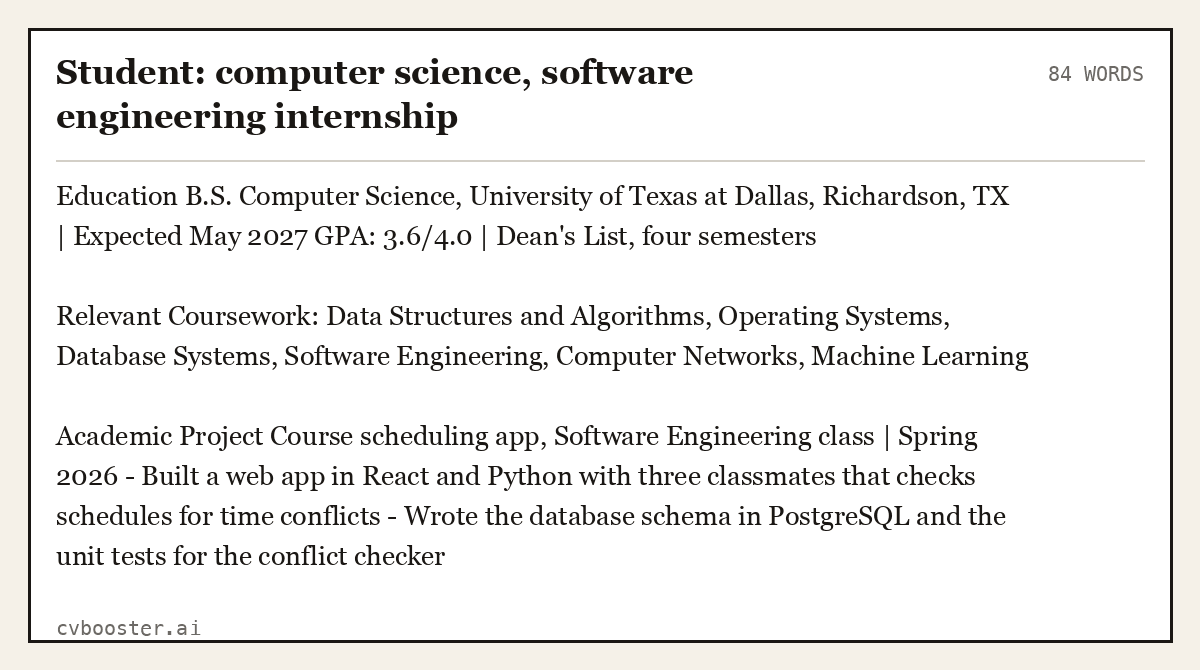
Here is a computer science student applying for a software engineering internship. The courses are picked for the posting, and the project shows one of them in use.
Student: computer science, software engineering internship (84 words)
Education B.S. Computer Science, University of Texas at Dallas, Richardson, TX | Expected May 2027 GPA: 3.6/4.0 | Dean's List, four semesters
Relevant Coursework: Data Structures and Algorithms, Operating Systems, Database Systems, Software Engineering, Computer Networks, Machine Learning
Academic Project Course scheduling app, Software Engineering class | Spring 2026 - Built a web app in React and Python with three classmates that checks schedules for time conflicts - Wrote the database schema in PostgreSQL and the unit tests for the conflict checker
Six titles a hiring manager can read at a glance, and one project that proves the list is more than a list.
When to include relevant coursework, and when to drop it
Coursework helps when the reader would otherwise have little to judge you on. Assumption University's career office describes its own guide as written for students showcasing "relevant coursework when applying for internships or jobs, especially when work experience is limited." That is the whole test.
Include it when:
- You are a student, a recent graduate or a high school applicant with little work history
- The posting asks for knowledge you learned in class, such as accounting principles, statistics or pharmacology
- You are changing careers and took courses for the new field
- Your degree name hides what you studied, such as a general business degree with a finance focus
Drop it when:
- You have a year or more of work in the field, because your job bullets now prove the knowledge
- The courses are required for every student in your major and say nothing extra
- The list pushes your experience onto a second page
- A course is planned but not started. Carnegie Mellon's resume checklist leaves future coursework out, and that is the safe rule
There is a quieter reason to drop it, too. A list of fourteen courses tells the reader you could not decide which ones mattered, and deciding what matters is the job.
How to list relevant coursework on a resume
There are three formats. Pick one and use it the same way for every degree.
- One line under the degree. "Relevant Coursework:" followed by four to six course titles, separated by commas. Best for most resumes.
- Two columns of bullets. UVM's guide notes the bullet format "with two columns is usually preferred as it optimizes space and is easy to decipher." Useful when you list six or more.
- Courses with one-line descriptions. Each course gets a short line on a project or skill. Use this for two or three courses that match the job closely.
On placement, UVM is direct: "The ideal location for Relevant Coursework is a separate section beneath Education or a subsection of Education, as it flows better between sections." MIT's career advising office adds that experience comes in many forms, and suggests that "In addition to jobs, internships, UROPS or leadership roles, consider including class projects, competitions or even personal projects." A class project belongs under Projects with bullets, even when the course is also in your coursework line.
Relevant coursework examples by field
Example 2: Nursing student, BSN
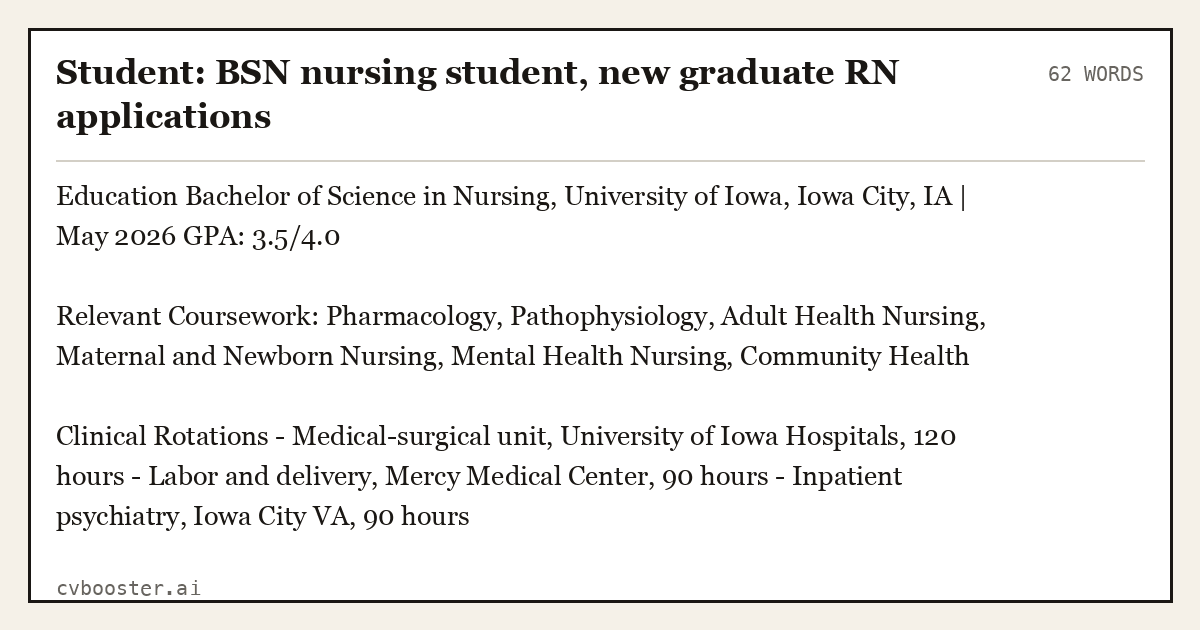
Nursing readers care about clinicals as much as courses. Put both in the Education section.
Student: BSN nursing student, new graduate RN applications (62 words)
Education Bachelor of Science in Nursing, University of Iowa, Iowa City, IA | May 2026 GPA: 3.5/4.0
Relevant Coursework: Pharmacology, Pathophysiology, Adult Health Nursing, Maternal and Newborn Nursing, Mental Health Nursing, Community Health
Clinical Rotations - Medical-surgical unit, University of Iowa Hospitals, 120 hours - Labor and delivery, Mercy Medical Center, 90 hours - Inpatient psychiatry, Iowa City VA, 90 hours
Example 3: Business student, finance internship
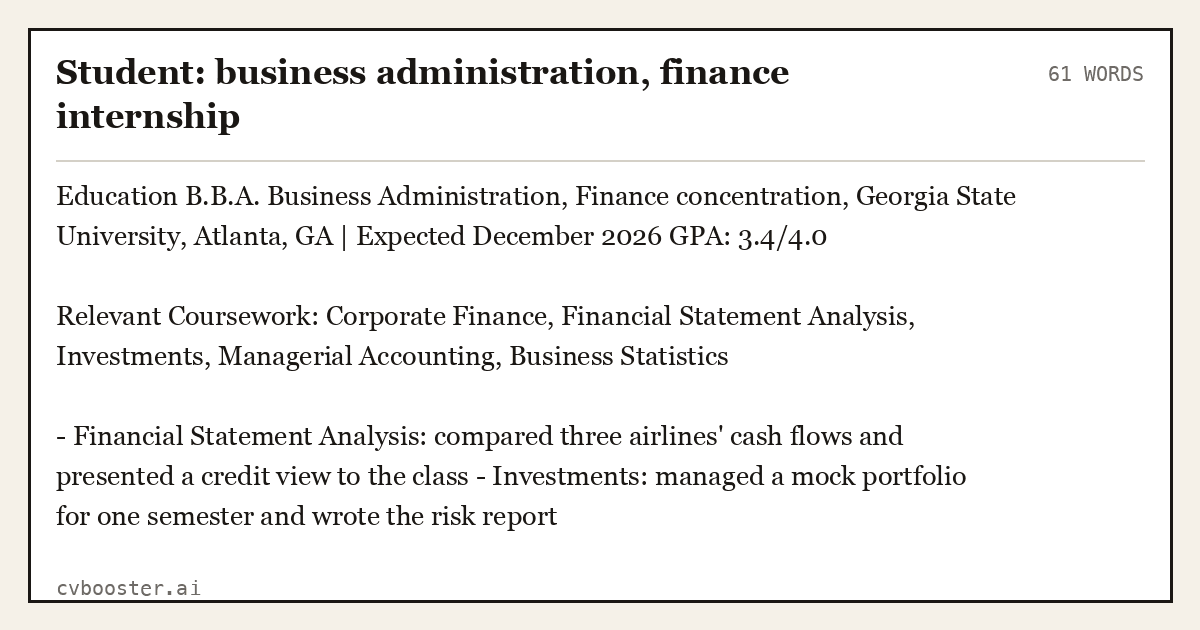
A general business degree needs the courses to show the finance focus the posting wants.
Student: business administration, finance internship (61 words)
Education B.B.A. Business Administration, Finance concentration, Georgia State University, Atlanta, GA | Expected December 2026 GPA: 3.4/4.0
Relevant Coursework: Corporate Finance, Financial Statement Analysis, Investments, Managerial Accounting, Business Statistics
- Financial Statement Analysis: compared three airlines' cash flows and presented a credit view to the class - Investments: managed a mock portfolio for one semester and wrote the risk report
Example 4: Engineering graduate
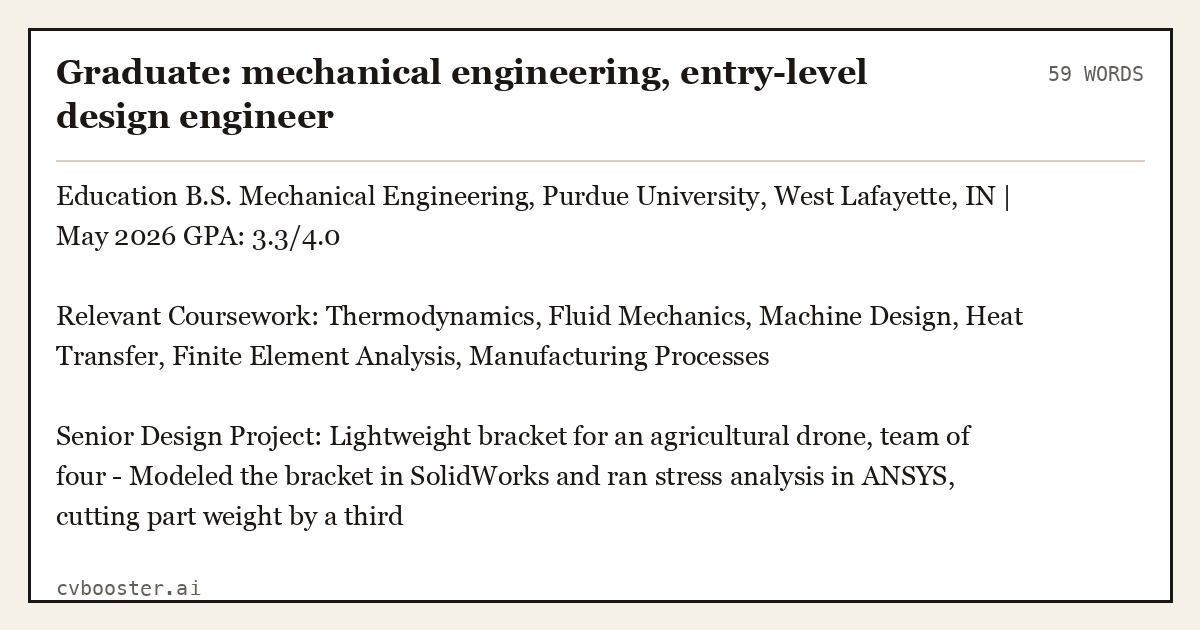
Engineering employers often look for specific technical courses. Use the course's real title and add the lab or design project.
Graduate: mechanical engineering, entry-level design engineer (59 words)
Education B.S. Mechanical Engineering, Purdue University, West Lafayette, IN | May 2026 GPA: 3.3/4.0
Relevant Coursework: Thermodynamics, Fluid Mechanics, Machine Design, Heat Transfer, Finite Element Analysis, Manufacturing Processes
Senior Design Project: Lightweight bracket for an agricultural drone, team of four - Modeled the bracket in SolidWorks and ran stress analysis in ANSYS, cutting part weight by a third
Example 5: Career changer with graduate courses
When you list courses from two levels, label them. Carnegie Mellon's engineering resume guide says it plainly: "If listing both undergraduate and graduate courses, labels should be included."
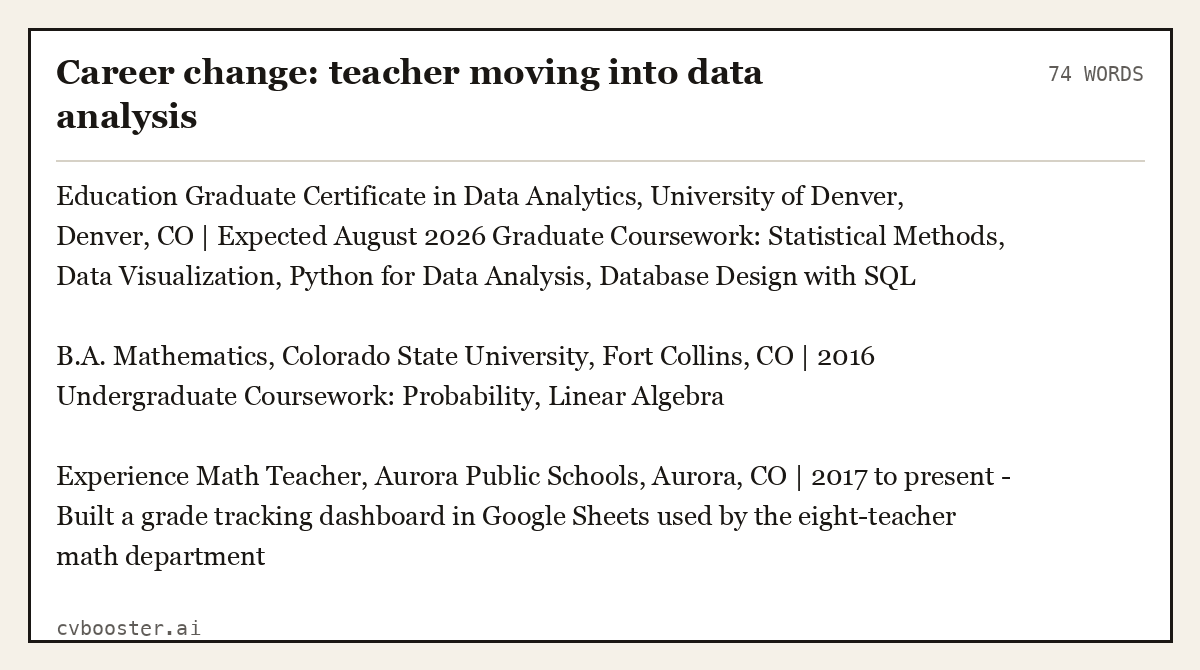
Career change: teacher moving into data analysis (74 words)
Education Graduate Certificate in Data Analytics, University of Denver, Denver, CO | Expected August 2026 Graduate Coursework: Statistical Methods, Data Visualization, Python for Data Analysis, Database Design with SQL
B.A. Mathematics, Colorado State University, Fort Collins, CO | 2016 Undergraduate Coursework: Probability, Linear Algebra
Experience Math Teacher, Aurora Public Schools, Aurora, CO | 2017 to present - Built a grade tracking dashboard in Google Sheets used by the eight-teacher math department
Example 6: High school student, first job or internship
High school resumes can list classes too. Pick the ones that match the job, and add honors or AP labels.
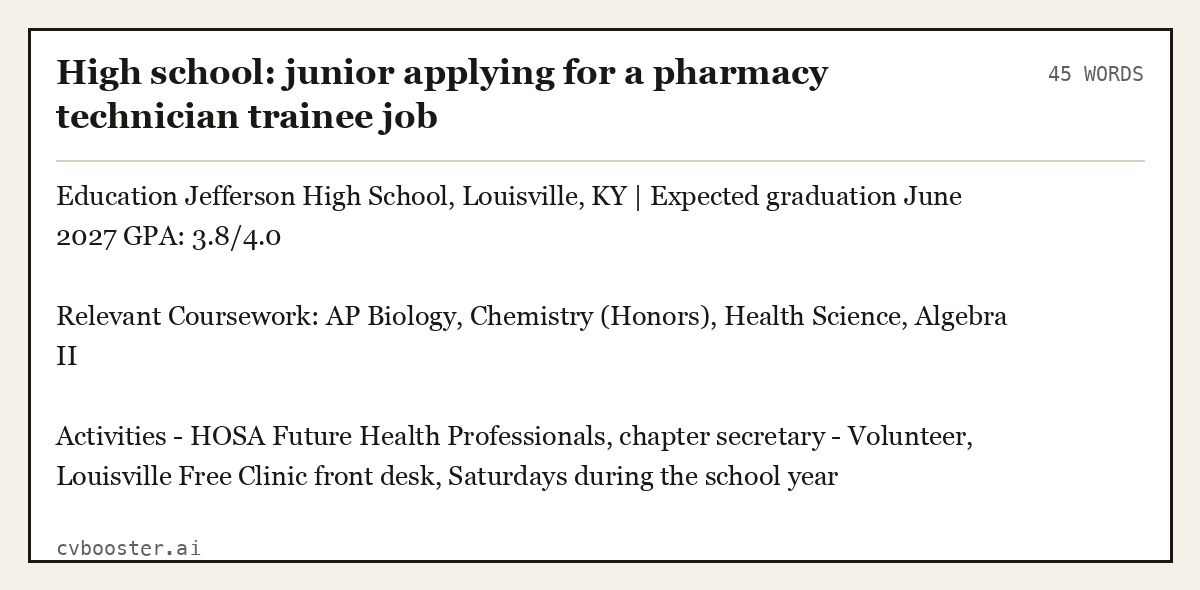
High school: junior applying for a pharmacy technician trainee job (45 words)
Education Jefferson High School, Louisville, KY | Expected graduation June 2027 GPA: 3.8/4.0
Relevant Coursework: AP Biology, Chemistry (Honors), Health Science, Algebra II
Activities - HOSA Future Health Professionals, chapter secretary - Volunteer, Louisville Free Clinic front desk, Saturdays during the school year
Mistakes that make coursework hurt
- Course numbers. "CS 3345" means nothing to a recruiter. Write "Data Structures and Algorithms."
- Intro classes everyone takes. English Composition rarely helps unless the job is in that field. Intro to Film Noir was a good class. It is not getting you the accounting job.
- Copying the transcript. Six courses at most for one degree. More than that and the reader stops reading.
- No proof. A course line is a claim. One project bullet turns it into evidence.
For the rest of the page, see our first job resume guide, how to show internships on a resume and the resume skills section guide. If your resume is still thin, the CV example with no experience shows what to put around your education.
Frequently asked questions
Should I put relevant coursework on my resume?
Yes, if you are a student, a recent graduate or changing careers, and the courses match the job. Drop it once you have a year or more of related work, because your experience now proves the same knowledge. A coursework line should make the reader more sure you can do the job, not fill space.
How many courses should I list as relevant coursework?
Four to six is the usual range for one degree, and UVM's career center suggests four to eight. Choose the courses that match words in the posting. If you need more than eight, you are listing your transcript, and the strongest courses get lost among the required ones.
Where does relevant coursework go on a resume?
Put it inside your Education section, on a line under the degree, or in a short section directly below Education. That keeps it next to the school and degree it belongs to. Class projects with real results can also go in a separate Projects section with bullets.
Can I list courses I am taking now?
Yes, if you are enrolled in them this term. Some writers mark them "in progress." Do not list courses you plan to take later, since the employer cannot check them and you cannot discuss them in depth. Carnegie Mellon's resume checklist says the coursework list should not include future coursework.
Do I need relevant coursework if I have an internship?
Often you need less of it. An internship with strong bullets proves more than a course title. Keep a short coursework line if the job asks for specific knowledge, such as accounting or statistics, and let the internship carry the rest of the page.
Related articles
- Abbreviation for Million: M, MM or Mil, and Which to Use
- Artist CV: Section Order, Format and 6 Complete Examples
- Biodata Format for Job: 6 Filled Samples and What to Include
- Canva Resume Template: How to Pick One and 6 Filled Examples
More articles
- Relocation Cover Letter: 6 Samples for Moving to a New City
- Residency Recommendation Letter: 6 Samples That Get Read
- Acceptance Resignation Letter: 6 Samples for Employers
Looking for a worked example for your job title? Browse the resume examples by job title.