Things to Put on a Resume: 9 Sections With Examples
By Mustafa Tarabya, founder of CVBooster · Published · Updated
8 min read
The things to put on a resume are your contact details, a short summary, your work experience, your education and your skills, plus optional sections such as certifications, projects and volunteer work when they help you get this job. The one constraint is relevance: every line has to help the reader decide on this job, so a thing that is true but beside the point stays off. Harvard's career services office calls a resume "a concise, informative summary of your abilities, education, and experience." Below are the nine sections, a written example of each, and two complete resumes. Written by Mustafa Tarabya, who hired for his own company, read every application himself and now writes CVBooster's guides.
Most people do not get stuck on what they did. They get stuck on whether the summer they spent repainting their aunt's fence counts. Sometimes it does. Here is how to tell.
A complete resume first, so you can see where everything goes
Before the section by section list, here is one full resume with every essential part in place. It belongs to a first-job applicant, the hardest case, because the page has to be filled without a long work history.
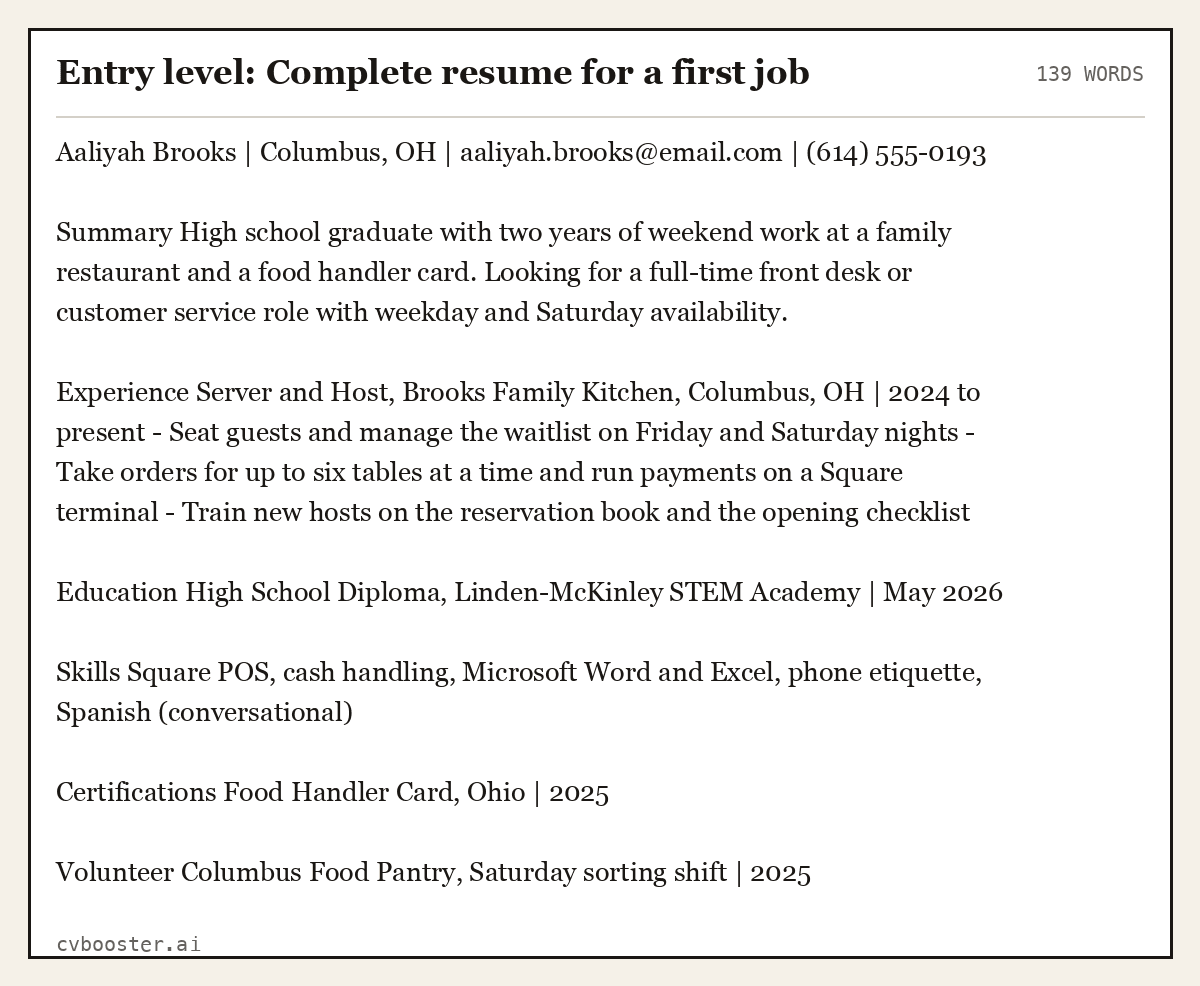
Entry level: Complete resume for a first job (139 words)
Aaliyah Brooks | Columbus, OH | aaliyah.brooks@email.com | (614) 555-0193
Summary High school graduate with two years of weekend work at a family restaurant and a food handler card. Looking for a full-time front desk or customer service role with weekday and Saturday availability.
Experience Server and Host, Brooks Family Kitchen, Columbus, OH | 2024 to present - Seat guests and manage the waitlist on Friday and Saturday nights - Take orders for up to six tables at a time and run payments on a Square terminal - Train new hosts on the reservation book and the opening checklist
Education High School Diploma, Linden-McKinley STEM Academy | May 2026
Skills Square POS, cash handling, Microsoft Word and Excel, phone etiquette, Spanish (conversational)
Certifications Food Handler Card, Ohio | 2025
Volunteer Columbus Food Pantry, Saturday sorting shift | 2025
Six sections, one page, nothing on it that a front desk manager would skip. That is the whole target.
The 5 things every resume needs
These five appear on almost every resume in the US, whatever the job.
1. Contact details
Name, city and state, phone, email, and a LinkedIn or portfolio link if you have one that helps. Leave off your full street address, date of birth, marital status and photo. None of them help the reader decide, and in the US most of them invite questions an employer does not want to be asked.
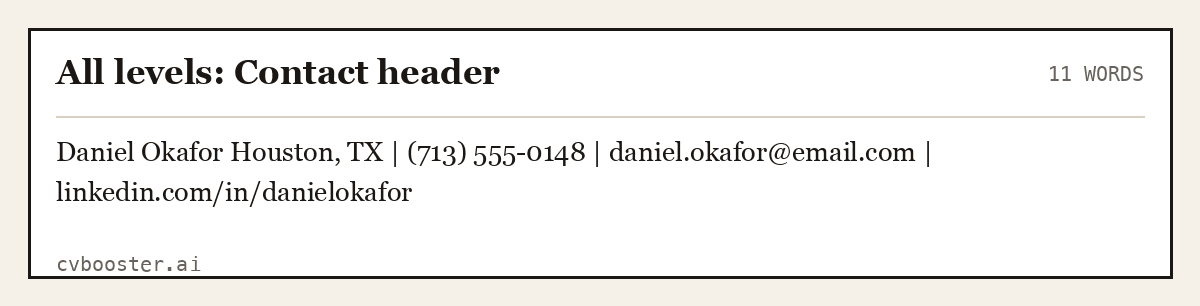
All levels: Contact header (11 words)
Daniel Okafor Houston, TX | (713) 555-0148 | daniel.okafor@email.com | linkedin.com/in/danielokafor
2. A summary or objective
Two or three lines at the top that say what you do and what you bring. Use a summary when you have experience in the field. Use an objective when you are new or changing direction; our resume objective examples show the difference with twelve samples.
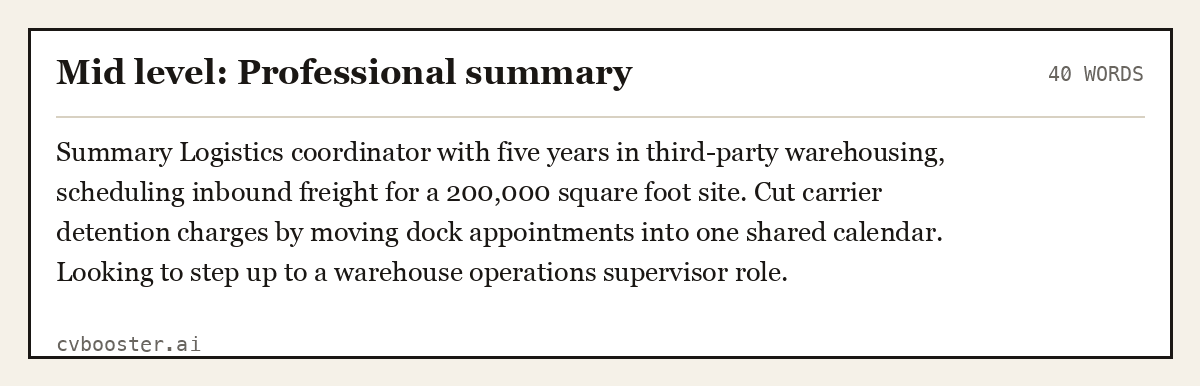
Mid level: Professional summary (40 words)
Summary Logistics coordinator with five years in third-party warehousing, scheduling inbound freight for a 200,000 square foot site. Cut carrier detention charges by moving dock appointments into one shared calendar. Looking to step up to a warehouse operations supervisor role.
For more on writing this part, see our guide to a professional summary for a resume.
3. Work experience
Job title, employer, city, dates, then three to five bullets that show what you did and what changed because you did it. Most recent job first. This is the section a hiring manager reads hardest, so put your strongest lines here.
UC Davis Human Resources describes the standard layout as one that "lists and describes your work history in reverse chronological order with your most recent position first." That is the default, and it is what most readers expect.
4. Education
Degree or diploma, school, graduation year. Add GPA only if it is strong or the posting asks. Add honors such as the dean's list. Once you have a few years of work, education moves below experience and shrinks to one line.
5. Skills
The tools, systems and hard skills the job asks for, in the posting's own words. Keep soft skills out of the list and show them inside your bullets instead. Our page on skills to put on a resume has lists by job type.
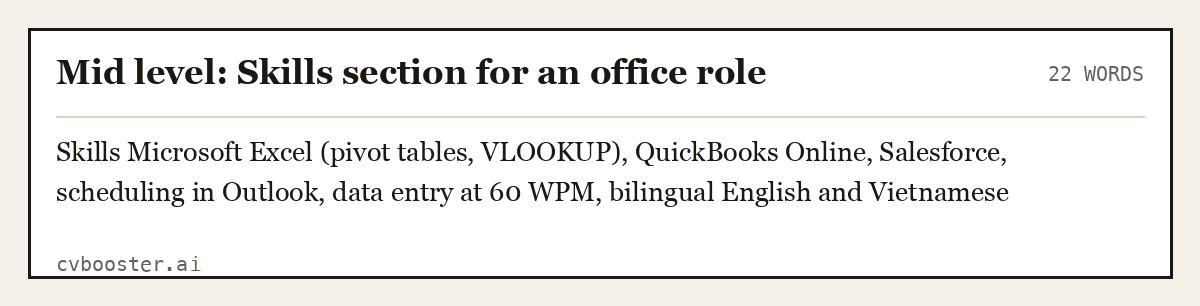
Mid level: Skills section for an office role (22 words)
Skills Microsoft Excel (pivot tables, VLOOKUP), QuickBooks Online, Salesforce, scheduling in Outlook, data entry at 60 WPM, bilingual English and Vietnamese
4 optional things to put on a resume when they help
Optional means: include it when it supports the job you are applying for, leave it off when it does not.
6. Certifications and licenses
Any license the job requires goes on the page, with the issuing body and the year. So does any certificate the posting names. A forklift certificate belongs on a warehouse resume and nowhere else.
7. Projects
Projects carry the page for students, career changers and anyone in a technical field. Name the project, what you built, and what it did.
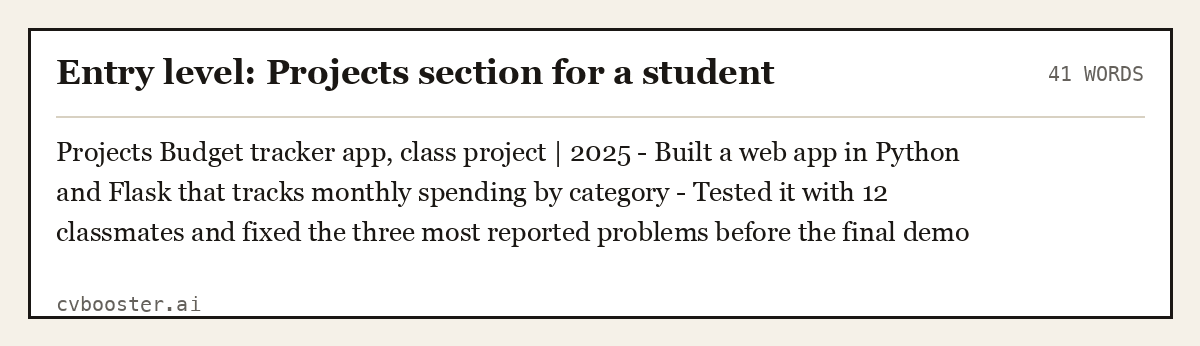
Entry level: Projects section for a student (41 words)
Projects Budget tracker app, class project | 2025 - Built a web app in Python and Flask that tracks monthly spending by category - Tested it with 12 classmates and fixed the three most reported problems before the final demo
8. Volunteer work
Volunteer work counts as experience when it uses the same skills as the job. Write it like a job: role, organization, dates, bullets.
9. Awards, languages and interests
Awards go in when they are recent or relevant. Languages go in with an honest level. Interests go in only when they connect to the job or the company, which our page on hobbies on a resume covers in detail.
Skills employers look for, and where to put them on the page
The National Association of Colleges and Employers names eight career readiness competencies that employers look for in new graduates. Two of them, in NACE's words:
- Communication: "Clearly and effectively exchange information, ideas, facts, and perspectives with persons inside and outside of an organization."
- Teamwork: "Build and maintain collaborative relationships to work effectively toward common goals, while appreciating diverse viewpoints and shared responsibilities."
These are not things to put on a resume as words in a list. They are things to show in your experience bullets. *Trained new hosts on the reservation book* is teamwork and communication in one line, and nobody has to take your word for it.
A complete mid-career resume with every section
Here is the same set of sections at a later stage. Education shrinks, experience grows, and the optional sections earn their place.
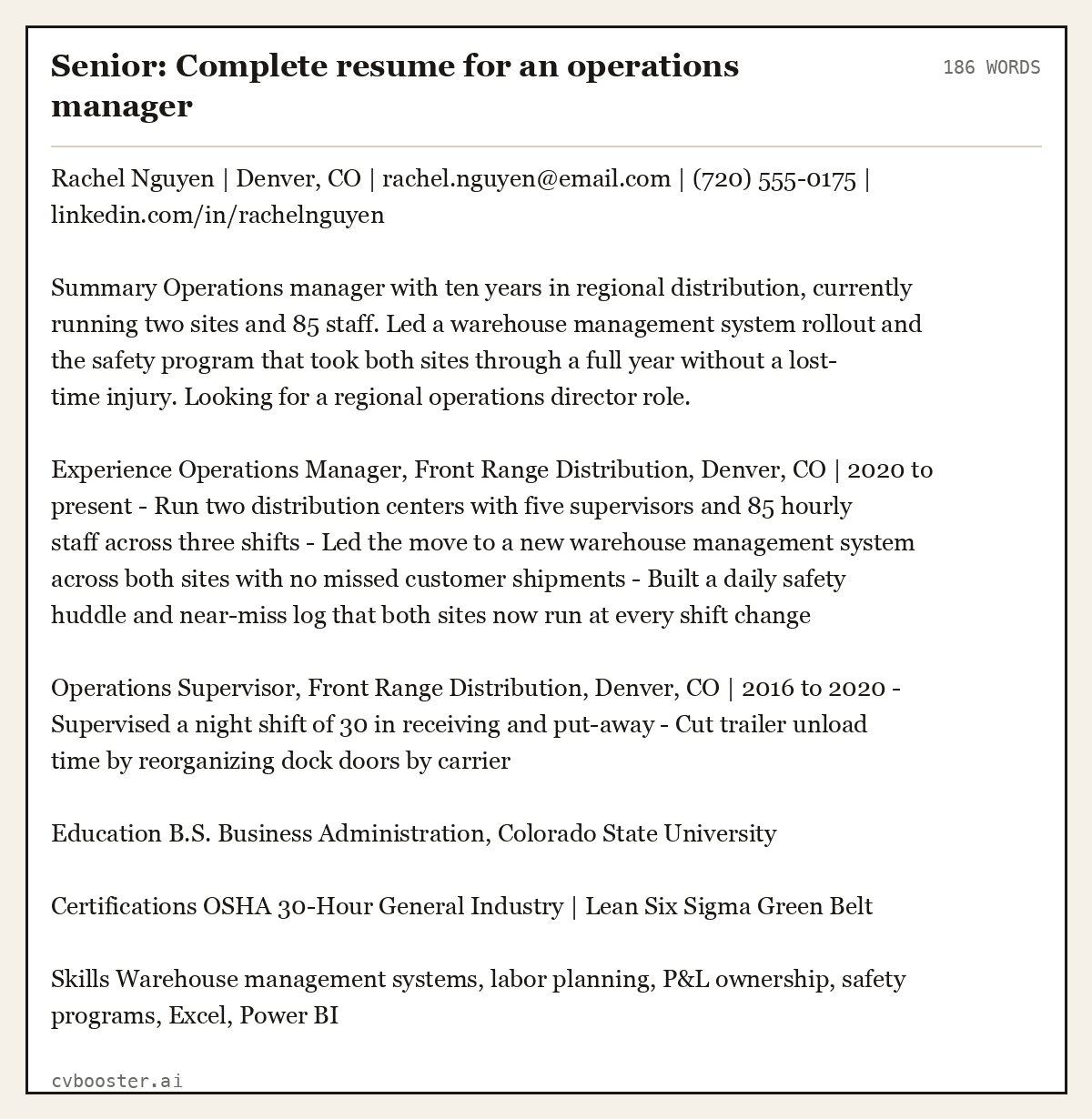
Senior: Complete resume for an operations manager (186 words)
Rachel Nguyen | Denver, CO | rachel.nguyen@email.com | (720) 555-0175 | linkedin.com/in/rachelnguyen
Summary Operations manager with ten years in regional distribution, currently running two sites and 85 staff. Led a warehouse management system rollout and the safety program that took both sites through a full year without a lost-time injury. Looking for a regional operations director role.
Experience Operations Manager, Front Range Distribution, Denver, CO | 2020 to present - Run two distribution centers with five supervisors and 85 hourly staff across three shifts - Led the move to a new warehouse management system across both sites with no missed customer shipments - Built a daily safety huddle and near-miss log that both sites now run at every shift change
Operations Supervisor, Front Range Distribution, Denver, CO | 2016 to 2020 - Supervised a night shift of 30 in receiving and put-away - Cut trailer unload time by reorganizing dock doors by carrier
Education B.S. Business Administration, Colorado State University
Certifications OSHA 30-Hour General Industry | Lean Six Sigma Green Belt
Skills Warehouse management systems, labor planning, P&L ownership, safety programs, Excel, Power BI
Notice what is not there. No objective, no interests, no references line, no GPA. At this level each of those would take space from a line that proves the job.
Things to leave off a resume
- Personal details such as age, date of birth, marital status, religion or a photo. US employers do not need them to decide.
- References. Write them on a separate page and send it when asked. The line *references available on request* adds nothing.
- Every job you ever had. Go back about ten to fifteen years unless older work is directly relevant.
- Reasons you left a job. That is an interview conversation.
- Salary history. Leave it off unless the application form asks for it.
- Skills you could not use tomorrow. If you would struggle with it on day one, it does not go in the skills list.
CareerOneStop, the US Department of Labor's job search site, has a resume writing guide that walks through the same sections; its own description is "Use this Resume Writing Guide to help you write each section of your resume."
How to decide what goes on your resume
Read the job posting and underline every requirement. Then for each thing you are unsure about, ask one question: does this line help prove I can do one of the underlined things? If yes, it goes on. If no, it comes off, however proud of it you are.
For the order of sections, our resume format guide covers layout, dates and file type.
Frequently asked questions
What should you put on a resume?
Put your contact details, a short summary or objective, your work experience with results, your education and your skills. Add certifications, projects, volunteer work, awards or languages when they support the job you are applying for. Leave off anything that does not help the reader decide on this particular job.
What are the 5 main things in a resume?
The five main things are contact information, a summary or objective, work experience, education and skills. Almost every US resume has these five. Everything else, such as certifications, projects, volunteer work and interests, is optional and goes in only when it supports the job you are applying for.
What should I put on my resume if I have no experience?
Put your education first, then any projects, volunteer work, school activities or informal jobs such as babysitting or helping in a family business. Write each one like a job, with what you did and what came of it. Add a skills section and a clear availability line for hourly roles.
What should not be on a resume?
Leave off your date of birth, marital status, religion, photo, full street address, salary history, references and reasons for leaving past jobs. Also leave off old jobs from more than about fifteen years ago unless they are directly relevant, and any skill you could not use on your first day.
How many things should be on a resume?
Most resumes have five to seven sections: the five essentials plus one or two optional ones that support the job. More sections means less room for each, so add an optional section only when it holds something stronger than the line it would push off the page.
Related articles
- Certification for Office Managers: 6 Lines That Get Read
- How to Add CPR Certification to a Resume: 5 Examples
- How to Put CPR Certification on a Resume: 6 Examples
- Industry Certification on a Resume: 8 Sector Examples
More articles
- To Whom It May Concern Letter: 8 Examples and the Rules
- Can a Resume Be 2 Pages? When It Works, With a Sample
- University Interview Questions and 8 Strong Sample Answers
Looking for a worked example for your job title? Browse the resume examples by job title.