Is a 2-Page Resume OK? When It Works, With a Sample
By Mustafa Tarabya, founder of CVBooster · Published · Updated
11 min read
Two pages is fine when you have two pages of relevant work. It stops being fine the moment page two exists because you could not bear to cut something. The length is not the question. The question is whether every line on both pages is arguing for this job.
That is a harder test than a page count, which is why the page count is the advice everyone repeats. But a tight two-page resume from someone with twelve years of experience reads as competent, and a padded two-page resume from someone with two years of experience reads as someone who has not learned to edit.
When is a two-page resume the right call?
There are a handful of situations where a second page is genuinely earned, and they share one feature: the material on page two would cost the reader something real if it were deleted.
- Roughly ten years or more of relevant experience, where compressing it to one page means reducing whole jobs to a single line.
- A technical or scientific field where the specifics are the qualification: the systems, the standards, the instruments, the regulatory frameworks you have worked under.
- Academic, clinical and research careers, where publications, registrations and teaching are part of the record rather than an appendix to it.
- Roles with a formal requirement to evidence criteria, where each criterion has to be addressed explicitly.
- Long project or contract histories, where a list of six-month engagements is the honest shape of the career.
When is the second page just padding?
When it exists because of formatting rather than content. Four signs, and any one of them means you have a one-page resume with a spacing problem:
- Page two is less than about two thirds full. A page with five lines on it is a page one that overflowed, and the reader can see exactly that.
- The margins are wide, the line spacing is generous, and the font is 12pt or larger. Tighten those before you accept a second page.
- Page two opens with hobbies, references available on request, or a list of software everyone uses.
- Your earliest jobs get the same number of bullets as your current one. A role from 2011 rarely needs four lines.
- The same achievement appears in the summary, in a skills section, and again in a bullet.
The honest version of the length rule is this: fill one page completely before you start a second, and fill the second one properly or go back to one. A page and a quarter is the worst outcome available.
What goes on page one and what goes on page two?
Assume page two might not be read. Not because readers are lazy, but because a first pass through a stack of applications is a filtering exercise, and filtering happens on the first screen. Build page one so that a decision could be made on it alone.
Page one carries your header, your summary if you use one, your skills if the role is defined by a toolset, and your two most recent or most relevant jobs with their strongest bullets. If there is one achievement that makes your case, it lives in the top third of page one.
Page two carries the rest of the work history in descending date order, education, certifications, publications, languages, and anything role-specific such as security clearances or professional registration. It is the supporting file, not the punchline. If your page two holds papers, our guide on how to write publications in a resume shows the citation format and how to label work in press. For an executive version, our CIO sample resumes show the scope line a chief information officer puts at the top of page one.
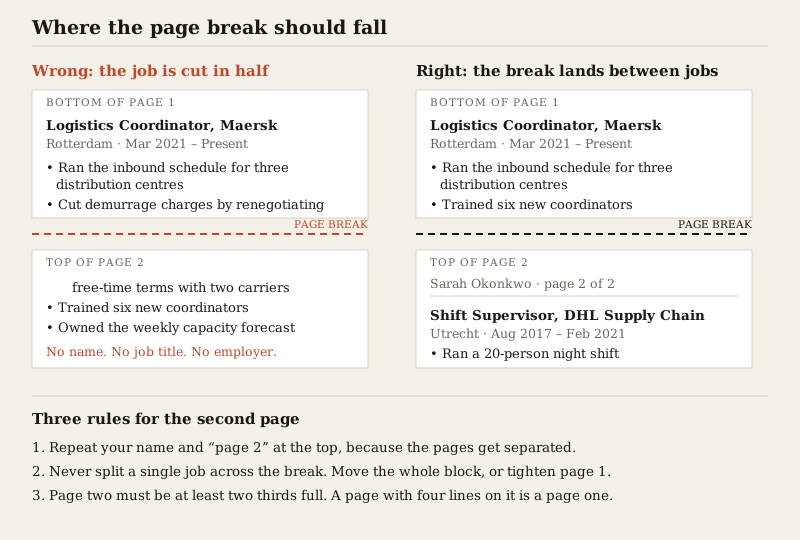
What are the mechanical rules for the page break?
This is where most two-page resumes fail, and the failures are invisible on screen because you are scrolling rather than turning pages. Print it, or at least view it two pages at a time, before you decide it is finished.
- Repeat your name at the top of page two, with a page number: "Sarah Okonkwo · page 2 of 2". Printed resumes get separated on desks, and a loose second page with no name on it is a loose second page in the bin.
- Never split a single job across the break. A job title and dates on page one with orphaned bullets on page two leaves the reader holding achievements attached to nothing.
- Never split a section heading from what it introduces. "Education" alone at the foot of page one is the classic version.
- Do not end page one mid-sentence in a bullet. Bullets should be short enough that this is rare, and when it happens, it is a signal to shorten the bullet.
- Do not repeat your full contact block on page two. Name and page number is the whole job.
- Use an explicit page break rather than a run of empty paragraphs. A stack of blank lines shifts the moment anything above it changes length.
Tip: If one job is two lines too long to fit on page one, do not shrink the font or narrow the margins to force it. Cut the weakest bullet from an older job instead. The cut is invisible; the squashed layout is not.
What goes in a resume 2nd page header?
A resume 2nd page header holds your name and the page number, and nothing else. It is there so a printed page two that gets separated from page one can still be matched to you. Keep it smaller than the main header on page one, in the same font, and leave the phone, email and address off: the reader already has them, and repeating the full contact block makes page two look like the start of a second resume.
- Plain: "Sarah Okonkwo, page 2 of 2" aligned right, one line.
- With the target title: "Sarah Okonkwo, Operations Director, page 2" when you send many applications at once.
- With one contact line, only if the employer asks for it: "Sarah Okonkwo, page 2, sarah.okonkwo@email.com".
- In Word or Google Docs, turn on the header option for a different first page, so page one keeps its full header and page two shows only the short line. In Pages, use the section setting that hides the header on the first page.
- Keep the page two header as normal text, not an image, and keep your full contact details in the body of page one, where every tracking system reads them.
For the page one version, with the name, title and contact line a recruiter reads first, see our guide to the resume header.
Two careers: one needs two pages, one does not
The abstract rule is easy to agree with and hard to apply to your own document, so here are two invented but realistic inventories. Everything in them is an example.
The one that genuinely needs two pages
A clinical nurse specialist with eighteen years behind her, applying for a senior post. Her material: a current role of six years, two earlier hospital roles of four and five years, a two-year agency period covering six placements, a nursing registration with a number and a renewal date, four mandatory competencies with dates, two specialist certifications, a teaching role supervising student placements, and a poster presentation at a national conference.
Compressing that to one page means deleting the registration details, the competencies, or the specialist certifications. Each of those is a gate the employer is actively checking for. Losing them to save a page is losing the application to save a page. Two pages here is not indulgence, it is the correct size of the document.
Her split: page one is the header, a four-line summary, registration and specialist certifications as a short block near the top because they are gating criteria, then the current role with five bullets and the previous role with three. Page two carries the two older roles at two bullets each, the agency placements condensed into one dated block, education, the mandatory competency list, and the teaching and presentation work.
The one that does not
A marketing coordinator three years out of university, applying for a mid-level role. His material: a current role of two years, a first role of one year, a six-month internship, a degree, four tools he uses daily, a half-finished online course, a student society position, and a hobbies line.
His draft runs to a page and a half, and the second half-page holds the society position, the hobbies, the unfinished course, an eight-item software list, and "References available on request". Every one of those is either assumed, incomplete, or from a different life.
Cut the hobbies, the references line, the unfinished course and five of the eight tools, trim each bullet to one line, and the whole career fits comfortably on one full page with margins that look deliberate. Nothing an employer wanted has been lost. What has gone is the evidence that he could not decide what mattered. His internship stays as one line under the first job, the placement shown in where to put an internship on a resume.
The difference between these two people is not seniority in the abstract. It is whether deleting page two would remove information the employer is looking for. Run that test on your own second page, item by item, and it will answer itself.
Sample of a two page resume, written to fit the rules
Here is a sample of a two page resume for an operations director with fifteen years of experience, the kind of career that earns the second page. Notice three things. The summary and the two most recent jobs fill page one. The break falls between two jobs, never inside one. Page two opens with the name and page number, then carries the older roles in shorter form, plus education, certifications and skills.
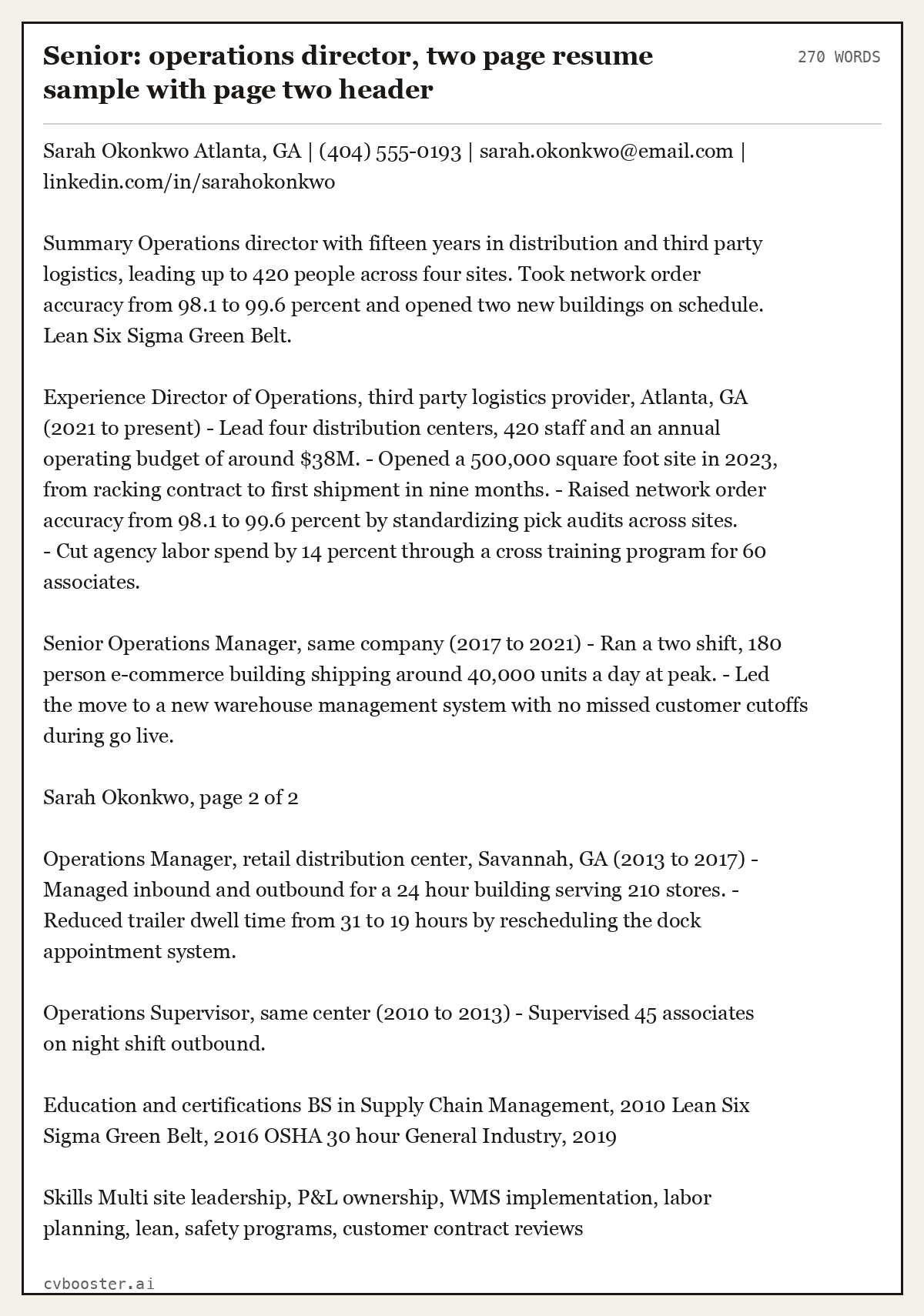
Senior: operations director, two page resume sample with page two header (270 words)
Sarah Okonkwo Atlanta, GA | (404) 555-0193 | sarah.okonkwo@email.com | linkedin.com/in/sarahokonkwo
Summary Operations director with fifteen years in distribution and third party logistics, leading up to 420 people across four sites. Took network order accuracy from 98.1 to 99.6 percent and opened two new buildings on schedule. Lean Six Sigma Green Belt.
Experience Director of Operations, third party logistics provider, Atlanta, GA (2021 to present) - Lead four distribution centers, 420 staff and an annual operating budget of around $38M. - Opened a 500,000 square foot site in 2023, from racking contract to first shipment in nine months. - Raised network order accuracy from 98.1 to 99.6 percent by standardizing pick audits across sites. - Cut agency labor spend by 14 percent through a cross training program for 60 associates.
Senior Operations Manager, same company (2017 to 2021) - Ran a two shift, 180 person e-commerce building shipping around 40,000 units a day at peak. - Led the move to a new warehouse management system with no missed customer cutoffs during go live.
Sarah Okonkwo, page 2 of 2
Operations Manager, retail distribution center, Savannah, GA (2013 to 2017) - Managed inbound and outbound for a 24 hour building serving 210 stores. - Reduced trailer dwell time from 31 to 19 hours by rescheduling the dock appointment system.
Operations Supervisor, same center (2010 to 2013) - Supervised 45 associates on night shift outbound.
Education and certifications BS in Supply Chain Management, 2010 Lean Six Sigma Green Belt, 2016 OSHA 30 hour General Industry, 2019
Skills Multi site leadership, P&L ownership, WMS implementation, labor planning, lean, safety programs, customer contract reviews
Some employers set the page limit for you. The USAJOBS Help Center says: "You must upload or build a resume that is two pages or less and meets all requirements listed in the job announcement." For a federal application, a sample like this one is the ceiling, not a starting point. For senior private sector roles, the accounting executive resume page shows the same two page structure for controllers and finance leaders.
What must never straddle the break, and why
Two mechanisms are at work, and they fail differently.
For a human, the page break is a discontinuity in attention. Everything above a bullet — the employer, the job title, the dates — is context the reader is holding in their head while they read it. Turning a page interrupts that. Bullets that begin page two under a job title left behind on page one arrive as claims attached to no employer, and the reader either flips back or, more likely, skims on.
For software, the break is usually a non-event: the text stream runs continuously across pages, so a job split across the break parses the same as one that is not. The one exception is worth knowing. If you have put your name at the top of page two, some extractions will treat that repeated line as ordinary body text sitting in the middle of your experience section, which is one more reason to keep it to a single restrained line rather than repeating your whole contact block.
- A job title with its dates must stay with at least its first two bullets. If only one bullet would fit under it, move the whole job.
- A section heading must never be the last line on page one. "Education" alone at the foot of a page is a heading introducing nothing.
- A date range must not be split from the role it belongs to.
- A multi-line bullet should not break mid-sentence. If it does, the bullet is too long anyway.
- A table or a grouped block — a certifications list, a skills block — should sit entirely on one page rather than being cut in half.
Tip: In Word, "Keep with next" and "Keep lines together" in the paragraph settings enforce most of this automatically. Apply them to your job titles and section headings once, and the layout stops breaking every time you edit a bullet above them.
Does the destination change the answer?
A little, and in a direction people usually get backwards.
Emailing a named person: the page break is a real event, because they may print it or read it two pages at a time. This is where the mechanical rules earn their keep, and where a second page that is nearly empty is most visible.
Uploading to a portal: the break is close to invisible, because the file is extracted into a text stream and often displayed inside the system as a continuous scroll. Length costs you nothing structurally here. What it costs is attention, since a reviewer scrolling a long extraction still stops when the relevant material stops.
A specified format, common in public sector and academic applications: the instruction wins. If the ad names a page limit, a font size or a required template, treat every general rule on this page as overridden.
Should a two-page resume be one file or two?
One file, two pages. Never two separate attachments, and never two files named page1 and page2. Send a single PDF unless the ad asks for something else, and name it something a stranger can file: your name, the role, and nothing else.
Length is also not an issue for parsing software in the way people fear. A parser reads the text stream and does not object to a second page. The layout choices people make to compress a resume onto one page cause far more parsing damage than the second page ever would, which is covered in more detail in ATS resumes in 2026.
Can resumes be double sided?
Resumes can be double sided, but a two page resume is better printed on two separate sheets. The reader at an interview table or a career fair lays the pages side by side, passes one to a colleague, or photocopies the stack, and the back of a sheet gets missed in all three cases. A double sided resume also makes the second page look like an afterthought, which is the opposite of what a strong page two should do.
The question only matters for paper. A PDF sent by email or uploaded to a portal has no sides, just two pages in one file, so for online applications the answer above about one file covers it.
- Print one side only, on two sheets of plain white or off white paper, and put your name and page 2 at the top of the second sheet.
- Do not staple the pages at an interview. Use a paper clip or a folder, so the reader can lay them side by side.
- Never put your resume and cover letter on the two sides of the same sheet. They are read by different people at different moments.
- If a printed application asks for a single sheet, cut to one page rather than printing on both sides of it.
Bring three or four printed copies to an interview, single sided, so every person on the panel has a full set.
How do you cut a resume down to size?
In this order, stopping as soon as it fits.
- Delete anything from more than about fifteen years ago, unless it is the reason you are qualified. Old roles can become one line each under a heading like "Earlier roles".
- Delete the duplicate claims. Anything said in the summary does not need saying again in a bullet.
- Delete the responsibilities that are implied by the job title. A nurse does not need a bullet explaining that they administered medication.
- Trim each bullet to one line. Most two-line bullets are one line plus a clause that explains something the reader already understood.
- Cut the skills that are assumed, then the sections that were filling space: hobbies, references on request, a personal statement that repeats the summary.
- Only then adjust margins and spacing, and only within the range that still looks deliberate.
Does three pages ever work?
In ordinary hiring, no. The exceptions are the ones where the document is not really a resume: academic CVs with a publication record, medical CVs, and some public-sector applications where the format is specified by the employer. If the ad tells you the expected length, that instruction outranks everything on this page.
Outside those cases, a third page is a signal that the editing has not happened yet. The reader will not be impressed by the volume, and the strongest thing you have done will be further from the top than it was before.
The check before you send it
- You have viewed both pages side by side, not scrolled through them.
- Page two is at least two thirds full.
- Your name and a page number sit at the top of page two.
- No job, and no section heading, is split across the break.
- Page one alone would be enough to justify an interview.
- It is one PDF, named with your name and the role.
Two pages is a decision about content, made once, and then a set of small mechanical checks that take five minutes. Get the format underneath it right first, which is what the resume format guide is for. If you decide one page is enough after all, how to make a one page resume shows the order of cuts.
Related articles
- How Long Should a Resume Be? The Honest Answer
- Accounting Executive Resume: 5 Examples by Career Level
- Administration Resume Examples: 8 Samples, Entry to Manager
- Aged Care Resume: 6 Australian Examples and a Template
More articles
- University Interview Questions and 8 Strong Sample Answers
- Stating Visa Status on a UK CV Without Losing the Job
- Warehouse Resume: Certs, Throughput, Safety
Looking for a worked example for your job title? Browse the resume examples by job title.