Dentist Salary, Career Path and CV
By CVBooster TeamPublished Updated
The median dentist salary in the United States is $170,950 a year, or $82.19 an hour, according to the U.S. Bureau of Labor Statistics (BLS), OEWS May 2025. That is the national middle: states, employers and hours move it, and BLS publishes nothing by years of experience. The pay figures on this page are for general dentists (BLS: Dentists, General). Orthodontists, oral surgeons and other specialists are counted separately and earn more. For a dental student weighing a residency against going straight into practice, that general dentist figure is the floor the specialties are measured from, and Alaska pays it best.
Below: a check of your own pay, the pay percentiles, hourly pay, pay in every state, the top-paying metro areas, what dentists do, how to become a dentist, the skills that go on a CV, and a CV example.
- Median annual pay
- $170,950
- Median hourly pay
- $82.19
- Employed, May 2025
- 124,390
Am I underpaid as a dentist?
Pick your state and type your pay. You get your place in the BLS pay range for dentists there, as a percentile.
Dentist salary in the United States
The BLS counts dentists in the occupation Dentists, General (SOC 29-1021). Half of them earn less than $170,950 a year and half earn more. The average, which a few very high earners pull up, is $191,350. The lowest-paid tenth earn $86,250 or less, and the highest-paid tenth earn $319,630 or more, which is about 3.7 times as much. The ratio is our arithmetic on two BLS figures.
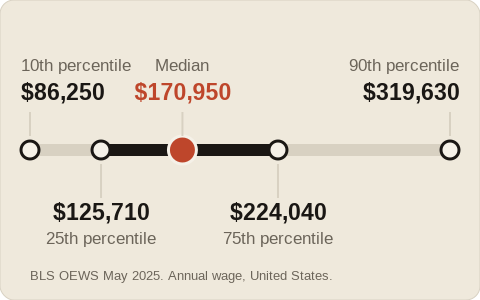
| Measure | Annual wage |
|---|---|
| 10th percentile | $86,250 |
| 25th percentile | $125,710 |
| Median (50th) | $170,950 |
| Mean (average) | $191,350 |
| 75th percentile | $224,040 |
| 90th percentile | $319,630 |
Source: U.S. Bureau of Labor Statistics, Occupational Employment and Wage Statistics (OEWS), May 2025, Dentists, General, retrieved 23 to 25 November 2026 from the BLS OEWS May 2025 national, state and metropolitan area files.
Dentist hourly pay
The median hourly wage for dentists is $82.19, as published by BLS for May 2025. That is the hourly view of the same national middle as the $170,950 annual median above, so use it when an employer quotes you a rate and not a salary. Annual pay for a job with part-time or shift work depends on the hours you are given, which no national table can tell you.
| Measure | Per hour |
|---|---|
| 10th percentile | $41.47 |
| 25th percentile | $60.44 |
| Median (BLS hourly figure) | $82.19 |
| 75th percentile | $107.71 |
| 90th percentile | $153.67 |
For dentists the median is the hourly wage BLS publishes. The other rows are our division of the BLS annual percentiles by 2,080 hours, the full-time year BLS uses to turn hourly pay into annual pay.
Dentist salary by state
Where you work changes the number more than most things. The highest median is in Alaska, at $230,990. The lowest published median is in Wyoming, at $123,830, a gap of $107,160 a year between two states. The gap is our subtraction of two BLS state medians. All figures below are the annual median wage in each state for May 2025.
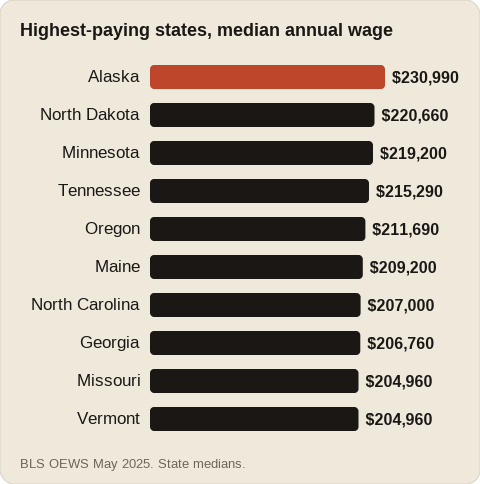
Top-paying states for dentists
| Rank | State | Median wage | vs US median |
|---|---|---|---|
| 1 | Alaska | $230,990 | +$60,040 |
| 2 | North Dakota | $220,660 | +$49,710 |
| 3 | Minnesota | $219,200 | +$48,250 |
| 4 | Tennessee | $215,290 | +$44,340 |
| 5 | Oregon | $211,690 | +$40,740 |
| 6 | Maine | $209,200 | +$38,250 |
| 7 | North Carolina | $207,000 | +$36,050 |
| 8 | Georgia | $206,760 | +$35,810 |
| 9 | Missouri | $204,960 | +$34,010 |
| 10 | Vermont | $204,960 | +$34,010 |
Dentist salary in all 50 states
| State | Median annual wage |
|---|---|
| Alaska | $230,990 |
| North Dakota | $220,660 |
| Minnesota | $219,200 |
| Tennessee | $215,290 |
| Oregon | $211,690 |
| Maine | $209,200 |
| North Carolina | $207,000 |
| Georgia | $206,760 |
| Missouri | $204,960 |
| Vermont | $204,960 |
| Virginia | $197,110 |
| Arizona | $194,180 |
| Wisconsin | $193,690 |
| New York | $183,060 |
| Massachusetts | $181,600 |
| Iowa | $181,520 |
| Nebraska | $179,750 |
| Arkansas | $178,930 |
| New Hampshire | $177,480 |
| Florida | $174,900 |
| New Jersey | $171,330 |
| Louisiana | $170,750 |
| West Virginia | $170,370 |
| Michigan | $169,930 |
| Washington | $169,730 |
| Maryland | $168,500 |
| Hawaii | $167,820 |
| Ohio | $167,410 |
| Montana | $167,200 |
| Indiana | $166,650 |
| Colorado | $166,240 |
| Oklahoma | $166,170 |
| California | $165,950 |
| Pennsylvania | $163,390 |
| Texas | $162,360 |
| Nevada | $162,200 |
| Rhode Island | $161,560 |
| Connecticut | $160,440 |
| South Carolina | $158,640 |
| South Dakota | $158,140 |
| Illinois | $156,110 |
| New Mexico | $155,260 |
| Mississippi | $143,660 |
| Kentucky | $134,160 |
| Utah | $133,320 |
| Idaho | $124,190 |
| Wyoming | $123,830 |
| Alabama | Not published by BLS |
| Delaware | Not published by BLS |
| Kansas | Not published by BLS |
BLS does not publish a figure for Alabama, Delaware, Kansas, usually because there are too few dentists in the survey sample to report one safely.
Top-paying metro areas for dentists
| Metro area | Median wage | Employed |
|---|---|---|
| North Port-Bradenton-Sarasota, FL | $241,850 | 450 |
| Memphis, TN-MS-AR | $238,040 | 280 |
| Columbia, SC | $228,820 | 480 |
| Anchorage, AK | $228,030 | 180 |
| Evansville, IN | $225,620 | 70 |
| Bend, OR | $224,990 | 120 |
| Atlanta-Sandy Springs-Roswell, GA | $222,690 | 1,710 |
| Hanford-Corcoran, CA | $222,430 | 60 |
| Portland-South Portland, ME | $221,190 | 150 |
| Minneapolis-St. Paul-Bloomington, MN-WI | $219,980 | 1,760 |
BLS publishes the dentist median for 316 metro areas; the national median is $170,950. 2 of these ten count fewer than 100 dentists or have no published headcount, so treat them as rough. Source: U.S. Bureau of Labor Statistics, OEWS May 2025, metropolitan area estimates.
Compare dentist pay
Put two states side by side, or set dentists next to another job. Every figure is from BLS OEWS May 2025.
| Measure | Alaska | Wyoming |
|---|---|---|
| Median annual wage | $230,990 | $123,830 |
| Median hourly wage | $111.05 | $59.53 |
| 10th percentile | $124,200 | $71,150 |
| 25th percentile | $129,910 | $101,970 |
| 75th percentile | $279,870 | $176,870 |
| 90th percentile | $320,440 | $235,090 |
| Employed, May 2025 | 310 | 240 |
The Alaska median is $107,160 a year higher. That difference is our subtraction of two BLS state medians. n/a means this page has only the BLS median for that state so far, or BLS released no figure for it. Source: BLS OEWS May 2025, Dentists, General.
Starting pay for dentists
BLS does not publish pay by years of experience, so nobody can honestly quote an official entry-level dentist salary. What the data gives is the bottom of the market. One in ten dentists earns $86,250 or less, and one in four earns $125,710 or less. Read those as the low end of the national range, not as what a new graduate will be offered, because older workers sit in the bottom tenth too.
The residency question: general dentist or specialist
The figures on this page are for general dentists, who hold 141,900 of the 161,400 dentist jobs. Their median is $170,950. BLS publishes separate medians for the specialists: oral and maxillofacial surgeons $352,220, prosthodontists $311,180, orthodontists $289,140 and the other specialists together $224,990.
Each of those jobs costs extra years. A specialty means a 2- to 4-year residency after dental school, and oral and maxillofacial surgery programs typically run 4 to 6 years, sometimes with a joint M.D. The numbers are small: BLS counts 7,100 orthodontists, 5,600 oral surgeons and 1,000 prosthodontists.
What moves a dentist's pay
BLS names four things: location, hours worked, specialty and years in practice. Hours matter more here than in most health jobs, because many dentists work less than 40 hours a week while some work far more.
Employer type shows up in the medians for all dentists too. Government pays $219,750 and outpatient care centers $195,330, against $173,760 in offices of dentists, where 78 percent of dentists work. Owners carry the payroll and supply costs of a practice, and BLS does not say how their take-home compares with an associate's salary.
States, metros and the rest of the dental team
Of the 47 states with a published median, Alaska pays general dentists the most at $230,990, while Wyoming is lowest at $123,830. The top metros are North Port-Bradenton-Sarasota, FL ($241,850, about 450 general dentists), Memphis, TN-MS-AR ($238,040, about 280 general dentists) and Columbia, SC ($228,820, about 480 general dentists). With a few hundred dentists or fewer, those metro medians are estimates. Atlanta-Sandy Springs-Roswell, GA, with about 1,710 general dentists, is the largest market in the top ten.
The general dentist median is $72,850 above the median dental hygienist and $122,880 above the median dental assistant, our subtraction of BLS medians. Hygienists typically need an associate's degree; the dentist route is a bachelor's, then dental school.
Related jobs
- Dental Hygienist salary and career path: The cleaning and prevention side of the practice, reached with an associate's degree.
- Dental Assistant salary and career path: Works chairside with the dentist, with the shortest route into dentistry.
What dentists do
Dentists diagnose and treat problems with the teeth, the gums and the parts of the mouth around them. They also coach patients on brushing, flossing, fluoride and the food choices that affect oral health.
Most are general practitioners who handle a wide mix of needs, from fillings to dentures. Those who own a practice also run the business side: bookkeeping, buying equipment and supplies, and hiring and supervising the hygienists, assistants, lab technicians and receptionists who work with them.
Duties BLS lists
- Remove decay from teeth and fill cavities
- Repair or remove damaged teeth
- Place sealants or whitening agents on teeth
- Give anesthetics so patients feel no pain during procedures
- Prescribe antibiotics or other medications
- Read x rays of the teeth, gums, jaw and nearby areas to diagnose problems
- Take models and measurements for dental appliances such as dentures
- Teach patients about diet, flossing, fluoride and other parts of dental care
A typical day
A general dentist works through a book of patients in the chair, wearing a mask, gloves and safety glasses. One visit is reading x rays and spotting decay, the next is numbing a tooth and drilling out a cavity, the next is measuring for a denture. Between patients there are records to write up, and in an owned practice there are staff and supply questions too. Some dentists keep evening or weekend hours for patients who cannot come in during the day.
Where they work
- BLS counts 161,400 dentist jobs in all, and 141,900 of them are general dentists. The employer split below is for all dentists together.
- Offices of dentists employed 78 percent of dentists and 12 percent were self-employed. Government, outpatient care centers and offices of physicians each employed 2 percent.
- Some dentists run their own business alone or with a small staff, some have partners, and others work as associate dentists in an established practice.
- Schedules vary. Many dentists work less than 40 hours a week, some work considerably more, and some work evenings and weekends to fit their patients.
Source: U.S. Bureau of Labor Statistics, Occupational Outlook Handbook, Dentists, read 25 November 2026. BLS counted about 141,900 jobs in 2025 and projects 6% growth from 2025 to 2035, faster than the average for all occupations.
How to become a dentist: the career path
Typical entry-level education, according to BLS: doctoral or professional degree. BLS says general dentists need a DDS or DMD from an accredited dental program, which most schools admit you to only after a bachelor's degree, and need no further training once dental school is done. Each step below comes from the BLS Occupational Outlook Handbook, and the last step is the pay.
- 1Study
Bachelor's degree with sciences
Most dental programs want at least a bachelor's degree and courses such as biology and chemistry. No major is required, though schools may prefer a science degree like biology.
- 2Prepare
Dental school entrance exam
Applicants usually take an entrance exam. Schools weigh it with grade point average, interviews and recommendations.
- 3Study
DDS or DMD degree
A Doctor of Dental Surgery (DDS) or Doctor of Medicine in Dentistry/Doctor of Dental Medicine (DMD) from an accredited program, with coursework in local anesthesia, anatomy, periodontics and radiology and supervised clinical work with patients.
- 4License
Written and clinical exams
Every state requires a license. Most ask for the accredited degree, the written exam and a state or regional clinical examination. Requirements vary by state.
- 5Specialize
Residency for a specialty (optional)
Specialties need a 2- to 4-year residency, often ending in a postdoctoral certificate or master's degree, plus a specialty license. Oral and maxillofacial surgery programs typically take 4 to 6 years. General dentists need no training after dental school.
- 6Pay
Median $170,950 a year
BLS median annual wage for dentists. The lowest-paid tenth earn $86,250 or less and the highest-paid tenth earn $319,630 or more.
Steps 1 to 5 for dentists: U.S. Bureau of Labor Statistics, Occupational Outlook Handbook, Dentists, "How to Become One", read 25 November 2026. Pay step: U.S. Bureau of Labor Statistics, OEWS May 2025.
Dentist skills and certifications
These come from the CVBooster dentist resume guide, which lists what employers look for on a dentist CV. Put the ones you really have near the top of your CV, in the words the job ad uses.
Core skills
People skills
Licenses and certifications
- State dental license, State board of dental examiners
- Integrated National Board Dental Examination, Joint Commission on National Dental Examinations
- DEA Registration, United States Drug Enforcement Administration
- Basic Life Support (BLS) for Healthcare Providers, American Heart Association
- Advanced Cardiovascular Life Support (ACLS), American Heart Association
Dentist salary questions
How much does a dentist make a year?
General dentists earn a median of $170,950 a year in the United States and a mean of $191,350, from BLS OEWS for May 2025. The lowest tenth earns $86,250 or less and the top tenth $319,630 or more. Specialists such as orthodontists are counted apart and earn more.
How much do dentists make an hour?
The BLS median hourly wage for general dentists is $82.19. Many dentists work less than 40 hours a week and some keep evening or weekend hours, so the yearly figure depends a lot on how many days a dentist spends in the chair.
How long does it take to become a dentist?
Most dental schools want a bachelor's degree first, then the DDS or DMD program, then the written and clinical licensing exams. BLS does not give a total number of years for the general route. A specialty adds a 2- to 4-year residency, and oral surgery typically 4 to 6 years.
What kind of dentist makes the most money?
In the BLS figures for May 2025, oral and maxillofacial surgeons have the highest median at $352,220, followed by prosthodontists at $311,180 and orthodontists at $289,140. General dentists, the largest group by far, sit at a median of $170,950.
Which state pays dentists the most?
Among the 47 states where BLS publishes a general dentist median, Alaska leads at $230,990, ahead of North Dakota at $220,660 and Minnesota at $219,200. Every published state is in the table above.
Is there demand for dentists?
BLS projects general dentist jobs to grow 6 percent from 2025 to 2035, adding 8,100 jobs, faster than the average for all occupations. It points to older people keeping their teeth longer, treatment for oral disease and the growing popularity of cosmetic dentistry.
Sources and method
- Pay: U.S. Bureau of Labor Statistics, Occupational Employment and Wage Statistics (OEWS), May 2025, Dentists, General (SOC 29-1021), national, state and metro area estimates, retrieved 23 to 25 November 2026 from the BLS OEWS May 2025 national, state and metropolitan area files. Wages are before tax. BLS defines what its wage figure includes and leaves out in the OEWS technical notes.
- The job, the route in and the outlook: U.S. Bureau of Labor Statistics, Occupational Outlook Handbook, Dentists, read 25 November 2026.
- Skills and certifications: the CVBooster dentist resume guide.
- Where we subtract or divide two BLS figures on this dentist page, the page says so. The pay check is an estimate between the published BLS percentiles for dentists and says so. Nothing else here is estimated.
Dentist CV example
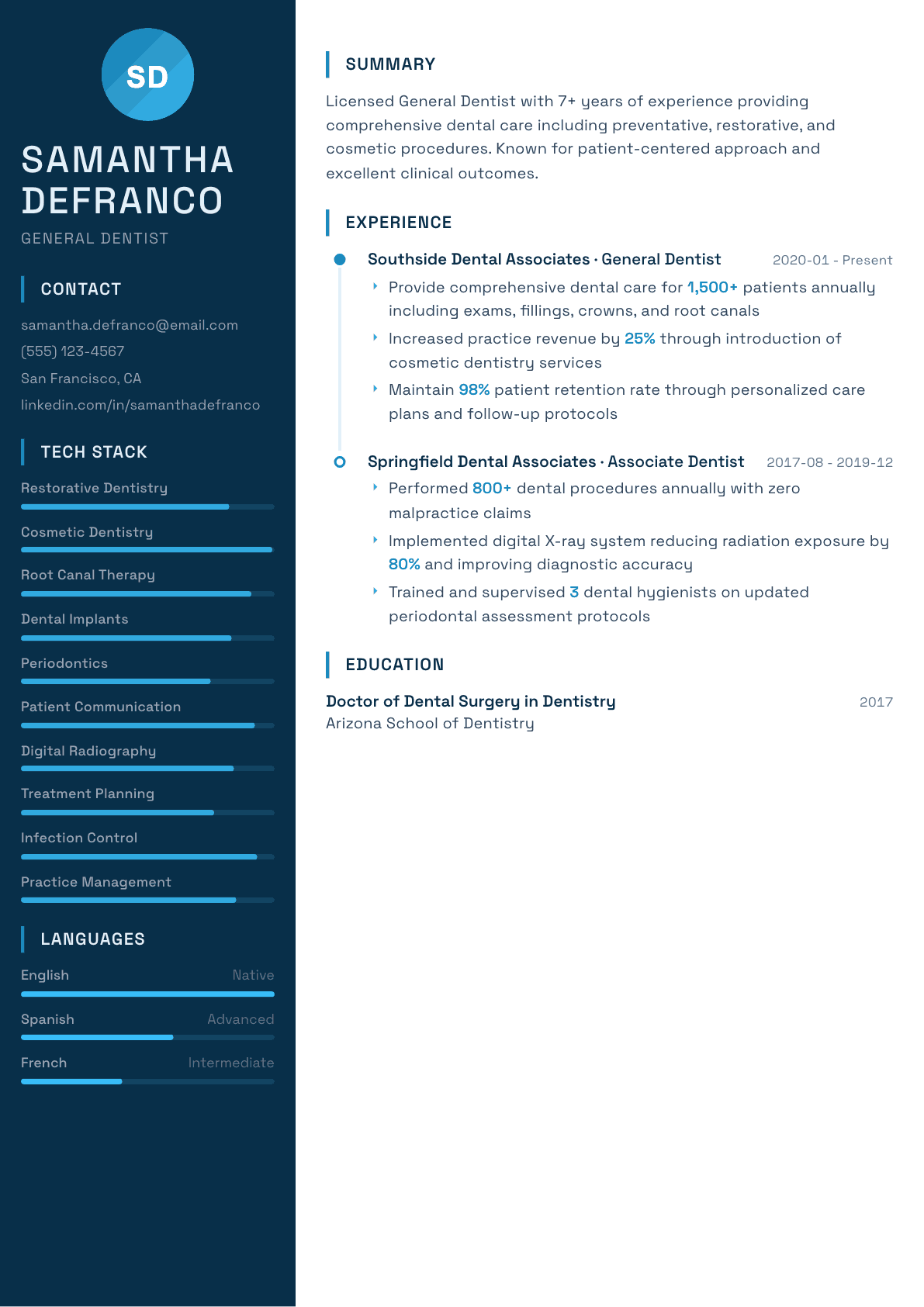
The CVBooster dentist resume guide has a finished example, three written summaries, before and after bullets and answers to the questions people ask.
Build your dentist CV
Create my CV