Dentist Resume Examples: free score, then the gap list
Polish Your Dentist Resume to Perfection
By Mustafa Tarabya, founder of CVBooster · Published · Updated
Dentist resume examples with expert tips, ATS keywords, and professional templates. See exactly what a winning general dentist resume looks like.
Sample resumes for a dentist
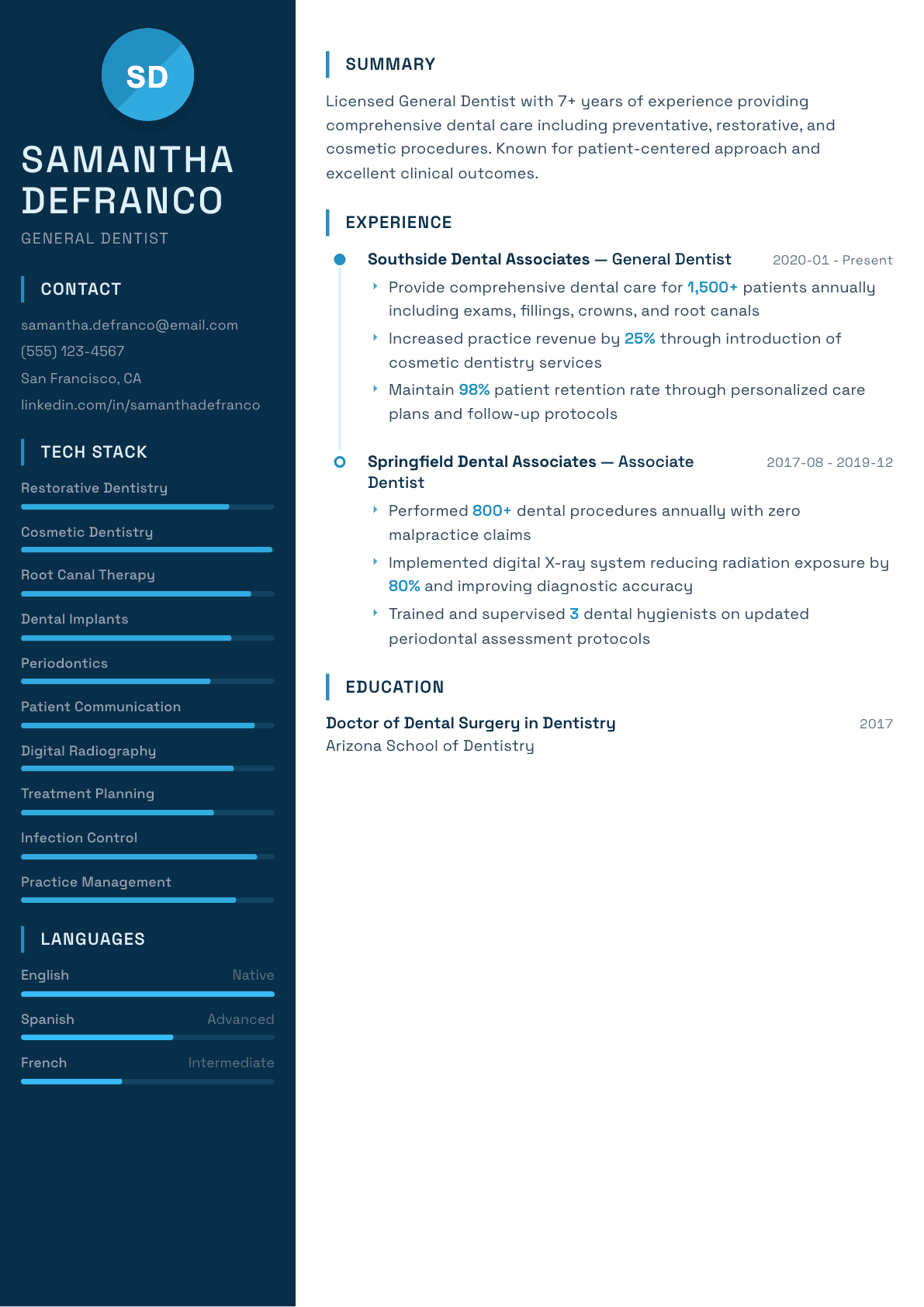
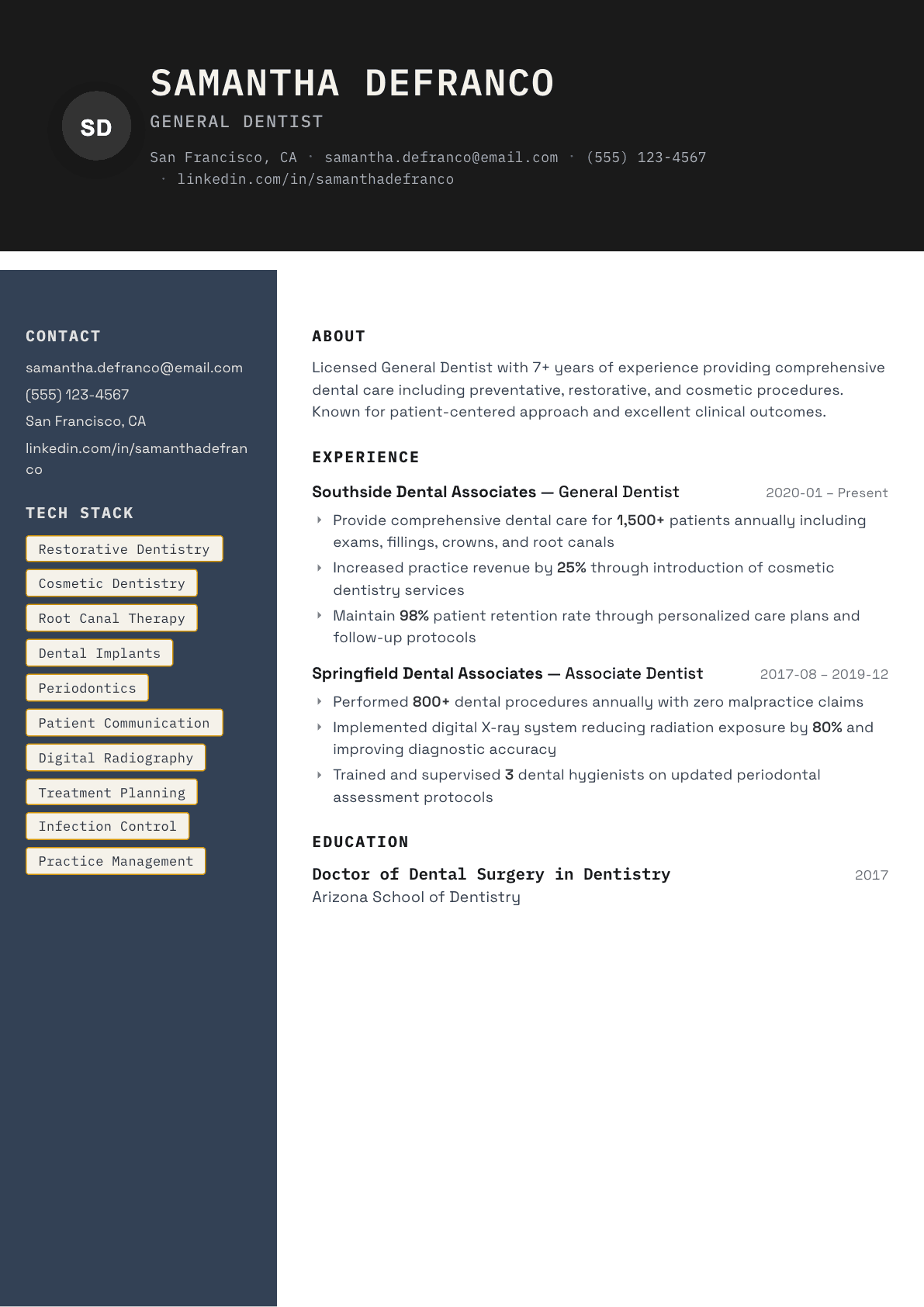
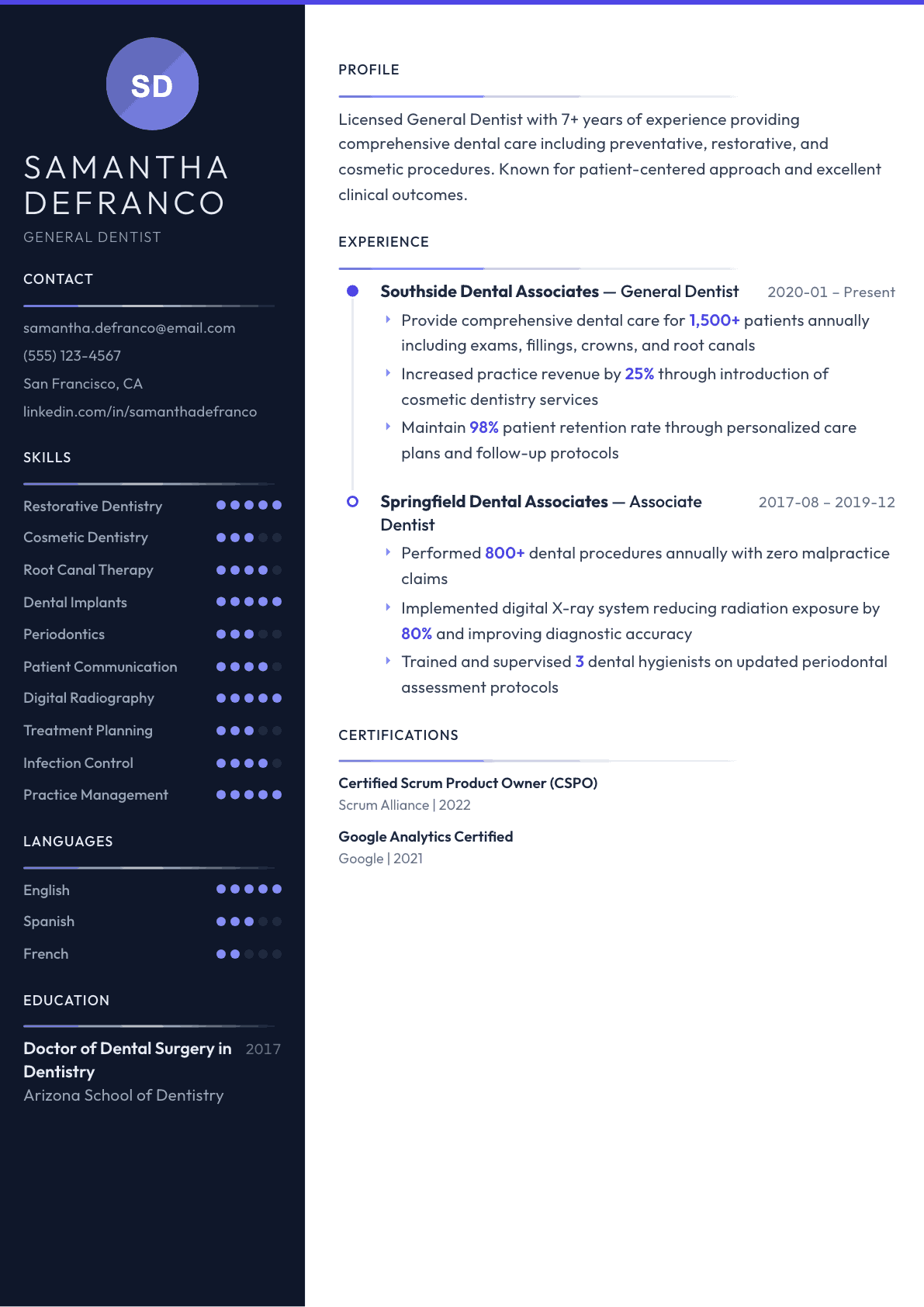
The same dentist content laid out in three CVBooster templates, so you can see what the finished document looks like before you write a word.
Example Dentist summary
General dentist, 7 years in group practice, seeing 1,500 patients a year across exams, restorative work, crowns and endodontics. Built the cosmetic service line that added 25% to practice revenue, holds 98% patient retention, and brought the practice onto digital radiography.
Skills to list on a Dentist resume
- Restorative Dentistry
- Cosmetic Dentistry
- Root Canal Therapy
- Dental Implants
- Periodontics
- Patient Communication
- Digital Radiography
- Treatment Planning
- Infection Control
- Practice Management
What actually gets this resume read
- Highlight your dental license, DEA number, and any specialty certifications.
- Quantify patient volumes, retention rates, and practice growth contributions.
- List specific procedures and technologies you're experienced with.
- Include continuing education courses to show commitment to current practices.
- Mention leadership in practice management if applicable.
How to write a dentist resume
A dentist resume has two audiences and they want opposite things. A group practice or dental service organization runs a recruiting process and screens for the DDS or DMD, the state license, the malpractice history and the procedure mix you can produce from day one. A private owner hiring an associate reads the same page looking for whether you can carry his schedule, keep his patients and, eventually, buy the practice.
Both of them stop on the same section: what you actually do with your hands. Molar endodontics, surgical extractions, implant placement or restoration, clear aligner cases, crown and bridge volume, pediatric behavior management. A resume that lists comprehensive dental care and stops there tells a hiring dentist nothing, because it describes every general dentist alive.
This guide sets out the section order a dental resume needs, how to write the clinical procedure block, three summaries covering a new graduate, a mid career associate and an owner or lead doctor, and the bullet rewrites that turn a duty list into evidence of production.
Format: one to two pages, credentials and license first
Reverse chronological, one page for a new graduate or a doctor under five years, two pages once you have residency, multiple practices or faculty work. Put the degree after your name in the header and open the body with a licensure block: state licenses with numbers withheld, DEA registration status, current CPR or ACLS, and any anesthesia permit your state issues.
Unlike an academic curriculum vitae, an associate position resume should stay short. Save the full publication and lecture list for faculty, hospital or specialty applications, and give private practice a one line mention of research or teaching instead.
- Header: name with DDS or DMD, city and state, phone, email.
- Order: summary, licensure and permits, clinical experience, clinical procedures performed, education and residency, continuing education, professional memberships.
- New graduates move education and any general practice residency above experience and expand the procedure counts from school.
Summary: practice type, procedure range, and production
Three sentences at most. Name the practice setting, the years in clinical practice, the procedures you do without referring out, and one production or retention figure. A hiring owner reading that you place and restore implants and complete molar endodontics in house is already calculating what stays inside the practice instead of leaving as a referral.
Avoid patient centered and passionate about oral health as an opener. Every applicant writes it. Replace it with the specific version: the patients per day you see, the case types you take, and the schedule you can hold.
Clinical procedures: give the block its own section
This is the section that separates a strong dentist resume from a generic one. Create a short block listing what you perform and, where you can, an annual or monthly count. Group it so a reader can scan: restorative, fixed prosthodontics, endodontics, oral surgery, periodontics, removable, implants and cosmetic.
Be honest about the boundaries. A doctor who writes anterior endodontics and refers molars is more credible than one who implies everything, because the first thing an owner does after hiring is watch which cases get referred out. Naming the boundary also tells him exactly which continuing education would expand the practice.
Add the technology you have used chairside: digital scanners, cone beam imaging, chairside milling, hard and soft tissue lasers, rotary endodontic systems, and the practice management software. A practice that owns a scanner and hires a doctor who has never used one loses weeks of chair time.
Experience: the practice, the schedule, and the numbers
Head each role with the practice type and size: solo owner office, multi doctor group, corporate group, federally qualified health center or military and public health service. Give the operatory count, hygiene column count, and patients seen per day, then write bullets that show production, case acceptance and patient retention rather than duties everyone shares.
Production numbers are legitimate on a dental resume, but write them as procedure volume, chair utilization or growth in a service line rather than currency, since compensation and collections vary too much between markets to compare fairly.
If you supervised assistants and hygienists, ran the morning huddle, set the treatment planning protocol or handled the emergency column, say so. Owners hire associates who reduce their management load, not just their clinical load.
Education, residency and continuing education
List the dental school and graduation, then any Advanced Education in General Dentistry or General Practice Residency, which many group practices treat as a strong signal because it means a year of supervised complex cases. Add class rank or honors only if strong, and only for the first few years after graduation.
Continuing education should be selective and current: implant placement courses, clear aligner certification, sedation training, endodontic or occlusion programs. Each one tells a practice which procedures you can add to their menu.
Dental resume sample: a general dentist, start to finish
Most searches for a dental resume sample come from dentists, so the complete example below is a general dentist moving from a group practice to a private associate role. Dental assistants, hygienists and dental office managers can keep the same order; each of those roles has its own resume page with samples on this site.
Profile: Dr. Leah Navarro, DMD, General Dentist. Licensed in two states. Six years in a busy group practice, comfortable with molar endodontics, surgical extractions and implant restoration, and a steady producer who keeps a full recall schedule. Looking for an associate role with a path to partnership.
- Credentials: DMD, state dental licenses in Oregon and Washington, DEA registration, BLS certification, local anesthesia and nitrous oxide permits.
- Current role, Associate Dentist, Cascade Family Dental Group, four years: sees a full adult and pediatric schedule four days a week in a six-chair office.
- Completes molar root canals in house that the practice previously referred out, and places single-tooth implants with a surgical guide.
- Rebuilt the hygiene recall process with the office manager, cutting the list of unscheduled recall patients roughly in half.
- Mentors two new graduate associates in treatment planning and case presentation.
- Previous role, Associate Dentist, Riverside Community Health Center, two years: served a mainly Medicaid patient base and handled emergency walk-in appointments.
- Education: Doctor of Dental Medicine, followed by a one-year hospital General Practice Residency.
- Continuing education: implant restoration and clear aligner coursework, each listed with the hours completed.
Dentist resume summary examples
New graduate
General dentist and recent DDS graduate with a completed Advanced Education in General Dentistry residency covering 190 restorative procedures, 40 endodontic cases and 60 surgical extractions. Licensed in Texas, trained on digital scanning and cone beam interpretation, seeking an associate position in a multi doctor practice.
Seven years as an associate
General dentist with seven years in a five operatory private practice, seeing 12 to 14 patients daily. Completes molar endodontics, surgical extractions and implant restorations in house, holds 96% patient retention, and grew the clear aligner service to 45 starts per year.
Owner or lead doctor
Practice owner and general dentist with sixteen years of clinical experience, leading two doctors, four hygienists and nine staff across eight operatories. Places and restores implants, mentors associates through their first surgical cases, and has lifted hygiene reappointment to 90% since taking over the practice.
Work experience bullets: before and after
Before: Provided comprehensive dental care to patients of all ages.
After: Treated 12 to 14 patients daily in a five operatory practice, covering restorative, crown and bridge, molar endodontics, surgical extractions and implant restoration without referring out.
The patient volume and the named procedure range let an owner picture your column instead of guessing at it.
Before: Performed root canals and extractions.
After: Completed roughly 90 endodontic cases per year including molars using a rotary system with apex location, and 140 extractions including impacted third molars.
Annual counts and the specific difficulty level prove capability that a bare procedure name only implies.
Before: Used new technology in the practice.
After: Introduced intraoral scanning for crown and aligner cases, cutting remake rates on fixed prosthetics and removing conventional impressions from about 80% of restorative appointments.
Naming the technology and what changed clinically turns a vague modernization claim into a result.
Before: Built good relationships with patients.
After: Held 96% patient retention across a panel of 1,800 by presenting treatment with intraoral photography and phasing larger plans over two to three visits.
Retention plus the method behind it is the evidence an owner needs, since the associate keeps or loses his patients.
Before: Supervised dental staff.
After: Led the daily huddle for four assistants and three hygienists, set the periodontal treatment planning protocol, and trained two new assistants on rubber dam and four handed restorative sequencing.
Specific leadership tasks show you reduce the owner's management load rather than adding to it.
Hard skills
- Restorative dentistry
- Crown and bridge
- Endodontic therapy
- Surgical and simple extractions
- Implant placement and restoration
- Removable prosthodontics
- Periodontal therapy and maintenance
- Cone beam computed tomography interpretation
- Intraoral digital scanning
- Clear aligner treatment planning
- Local anesthesia and nitrous oxide sedation
- Emergency and trauma management
- Dentrix and Eaglesoft practice management
Soft skills
- Treatment presentation
- Case sequencing judgment
- Anxious patient management
- Team leadership and huddles
- Referral relationship building
- Clear consent conversations
Certifications worth listing
- State dental license (State board of dental examiners)
- Integrated National Board Dental Examination (Joint Commission on National Dental Examinations)
- DEA Registration (United States Drug Enforcement Administration)
- Basic Life Support (BLS) for Healthcare Providers (American Heart Association)
- Advanced Cardiovascular Life Support (ACLS) (American Heart Association)
- Fellowship (FAGD) (Academy of General Dentistry)
Mistakes that cost dentist candidates the interview
- Submitting a full academic curriculum vitae to a private practice, when the owner wants a two page resume with the procedure block on the first page.
- Writing comprehensive dental care and never naming a procedure, which forces the reader to assume you refer most of it out.
- Leaving out patients seen per day, so a hiring dentist cannot judge whether you can hold the schedule he needs filled.
- Hiding the residency or advanced education program in a dense education paragraph instead of giving it a visible line.
- Overstating implant or endodontic experience, which is exposed in the first month by which cases you send away.
- Listing every continuing education course ever taken rather than the four or five that expand what the practice can offer.
- Omitting the practice management software and imaging systems, which are a real part of how quickly a new associate becomes productive.
Dentist resume questions
Should a dentist send a resume or a curriculum vitae?
Send a resume of one or two pages to private practices, group practices and dental service organizations. Send a full curriculum vitae only for faculty positions, hospital dentistry, residency applications and specialty programs, where publications and teaching are part of the evaluation.
What procedures should I list on a dentist resume?
List what you perform routinely and unsupervised, grouped by category, with annual counts where you have them. Include the boundary too, such as anterior endodontics with molars referred, because an honest boundary is more persuasive than an implied claim to do everything.
How do I show production without listing income?
Use procedure volume, patients per day, chair utilization, case acceptance rate, patient retention and growth in a specific service such as aligner starts or implant restorations. These travel across markets, while collections figures depend on fee schedules that differ from practice to practice.
Does a general practice residency matter on the resume?
Yes, particularly in the first five years. A completed general practice residency or advanced education program signals a supervised year of complex cases, medically compromised patients and emergency coverage, so give it its own line with the procedure counts you accumulated.
How should a dentist handle a gap in clinical practice?
State it briefly and factually in the experience timeline, then show how you returned to clinical readiness: continuing education hours, hands on courses, volunteer clinic days or a period of supervised practice. Hiring dentists worry about rust, so answer that concern rather than leaving a silent gap.