Welder Salary, Career Path and CV
By CVBooster TeamPublished Updated
The median welder salary in the United States is $53,750 a year, or $25.84 an hour, according to the U.S. Bureau of Labor Statistics (BLS), OEWS May 2025. That is the national middle: states, employers and hours move it, and BLS publishes nothing by years of experience. BLS counts welders together with cutters, solderers and brazers. A high school diploma plus training gets you in, and the industry you weld for moves the pay more than the title does.
Below: a check of your own pay, the pay percentiles, hourly pay, pay in every state, the top-paying metro areas, what welders do, how to become a welder, the skills that go on a CV, and a CV example.
- Median annual pay
- $53,750
- Median hourly pay
- $25.84
- Employed, May 2025
- 416,210
Am I underpaid as a welder?
Pick your state and type your pay. You get your place in the BLS pay range for welders there, as a percentile.
Welder salary in the United States
The BLS counts welders in the occupation Welders, Cutters, Solderers, and Brazers (SOC 51-4121). Half of them earn less than $53,750 a year and half earn more. The average, which a few very high earners pull up, is $56,760. The lowest-paid tenth earn $39,240 or less, and the highest-paid tenth earn $77,530 or more, which is about 2.0 times as much. The ratio is our arithmetic on two BLS figures.
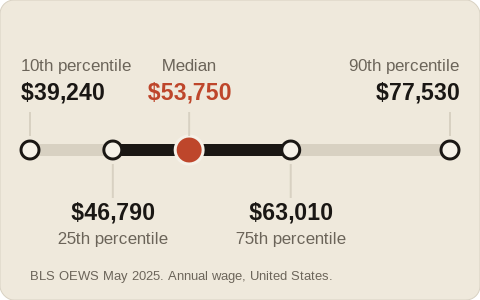
| Measure | Annual wage |
|---|---|
| 10th percentile | $39,240 |
| 25th percentile | $46,790 |
| Median (50th) | $53,750 |
| Mean (average) | $56,760 |
| 75th percentile | $63,010 |
| 90th percentile | $77,530 |
Source: U.S. Bureau of Labor Statistics, Occupational Employment and Wage Statistics (OEWS), May 2025, Welders, Cutters, Solderers, and Brazers, retrieved 23 to 25 November 2026 from the BLS OEWS May 2025 national, state and metropolitan area files.
Welder hourly pay
The median hourly wage for welders is $25.84, as published by BLS for May 2025. That is the hourly view of the same national middle as the $53,750 annual median above, so use it when an employer quotes you a rate and not a salary. Annual pay for a job with part-time or shift work depends on the hours you are given, which no national table can tell you.
| Measure | Per hour |
|---|---|
| 10th percentile | $18.87 |
| 25th percentile | $22.50 |
| Median (BLS hourly figure) | $25.84 |
| 75th percentile | $30.29 |
| 90th percentile | $37.27 |
For welders the median is the hourly wage BLS publishes. The other rows are our division of the BLS annual percentiles by 2,080 hours, the full-time year BLS uses to turn hourly pay into annual pay.
Welder salary by state
Where you work changes the number more than most things. The highest median is in Alaska, at $80,840. The lowest published median is in Arkansas, at $47,970, a gap of $32,870 a year between two states. The gap is our subtraction of two BLS state medians. All figures below are the annual median wage in each state for May 2025.
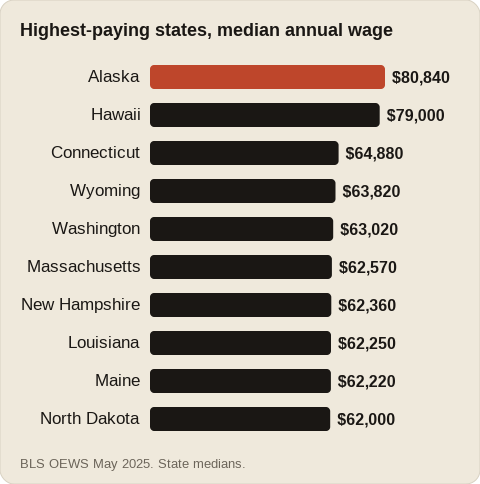
Top-paying states for welders
| Rank | State | Median wage | vs US median |
|---|---|---|---|
| 1 | Alaska | $80,840 | +$27,090 |
| 2 | Hawaii | $79,000 | +$25,250 |
| 3 | Connecticut | $64,880 | +$11,130 |
| 4 | Wyoming | $63,820 | +$10,070 |
| 5 | Washington | $63,020 | +$9,270 |
| 6 | Massachusetts | $62,570 | +$8,820 |
| 7 | New Hampshire | $62,360 | +$8,610 |
| 8 | Louisiana | $62,250 | +$8,500 |
| 9 | Maine | $62,220 | +$8,470 |
| 10 | North Dakota | $62,000 | +$8,250 |
Welder salary in all 50 states
| State | Median annual wage |
|---|---|
| Alaska | $80,840 |
| Hawaii | $79,000 |
| Connecticut | $64,880 |
| Wyoming | $63,820 |
| Washington | $63,020 |
| Massachusetts | $62,570 |
| New Hampshire | $62,360 |
| Louisiana | $62,250 |
| Maine | $62,220 |
| North Dakota | $62,000 |
| Nevada | $61,520 |
| Vermont | $60,890 |
| Maryland | $60,310 |
| Minnesota | $60,280 |
| New Mexico | $59,840 |
| Oregon | $59,450 |
| New Jersey | $59,440 |
| Virginia | $59,180 |
| New York | $59,140 |
| Colorado | $58,590 |
| Wisconsin | $58,410 |
| Utah | $58,380 |
| California | $58,060 |
| Delaware | $57,270 |
| Montana | $55,610 |
| Arizona | $55,600 |
| Iowa | $55,090 |
| Texas | $53,340 |
| Pennsylvania | $52,900 |
| Nebraska | $52,220 |
| Missouri | $51,950 |
| Kentucky | $51,470 |
| Illinois | $51,320 |
| Mississippi | $51,100 |
| Florida | $50,640 |
| North Carolina | $50,590 |
| Rhode Island | $50,580 |
| Idaho | $50,530 |
| Ohio | $50,340 |
| Michigan | $49,990 |
| South Carolina | $49,980 |
| Indiana | $49,730 |
| Oklahoma | $49,720 |
| South Dakota | $49,440 |
| Kansas | $49,410 |
| West Virginia | $48,810 |
| Alabama | $48,490 |
| Georgia | $48,430 |
| Tennessee | $48,040 |
| Arkansas | $47,970 |
Top-paying metro areas for welders
| Metro area | Median wage | Employed |
|---|---|---|
| Lima, OH | $85,790 | 470 |
| Urban Honolulu, HI | $81,120 | 430 |
| Fairbanks-College, AK | $80,210 | 70 |
| Baton Rouge, LA | $78,170 | 3,690 |
| Hartford-West Hartford-East Hartford, CT | $75,040 | 670 |
| Anchorage, AK | $74,000 | 250 |
| Lake Charles, LA | $72,920 | 970 |
| Bremerton-Silverdale-Port Orchard, WA | $71,720 | 740 |
| Kahului-Wailuku, HI | $67,280 | 40 |
| Portland-South Portland, ME | $66,420 | 1,060 |
BLS publishes the welder median for 382 metro areas; the national median is $53,750. 2 of these ten count fewer than 100 welders or have no published headcount, so treat them as rough. Source: U.S. Bureau of Labor Statistics, OEWS May 2025, metropolitan area estimates.
Compare welder pay
Put two states side by side, or set welders next to another job. Every figure is from BLS OEWS May 2025.
| Measure | Alaska | Arkansas |
|---|---|---|
| Median annual wage | $80,840 | $47,970 |
| Median hourly wage | $38.87 | $23.06 |
| 10th percentile | $49,660 | $37,380 |
| 25th percentile | $61,280 | $42,950 |
| 75th percentile | $98,500 | $55,280 |
| 90th percentile | $109,940 | $62,830 |
| Employed, May 2025 | 790 | 6,150 |
The Alaska median is $32,870 a year higher. That difference is our subtraction of two BLS state medians. n/a means this page has only the BLS median for that state so far, or BLS released no figure for it. Source: BLS OEWS May 2025, Welders, Cutters, Solderers, and Brazers.
Starting pay for welders
BLS does not publish pay by years of experience, so nobody can honestly quote an official entry-level welder salary. What the data gives is the bottom of the market. One in ten welders earns $39,240 or less, and one in four earns $46,790 or less. Read those as the low end of the national range, not as what a new graduate will be offered, because older workers sit in the bottom tenth too.
Who pays welders more
Most welders work in manufacturing, but manufacturing is not the best payer. BLS industry medians are $59,440 for specialty trade contractors, $51,210 in manufacturing, $50,290 at merchant wholesalers of durable goods and $48,810 in administrative and support and waste management services.
BLS says welding wages vary with experience and skill level, the industry and the size of the company. It does not publish pay by welding process, so there is no official MIG, TIG or pipe welding wage; the industry and the employer are the levers the data can show.
Where the money is
Alaska ($80,840) and Hawaii ($79,000) stand well clear of every other state; the third, Connecticut, is $14,120 lower than Hawaii, by our subtraction.
The highest metro median is in Lima, OH, at $85,790. Among the ten best-paying metros, Baton Rouge, LA has by far the most welders, about 3,690, which makes its $78,170 median one of the more solid figures on the list. Others, such as Fairbanks-College, AK and Kahului-Wailuku, HI, count fewer than a hundred, and BLS metro medians for groups that small are estimates.
Slow growth, steady openings
BLS projects only 2 percent employment growth from 2025 to 2035, slower than the average. Even so, it expects about 40,300 openings a year, mostly from replacing welders who retire or move to other occupations.
Demand has two sides in the outlook. Aging infrastructure means bridges, highways and buildings to rebuild, and manufacturing plants that make metal products and machinery still need welders. Against that, BLS says automation in manufacturing may limit overall demand, which matters in a trade where manufacturing holds 63 percent of the jobs.
Related jobs
- Electrician salary and career path: Another skilled trade where the route mixes school, an apprenticeship and work on site.
- Civil Engineer salary and career path: Civil engineers design the bridges, highways and buildings BLS expects welders to help rebuild.
What welders do
Welders use hand-held or remotely controlled equipment to join metal parts and to fill holes, indentations or seams in metal products. Heat from a torch or an electric arc melts the pieces and fuses them into a permanent bond, and the welder picks the process to suit factors such as the metals being joined.
BLS counts three related trades in the same occupation. Cutters use an electric arc, plasma or burning gases to cut metal to size and to dismantle large objects such as ships, railroad cars and buildings. Solderers and brazers join metal with a melted filler: soldering uses a lower temperature, and brazing can join dissimilar metals.
Duties BLS lists
- Read and interpret blueprints, sketches and specifications
- Work out and measure the dimensions of the parts to be welded
- Inspect the structures or materials before welding them
- Weld the materials to the blueprint specifications
- Watch the weld as it forms and adjust the heat when needed
- Keep the welding equipment and machinery in working order
A typical day
It starts with the drawing: read the blueprint, measure the parts and inspect the metal. Then the welding itself, watching the molten metal and adjusting the heat as it flows, often overhead or while bending, stooping or standing for long periods. In plants that run two or three shifts a day, the working day may be an evening or a weekend.
Where they work
- Manufacturing employed 63 percent of welders, cutters, solderers and brazers, specialty trade contractors 8 percent and merchant wholesalers of durable goods 5 percent. Another 4 percent were self-employed and 4 percent worked in administrative and support and waste management services.
- The work can be outdoors in any weather, on a scaffold or platform high off the ground, or indoors in a confined area built to contain sparks and glare.
- Hazards include fumes, very hot materials and the intense light of the arc. Welding helmets, hearing protection and heat-resistant gloves are the standard protection.
- Most work full time and some work more than 40 hours a week. Many manufacturing firms run two or three 8- to 12-hour shifts each day.
Source: U.S. Bureau of Labor Statistics, Occupational Outlook Handbook, Welders, Cutters, Solderers, and Brazers, read 25 November 2026. BLS counted about 437,700 jobs in 2025 and projects 2% growth from 2025 to 2035, slower than the average for all occupations.
How to become a welder: the career path
Typical entry-level education, according to BLS: high school diploma or equivalent. BLS gives no length for welding programs, but says that even entry-level workers with formal technical training still get several months of on-the-job training. Each step below comes from the BLS Occupational Outlook Handbook, and the last step is the pay.
- 1Start
High school diploma and technical training
Employers often prefer or require both. Training comes from high school technical classes, vocational-technical institutes, community colleges, private welding schools or the U.S. Armed Forces. Blueprint reading, shop math, mechanical drawing and some knowledge of electricity help.
- 2Or train
Employer apprenticeship
Some apprenticeships take entry-level workers with no experience or training; others are for people who have finished a vocational-technical welding program.
- 3Train
Months on the job
Entry-level workers with formal training still receive several months of on-the-job training. Some employers hire beginners and train them entirely on the job, but many prefer trained or credentialed applicants.
- 4Requirements
OSHA electrical safety training
The Occupational Safety and Health Administration (OSHA) requires welders to complete training on electrical safety. Other OSHA training is available but generally not required.
- 5Certify
Certification and local licenses
Welders must be licensed in some states and localities. Professional organizations offer courses leading to general certification, some employers require general or specific certification for particular jobs, and some pay for the training and testing.
- 6Pay
Median $53,750 a year
BLS median annual wage for welders. The lowest-paid tenth earn $39,240 or less and the highest-paid tenth earn $77,530 or more.
Steps 1 to 5 for welders: U.S. Bureau of Labor Statistics, Occupational Outlook Handbook, Welders, Cutters, Solderers, and Brazers, "How to Become One", read 25 November 2026. Pay step: U.S. Bureau of Labor Statistics, OEWS May 2025.
Welder skills and certifications
These come from the CVBooster welder resume guide, which lists what employers look for on a welder CV. Put the ones you really have near the top of your CV, in the words the job ad uses.
Core skills
People skills
Licenses and certifications
- Certified Welder (CW), American Welding Society
- Certified Welding Inspector (CWI), American Welding Society
- Certified Welding Educator (CWE), American Welding Society
- NCCER Welding Certification, National Center for Construction Education and Research
- OSHA 30-Hour Construction Outreach Training, OSHA Training Institute
Welder salary questions
How much do welders make a year?
The BLS median for welders, cutters, solderers and brazers is $53,750 a year and the mean $56,760. The lowest-paid tenth earn $39,240 or less; the highest-paid tenth earn $77,530 or more. Source: U.S. Bureau of Labor Statistics, OEWS May 2025.
How much do welders make an hour?
$25.84 an hour at the national median. Some welders work more than 40 hours a week and many factories run around the clock, but BLS publishes no overtime figure, so the yearly total depends on the hours you get.
What type of welding pays the most?
BLS does not publish pay by welding process. What it does publish is pay by industry, and specialty trade contractors lead the list it gives at $59,440, above manufacturing at $51,210. It also says pay varies with skill level and company size.
Do welders need a license or certification?
In some states and localities, welders must be licensed, and the rules vary. Certification is offered through professional organizations, some employers require it for particular jobs, and some pay for the training and testing. OSHA requires training on electrical safety.
How long does it take to become a welder?
BLS does not give a program length. It says employers often want a high school diploma and technical training, and that even trained entry-level workers still get several months of on-the-job training. An employer apprenticeship is another way in, sometimes with no prior experience.
Which state pays welders the most?
Alaska, with a median of $80,840. Hawaii is next at $79,000, then Connecticut at $64,880. The lowest published median is in Arkansas, $47,970. The tables above give every state for May 2025.
Sources and method
- Pay: U.S. Bureau of Labor Statistics, Occupational Employment and Wage Statistics (OEWS), May 2025, Welders, Cutters, Solderers, and Brazers (SOC 51-4121), national, state and metro area estimates, retrieved 23 to 25 November 2026 from the BLS OEWS May 2025 national, state and metropolitan area files. Wages are before tax. BLS defines what its wage figure includes and leaves out in the OEWS technical notes.
- The job, the route in and the outlook: U.S. Bureau of Labor Statistics, Occupational Outlook Handbook, Welders, Cutters, Solderers, and Brazers, read 25 November 2026.
- Skills and certifications: the CVBooster welder resume guide.
- Where we subtract or divide two BLS figures on this welder page, the page says so. The pay check is an estimate between the published BLS percentiles for welders and says so. Nothing else here is estimated.
Welder CV example
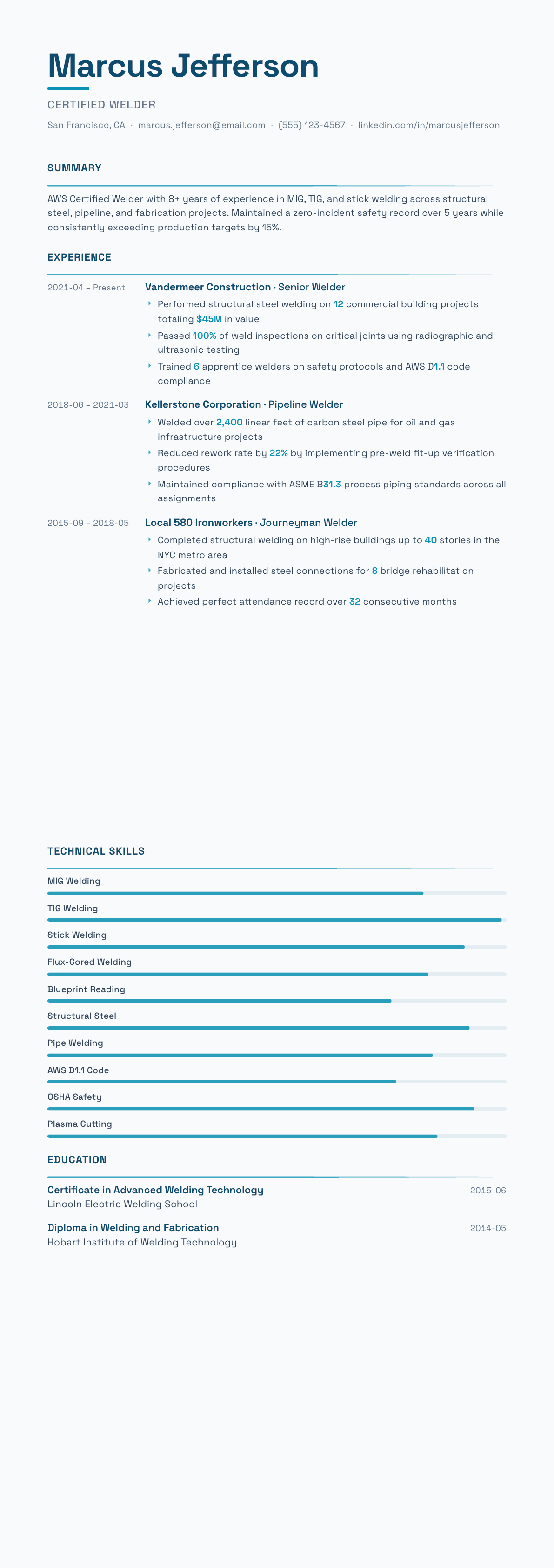
The CVBooster welder resume guide has a finished example, three written summaries, before and after bullets and answers to the questions people ask.
- Welder resume examples
- MIG welder resume examples
- TIG welder resume examples
- Pipe welder resume examples
Build your welder CV
Create my CV