Electrician Salary, Career Path and CV
By CVBooster TeamPublished Updated
The median electrician salary in the United States is $63,190 a year, or $30.38 an hour, according to the U.S. Bureau of Labor Statistics (BLS), OEWS May 2025. That is the national middle: states, employers and hours move it, and BLS publishes nothing by years of experience. The training is paid, and the top tenth earn $108,510 or more.
Below: the pay percentiles, hourly pay, pay in all 50 states, what electricians do, how to become an electrician, the skills that go on a CV, and a CV example.
- Median annual pay
- $63,190
- Median hourly pay
- $30.38
- Employed, May 2025
- 757,220
Electrician salary in the United States
The BLS counts electricians in the occupation Electricians (SOC 47-2111). Half of them earn less than $63,190 a year and half earn more. The average, which a few very high earners pull up, is $71,490. The lowest-paid tenth earn $42,640 or less, and the highest-paid tenth earn $108,510 or more, which is about 2.5 times as much. The ratio is our arithmetic on two BLS figures.
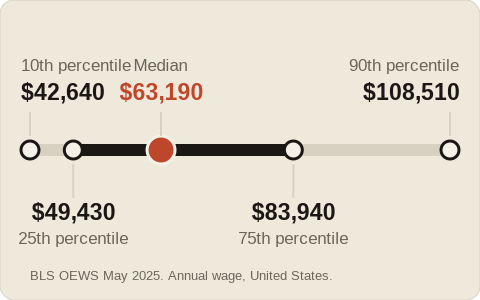
| Measure | Annual wage |
|---|---|
| 10th percentile | $42,640 |
| 25th percentile | $49,430 |
| Median (50th) | $63,190 |
| Mean (average) | $71,490 |
| 75th percentile | $83,940 |
| 90th percentile | $108,510 |
Source: U.S. Bureau of Labor Statistics, Occupational Employment and Wage Statistics (OEWS), May 2025, Electricians, retrieved 23 November 2026 through the BLS Public Data API.
Electrician hourly pay
The median hourly wage for electricians is $30.38, as published by BLS for May 2025. That is the hourly view of the same national middle as the $63,190 annual median above, so use it when an employer quotes you a rate and not a salary. Annual pay for a job with part-time or shift work depends on the hours you are given, which no national table can tell you.
Electrician salary by state
Where you work changes the number more than most things. The highest median is in Oregon, at $101,310. The lowest published median is in Arkansas, at $49,070, a gap of $52,240 a year between two states. The gap is our subtraction of two BLS state medians. All figures below are the annual median wage in each state for May 2025.
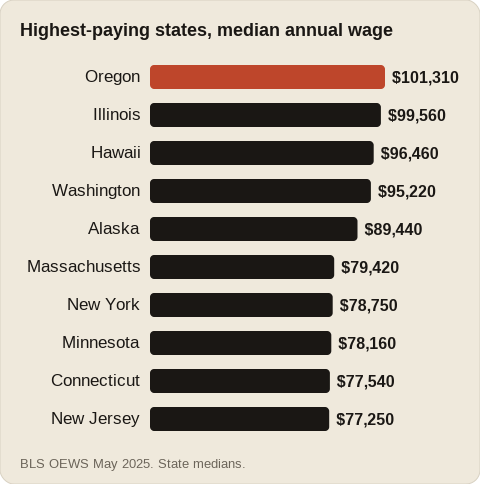
Top-paying states for electricians
| Rank | State | Median wage | vs US median |
|---|---|---|---|
| 1 | Oregon | $101,310 | +$38,120 |
| 2 | Illinois | $99,560 | +$36,370 |
| 3 | Hawaii | $96,460 | +$33,270 |
| 4 | Washington | $95,220 | +$32,030 |
| 5 | Alaska | $89,440 | +$26,250 |
| 6 | Massachusetts | $79,420 | +$16,230 |
| 7 | New York | $78,750 | +$15,560 |
| 8 | Minnesota | $78,160 | +$14,970 |
| 9 | Connecticut | $77,540 | +$14,350 |
| 10 | New Jersey | $77,250 | +$14,060 |
Electrician salary in all 50 states
| State | Median annual wage |
|---|---|
| Oregon | $101,310 |
| Illinois | $99,560 |
| Hawaii | $96,460 |
| Washington | $95,220 |
| Alaska | $89,440 |
| Massachusetts | $79,420 |
| New York | $78,750 |
| Minnesota | $78,160 |
| Connecticut | $77,540 |
| New Jersey | $77,250 |
| Montana | $76,760 |
| Wisconsin | $76,540 |
| Michigan | $76,270 |
| California | $76,160 |
| Wyoming | $76,120 |
| Maine | $75,380 |
| Rhode Island | $74,090 |
| Nevada | $73,570 |
| Maryland | $73,490 |
| Indiana | $68,490 |
| Pennsylvania | $67,600 |
| Kansas | $65,860 |
| North Dakota | $65,710 |
| Missouri | $65,410 |
| West Virginia | $64,810 |
| Ohio | $64,700 |
| Delaware | $63,700 |
| Vermont | $63,430 |
| Idaho | $63,000 |
| Virginia | $62,900 |
| New Hampshire | $62,840 |
| Colorado | $62,230 |
| Utah | $62,000 |
| Louisiana | $61,540 |
| South Dakota | $61,390 |
| Tennessee | $61,090 |
| Arizona | $61,060 |
| Oklahoma | $61,010 |
| Iowa | $60,860 |
| Mississippi | $60,860 |
| Nebraska | $60,820 |
| Kentucky | $59,720 |
| South Carolina | $58,740 |
| Texas | $58,570 |
| New Mexico | $58,390 |
| Georgia | $58,320 |
| Florida | $57,250 |
| North Carolina | $56,800 |
| Alabama | $55,690 |
| Arkansas | $49,070 |
Starting pay for electricians
BLS does not publish pay by years of experience, so nobody can honestly quote an official entry-level electrician salary. What the data gives is the bottom of the market. One in ten electricians earns $42,640 or less, and one in four earns $49,430 or less. Read those as the low end of the national range, not as what a new graduate will be offered, because older workers sit in the bottom tenth too.
What electricians do
Electricians install, maintain and repair electrical power, communications, lighting and control systems in homes, businesses and factories.
Duties BLS lists
- Read blueprints or technical diagrams
- Install and maintain wiring, control and lighting systems
- Inspect components such as transformers and circuit breakers
- Identify electrical problems with testing devices
- Repair or replace wiring, equipment or fixtures
- Follow state and local building regulations based on the National Electrical Code
- Direct and train workers who install, maintain or repair wiring or equipment
A typical day
Work moves between sites: read the plans, run and connect wiring, test, find the fault, then repair or replace. BLS notes electricians work indoors and outdoors and may travel between worksites, and that evenings, weekends and overtime are common.
Where they work
- Electrical contractors and other wiring installation contractors were the largest employer, at 66 percent.
- Almost all electricians work full time. Schedules may include evenings and weekends, and overtime is common.
- Common injuries include electrical shocks, falls and burns, so protective clothing and safety glasses are advised.
Source: U.S. Bureau of Labor Statistics, Occupational Outlook Handbook, Electricians, read 23 November 2026. BLS counted about 821,000 jobs in 2025 and projects 9% growth from 2025 to 2035, much faster than the average for all occupations.
How to become an electrician: the career path
Typical entry-level education, according to BLS: high school diploma or equivalent. Most electricians learn the trade in a 4- or 5-year apprenticeship program. Each step below comes from the BLS Occupational Outlook Handbook, and the last step is the pay.
- 1Start
High school diploma or equivalent
The typical entry-level education is a high school diploma or equivalent.
- 2Train
Apprenticeship
BLS says most electricians learn the trade in a 4- or 5-year apprenticeship. For each year, apprentices typically receive 2,000 hours of paid on-the-job training plus technical instruction.
- 3Shortcut
Credit for experience
Workers with electrical experience from the military or construction may qualify for a shortened apprenticeship.
- 4License
State license
Most states require electricians to pass a test and be licensed. Requirements vary by state, and the tests cover the National Electrical Code and state and local codes.
- 5Pay
Median $63,190 a year
BLS median annual wage for electricians. The lowest-paid tenth earn $42,640 or less and the highest-paid tenth earn $108,510 or more.
Steps 1 to 4: U.S. Bureau of Labor Statistics, Occupational Outlook Handbook, Electricians, "How to Become One", read 23 November 2026. Pay step: U.S. Bureau of Labor Statistics, OEWS May 2025.
Electrician skills and certifications
These come from the CVBooster electrician resume guide, which lists what employers look for on a electrician CV. Put the ones you really have near the top of your CV, in the words the job ad uses.
Core skills
People skills
Licenses and certifications
- Journeyman Electrician License, State electrical licensing board
- Master Electrician License, State electrical licensing board
- OSHA 30-Hour Construction, OSHA Training Institute
- NFPA 70E Electrical Safety Training, National Fire Protection Association
- Certified Electrical Safety Compliance Professional, National Fire Protection Association
More guides
Electrician salary questions
How much does an electrician make a year?
The median is $63,190 a year and the mean is $71,490. The lowest-paid tenth earn $42,640 or less and the highest-paid tenth earn $108,510 or more. Source: U.S. Bureau of Labor Statistics, OEWS May 2025.
How much does an electrician make an hour?
The median hourly wage is $30.38. Overtime is common in this job, so what you earn in a week can differ from the base hourly rate.
Which state pays electricians the most?
Oregon has the highest median at $101,310, followed by Illinois at $99,560 and Hawaii at $96,460. These are state medians for May 2025 from U.S. Bureau of Labor Statistics, OEWS May 2025, and the table above lists all 50 states.
What does a new electrician earn?
BLS does not publish pay by years of experience or by apprentice year. The 10th percentile is $42,640 and the 25th is $49,430, which marks the lower end of the national market.
How long does it take to become an electrician?
BLS says most electricians learn the trade in a 4- or 5-year apprenticeship, with 2,000 hours of paid on-the-job training each year plus technical instruction. Most states then require a licensing test.
Is electrician a growing job?
BLS projects 9% employment growth from 2025 to 2035, much faster than the average for all occupations, adding about 75,900 jobs to the 821,000 held in 2025.
Sources and method
- Pay: U.S. Bureau of Labor Statistics, Occupational Employment and Wage Statistics (OEWS), May 2025, Electricians (SOC 47-2111), national and state estimates, retrieved 23 November 2026 through the BLS Public Data API. Wages are before tax. BLS defines what its wage figure includes and leaves out in the OEWS technical notes.
- The job, the route in and the outlook: U.S. Bureau of Labor Statistics, Occupational Outlook Handbook, Electricians, read 23 November 2026.
- Skills and certifications: the CVBooster electrician resume guide.
- Where we subtract or divide two BLS figures, the page says so. Nothing else on this page is estimated.
Electrician CV example
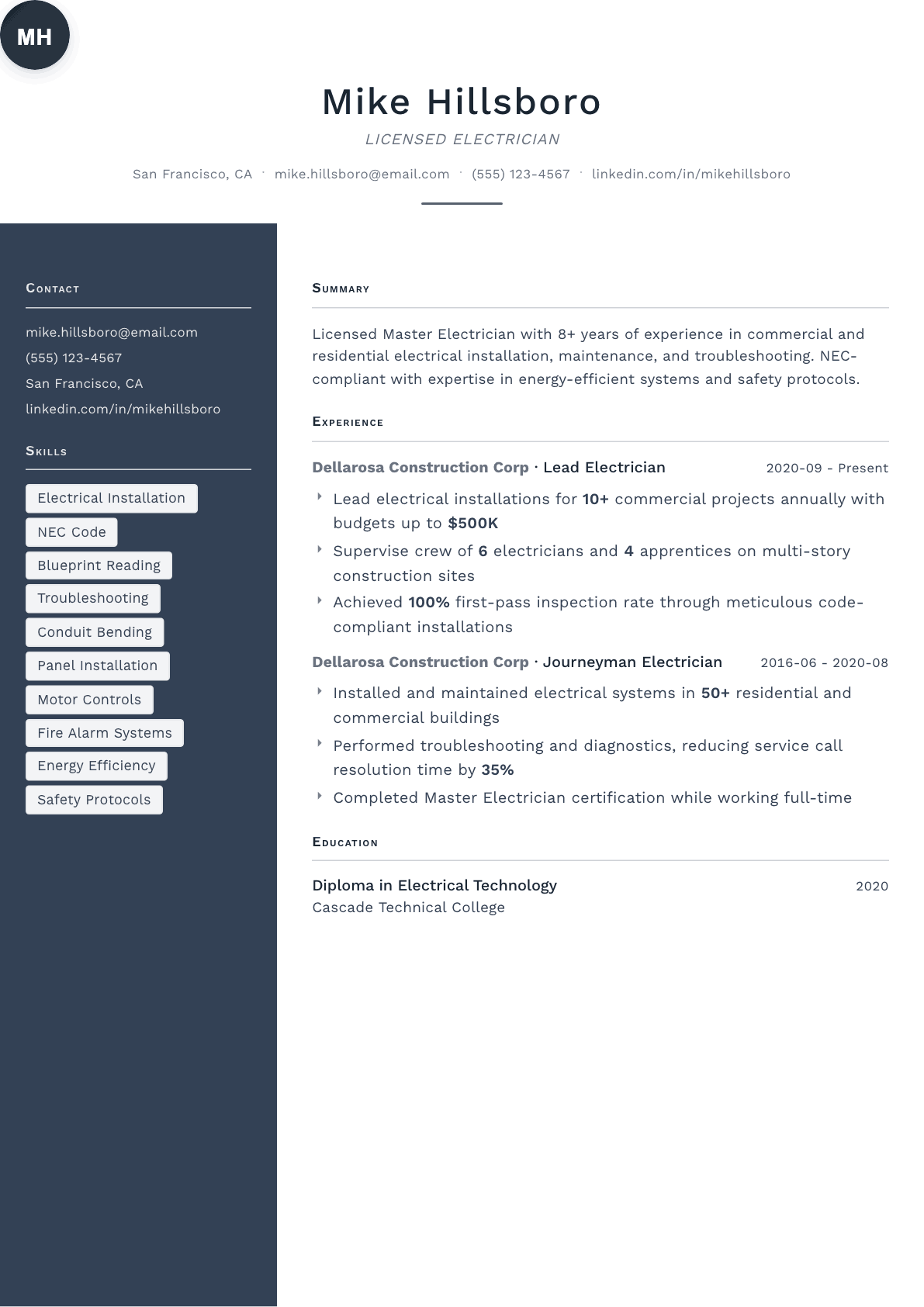
The CVBooster resume guide for this job has a finished example, three written summaries, before and after bullets and answers to the questions people ask.
Build your electrician CV
Create my CV