Electrician Resume Examples: free ATS score and gap list
Electrician Resume Examples for Electrical Jobs
By Mustafa Tarabya, founder of CVBooster · Published · Updated
Electrician resume examples for electrical jobs: license and hours first, then residential, commercial or industrial work written so a foreman can place you.
Sample resumes for a electrician
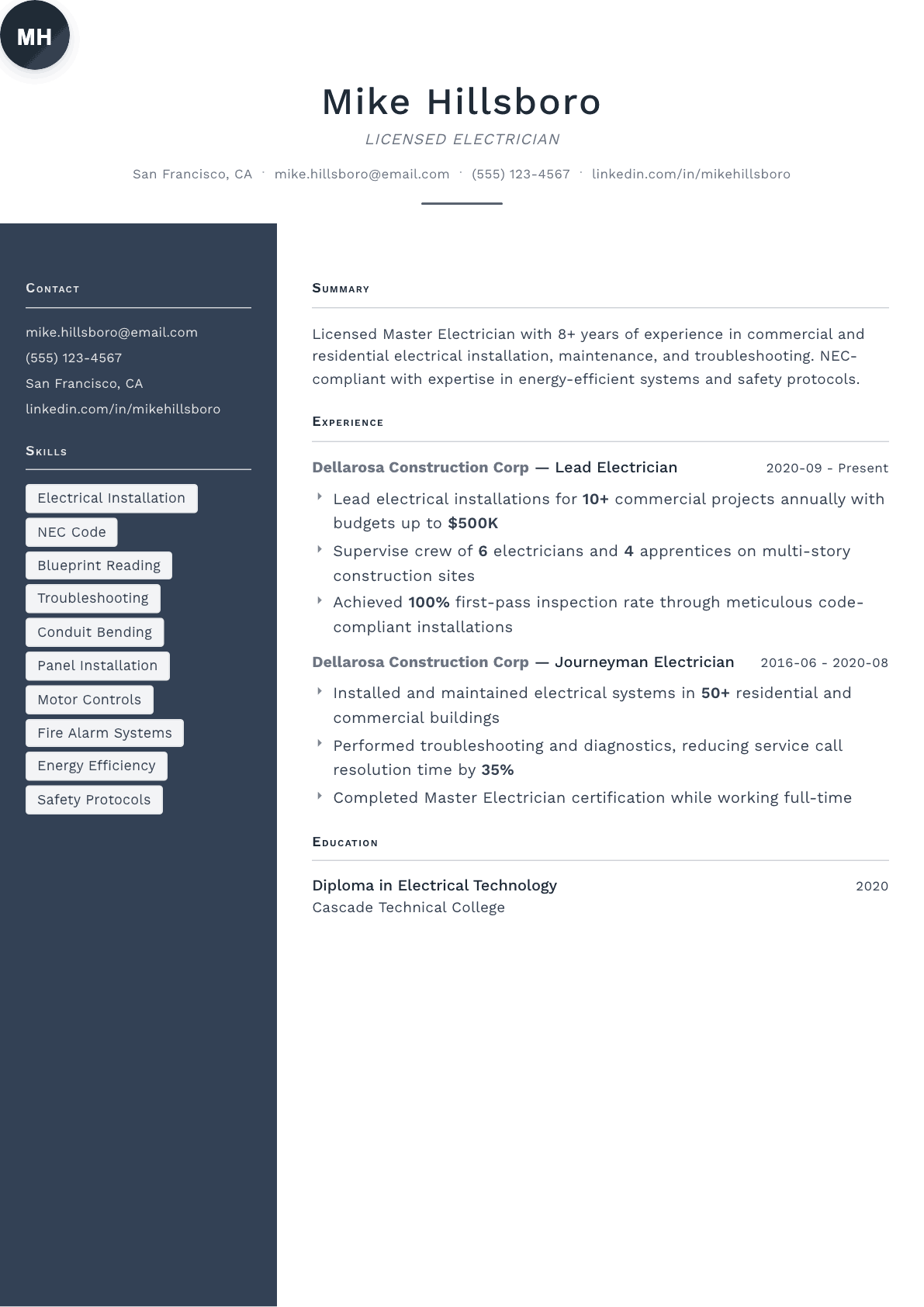
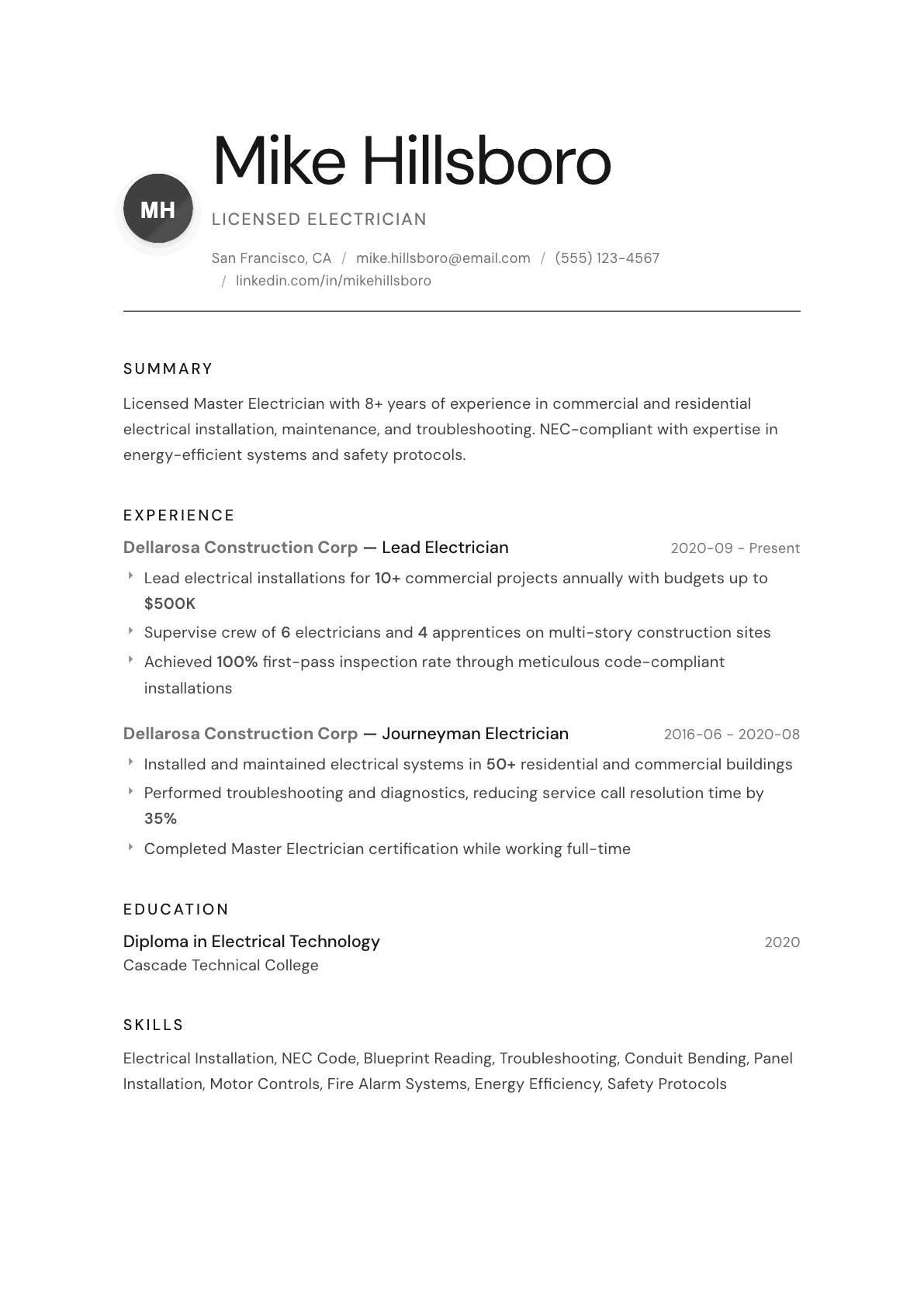
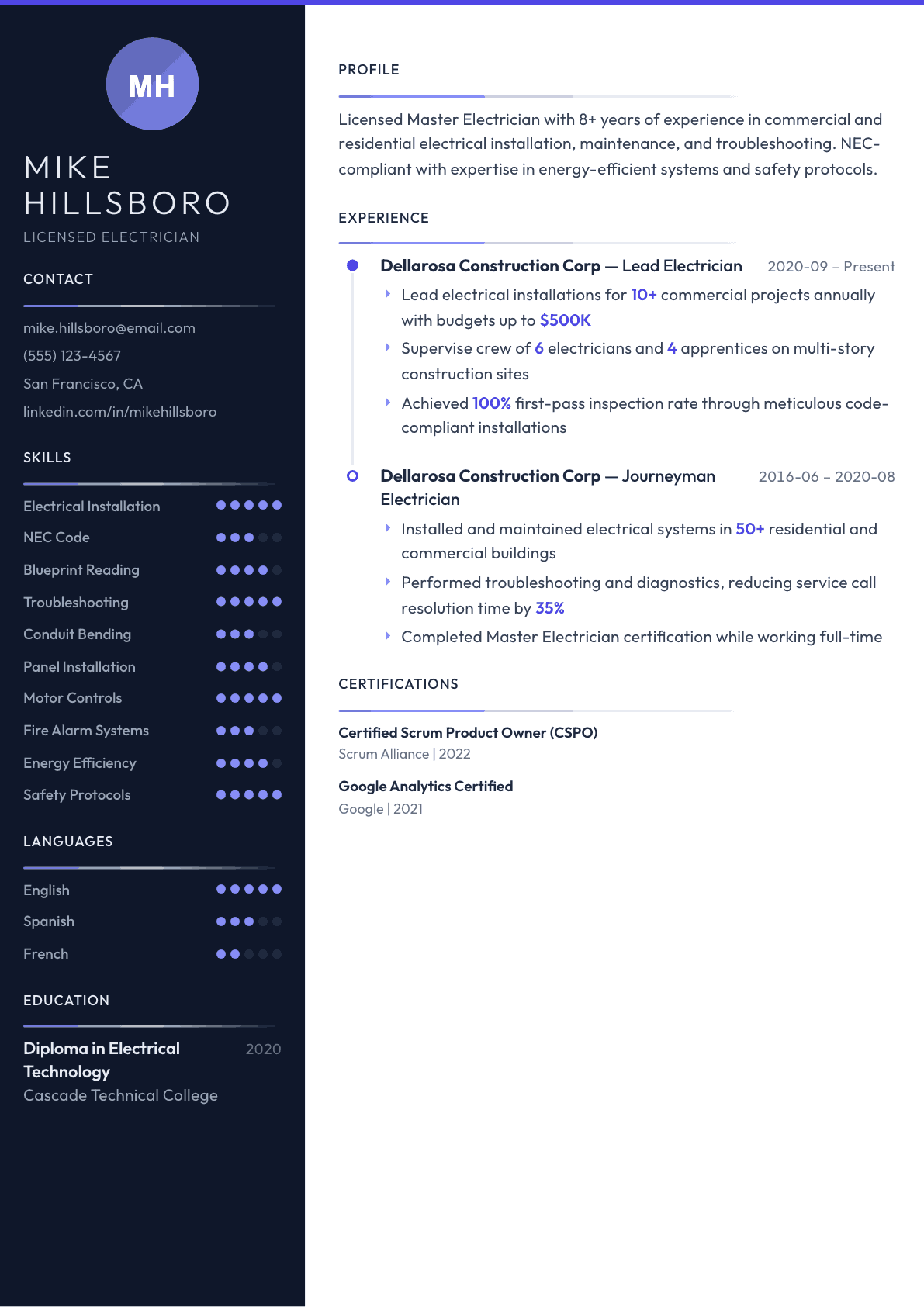
The same electrician content laid out in three CVBooster templates, so you can see what the finished document looks like before you write a word.
Example Electrician summary
Master electrician, 8 years from apprentice through journeyman, leading installations on 10 commercial projects a year with budgets to $500K. Runs a crew of six electricians and four apprentices, and has held a 100% first-pass inspection rate on code-compliant work.
Skills to list on a Electrician resume
- Electrical Installation
- NEC Code
- Blueprint Reading
- Troubleshooting
- Conduit Bending
- Panel Installation
- Motor Controls
- Fire Alarm Systems
- Energy Efficiency
- Safety Protocols
What actually gets this resume read
- List all licenses and certifications (Master, Journeyman, OSHA).
- Include specific systems experience (residential, commercial, industrial).
- Quantify: projects completed, inspection pass rates, crew sizes.
- Show progression from apprentice to journeyman to master.
- Highlight safety record and code compliance achievements.
How to write a electrician resume
An electrician resume is screened on three facts before anything else: your license and the state that issued it, whether your work is residential, commercial or industrial, and whether you can be sent out alone. Everything else on the page exists to support those three.
The resumes that get passed over describe electricity rather than the work. Installed wiring, performed maintenance, followed safety procedures. A foreman reading that cannot tell whether you have pulled feeders in a high-rise, terminated a switchgear lineup, or swapped receptacles in apartments.
A resume for electrical work in the trades follows the same rule whether you are an apprentice, a journeyman or a master: license, sector, scope. This guide covers how to present licensing and hours, how to write installation, service and troubleshooting experience so a foreman can place you, three summaries, before and after bullets, and the license questions electricians ask most when they change states or employers.
Format: license first, one page for most electricians
One page, plain, single column. Put the license type, the issuing state and your classification in the header area: apprentice with hours, journeyman, or master. Contractors filter on classification before they read a word of your experience, and a resume that hides it goes to the bottom of the pile.
If you hold licenses in more than one state, or a reciprocity agreement covers you, say so. Multistate contractors treat that as a hiring advantage because it removes a delay before you can be put on a job.
- Header: name, city, phone, email, classification, license type and state.
- Order: summary, licenses and certifications, experience, technical skills, apprenticeship and training.
- Under each employer: sector, project types, typical job size, crew size, and whether you ran service calls or installations.
- Apprentices should list documented on-the-job hours and classroom hours toward the license.
Summary: classification, sector and what you install
Two or three lines. Classification, years, sector, and the systems you work on: service and distribution, branch circuits, motor controls, fire alarm, low voltage and data, lighting control, or solar and storage. A commercial contractor hiring for a switchgear job screens for exactly those words.
Experience: installations, service calls and industrial work
Installation work should name the assemblies and the scale: panels and subpanels, feeders and conduit sizes, transformers, switchgear, motor control centers, generators and transfer switches, and the raceway types you have run. Add the environment, because a hospital corridor and an open warehouse are not comparable jobs.
Service and troubleshooting work should name the method and the instruments: the meter, the clamp, the thermal camera, the insulation tester, and how you isolated the fault. Contractors pay for diagnosis speed, and a resume that shows a diagnostic process is worth more than one listing repairs.
Say what happened at inspection. First-time pass rates, your working relationship with inspectors, and how you handled a correction notice tell a foreman whether your work creates rework for him later.
An industrial electrician resume reads differently, because the reader runs a plant rather than a job site and cares about uptime. Lead with the equipment: PLCs, variable frequency drives, motor control centers, instrumentation and the preventive maintenance route. The industrial electrician resume example below is one complete role entry; use it as a template and swap in your own plant and equipment.
- Industrial Electrician, Harlan Packaging, plant maintenance team, rotating shifts on a floor of about 140 machines.
- Troubleshot PLC controlled packaging lines and variable frequency drives, reading ladder logic to isolate faults while the rest of the line kept running.
- Maintained 480 volt motor control centers and switchgear under lockout and tagout, wearing arc flash PPE to the plant electrical safety program.
- Ran the weekly preventive maintenance route for conveyors, compressors and dust collectors and closed every work order in the CMMS.
- Installed and terminated sensors, control wiring and conduit for a new filling line, which passed inspection without a correction notice.
Code, safety and documentation
Code fluency is the professional core of this trade. Say which code cycle you work under, the local amendments you have dealt with, and where you are strongest: grounding and bonding, conductor sizing and derating, overcurrent protection, hazardous locations, or emergency systems.
- Safety: lockout and tagout, arc flash boundaries, protective equipment categories, energized work permits.
- Testing: insulation resistance testing, phase rotation, torque values on terminations, thermographic scanning.
- Documentation: as-built markups, panel schedules, load calculations and testing records.
- Site requirements: safety card, confined space, fall protection, aerial and scissor lift training.
Licensing, apprenticeship and an electrical resume example from Canada
Give the apprenticeship program and the sponsor, whether that is a joint program with a local union or a state-registered nonunion program, and the completion. Then the license, the state, and the continuing education you keep current, since most states require code update hours to renew.
Specialty licenses and certifications are worth listing when the posting touches them: fire alarm, low voltage, medium voltage, solar installation, or a manufacturer program for electric vehicle charging equipment.
In Canada the license line names the province and the trade certificate instead of a state: a provincial certificate of qualification for construction electricians, such as Ontario's 309A, and the Red Seal endorsement if you hold it, which employers in other provinces recognize. Apprentices list the level they have completed and their hours. The electrical resume example below is written that way; the person and employer are invented.
- Header: Ethan Clarke, Construction Electrician, 309A and Red Seal, city and province, phone, email.
- Summary: Licensed construction electrician with six years on commercial and institutional projects. Runs crews of three on tenant fit outs, installs and terminates distribution panels and feeders, and works to the Canadian Electrical Code. Working at heights and WHMIS training current.
- Experience: Construction Electrician, a commercial electrical contractor. Installed branch circuits, conduit runs and lighting controls on school and office projects; terminated feeders and panels; walked the inspector through rough in and final inspections; mentored two apprentices.
- Apprenticeship: construction and maintenance electrician apprenticeship completed, all in school levels and on the job hours logged, then the certificate of qualification exam passed.
Keywords an electrical posting repeats
Electrical postings recycle standard language: code compliance, conduit bending, branch circuits, service upgrades, motor controls, troubleshooting, blueprint reading, lockout and tagout, and the sector words commercial, industrial or residential. Use the same phrasing, and put the license and classification where a keyword search will find them.
Electrician resume summary examples
Apprentice
Third-year electrical apprentice with documented on-the-job hours on commercial fit-out work: branch circuits, conduit bending, fixture installation and panel terminations. Completed classroom hours toward the journeyman exam, holds a thirty hour safety card, and works from prints with limited supervision.
Journeyman
Licensed journeyman electrician with 8 years in commercial and light industrial installation. Pulls and terminates feeders, sets panels and transformers, installs motor controls, and troubleshoots service calls with a meter and a thermal camera. Clean first-time inspection record on multi-story fit-outs.
Master electrician or foreman
Master electrician with 14 years leading commercial electrical installations and supervising crews of up to 10 including apprentices. Runs layout, material ordering and inspection coordination on multi-story projects, and handles switchgear, generator and automatic transfer switch work.
Work experience bullets: before and after
Before: Installed electrical systems in commercial buildings.
After: Installed and terminated 400 amp services, subpanels and branch circuits across 10 commercial tenant fit-outs a year, working from stamped prints and panel schedules.
Amperage, assemblies and annual volume let a foreman judge whether you can run his job without supervision.
Before: Troubleshot electrical problems.
After: Traced an intermittent trip on a packaged rooftop unit to a damaged conductor in a wet raceway using an insulation resistance tester, and restored service the same afternoon.
A specific fault, the instrument and the outcome show a diagnostic method rather than a claim of skill.
Before: Supervised other electricians.
After: Led a crew of 6 electricians and 4 apprentices on multi-story fit-outs, assigning daily tasks, checking terminations and running the material order for each floor.
Crew size plus the actual supervisory tasks separates a lead from someone who occasionally answered questions.
Before: Made sure work met code.
After: Passed rough and final inspections on the first attempt across 3 consecutive projects, including grounding and bonding at a service upgrade the inspector flagged as a common failure.
A pass record and a named code area prove code fluency in a way that code compliant never does.
Before: Worked safely on the job site.
After: Applied lockout and tagout on every service change, wrote 2 energized work permits with the required arc flash protective equipment, and kept a clean record over 8 years.
Naming the procedures and the permits shows real electrical safety practice instead of a generic safety line.
Hard skills
- Branch circuit and feeder installation
- Conduit bending and raceway installation
- Panel, transformer and switchgear termination
- Motor controls and variable frequency drives
- Residential and commercial service upgrades
- Troubleshooting with meter and thermal imaging
- Electrical code application
- Grounding and bonding
- Fire alarm and low voltage systems
- Generator and automatic transfer switch installation
- Blueprint and single-line diagram reading
- Lockout, tagout and arc flash safety
- Load calculations
- Lighting control systems
Soft skills
- Working unsupervised
- Customer communication on service calls
- Coordination with other trades
- Apprentice mentoring
- Time estimation on tasks
- Documentation habits
Certifications worth listing
- Journeyman Electrician License (State electrical licensing board)
- Master Electrician License (State electrical licensing board)
- OSHA 30-Hour Construction (OSHA Training Institute)
- NFPA 70E Electrical Safety Training (National Fire Protection Association)
- Certified Electrical Safety Compliance Professional (National Fire Protection Association)
- Fire Alarm Systems Certification (National Institute for Certification in Engineering Technologies)
Mistakes that cost electrician candidates the interview
- Omitting the license classification and state, which stops the resume at the first filter in a licensed trade.
- Describing tasks any helper performs instead of the assemblies and services you installed and terminated.
- Leaving out the sector, so a commercial contractor cannot tell your work from residential remodel calls.
- Writing code compliant with nothing behind it. Name the code areas you know well and the inspections you passed.
- Skipping troubleshooting examples, which is the best paid part of the trade and the easiest to demonstrate.
- Failing to list apprenticeship hours when applying as an apprentice, since hours are what the employer must track.
Electrician resume questions
Do I need to put my electrical license number on a resume?
You do not have to print the number, and many electricians write the classification, the state and available on request instead. What you must include is the license type and the issuing state, because contractors verify it before scheduling an interview.
How do I show apprenticeship hours?
List the program, the sponsor, the year level you are in, and your documented on-the-job and classroom hours. Employers register apprentices and track hours toward the exam, so a clear count tells them exactly where you fit in their program.
What should a resume for electrical jobs include?
License, state and hours at the top, then the sector, because that decides the assemblies you list. A commercial resume leads with feeders, switchgear, motor controls, conduit systems and coordination with other trades. A residential one leads with service upgrades, remodels, device work and customer interaction inside occupied homes.
How do I adapt my resume for another state or province?
Check reciprocity for your license class and state your position in the header: licensed in your current state or province and eligible to reciprocate or to sit for the exam. In Canada the Red Seal endorsement is the line that travels between provinces. Add your code hours so contractors know your training is current.
What should an industrial electrician resume sample show?
Plant equipment and uptime rather than job sites. A good industrial electrician resume sample names the PLC platform, the drives, the motor control centers and the instrumentation you service, the preventive maintenance route you own, and how you handle lockout and tagout. Service work is written as diagnosis: symptom, method, instrument and fix.
Related resume examples
- Construction Manager Resume example
- Plumber Resume example
- Mechanic Resume example
- Journeyman Electrician Resume example
- Solar Installer Resume example
- Master Electrician Resume example