Pharmacist Salary, Career Path and CV
By CVBooster TeamPublished Updated
The median pharmacist salary in the United States is $140,910 a year, or $67.75 an hour, according to the U.S. Bureau of Labor Statistics (BLS), OEWS May 2025. That is the national middle: states, employers and hours move it, and BLS publishes nothing by years of experience. The degree is a doctorate, and every figure below has its source.
Below: the pay percentiles, hourly pay, pay in all 50 states, what pharmacists do, how to become a pharmacist, the skills that go on a CV, and a CV example.
- Median annual pay
- $140,910
- Median hourly pay
- $67.75
- Employed, May 2025
- 321,970
Pharmacist salary in the United States
The BLS counts pharmacists in the occupation Pharmacists (SOC 29-1051). Half of them earn less than $140,910 a year and half earn more. The average, which a few very high earners pull up, is $140,920. The lowest-paid tenth earn $99,290 or less, and the highest-paid tenth earn $174,230 or more, which is about 1.8 times as much. The ratio is our arithmetic on two BLS figures.
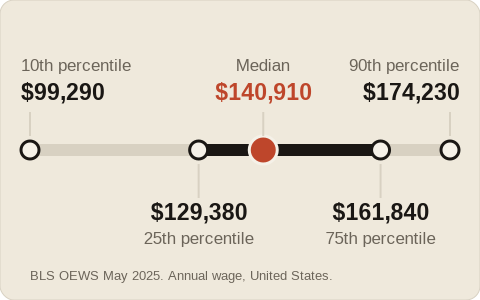
| Measure | Annual wage |
|---|---|
| 10th percentile | $99,290 |
| 25th percentile | $129,380 |
| Median (50th) | $140,910 |
| Mean (average) | $140,920 |
| 75th percentile | $161,840 |
| 90th percentile | $174,230 |
Source: U.S. Bureau of Labor Statistics, Occupational Employment and Wage Statistics (OEWS), May 2025, Pharmacists, retrieved 23 November 2026 through the BLS Public Data API.
Pharmacist hourly pay
The median hourly wage for pharmacists is $67.75, as published by BLS for May 2025. That is the hourly view of the same national middle as the $140,910 annual median above, so use it when an employer quotes you a rate and not a salary. Annual pay for a job with part-time or shift work depends on the hours you are given, which no national table can tell you.
Pharmacist salary by state
Where you work changes the number more than most things. The highest median is in Alaska, at $167,310. The lowest published median is in Rhode Island, at $128,180, a gap of $39,130 a year between two states. The gap is our subtraction of two BLS state medians. All figures below are the annual median wage in each state for May 2025.
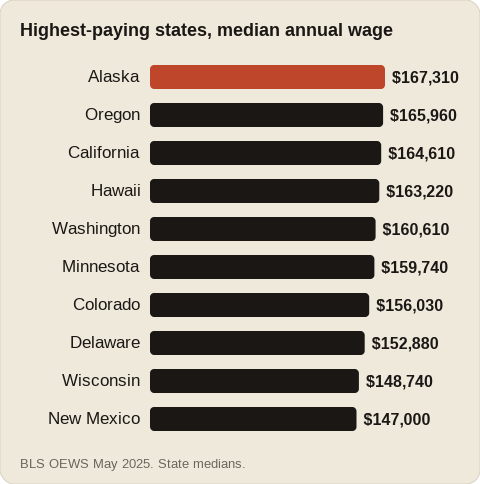
Top-paying states for pharmacists
| Rank | State | Median wage | vs US median |
|---|---|---|---|
| 1 | Alaska | $167,310 | +$26,400 |
| 2 | Oregon | $165,960 | +$25,050 |
| 3 | California | $164,610 | +$23,700 |
| 4 | Hawaii | $163,220 | +$22,310 |
| 5 | Washington | $160,610 | +$19,700 |
| 6 | Minnesota | $159,740 | +$18,830 |
| 7 | Colorado | $156,030 | +$15,120 |
| 8 | Delaware | $152,880 | +$11,970 |
| 9 | Wisconsin | $148,740 | +$7,830 |
| 10 | New Mexico | $147,000 | +$6,090 |
Pharmacist salary in all 50 states
| State | Median annual wage |
|---|---|
| Alaska | $167,310 |
| Oregon | $165,960 |
| California | $164,610 |
| Hawaii | $163,220 |
| Washington | $160,610 |
| Minnesota | $159,740 |
| Colorado | $156,030 |
| Delaware | $152,880 |
| Wisconsin | $148,740 |
| New Mexico | $147,000 |
| Arizona | $146,930 |
| South Dakota | $146,790 |
| Idaho | $144,900 |
| Indiana | $144,290 |
| Utah | $144,240 |
| Virginia | $144,060 |
| New Hampshire | $143,020 |
| New York | $142,090 |
| Montana | $142,080 |
| North Dakota | $142,040 |
| Connecticut | $141,290 |
| Maine | $140,930 |
| Nevada | $140,030 |
| Wyoming | $139,550 |
| Nebraska | $139,330 |
| Illinois | $139,080 |
| Maryland | $138,990 |
| Iowa | $138,860 |
| North Carolina | $138,860 |
| Texas | $138,260 |
| Massachusetts | $138,170 |
| Pennsylvania | $138,160 |
| Michigan | $137,860 |
| Kansas | $137,800 |
| New Jersey | $137,620 |
| Missouri | $137,610 |
| Georgia | $137,120 |
| Ohio | $137,020 |
| Kentucky | $136,530 |
| Vermont | $136,270 |
| Arkansas | $136,060 |
| Florida | $135,970 |
| South Carolina | $135,700 |
| Oklahoma | $135,140 |
| Alabama | $134,630 |
| West Virginia | $133,430 |
| Tennessee | $133,390 |
| Mississippi | $133,230 |
| Louisiana | $132,410 |
| Rhode Island | $128,180 |
Starting pay for pharmacists
BLS does not publish pay by years of experience, so nobody can honestly quote an official entry-level pharmacist salary. What the data gives is the bottom of the market. One in ten pharmacists earns $99,290 or less, and one in four earns $129,380 or less. Read those as the low end of the national range, not as what a new graduate will be offered, because older workers sit in the bottom tenth too.
What pharmacists do
Pharmacists dispense prescription medications and give patients information about the drugs and how to use them.
Duties BLS lists
- Fill prescriptions in the amounts physicians specify
- Check patients' allergies, conditions and other medications for potential interactions
- Instruct patients on proper use, side effects and storage
- Give vaccinations such as flu shots
- Work with insurance companies on billing issues
- Supervise pharmacy technicians and pharmacists in training
- Keep patient and pharmacy records
A typical day
The day is built around prescriptions: fill them, check each one against the patient's allergies, conditions and other medicines, explain how to take it, give vaccinations when asked, and keep records. BLS notes pharmacists spend much of the workday standing.
Where they work
- The largest employers were pharmacies and drug retailers (37 percent) and hospitals (32 percent).
- Most work full time. Those in facilities open 24 hours may work nights, weekends and holidays.
Source: U.S. Bureau of Labor Statistics, Occupational Outlook Handbook, Pharmacists, read 23 November 2026. BLS counted about 325,200 jobs in 2025 and projects 5% growth from 2025 to 2035, faster than the average for all occupations.
How to become a pharmacist: the career path
Typical entry-level education, according to BLS: doctoral or professional degree. Pharm.D. programs usually take 4 years, and applicants typically need at least 2 years of undergraduate prerequisite courses first. Each step below comes from the BLS Occupational Outlook Handbook, and the last step is the pay.
- 1Prepare
Undergraduate prerequisites
Pharm.D. programs typically require applicants to have at least 2 years of undergraduate prerequisite courses.
- 2Study
Doctor of Pharmacy (Pharm.D.)
Programs usually take 4 years, though some offer a 3-year option and others admit high school graduates into a 6-year program.
- 3License
State license
All states require a license. After the degree, candidates typically pass two exams and complete a state-specified number of internship hours, and pharmacists complete continuing education to keep it.
- 4Specialize
Optional residency or fellowship
Pharmacists seeking clinical or advanced positions may complete a residency or fellowship, typically 1 to 2 years.
- 5Pay
Median $140,910 a year
BLS median annual wage for pharmacists. The lowest-paid tenth earn $99,290 or less and the highest-paid tenth earn $174,230 or more.
Steps 1 to 4: U.S. Bureau of Labor Statistics, Occupational Outlook Handbook, Pharmacists, "How to Become One", read 23 November 2026. Pay step: U.S. Bureau of Labor Statistics, OEWS May 2025.
Pharmacist skills and certifications
These come from the CVBooster pharmacist resume guide, which lists what employers look for on a pharmacist CV. Put the ones you really have near the top of your CV, in the words the job ad uses.
Core skills
People skills
Licenses and certifications
- Board Certified Pharmacotherapy Specialist (BCPS), Board of Pharmacy Specialties
- Board Certified Ambulatory Care Pharmacist (BCACP), Board of Pharmacy Specialties
- Board Certified Oncology Pharmacist (BCOP), Board of Pharmacy Specialties
- Board Certified Infectious Diseases Pharmacist (BCIDP), Board of Pharmacy Specialties
- Pharmacy-Based Immunization Delivery certificate, American Pharmacists Association
More guides
Pharmacist salary questions
How much does a pharmacist make a year?
The median is $140,910 a year and the mean is $140,920. The lowest-paid tenth earn $99,290 or less and the highest-paid tenth earn $174,230 or more. Source: U.S. Bureau of Labor Statistics, OEWS May 2025.
How much does a pharmacist make an hour?
The median hourly wage is $67.75. Pharmacists in 24-hour facilities may work nights, weekends and holidays, which is worth asking about when you compare an hourly rate.
Which state pays pharmacists the most?
Alaska has the highest median at $167,310, followed by Oregon at $165,960 and California at $164,610. These are state medians for May 2025 from U.S. Bureau of Labor Statistics, OEWS May 2025, and the table above lists all 50 states.
What does a new pharmacist earn?
BLS does not publish pay by years of experience. The 10th percentile is $99,290 and the 25th is $129,380, which marks the lower end of the national market.
How long does it take to become a pharmacist?
You need a Doctor of Pharmacy degree. BLS says programs usually take 4 years after at least 2 years of undergraduate prerequisites, then licensure with two exams and internship hours. A residency adds 1 to 2 years.
Is pharmacist a growing job?
BLS projects 5% employment growth from 2025 to 2035, faster than the average for all occupations, adding about 17,100 jobs to the 325,200 held in 2025.
Sources and method
- Pay: U.S. Bureau of Labor Statistics, Occupational Employment and Wage Statistics (OEWS), May 2025, Pharmacists (SOC 29-1051), national and state estimates, retrieved 23 November 2026 through the BLS Public Data API. Wages are before tax. BLS defines what its wage figure includes and leaves out in the OEWS technical notes.
- The job, the route in and the outlook: U.S. Bureau of Labor Statistics, Occupational Outlook Handbook, Pharmacists, read 23 November 2026.
- Skills and certifications: the CVBooster pharmacist resume guide.
- Where we subtract or divide two BLS figures, the page says so. Nothing else on this page is estimated.
Pharmacist CV example
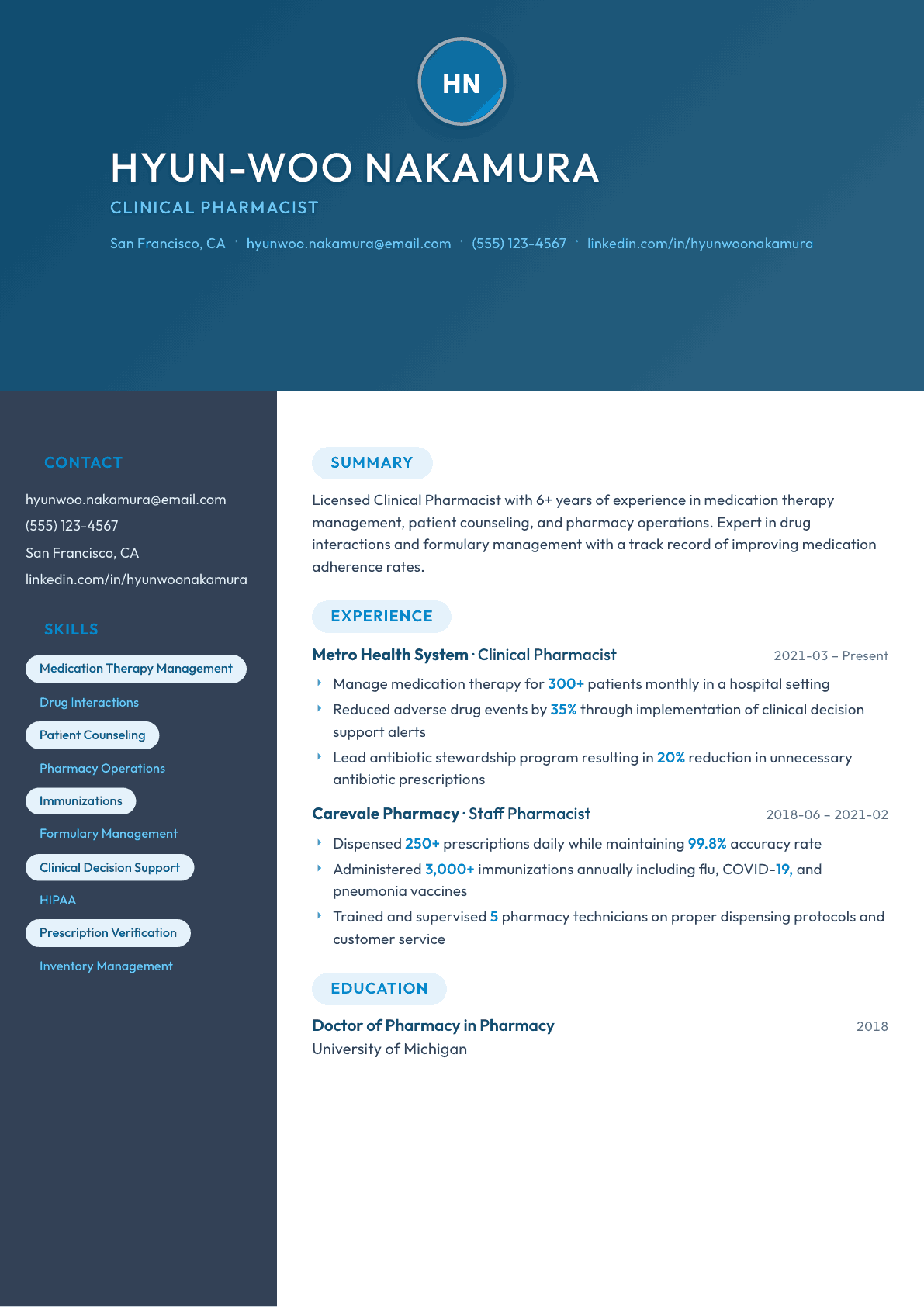
The CVBooster resume guide for this job has a finished example, three written summaries, before and after bullets and answers to the questions people ask.
Build your pharmacist CV
Create my CV