Pharmacist Resume Examples: free ATS score and gap list
Fill Your Pharmacist Resume with Winning Content
By Mustafa Tarabya, founder of CVBooster · Published · Updated
Pharmacist resume examples with expert tips, ATS keywords, and professional templates. See exactly what a winning clinical pharmacist resume looks like.
Sample resumes for a pharmacist
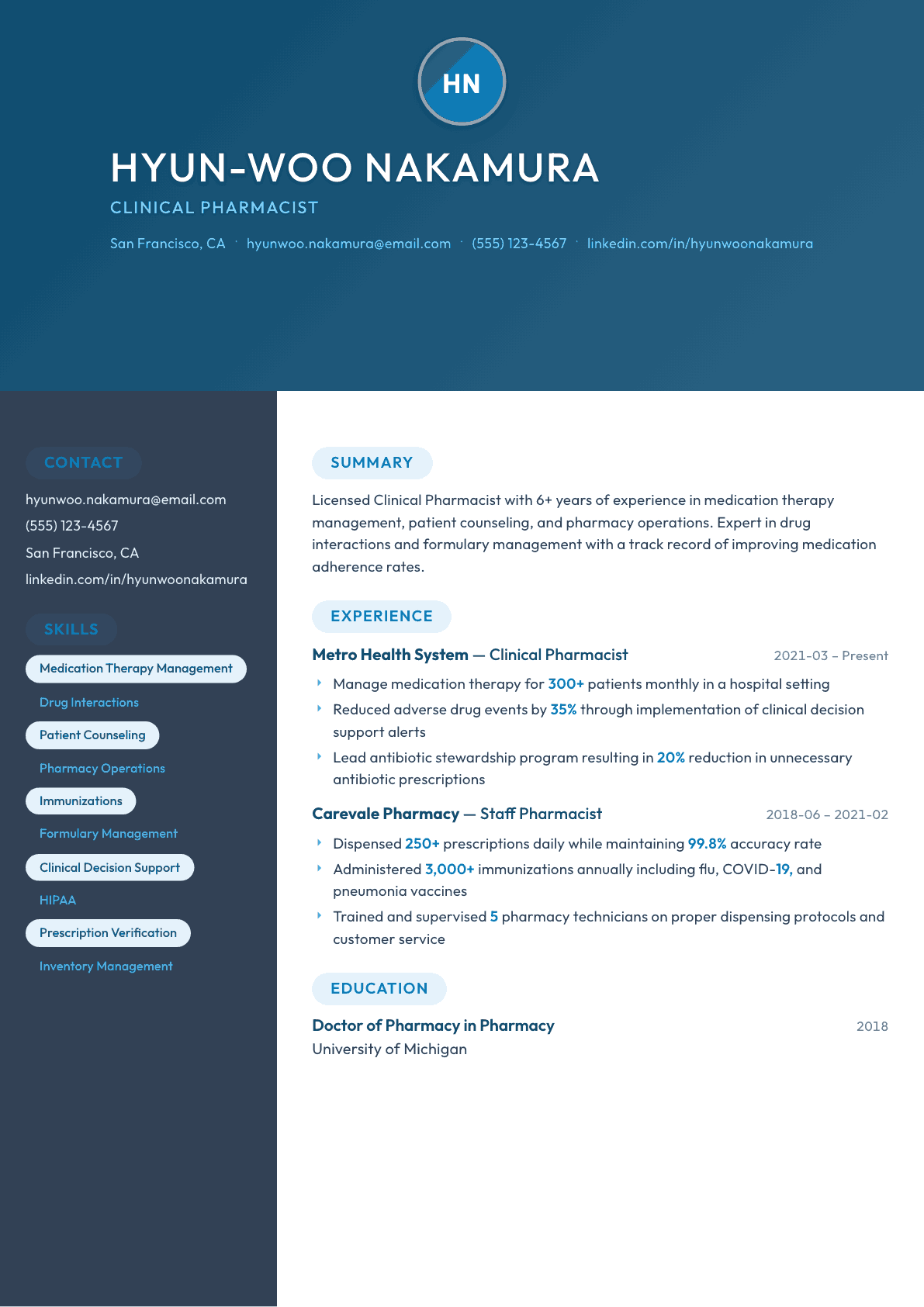
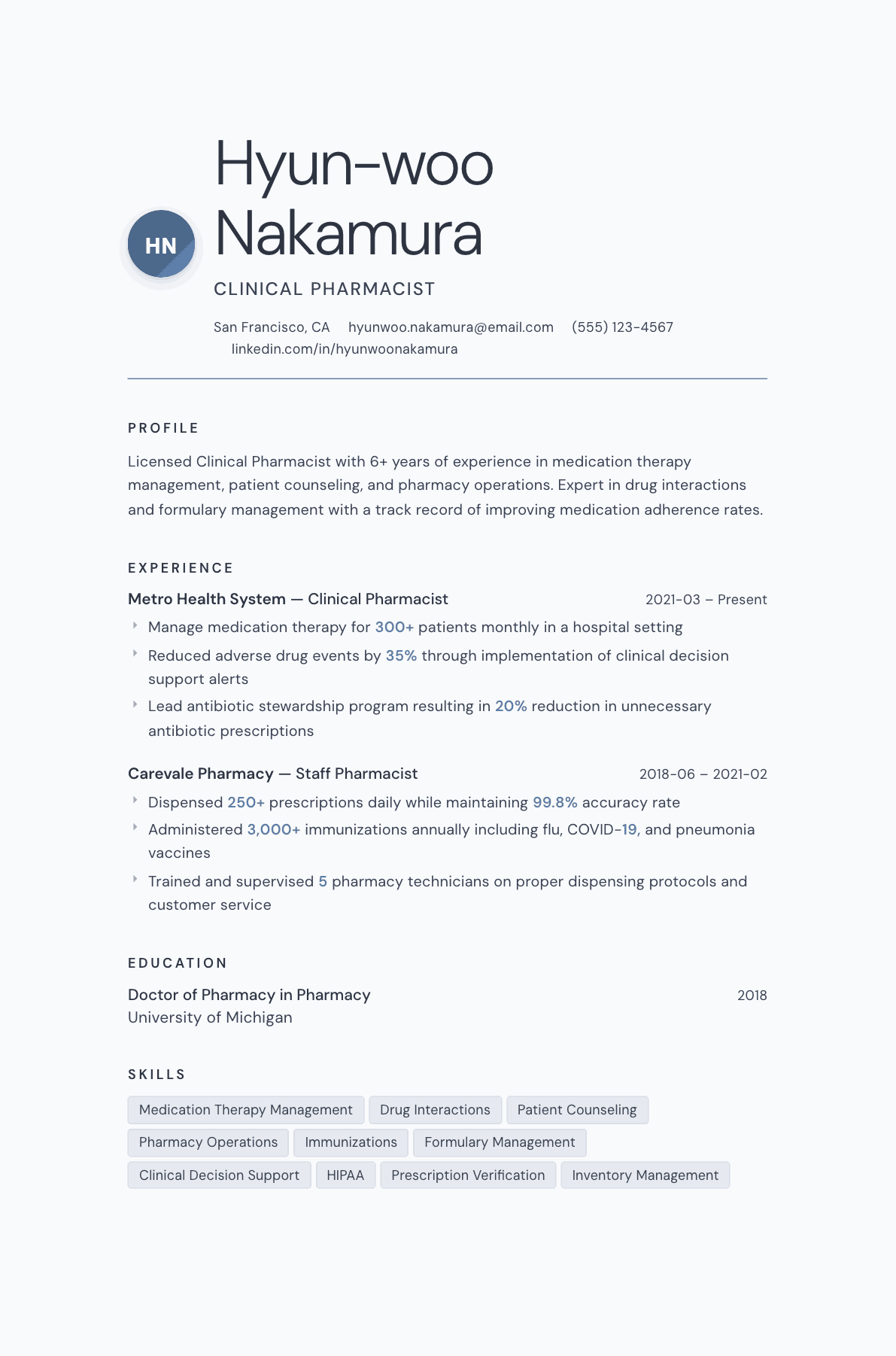
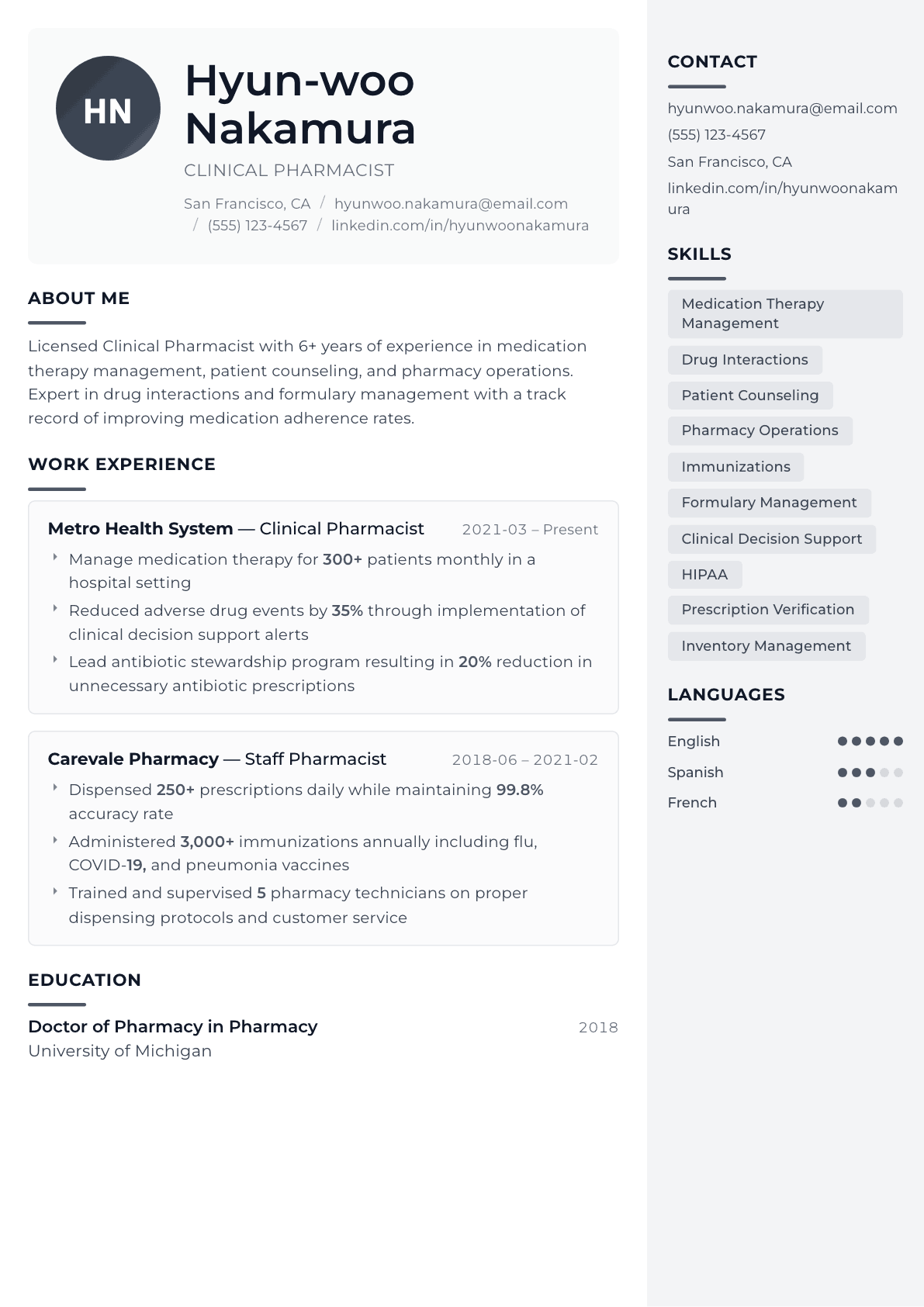
The same pharmacist content laid out in three CVBooster templates, so you can see what the finished document looks like before you write a word.
Example Pharmacist summary
PharmD with 6 years across hospital and retail practice, currently managing therapy for 300 inpatients a month and leading antibiotic stewardship. Cut adverse drug events 35% with clinical decision support alerts, and previously dispensed 250 prescriptions a day at 99.8% accuracy while giving 3,000 immunizations a year.
Skills to list on a Pharmacist resume
- Medication Therapy Management
- Drug Interactions
- Patient Counseling
- Pharmacy Operations
- Immunizations
- Formulary Management
- Clinical Decision Support
- HIPAA
- Prescription Verification
- Inventory Management
What actually gets this resume read
- List your PharmD, state license, and any board certifications (BCPS, BCGP).
- Quantify prescription volumes, accuracy rates, and patient outcomes.
- Highlight clinical programs you've developed or managed.
- Include immunization and patient education experience.
- Mention experience with pharmacy management systems (Epic, Pyxis).
How to write a pharmacist resume
A pharmacist resume is screened by a pharmacy director, a clinical coordinator or a district manager, and the first pass is entirely credential driven: the doctor of pharmacy degree, the state license and its status, any residency training, board certification, and immunization authority. Only after those clear does anyone read what you actually did.
The second pass depends entirely on the setting. A hospital clinical coordinator wants to see the services you cover, the rounds you attend, the protocols you manage under a collaborative agreement, and the stewardship or anticoagulation work you own. A retail district manager wants dispensing volume, accuracy, immunizations, adherence programs, workflow and staff supervision. A resume that is not written for one of those two readers satisfies neither.
This guide covers the section order pharmacy employers expect, how to present licensure, residency and board certification, how to write clinical services and dispensing volume with the right numbers, and the questions pharmacists ask when moving between community, hospital, ambulatory care, managed care and industry roles.
Format: credentials line, licensure block, then setting-matched experience
Reverse chronological, one page for community pharmacists early in a career and two pages for clinical, residency trained or supervisory pharmacists. Write the credential string after your name in the order the profession uses: doctorate, licensure, then board certification, so that a director reads the whole qualification in one line.
Give licensure and certification their own block near the top: pharmacist license by state with expiration, immunization certification and authority, any controlled substance registration your state issues, and board certification with the certifying body. Multi-state licensure matters for telepharmacy and for chains operating across state lines.
- Header: name with credentials, city and state, phone, email, and the states you are licensed in.
- Sections in this order: summary, licensure and certification, professional experience, residency and rotations, clinical services and systems, education.
- Residency trained candidates give each residency year its own entry with the site, the emphasis and the longitudinal service covered.
Summary: setting, scope, volume, specialty
Four lines. Name the setting, the years, the scope of practice and one area of depth. "Clinical pharmacist with six years in an acute care hospital covering internal medicine and the intensive care unit, managing anticoagulation and antimicrobial stewardship under a collaborative practice agreement" is a complete answer to what a coordinator wants to know.
For a community role, replace the clinical scope with the operational one: daily prescription volume, immunization volume, the staff you supervise, and the clinical services you provide such as adherence programs, point of care testing and medication therapy management.
Clinical experience: the services you own and the decisions you make
In hospital and ambulatory settings the reader is looking for ownership, not participation. Name the services you cover and the work you do on them: pharmacokinetic dosing for vancomycin and aminoglycosides, renal dose adjustment, anticoagulation management, total parenteral nutrition, antimicrobial stewardship interventions, code and rapid response coverage, medication reconciliation on admission and discharge, and formulary review or guideline authorship.
Say whether you practice under a collaborative practice agreement or protocol, because that defines your authority to initiate, adjust and monitor therapy. It is one of the strongest scope signals on a pharmacist resume and it is often left out entirely.
Interventions are the natural metric. Documented interventions, cost avoidance expressed as a count rather than a currency figure, adverse drug event reduction, stewardship acceptance rates and time to appropriate therapy are all measures pharmacy departments already report. Use theirs rather than inventing your own.
Community and operational experience: volume, accuracy, workflow
In retail and health system outpatient settings, write the operational numbers a district manager compares: prescriptions filled per day, immunizations administered per season, technician and intern headcount supervised, wait time or promise time performance, and any workflow change you implemented.
Accuracy and safety deserve a bullet of their own. Verification volume, near miss reporting, controlled substance inventory and reconciliation, and any audit you passed without findings all say more about your practice than a claim of attention to detail.
Clinical programs in the community setting are what distinguish a candidate now: immunizations, point of care testing, hormonal contraception and other prescriptive authority where the state grants it, naloxone dispensing, medication therapy management completion, adherence and refill synchronization, and specialty or compounding services. Name the ones you have actually run.
Systems and the words the posting will use
Name the systems you work in: the hospital electronic health record and its pharmacy module, the community dispensing system, automated dispensing cabinets, sterile compounding workflow software, and any clinical surveillance tool used for stewardship or dosing alerts. Platform familiarity shortens the training period and directors weigh it.
Pharmacy postings repeat a stable vocabulary: medication therapy management, medication reconciliation, drug utilization review, formulary management, clinical decision support, patient counseling, immunization administration, sterile and non-sterile compounding, controlled substance compliance, and interdisciplinary rounds. Mirror the posting language once in a skills block and once inside a bullet.
Compounding standards are worth naming precisely if you have practiced under them, because sterile compounding competence is a specific, verifiable qualification rather than a general claim about accuracy.
Pharmacist resume summary examples
New graduate pharmacist
Doctor of pharmacy graduate licensed and immunization certified, with advanced rotations in acute care internal medicine, ambulatory care, community practice and infectious disease. Comfortable with medication reconciliation, pharmacokinetic dosing and patient counseling, and seeking a hospital staff or community position.
Six years clinical
Clinical pharmacist with six years in acute care covering internal medicine and the intensive care unit, dosing vancomycin and managing anticoagulation under a collaborative practice agreement. Leads antimicrobial stewardship rounds twice weekly and precepts fourth year pharmacy students on longitudinal rotations.
Pharmacy manager or coordinator
Pharmacy manager with twelve years across community and health system practice, currently leading a team of six pharmacists and fourteen technicians. Owns controlled substance compliance, sterile compounding oversight and the immunization program, and rebuilt the workflow that sets daily verification capacity.
Work experience bullets: before and after
Before: Provided pharmaceutical care to hospital patients.
After: Covered internal medicine and intensive care services for roughly 300 patients monthly, attending daily rounds and completing medication reconciliation at admission and discharge.
Service coverage, patient volume and rounding presence describe the clinical job rather than the profession.
Before: Reduced medication errors.
After: Cut adverse drug events on the medicine service by building clinical decision support alerts for renal dosing and by adding a pharmacist check to the discharge medication list.
Naming the two interventions makes the safety result attributable to your work.
Before: Participated in antibiotic stewardship.
After: Led twice weekly stewardship rounds with an infectious disease physician, recommending de-escalation and intravenous to oral conversion, with most recommendations accepted and documented in the chart.
Cadence, partner and acceptance turn committee membership into demonstrated clinical influence.
Before: Filled prescriptions accurately.
After: Verified more than 250 prescriptions daily in a high volume community pharmacy while maintaining an accuracy record with no reportable dispensing errors across three annual audits.
Volume plus an audited accuracy record is far stronger than a claim about carefulness.
Before: Gave vaccines to patients.
After: Administered thousands of immunizations across two seasons including influenza, pneumococcal and travel vaccines, and trained four technicians to run the scheduling and screening workflow.
Scale plus the team you built shows program ownership rather than task completion.
Hard skills
- Medication therapy management
- Pharmacokinetic dosing
- Anticoagulation management
- Antimicrobial stewardship
- Medication reconciliation
- Drug utilization review
- Formulary management
- Sterile and non-sterile compounding
- Immunization administration
- Controlled substance compliance
- Patient counseling
- Clinical decision support and order verification
Soft skills
- Recommending therapy changes to physicians
- Counseling clarity with patients
- Prioritization at peak volume
- Precepting students and residents
- Technician supervision
- Composure during drug shortages
Certifications worth listing
- Board Certified Pharmacotherapy Specialist (BCPS) (Board of Pharmacy Specialties)
- Board Certified Ambulatory Care Pharmacist (BCACP) (Board of Pharmacy Specialties)
- Board Certified Oncology Pharmacist (BCOP) (Board of Pharmacy Specialties)
- Board Certified Infectious Diseases Pharmacist (BCIDP) (Board of Pharmacy Specialties)
- Pharmacy-Based Immunization Delivery certificate (American Pharmacists Association)
- Certified Diabetes Care and Education Specialist (CDCES) (Certification Board for Diabetes Care and Education)
Mistakes that cost pharmacist candidates the interview
- Sending a clinical resume to a community role or a dispensing resume to a hospital role, when the two readers want opposite evidence.
- Leaving the license state and status off the page, which stops a file at the first human resources check.
- Never naming a collaborative practice agreement or protocol, so the reader cannot tell what therapy you may initiate or adjust.
- Omitting residency detail, when the site, the emphasis and the longitudinal service are exactly what a coordinator evaluates.
- Writing cost avoidance as a currency total, which reads as unverifiable, instead of intervention counts and acceptance rates.
- Skipping dispensing volume and verification numbers in a community application where those are the comparison metrics.
- Listing immunization certification without the actual volume administered or the program you helped run.
Pharmacist resume questions
Do I need a residency to get a hospital pharmacist job?
A first year residency is expected for most clinical positions and many staff roles at academic centers, while community hospitals still hire experienced pharmacists without one. If you do not have a residency, lead with the services you cover independently and any board certification.
How should I present board certification?
Put the credential after your name and repeat it in the licensure block with the certifying body and the recertification date. Board certification is the clearest signal of specialty depth for a pharmacist who is not residency trained, and it should never be buried.
What numbers belong on a community pharmacist resume?
Prescriptions verified or filled per day, immunizations administered per season, technicians and interns supervised, medication therapy management cases completed, and audit results. Those are the operational measures a district manager uses to compare candidates.
How do I move from retail into a clinical or ambulatory care role?
Lead with the clinical services you already deliver: medication therapy management, immunizations, point of care testing, adherence programs and any prescriptive authority your state grants. Then name the protocols you follow and any certificate training you completed in the target area.
How long should a pharmacist resume be?
One page early in a community career and two pages once you have residency training, board certification, precepting or management responsibility. Do not compress residency and licensure detail to save space, because those are the sections that get verified first.