Registrar Resume Examples: free ATS score and gap list
Write a Registrar Resume That Proves Records Accuracy at Scale
By Mustafa Tarabya, founder of CVBooster · Published · Updated
Build a registrar resume with a full example, student information system keywords, FERPA language, and section by section writing guidance.
Sample resumes for a registrar
The same registrar content laid out in three CVBooster templates, so you can see what the finished document looks like before you write a word.
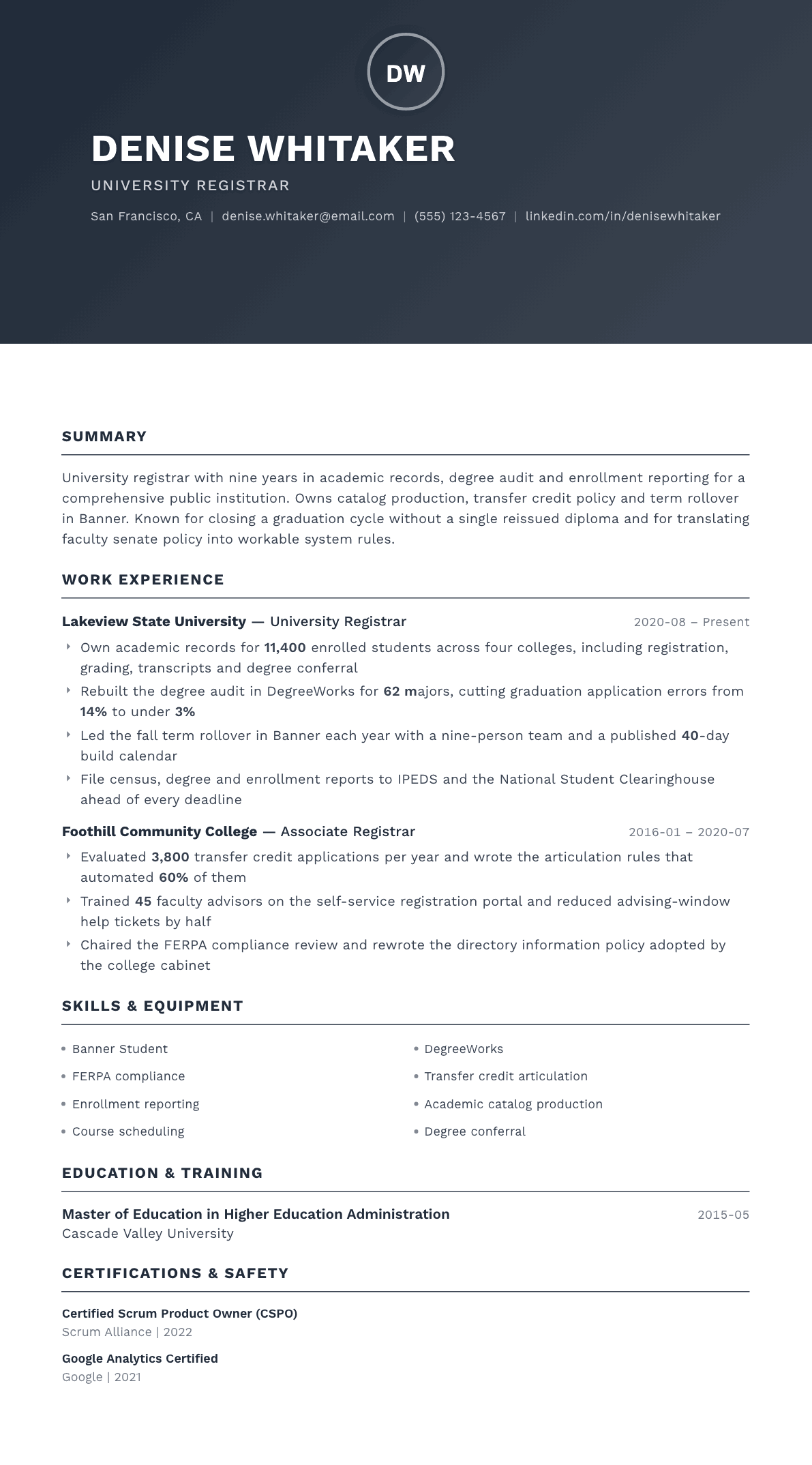
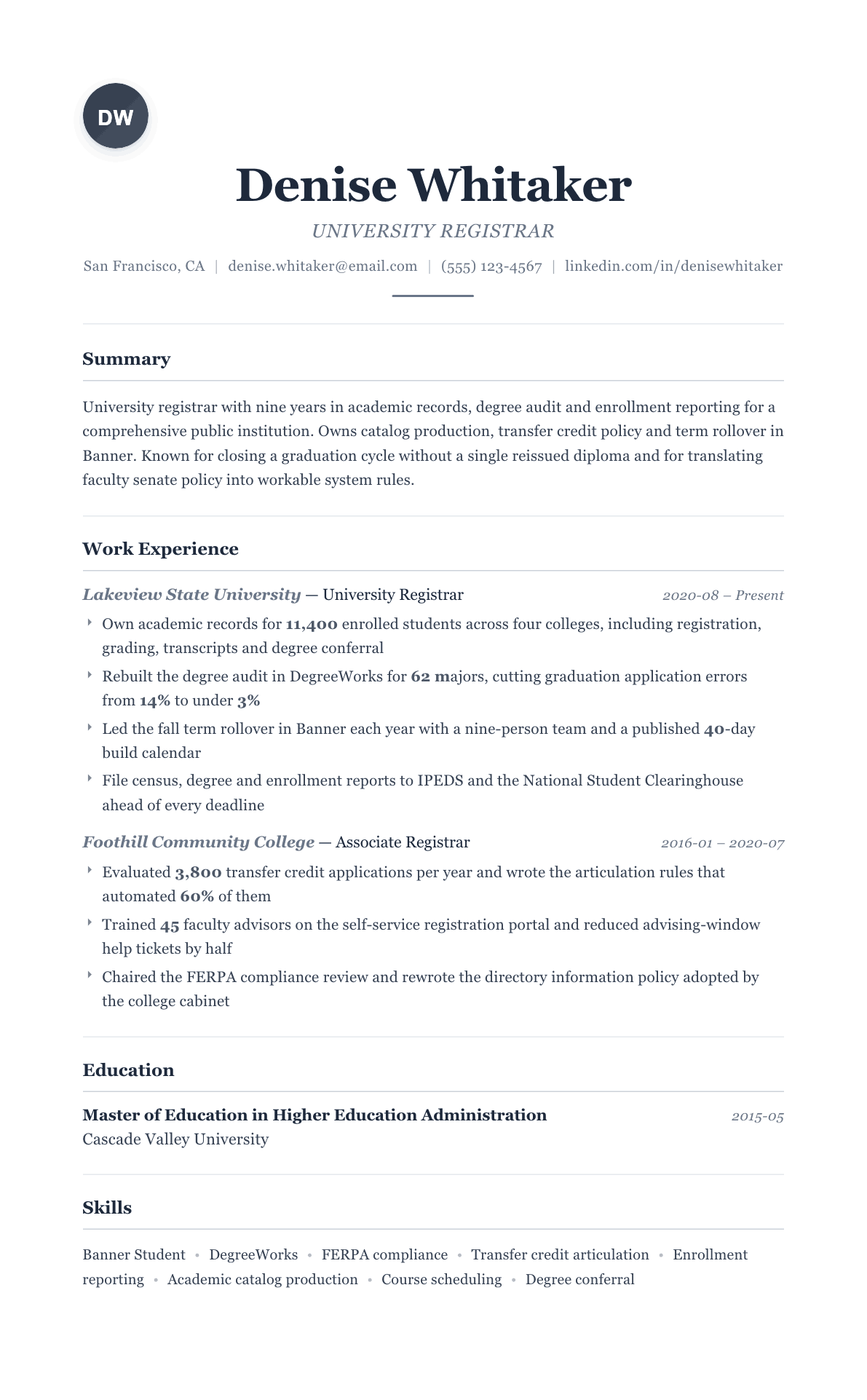
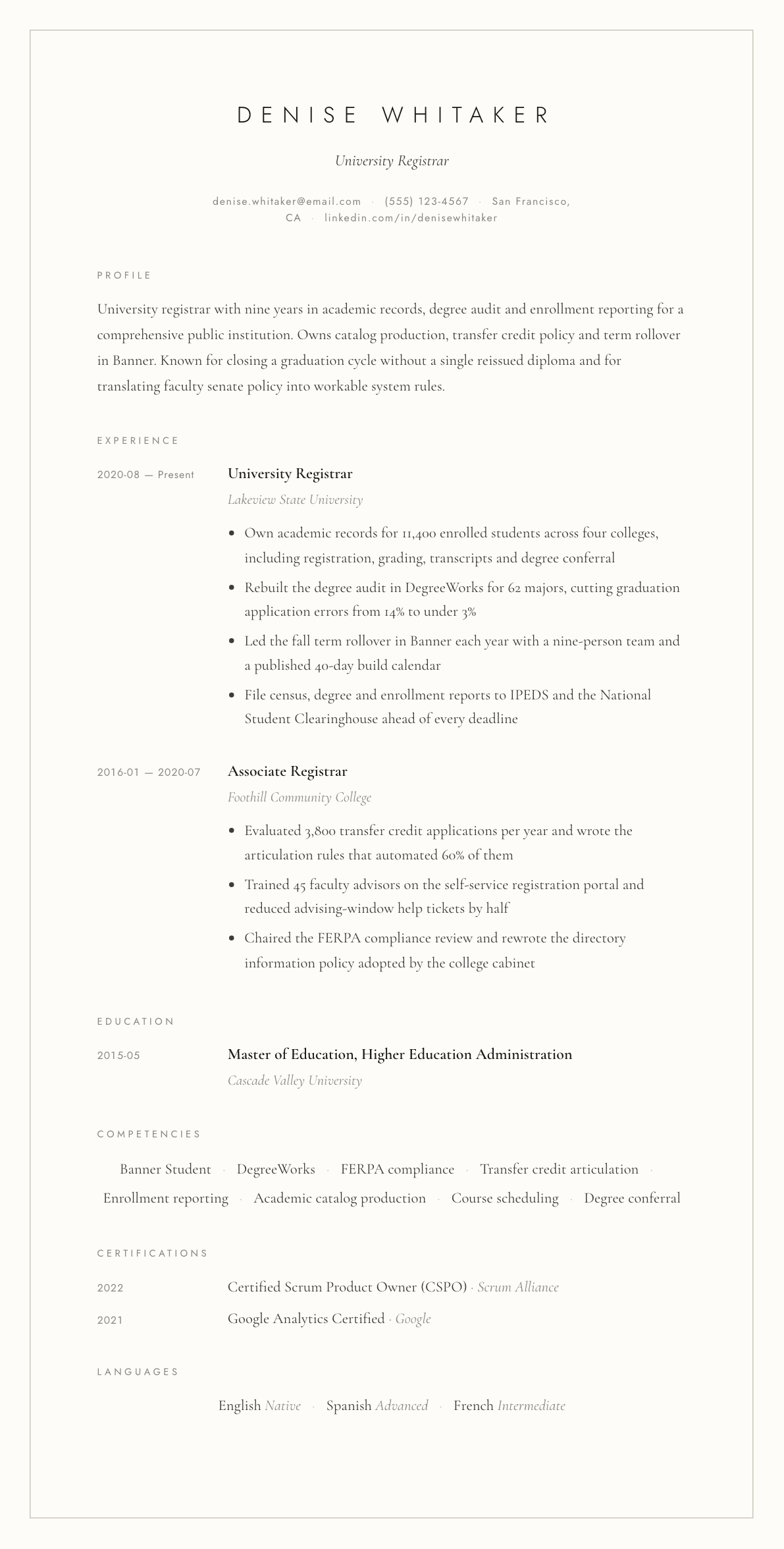
Example Registrar summary
Registrar with nine years of academic records leadership at public two-year and four-year institutions. Runs registration, grading, degree audit and conferral in Banner for more than eleven thousand students, and files census and Clearinghouse reporting on time every term. Rewrote a transfer articulation ruleset that automated most credit evaluations. Seeking a registrar role at a growing regional university.
Skills to list on a Registrar resume
- Student information systems
- Banner Student
- Ellucian Colleague
- PeopleSoft Campus Solutions
- DegreeWorks
- FERPA compliance
- Academic records management
- Transfer credit evaluation
- Degree audit and conferral
- Course and room scheduling
- Enrollment reporting
- IPEDS reporting
- Catalog and curriculum management
- Commencement operations
- Veterans benefits certification
- SQL reporting
What actually gets this resume read
- Name the student information system in the header skills line, because Banner, Colleague, PeopleSoft and Workday Student are rarely interchangeable to a search committee.
- Give the enrollment headcount and the number of colleges or campuses you served, so the reader can size the records operation you ran.
- Show FERPA work as something you decided, not something you attended: a policy you rewrote, a release form you redesigned, an audit you passed.
- Put reporting cycles on the page by name: census files, IPEDS submissions, National Student Clearinghouse uploads and veterans certification.
- Describe term rollover, catalog build and commencement as projects with a calendar, a team size and a deadline you held.
- List the degree audit tool separately from the SIS, since many postings screen for DegreeWorks or Stellic experience on its own line.
How to write a registrar resume
A registrar resume is judged on one question: can this person be trusted with the official academic record. Everything else is secondary. The provost or dean chairing the search wants evidence that transcripts were accurate, that degrees conferred on time, that census files went out clean, and that nobody had to reissue a diploma because a hold was released early.
That makes the registrar file unusually concrete. Name the student information system, the degree audit tool, the enrollment size, the reporting cycles you owned and the policy work you signed. A resume that says 'managed academic records' without naming Banner, Colleague, PeopleSoft or Workday Student tells a search committee nothing it can screen on.
This guide covers the section order registrar searches expect, how to size your operation on the page, three summaries for a records specialist, an associate registrar and a registrar, before-and-after bullets, and the questions that come up when a records professional sits down to write.
Format: two pages, systems named in the top third
Reverse chronological, two pages once you are past an assistant title. Registrar work compounds, and a one-page file forces you to cut the reporting cycles and the system migrations that make you hirable. Keep a single column, because campus applicant tracking systems in higher education parse columns badly and dates matter more here than in almost any other field.
Put a technical line high on the page listing the student information system, the degree audit product, the reporting tools and the document imaging platform. Search committees screen on those names first, then read the narrative.
- Header: name, city and state, phone, professional email, and an association membership line if you hold one.
- Sections in this order: summary, systems and tools, professional experience, education, professional development and service.
- Give every institution a size descriptor: public four-year, community college district, private liberal arts, and the enrollment.
Summary: institution type, enrollment, systems, one thing you fixed
Four lines at most. State the institution type and enrollment, the system you work in, and the functional areas you own: registration, grading, transcripts, degree audit, conferral, scheduling, compliance reporting. Close with one specific improvement you made rather than a claim about attention to detail.
If you are moving up from associate registrar, use the summary to show the scope you already carried alone. Committees hire registrars who have already run a term without the director in the building.
Experience: cycles, volumes, and the decisions you owned
The academic year is a set of repeating cycles, so build each job around them. Registration build and term rollover. Grading and grade change workflow. Census and enrollment verification. Degree audit and graduation clearance. Commencement. Catalog production. A committee reading your file wants to know which of those you owned outright, which you supported, and how large each one was.
Volumes convert experience into a number a reader can compare: enrolled headcount, sections scheduled per term, transcripts issued, transfer evaluations completed, degrees conferred. Pair each with the outcome, not just the count. 'Cleared 1,600 graduation applications with a three-day average review' says far more than 'processed graduation applications.'
Do not spend bullets on tasks any records office performs. Data entry, answering the front counter and running standard reports are assumed. Spend the space on articulation rules you wrote, a catalog you moved to a new platform, a compliance finding you closed, or an audit you passed without exception.
Compliance and reporting: prove you can carry the deadlines
FERPA belongs on a registrar resume as work, not as a keyword. Show the training you delivered, the directory information policy you revised, the release workflow you rebuilt, or the third-party request process you documented. Everyone claims familiarity, so specificity is what separates the file.
The same is true of external reporting. Name the submissions you personally prepared: IPEDS components, National Student Clearinghouse enrollment and degree files, state reporting, veterans benefits certification, and athletics eligibility certification where applicable. A registrar who has never missed a Clearinghouse deadline should say so plainly.
- Name each recurring submission and your role: prepared, reviewed, certified or signed.
- Include any accreditation self-study or program review you contributed data to.
- Mention system migrations by product and by your role in testing, mapping or training.
Skills and keywords the screen is looking for
Registrar postings recycle the same vocabulary: academic records, degree audit, transfer credit articulation, curriculum and catalog management, scheduling, enrollment verification, academic policy, FERPA. Mirror those phrases once in the skills block and once inside a bullet where you show the work.
Add the technical layer that many candidates leave off: SQL or Argos reporting, Ellucian workflow, CRM integration, electronic transcript exchange through a national clearinghouse or a state network, and any scheduling optimizer such as Ad Astra or CollegeNET. Those lines move a file toward the interview pile at larger institutions.
Registrar resume summary examples
Records specialist
Academic records specialist with three years in a community college registrar office processing registration changes, transcripts and enrollment verifications in Colleague. Trained on FERPA release procedures and transfer credit entry, and rebuilt the missing-document tracker used by the front counter team.
Associate registrar
Associate registrar at a private university of 4,800 students, responsible for term rollover, course scheduling and degree audit in Banner and DegreeWorks. Led the transfer articulation rewrite that automated most incoming evaluations, and prepared the IPEDS and Clearinghouse submissions for five consecutive years.
University registrar
University registrar for a public institution with more than eleven thousand students across four colleges. Owns records, registration, scheduling, conferral and compliance reporting, directs a staff of nine, and has closed six graduation cycles without a reissued diploma. Led the migration from a legacy catalog system to a curriculum management platform.
Work experience bullets: before and after
Before: Responsible for maintaining student academic records.
After: Maintained the official academic record for more than eleven thousand enrolled students, including registration, grade posting, transcript issuance and degree conferral across four colleges.
The headcount and the named functions let a committee size the operation instead of guessing at it.
Before: Worked with the degree audit system.
After: Rebuilt degree audit encoding in DegreeWorks for 62 majors and 14 minors, cutting graduation application errors from 14% to under 3% in two cycles.
Naming the product, the scope and the error movement turns a tool mention into demonstrated ownership.
Before: Handled transfer credit.
After: Evaluated 3,800 transfer applications a year and wrote articulation rules that automated 60% of incoming credit decisions without faculty review.
Volume plus the automation share shows you improved the process rather than only working inside it.
Before: Ensured FERPA compliance.
After: Chaired the annual FERPA review, rewrote the directory information policy adopted by cabinet, and delivered training to 120 staff and faculty advisors.
Compliance becomes credible when it is attached to a policy you authored and an audience you taught.
Before: Submitted required reports on time.
After: Prepared and certified census, degree and enrollment submissions to IPEDS and the National Student Clearinghouse, with no late file across seven reporting years.
Naming the specific submissions and the streak is the reporting claim a director can actually verify.
Hard skills
- Banner Student
- Ellucian Colleague
- PeopleSoft Campus Solutions
- Workday Student
- DegreeWorks
- Academic catalog and curriculum management
- Transfer credit articulation
- Course and room scheduling
- Degree audit and graduation clearance
- Enrollment verification
- IPEDS and Clearinghouse reporting
- FERPA policy administration
- SQL and Argos reporting
- Electronic transcript exchange
Soft skills
- Deadline discipline
- Policy interpretation
- Cross-office coordination
- Staff supervision
- Written communication with faculty
- Discretion with confidential records
Mistakes that cost registrar candidates the interview
- Leaving the student information system off the resume, which is the single field most registrar searches screen on first.
- Writing duties instead of cycles, so the reader cannot tell whether you have ever owned a term rollover start to finish.
- Omitting enrollment size, which makes a district office of thirty thousand students look identical to a campus of nine hundred.
- Treating FERPA as a keyword rather than showing a policy, a training session or an audit you handled.
- Burying compliance reporting at the bottom when it is often the deliverable a provost worries about most.
- Using a two-column template with icons, which campus parsers frequently reorder and which drops your employment dates.
Registrar resume questions
How long should a registrar resume be?
Two pages once you have held an associate or director title. Records work is cyclical and cumulative, and cutting to one page usually means deleting the reporting cycles, system migrations and policy work that make the file competitive.
Do I need to name the student information system?
Yes, and near the top. Banner, Colleague, PeopleSoft and Workday Student are not interchangeable, and many institutions filter candidates by product because retraining a registrar on a new system takes an entire academic year.
How do I show FERPA experience without sounding generic?
Describe a decision instead of a familiarity. A policy you rewrote, a release form you redesigned, a third-party request workflow you documented, or training you delivered to advisors carries weight that a compliance keyword never will.
What if I am moving from a community college to a university?
Say what transfers and what scales. Articulation, state reporting and high-volume registration are directly comparable. Add a line showing you understand the differences in graduate records, athletics certification and academic senate governance you will inherit.
Should I list professional association membership?
List it if it is active and if you have presented, served on a committee or completed a professional development track. A bare membership line adds little, but visible participation signals that you follow policy changes across the field.