University Professor Resume Examples: what gets the call
Publish a University Professor Resume That Earns Tenure-Track Offers
By Mustafa Tarabya, founder of CVBooster · Published · Updated
Create a university professor CV highlighting research publications, teaching philosophy, and grant funding with the academic rigor search committees expect.
Sample resumes for a university professor
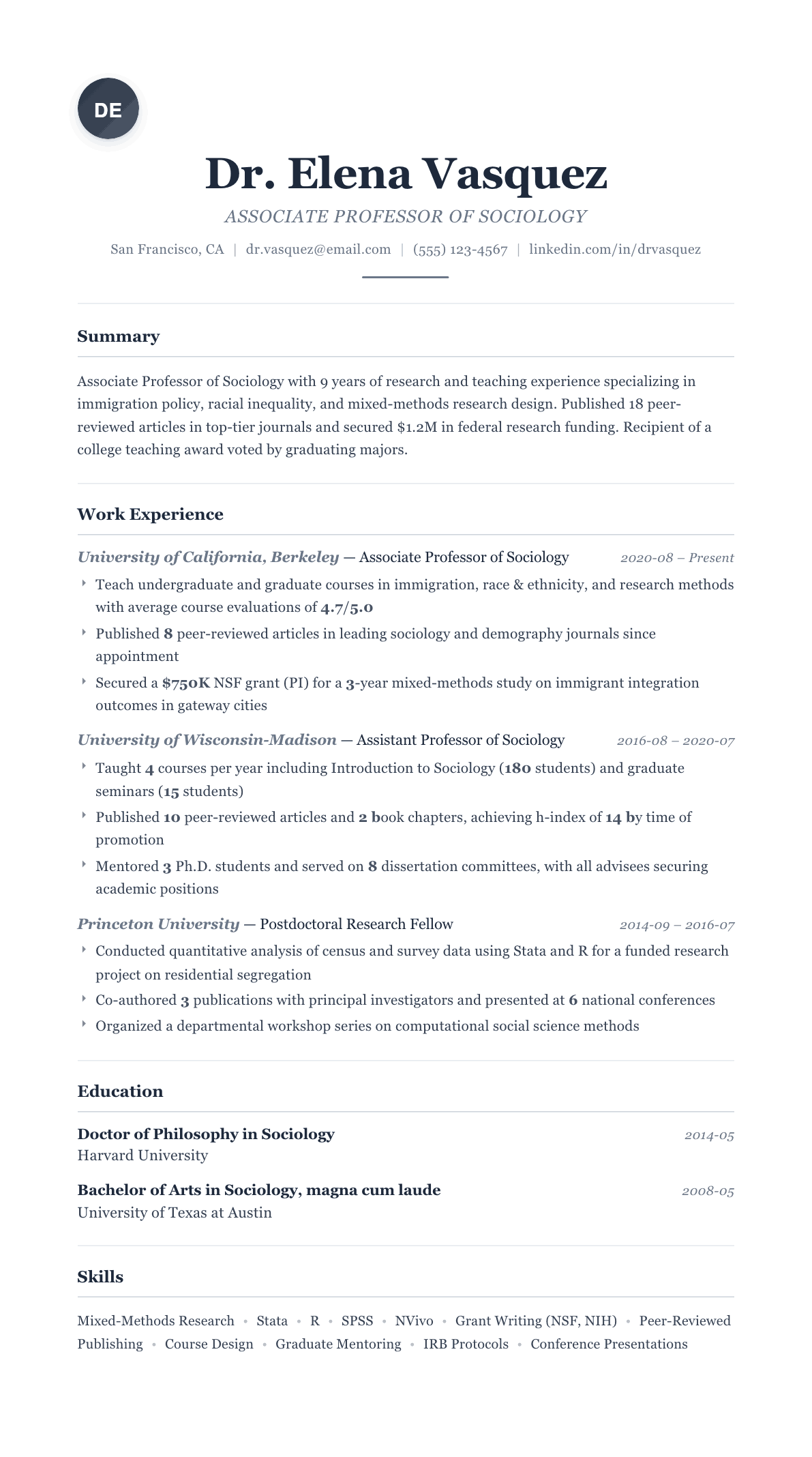
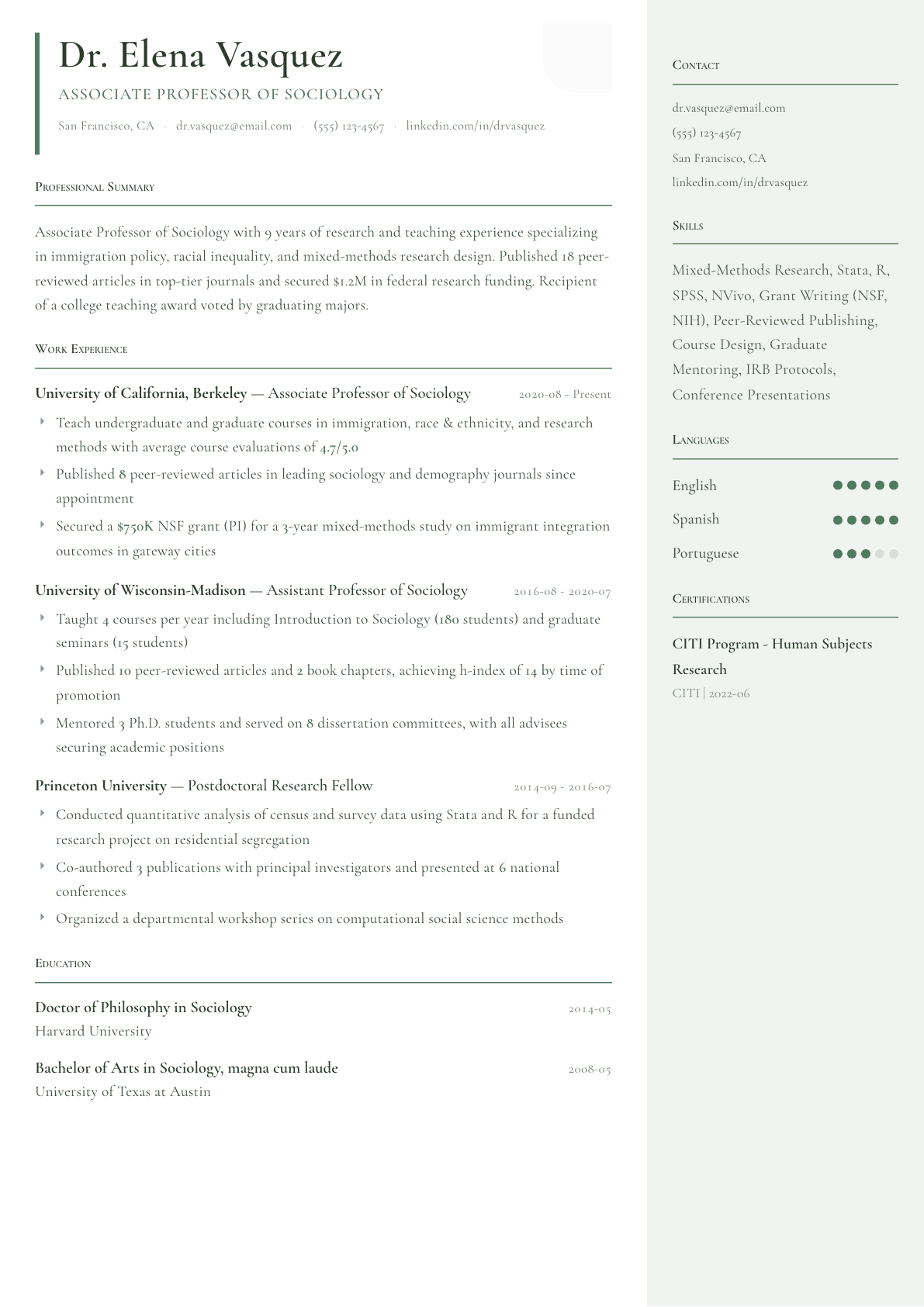
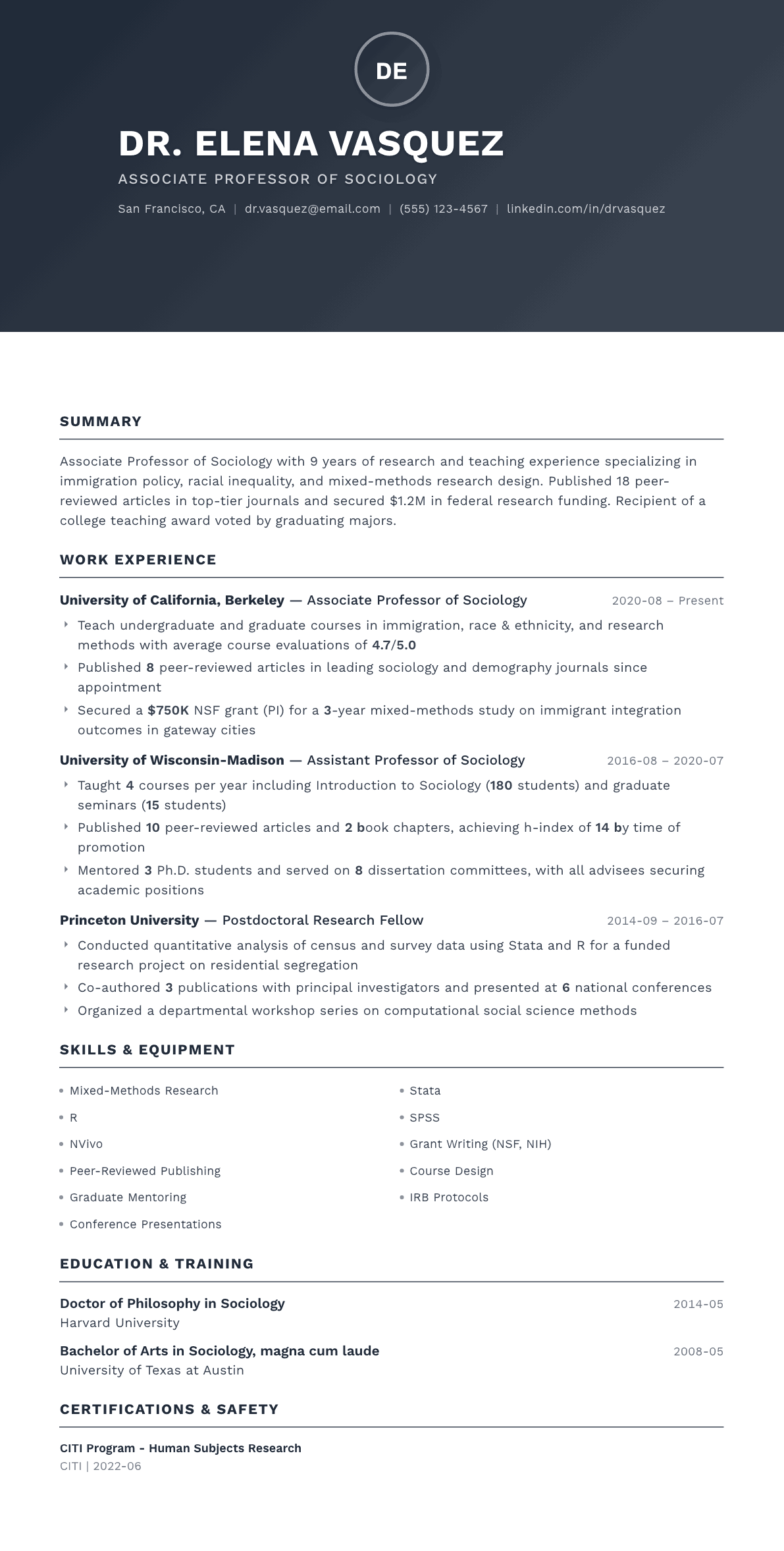
The same university professor content laid out in three CVBooster templates, so you can see what the finished document looks like before you write a word.
Example University Professor summary
Associate Professor of Sociology with 9 years of research and teaching experience. Published 18 peer-reviewed articles in top-tier journals and secured $1.2M in NSF/NIH funding. Expert in mixed-methods research design with a commitment to mentoring the next generation of scholars.
Skills to list on a University Professor resume
- Peer-Reviewed Research
- Grant Writing (NSF, NIH)
- Mixed-Methods Design
- Stata / R / SPSS
- Qualitative Analysis (NVivo)
- Course Design & Instruction
- Graduate Mentoring
- Dissertation Supervision
- IRB Protocols
- Conference Presentations
- Academic Publishing
- Curriculum Development
- Data Visualization
- Research Ethics
What actually gets this resume read
- Lead with research focus areas, publications, and grants in a dedicated section.
- Include h-index, citation counts, or journal impact factors if impressive.
- List teaching experience with course names, enrollment sizes, and evaluation scores.
- Detail grant funding: agency, amount, role (PI/Co-PI), and project duration.
- Describe mentoring: Ph.D. students, dissertation committees, postdoc supervision.
- Include service: editorial boards, committees, conference organization, peer review.
How to write a university professor resume
Academic hiring runs on a curriculum vitae, not a resume, and the difference is not cosmetic. A CV is a complete record, it grows for the length of a career, and a search committee expects to find every publication, every course, every grant and every student you have supervised. Trimming it to two pages to look concise signals that you do not know how the process works.
The committee is a group of faculty in your field reading dozens of files in a few weeks. They sort quickly by fit with the advertised area, then read the publication record for placement and trajectory, then the teaching record against the courses the department actually needs covered, then funding. Only the shortlist gets read closely. Your job is to make the first pass effortless.
This guide covers CV structure and section order, how to present publications so a reader can judge them, how to make a teaching record legible, and what changes when you are applying to a research university, a teaching-focused college or a community college. It ends with the questions candidates ask most on the academic job market.
Structure: section order signals what kind of job you want
Put the sections in the order the hiring institution cares about. At a research university, that means education, appointments, publications, grants, then teaching, service and mentoring. At a teaching-focused college or a community college, teaching experience, courses taught and evidence of teaching effectiveness move above publications, and the committee will notice if you left the research-first order in place. Two versions of the same CV is normal practice.
Use plain headings and reverse chronology inside each section. No columns, no icons, no rating bars. Page numbers and your name in a running header are appreciated by committees printing files for a meeting. Length follows career stage: a new PhD is often four to eight pages, a mid-career professor considerably more.
- Header: name, degrees, department, institution, professional email, and a persistent researcher identifier.
- Research track order: education, appointments, publications, grants, invited talks, teaching, advising, service.
- Teaching track order: education, teaching appointments, courses taught, teaching evaluation and development, publications, service.
Publications: format so a reader can judge them in seconds
Group by type and label each group clearly: peer-reviewed journal articles, book chapters, books and edited volumes, conference proceedings, and work under review or in preparation kept in a separate clearly marked block. Never mix a manuscript in preparation into the same list as published work.
Use your field citation style, put the full author list in order, and mark your own name in bold or with an asterisk so a reader can see your position. In fields where author order carries meaning, mark corresponding authorship and note co-first authors. Add the venue every time. Committee members judge a record by where the work appeared, and hiding the journal name forces them to look it up, which they will not do for every file.
If you supervise students, marking student co-authors is worth doing. It shows a committee that you produce work through a group rather than alone, which is exactly what they are hiring you to do.
Grants and funding without turning the CV into an invoice
List each award with the funding body, the program, your role as principal investigator or co-investigator, the project title and the period. Role is the part committees read most closely, because leading an externally funded project is a different signal from being named on someone else's. Keep internal seed awards in a separate subsection so they do not dilute the external record.
Include submitted and unfunded proposals only in a clearly labeled block, and only when the application record itself is the point, for instance when you are early in a career and want to show you are already writing to a federal agency. Never present a pending application in a way that reads as an award.
Teaching and mentoring: courses, levels, and evidence
A courses taught table is worth more than a paragraph. Give the course title and number, the level, the enrollment, whether you designed it or inherited it, and how many times you have run it. A committee needs to know whether you can cover the required methods sequence and the large introductory lecture, which are usually the real staffing problem behind the advertisement.
Evidence of effectiveness belongs here too, handled carefully. Course evaluation scores can be included with the scale and the departmental comparison, or left out entirely if your institution reports them in a way that does not travel. Teaching awards, peer observation, curriculum development and pedagogy training are all stronger signals than a bare number.
Mentoring is its own section once you have any: doctoral students advised with their placements, master's theses, undergraduate research students, and committee memberships. Placement outcomes for your advisees say more about you as a supervisor than anything you can claim directly.
Service, and what the CV does not carry
Departmental, institutional and disciplinary service goes near the end, but it is read. Journal reviewing, editorial roles, conference organizing, program committees and society offices show that the field knows you. Departmental committee work shows you will carry load once hired, which matters more at small institutions than at large ones.
The CV does not carry argument. The cover letter, the research statement, the teaching statement and the diversity statement do that work, and they are where you explain the trajectory the CV only lists. Keep the CV factual, keep every entry verifiable, and let the other documents make the case.
University Professor resume summary examples
Candidate on the job market
Sociology PhD candidate defending this spring, working on immigration policy and mixed-methods design. Three peer-reviewed articles published and 2 under review, instructor of record for 2 undergraduate courses, and a dissertation fellowship supporting the final year of fieldwork in 2 gateway cities.
Assistant professor going up for tenure
Assistant professor of sociology with 10 peer-reviewed articles and 2 book chapters since appointment, principal investigator on a federally funded 3-year study of immigrant integration. Teaches 4 courses a year including the graduate methods sequence and has chaired 3 dissertation committees.
Associate professor
Associate professor of sociology with 18 peer-reviewed publications, a monograph under contract, and continuous external funding as principal investigator across 6 years. Directs the graduate program, has advised 5 doctoral students to completion, and serves on the editorial board of a field journal.
Work experience bullets: before and after
Before: Published several articles in academic journals.
After: Published 8 peer-reviewed articles since appointment, 5 as first or corresponding author, in general sociology and demography journals, with 2 co-authored with doctoral advisees.
Counts, authorship position and student co-authorship let a committee judge the record without opening a database.
Before: Taught undergraduate and graduate courses.
After: Served as instructor of record for the 180-student introductory lecture 4 times and designed the graduate mixed-methods seminar now required for the doctoral program.
Enrollment, repetition and course design separate carrying the teaching load from covering a section once.
Before: Received research funding.
After: Principal investigator on a 3-year federal grant supporting a mixed-methods study, with a doctoral research assistant and a survey subcontract managed under the award.
Role, duration and what the award actually paid for show grant management rather than a line of income.
Before: Mentored graduate students.
After: Chaired 3 dissertation committees to completion and served on 8 others, with all 3 advisees placing in tenure-track or postdoctoral positions.
Placement outcomes are the only mentoring evidence a search committee treats as hard.
Before: Active in the profession.
After: Reviewed roughly 15 manuscripts a year for 4 journals, organized 2 conference sessions, and served on the section awards committee of the national association.
Named service with volume shows standing in the field instead of asserting it.
Hard skills
- Peer-reviewed publishing
- Grant writing and proposal development
- Research design
- Quantitative analysis
- Qualitative and mixed-methods research
- Statistical software such as R and Stata
- Graduate curriculum development
- Instructor of record for large lectures
- Doctoral supervision
- Institutional review board protocols
- Manuscript peer review
- Conference organizing
Soft skills
- Mentoring early-career researchers
- Collaborative authorship
- Public communication of research
- Committee leadership
- Grant team coordination
- Teaching across ability levels
Mistakes that cost university professor candidates the interview
- Sending a two-page resume to an academic search when the committee expects a full curriculum vitae.
- Mixing manuscripts in preparation into the published list, which committees treat as a credibility problem rather than an oversight.
- Leaving out journal names or author order, forcing a reader to look up work they will simply skip instead.
- Using the same research-first section order for a teaching-focused college that wants to see courses and evidence of effectiveness first.
- Listing every conference presentation from graduate school once you are mid-career, which buries the work that matters.
- Presenting pending applications so they read like funded awards.
- Omitting the mentoring section, which is often the strongest evidence available to a mid-career candidate.
University Professor resume questions
How long should an academic CV be?
As long as the record honestly requires. A candidate finishing a doctorate is commonly four to eight pages, an established professor much longer. Length is never the problem; disorganization is, so invest in clear section headings and consistent formatting instead of cutting entries.
Should I list publications that are under review?
Yes, in a separate block labeled under review or in preparation, with the venue named only when a manuscript has actually been submitted. Keep it well away from the published list so no reader can mistake one for the other.
How do I present teaching evaluations?
Give the scale, the number of respondents and the departmental or course mean alongside your own, or omit the numbers and present teaching awards, peer observations and course design instead. Bare scores without context are read as noise by most committees.
What changes when applying to a community college?
Teaching moves to the front and research moves back. Emphasize the range of courses you can cover, developmental and introductory teaching, advising, and experience with students who work while studying. Publications stay on the CV but stop being the headline.
Do I need a separate resume for non-academic jobs?
Yes. Industry, government and nonprofit hiring reads a two-page resume, so translate the CV: projects instead of publications, methods and software as skills, budget and team size for grants, and training delivered instead of courses taught.