Education Administrator Resume Examples: free ATS score
Administer an Education Resume That Commands District-Level Respect
By Mustafa Tarabya, founder of CVBooster · Published · Updated
Create an education administrator resume showcasing strategic planning, policy development, and organizational management with system-wide impact metrics.
Sample resumes for a education administrator
The same education administrator content laid out in three CVBooster templates, so you can see what the finished document looks like before you write a word.
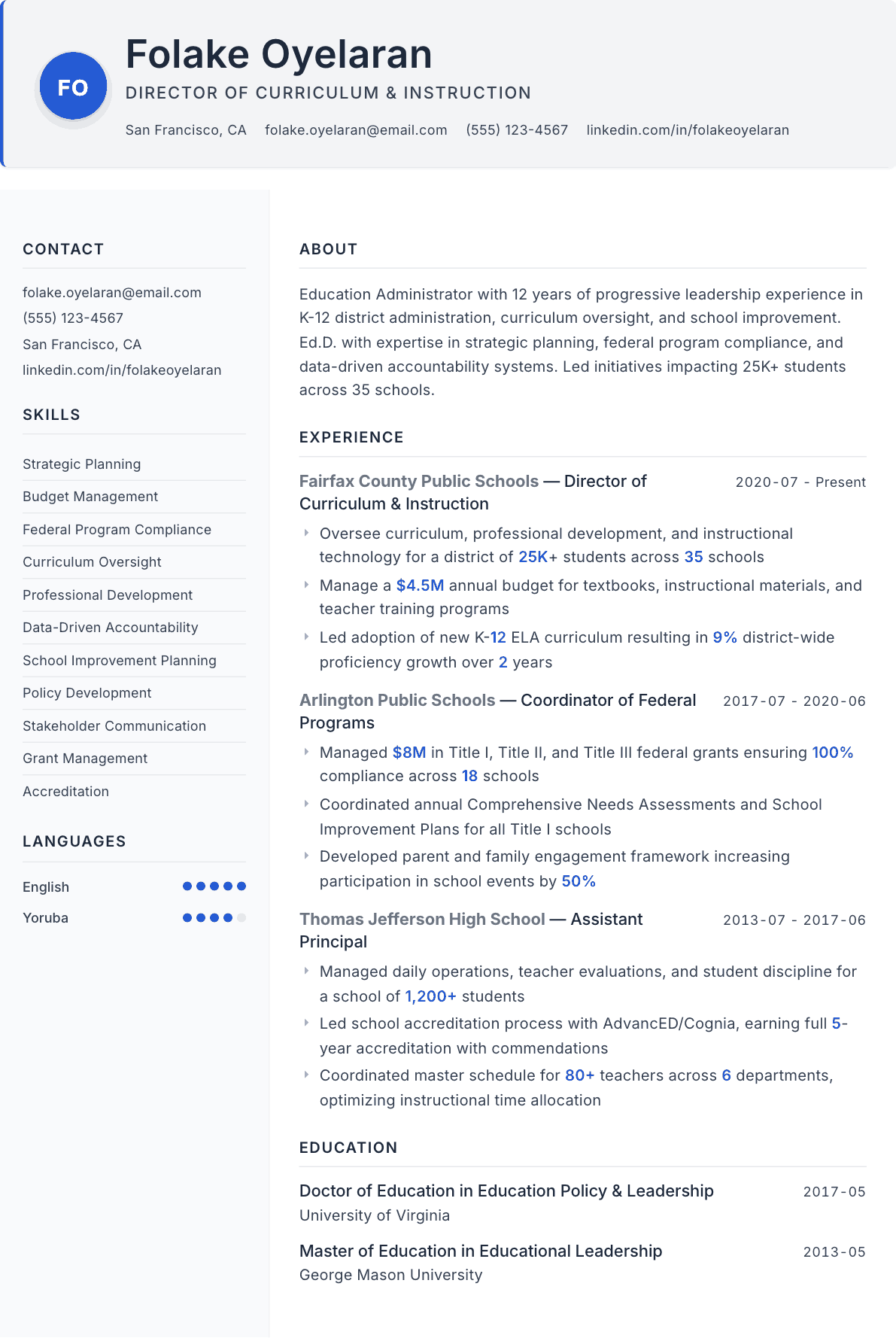
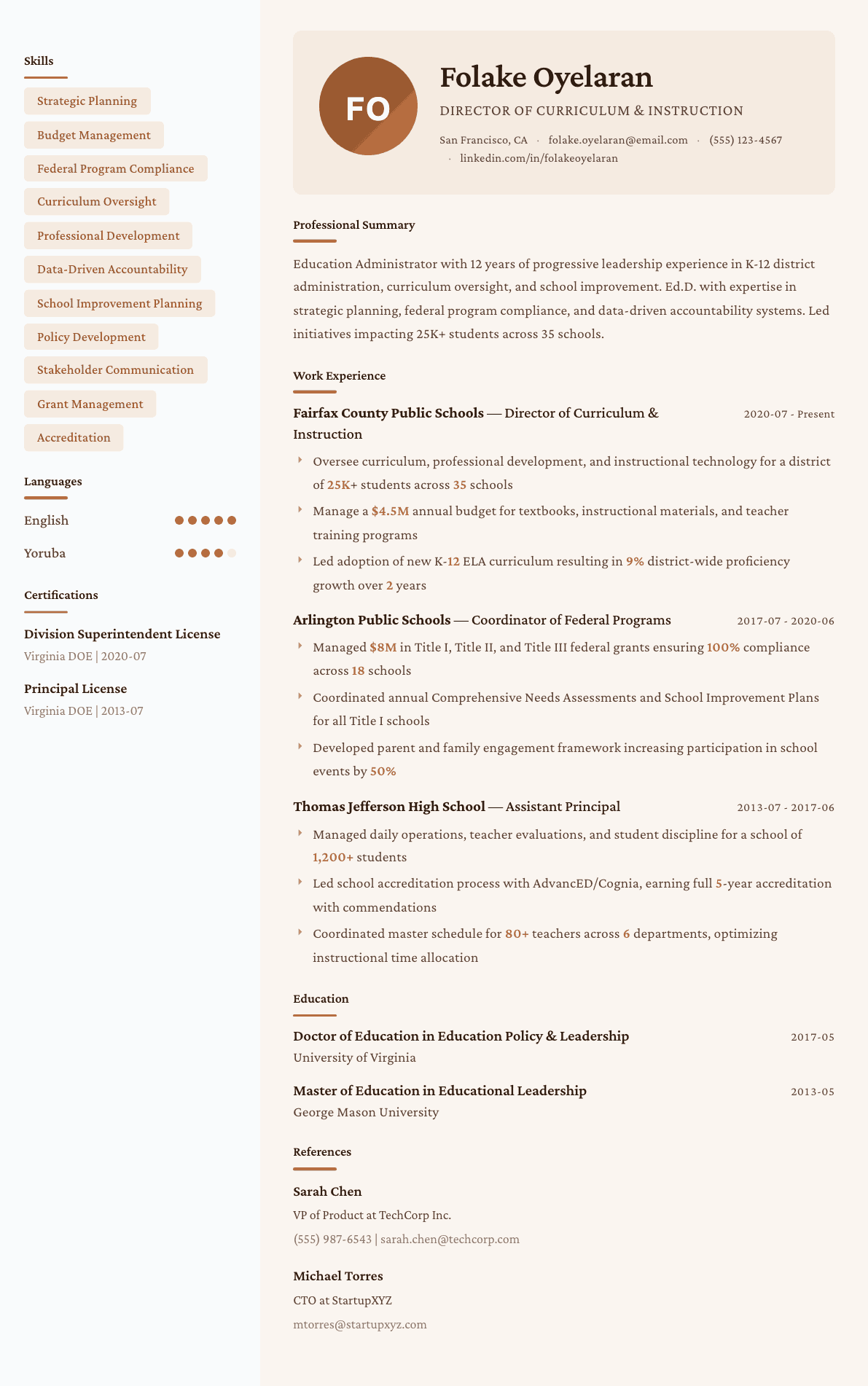
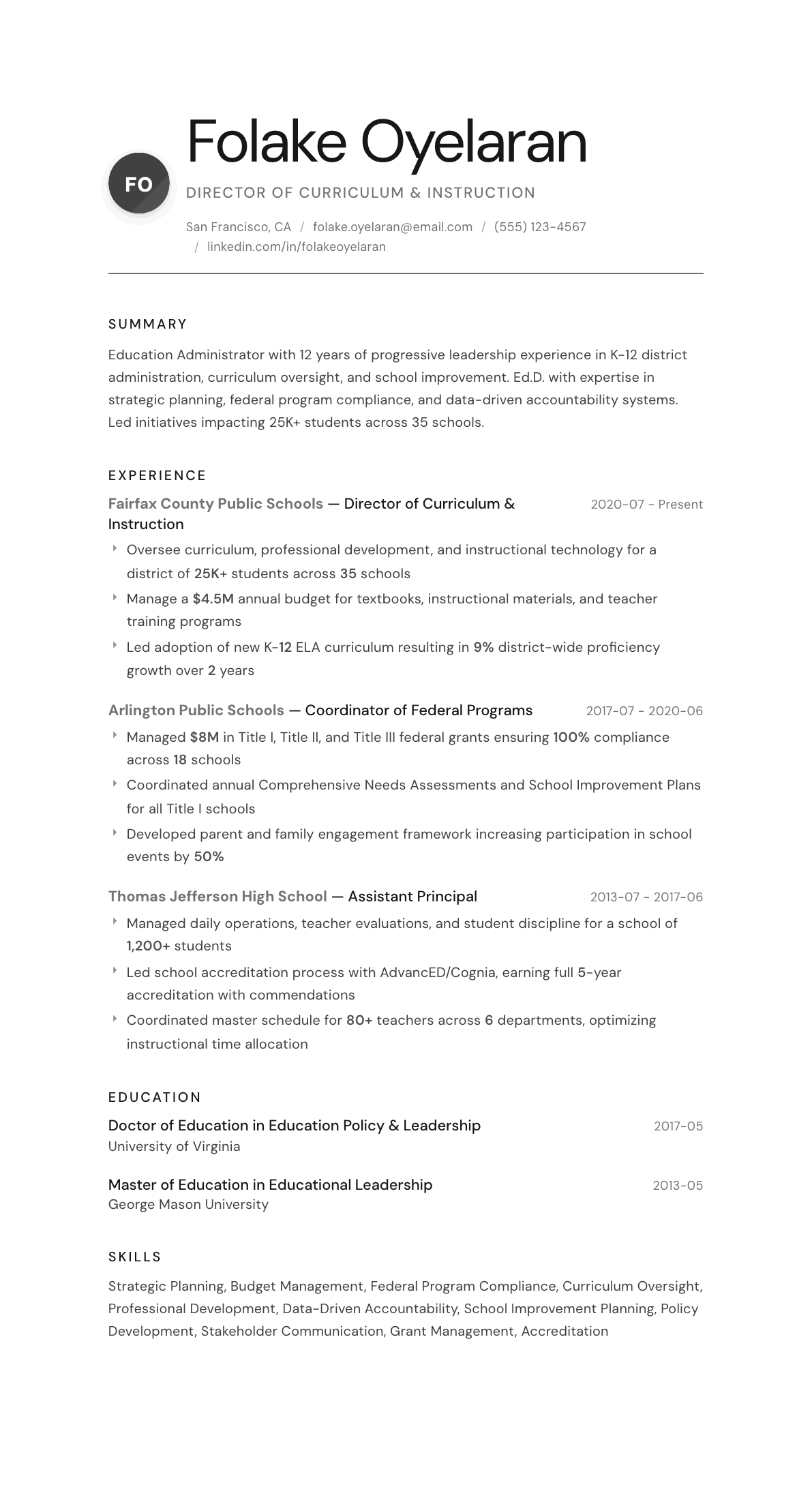
Example Education Administrator summary
Education Administrator with 12 years of progressive K-12 leadership experience. Ed.D. in Education Policy with expertise in curriculum oversight, federal program compliance, and strategic planning. Led district-wide initiatives impacting 25K+ students across 35 schools with measurable academic growth.
Skills to list on a Education Administrator resume
- Strategic Planning
- Budget & Resource Management
- Federal Program Compliance (Title I/II/III)
- Curriculum Oversight
- Professional Development Design
- Data-Driven Accountability
- School Improvement Planning
- Policy Development
- Stakeholder Engagement
- Grant Writing & Management
- Accreditation (Cognia)
- Human Resources
- Equity & Access Initiatives
- Board Presentations
What actually gets this resume read
- Lead with district-level scope: number of schools, students, teachers, and budget managed.
- Highlight federal program knowledge: Title I, IDEA, ESEA/ESSA, Title III, 21st Century.
- Quantify system-wide outcomes: proficiency growth, graduation rates, achievement gap closures.
- Include administrative licensure and advanced degrees (Ed.D., Ph.D., Ed.S.).
- Describe strategic initiatives: curriculum adoption, technology integration, equity programs.
- Reference accreditation and compliance experience: AdvancED/Cognia, state accountability systems.
How to write a education administrator resume
An education administrator application is read twice, and the two readings want different things. Human resources checks the administrative license, the degree and the years of experience against the posted minimums, because a district cannot advance a candidate who is not licensable for the position. Then a superintendent or a board committee reads for scope and for evidence: how many schools, how many students, how large a budget, and what actually improved while you held the position.
The scope question is the one candidates most often leave unanswered. Education administrator covers a school-level assistant principal, a district director of curriculum, a special education director and a chief academic officer, and each reader is trying to work out whether your last job was larger or smaller than the one they are filling. If they cannot tell in ten seconds, the file goes down the pile.
This guide covers the license and scope block, how to write school improvement results honestly, the federal program and compliance language a board expects, and the questions administrators ask when they move from a building to a district office or across state lines.
Format: two pages, license visible, scope block under the summary
Two pages is expected at this level. Put the administrative credential directly under your header with the state, the endorsement and the grade band, whether that is a principal, supervisor, curriculum director or superintendent license, and note reciprocity if you are applying out of state. Add the degree, since many district positions require a specialist or doctoral degree in the minimums.
Then a short scope block: schools, students, staff supervised, budget responsibility described by what it funded, and the programs you owned. This is the fastest way to be read as the right size for the role.
- Header: name, city and state, phone, email, and the administrative license with state and endorsement.
- Section order: license and education, summary, scope, administrative experience, teaching experience, service and professional development.
- Candidates applying across state lines should state license reciprocity status rather than leaving the committee to check it.
Summary: level, scope, and the outcomes you are accountable for
Name the level of the position, the scope in numbers, and two or three outcomes you owned. Administrators are hired to fix something, so the summary should say what you have fixed: a school off an improvement list, a graduation rate raised, a special education compliance backlog cleared, a curriculum adoption delivered, or a budget stabilized after an enrollment decline.
Leave out the language of visionary leadership and lifelong learning. Every candidate at this level writes it, so it separates nobody and costs you two lines of a page a superintendent is skimming.
Experience: instructional leadership with the evidence attached
Write each role around the levers an administrator actually pulls. Teacher evaluation and coaching cycles under your state framework, professional learning community structures, master schedule design, curriculum adoption and implementation, intervention and multi-tiered systems of support, data review cycles, and the hiring and retention of staff.
Attach evidence to each lever with the honest unit of measure: proficiency or growth on the state assessment by subgroup, graduation and dropout rates, attendance and chronic absenteeism, discipline referrals and suspension rates, advanced course enrollment and passing rates, teacher retention, and survey results from staff or families. Give the baseline and the period so a board member can judge the change.
Be careful with attribution. Committees at this level are experienced and skeptical, so say what you led, what you supported and what the team achieved. A candidate who claims sole credit for a district-wide gain loses more credibility than the gain buys.
Compliance, budget and the board-facing side
Name the federal and state programs you have administered: Title I schoolwide and targeted assistance plans, Title II professional development funds, Title III for English learners, and the Individuals with Disabilities Education Act with its child find, individualized education program and least restrictive environment requirements. Add state accountability designations and the improvement planning that follows them.
Then the money and the governance. Budget building and monitoring, grant writing and grant reporting, personnel actions, negotiated agreement administration, procurement, audit responses, board presentations and policy drafting. Also name the accreditation or external review processes you have led, such as a Cognia engagement review or a state program review.
Include crisis and safety leadership, because it is now part of every administrator interview: emergency operations plans, threat assessment teams, drills, and the communication protocol you used with families during an incident.
Stakeholders, equity and how you handled the hard year
Show engagement with the groups that decide whether an initiative survives: teacher union leadership, site councils, parent organizations, the board, community partners and municipal agencies. Concrete examples matter more than the word collaboration, so name a negotiation, a contentious adoption you carried, or a boundary or consolidation decision you communicated.
On equity, use measurable work rather than adjectives. Gap closure by subgroup with the baseline, access to advanced coursework, discipline disproportionality reduction, English learner reclassification rates, or a staff diversity hiring result. A board that has read fifty applications remembers the one with numbers.
Education Administrator resume summary examples
Moving into administration
Instructional coach and department chair with nine classroom years, completing a principal licensure program and an administrative internship covering master schedule design, teacher observation cycles and intervention planning. Led a literacy adoption across a 900-student middle school and raised eighth grade reading proficiency by 9 points.
Building administrator
Assistant principal with five years in a 1,400-student comprehensive high school, supervising 38 teachers, the master schedule and the multi-tiered support system. Reduced chronic absenteeism from 24% to 15% over three years and raised advanced course enrollment among first-generation students by a third.
District administrator
Director of curriculum and instruction for a district of 35 schools and 25 thousand students, leading Title I and Title III programs, a K-12 mathematics adoption and the district professional learning plan. Moved two schools off the state improvement list and led a successful accreditation engagement review.
Work experience bullets: before and after
Before: Provided instructional leadership to teachers and staff.
After: Ran a full observation and coaching cycle for 38 teachers under the state evaluation framework, with two formal observations and six informal walkthroughs each, feeding a department-level professional learning plan.
Teacher count and observation frequency show the actual supervisory load behind the phrase instructional leadership.
Before: Improved test scores at the school.
After: Raised eighth grade mathematics proficiency from 41% to 58% over three years by adding a daily intervention block, retraining the department on the adopted curriculum, and reviewing common assessment data every three weeks.
A baseline, a period and the specific mechanisms make the gain checkable rather than asserted.
Before: Managed federal programs for the district.
After: Administered Title I schoolwide plans for 14 campuses and Title III services for 2,100 English learners, cleared a monitoring finding on parent and family engagement documentation, and passed the following state review with no findings.
Program names, scale and a resolved monitoring finding are the evidence a board member recognizes as compliance work.
Before: Handled the school budget.
After: Built and monitored a general fund and grant budget covering staffing, curriculum, technology refresh and intervention, and absorbed a 6% allocation cut without reducing classroom teaching positions.
Naming what the budget funded and the choice made under a cut shows financial judgment, not custody.
Before: Worked to improve equity for all students.
After: Removed the teacher recommendation requirement for advanced placement enrollment, added a summer bridge course, and increased Black and Hispanic student enrollment in advanced placement from 18% to 34% of seats in two years.
A named policy change with an enrollment result turns an equity statement into a documented outcome.
Hard skills
- Teacher evaluation and coaching cycles
- Master schedule design
- Curriculum adoption and implementation
- Multi-tiered systems of support
- School improvement planning
- Title I, Title II and Title III administration
- Special education compliance under federal law
- Budget development and monitoring
- Grant writing and reporting
- Data analysis and accountability reporting
- Accreditation and program review
- Personnel and negotiated agreement administration
- Emergency operations and threat assessment
- Board presentation and policy drafting
Soft skills
- Difficult personnel conversations
- Negotiation with bargaining units
- Communicating with families during a crisis
- Building coalitions across departments
- Holding a decision under public pressure
- Delegation to building leaders
Certifications worth listing
- State Administrative License, Principal (State Department of Education)
- Superintendent License (State Department of Education)
- National Board Certification (National Board for Professional Teaching Standards)
Mistakes that cost education administrator candidates the interview
- Leaving out the scope block, so a superintendent cannot tell whether you led one building or thirty-five.
- Claiming personal credit for district-wide gains that a large team delivered, which experienced committees discount immediately.
- Burying the administrative license when it is the first item human resources verifies.
- Reporting achievement changes with no baseline and no time period attached.
- Skipping federal program and special education compliance, the two areas where a district faces real legal exposure.
- Filling the summary with visionary leadership language that every other applicant at this level has already used.
- Omitting budget and personnel work, which are what actually distinguish an administrator from a teacher leader.
Education Administrator resume questions
What license do I need to be an education administrator?
Public school positions require a state administrative credential, usually a principal or supervisor license for building roles and a district or superintendent license for central office positions. Requirements vary by state, so name your license, endorsement and any reciprocity status on the resume itself.
Should I keep my teaching experience on an administrator resume?
Yes, but compress it. Two or three lines per teaching role covering the subject, grade level and any leadership such as department chair or instructional coaching is enough. The administrative sections carry the application, and classroom credibility only needs to be established.
How do I show results without overstating my role?
Use precise verbs. Led, co-led, supported and supervised all mean different things to a committee. Attach the team where a team existed, give the baseline and the period, and let the reader see that you know the difference between your contribution and the district's.
How do I apply for administrative roles in another state?
Check the reciprocity pathway before you apply and state it plainly on the resume, such as a license held in one state with an application filed in the other. Committees rarely reject an out-of-state candidate for licensure, but they will not chase an unanswered question.
Do I need a doctorate for a district administrator position?
Many superintendent and senior central office postings list a doctorate as required or preferred, while director-level roles often accept a master's or specialist degree with strong experience. Read the minimum qualifications section, since a preference is negotiable and a requirement is not.