Actor Resume Examples: what a hiring manager reads first
Format an Actor Resume Casting Directors Can Read Fast
By Mustafa Tarabya, founder of CVBooster · Published · Updated
Actor resume examples with the standard credit format, training and special skills sections, and the layout casting directors expect on a headshot back.
Sample resumes for a actor
The same actor content laid out in three CVBooster templates, so you can see what the finished document looks like before you write a word.
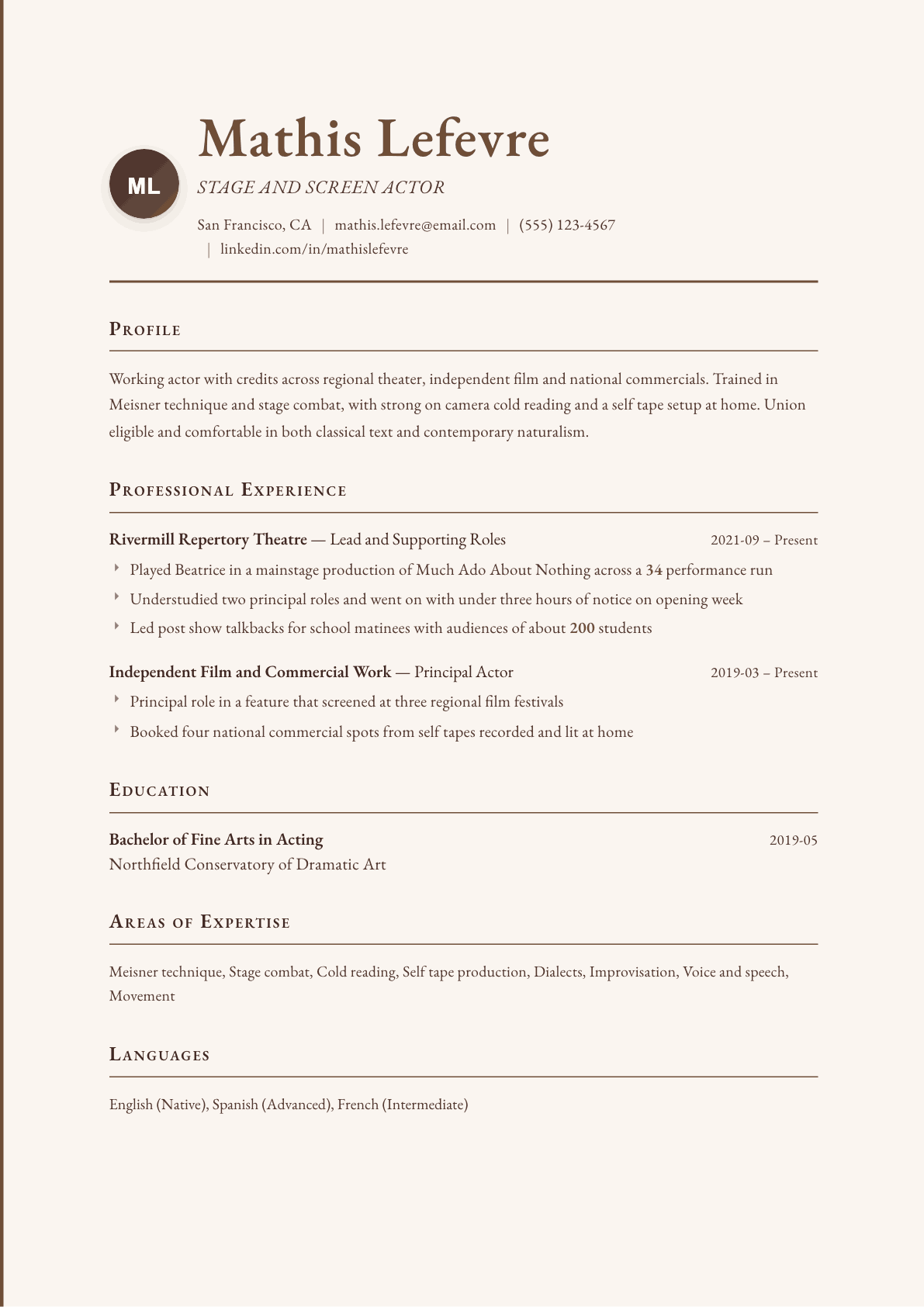
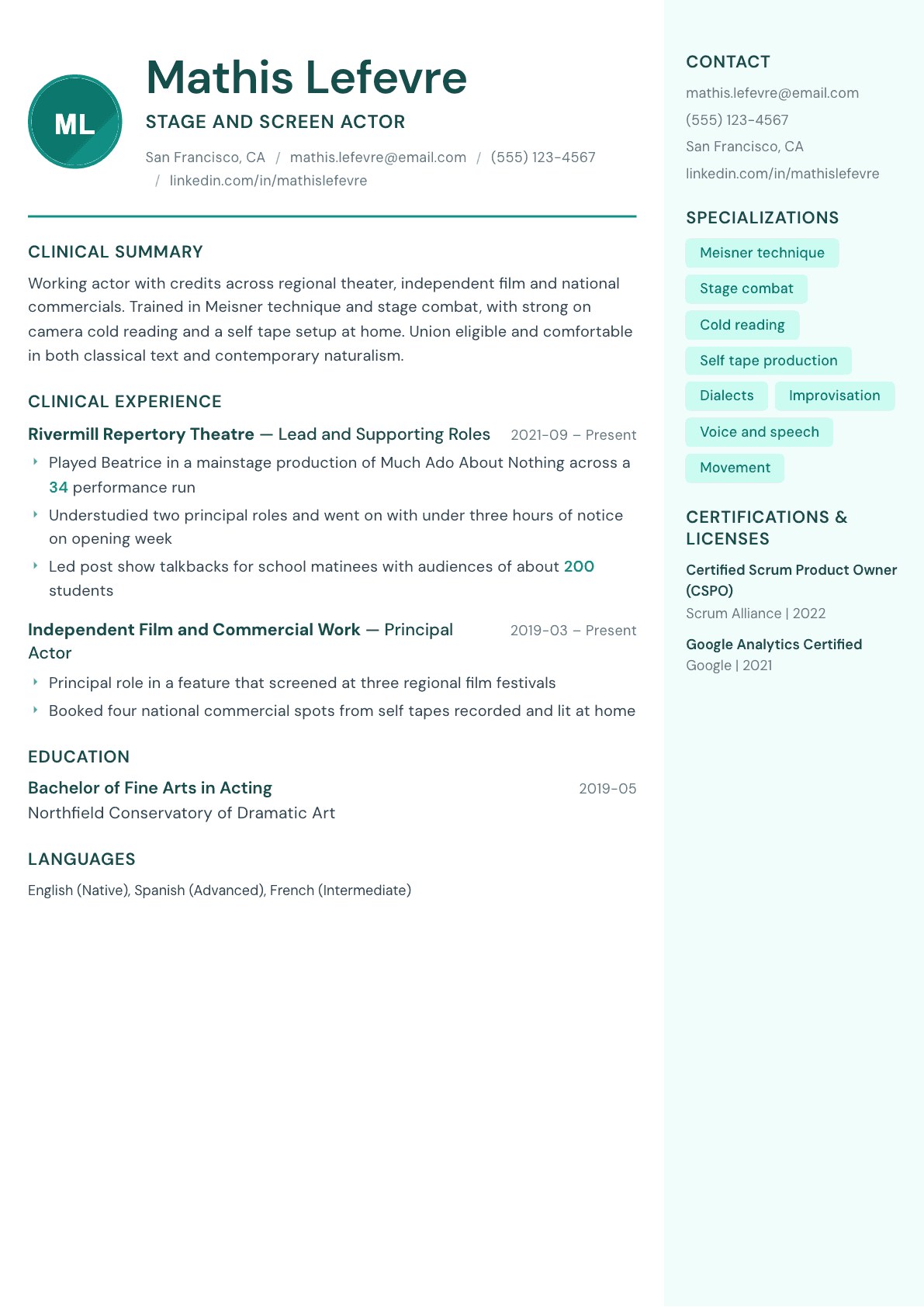
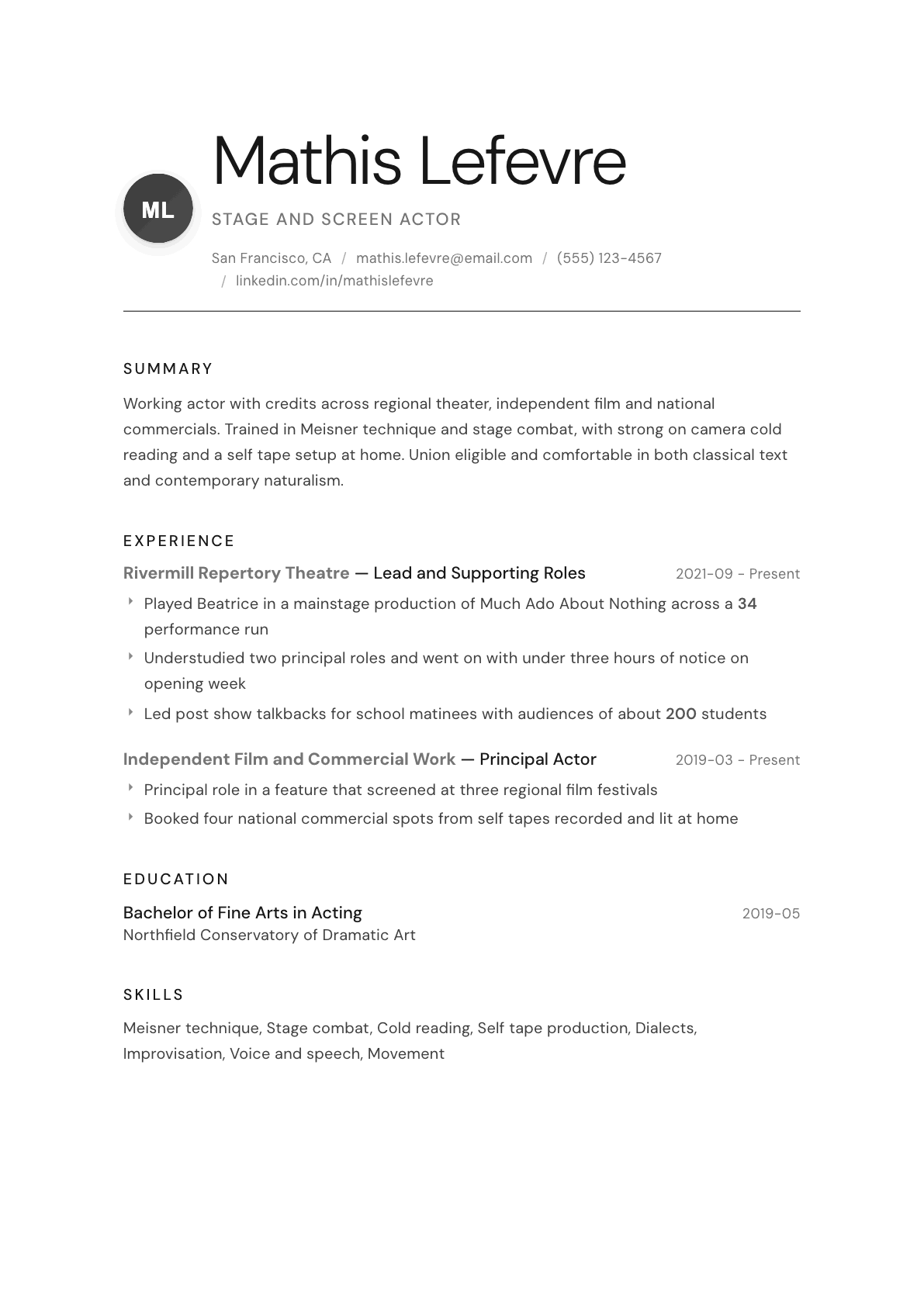
Example Actor summary
Stage and screen actor with regional theater credits, independent film leads and national commercial bookings. Conservatory trained in Meisner technique with continuing study in on camera scene work. Certified in unarmed stage combat, fluent in two dialect families, and equipped with a home self tape setup that turns audition requests around within a day. Union eligible and available for regional contracts.
Skills to list on a Actor resume
- Meisner technique
- Classical text
- Cold reading
- Self tape production
- Dialects and accents
- Stage combat
- Improvisation
- Voice and speech
- Movement and dance
- Script analysis
- On camera technique
- Audition preparation
- Understudy work
What actually gets this resume read
- Use the standard three column credit format: production title, role or billing, and the theater, studio or director.
- Never pad credits or invent billing, because casting offices call the production and the correction ends the meeting.
- Group credits by medium, listing film, television, theater and commercials as separate blocks in that order.
- Keep commercial credits as conflicts available on request rather than listing brands that could block a booking.
- Put training under credits with the teacher name, since coaches carry more weight than school names in casting rooms.
- Keep special skills honest and specific: dialects you can hold, instruments you can play, licenses and sports you can do on camera.
How to write a actor resume
An actor resume is not a business resume with different jobs on it. It is a credits document, traditionally printed and stapled to the back of a headshot, and casting offices read it in a specific order they have read it in for decades: name and union status, physical and contact essentials, credits by medium, training, then special skills. Any layout that breaks that order slows the read, and the read is short.
Casting is also the one field where padding is genuinely dangerous. Offices are small, everyone knows the same directors, and a phone call confirms a billing claim in a minute. An inflated credit does not usually get argued about, it just ends the meeting quietly and removes you from a list you will never see.
This guide covers the standard credit format, how to group by medium, where training belongs and why teacher names outrank school names, how to keep special skills honest, and what casting expects from a self tape setup.
Format: one page, headshot size, three column credits
One page, always, trimmed to headshot size if you print it. The credit block uses three columns: the production title on the left, your role or billing in the middle, and the company, theater, network or director on the right. That third column is the one casting scans, because a recognized director or house is an implicit reference.
Put your name at the top with union status and representation if you have it, then height, hair and eye color if the market you work in expects them, then contact. Keep your personal address off the page and let the agent or a phone number handle contact.
- Header: name, union status, representation, contact, and physical details your market expects.
- Credits grouped by medium in this order: film, television, theater, commercials.
- Training block after credits, listing the discipline, the teacher and the studio.
- Special skills last, on one or two lines, only skills you could perform tomorrow.
Credits: role type matters more than title size
For screen work, list the billing the industry uses: lead, supporting, principal, co star, guest star, recurring, featured. For theater, list the character name and the production, because a casting director reads Beatrice in a mainstage production and immediately knows the size and the demand of the part.
Understudy and cover work belongs on the page and should be labeled honestly. Going on with a few hours of notice is a genuine professional credential, and casting reads it as evidence you learn fast and hold your nerve, which is exactly what a short notice booking asks for.
Keep commercial credits as a single line saying conflicts available on request. Listing brands can block you from a competing category booking, and every casting office already understands the convention.
Training: name the teacher, not just the school
List training as discipline, teacher, and studio or conservatory: acting technique, on camera scene study, voice and speech, movement, stage combat, dialects. Coaches carry weight in casting rooms because a reader who knows the teacher knows what you were drilled in, which a degree title alone never communicates.
Keep ongoing study visible. Actors who are in a weekly class read as working actors, and a casting director who is choosing between two similar tapes often leans toward the one who is clearly still training.
Special skills: specific, current and provable on camera
This section exists because commercial and film briefs ask for it directly. Dialects you can hold under pressure, instruments you can actually play on camera, sports, dance forms, driving including manual transmission, swimming, horse riding, licenses and certifications. Each entry is a potential booking, and each false entry is a potential public failure on a set.
Be exact about level. Intermediate piano and conversational Spanish are useful and honest. Fluent and expert are words a casting director will test, sometimes in the room, and there is no recovery from failing that test.
Self tape and the practical lines casting looks for
A working self tape setup is now part of being castable. Say that you have one, and that you can turn a tape around inside a day. Casting offices with a short window send the sides to the actors they believe will return something usable and lit rather than to the ones they hope will.
Note your work locations plainly, including whether you can work as a local hire in a second market. That single line decides whether an office can afford to bring you in, and it is left off more resumes than any other useful detail.
Actor resume summary examples
Conservatory graduate
Recently graduated actor with conservatory training in Meisner technique, voice and movement, and credits in student film and regional ensemble work. Certified in unarmed stage combat, holds two dialects, and tapes auditions from a lit home setup. Available for regional contracts and local hire in a second market.
Working actor
Working actor with regional theater leads, independent film credits and national commercial bookings. Trained in Meisner technique with continuing on camera scene study. Strong cold reader, comfortable in classical text and contemporary naturalism, and covered two principal roles across a 34 performance run.
Established credits
Actor with a decade of leading regional stage roles, recurring screen work and voiceover bookings. Classical text and contemporary drama, with stage combat certification and three dialect families held at performance level. Experienced leading school matinee talkbacks and mentoring younger company members during long runs.
Work experience bullets: before and after
Before: Acted in Much Ado About Nothing.
After: Played Beatrice in a mainstage production of Much Ado About Nothing across a 34 performance run, directed by the company artistic director.
Role, run length and who directed it give casting the scale and the reference in one line.
Before: Was an understudy for a play.
After: Understudied two principal roles and went on with under three hours of notice during opening week, performing the full track including staging and fight calls.
The notice period and what the track included turn a passive credit into proof of reliability.
Before: Did some commercial work.
After: Booked four national commercial spots from self taped auditions recorded and lit at home, with conflicts available on request.
It shows a booking rate from tapes and follows the conflict convention casting expects.
Before: Appeared in an indie film.
After: Principal role in an independent feature that screened at three regional film festivals, shot over an 18 day schedule on location.
Billing, festival exposure and shoot length tell casting what kind of set experience you have.
Before: Good with audiences and outreach.
After: Led post show talkbacks for school matinees with audiences of around 200 students, taking unscripted questions about text and character.
A vague people skill becomes a specific, verifiable duty a company can call and confirm.
Hard skills
- Meisner technique
- Classical text
- Cold reading
- Self tape production
- Dialects and accents
- Stage combat
- Improvisation
- Voice and speech
- Movement and dance
- Script analysis
- On camera technique
- Audition preparation
- Understudy and cover work
Soft skills
- Taking direction quickly
- Rehearsal room generosity
- Memorization under pressure
- Resilience through rejection
- Company professionalism
- Punctuality on call
Certifications worth listing
- Actor Combatant Certification (Society of American Fight Directors)
- Basic Life Support (BLS) (American Heart Association)
Mistakes that cost actor candidates the interview
- Inflating billing or claiming a role you covered but never performed, which a single phone call to the company undoes.
- Mixing film, television, theater and commercial credits into one date ordered list, which forces casting to sort it for you.
- Listing every commercial brand instead of the conflicts line, which can quietly block you from a competing category.
- Naming only the school in the training block, when the teacher is the detail a casting director actually recognizes.
- Claiming fluent languages or expert instruments that would fail the moment someone asks you to demonstrate them.
- Running the resume onto a second page, when the convention is one page trimmed to sit on the back of a headshot.
Actor resume questions
What goes at the top of an actor resume?
Your name, union status and representation, then contact and the physical details your market expects such as height and coloring. Personal address never belongs there, and the headshot on the reverse carries everything else about appearance.
How do I list credits with no professional work yet?
List student films, university productions and community theater honestly under the right medium heading, then lean on the training block. Casting expects a short credit list early and reads the training and special skills sections more closely instead.
Should I put my commercial credits on the resume?
Write the line conflicts available on request instead of naming brands. It is the standard convention, it protects you from category conflicts on a new booking, and casting offices read it as knowing how the business works.
Do special skills actually get people cast?
Yes, regularly. Commercial and film briefs ask for drivers, riders, swimmers, instrumentalists and specific dialects, and casting searches on those terms. The only rule is that everything listed must be performable on the day without rehearsal.
How often should I update an acting resume?
After every booking and every finished class. Keep a master file with everything, then trim to the strongest one page version for each submission, leading with the medium that matches what the office is casting.