Voice Actor Resume Examples: free ATS score and gap list
Write a Voice Actor Resume That Books the Audition
By Mustafa Tarabya, founder of CVBooster · Published · Updated
Voice actor resume examples covering demo placement, home studio specs, genre credits and the technical details casting hears before they hear you.
Sample resumes for a voice actor
The same voice actor content laid out in three CVBooster templates, so you can see what the finished document looks like before you write a word.
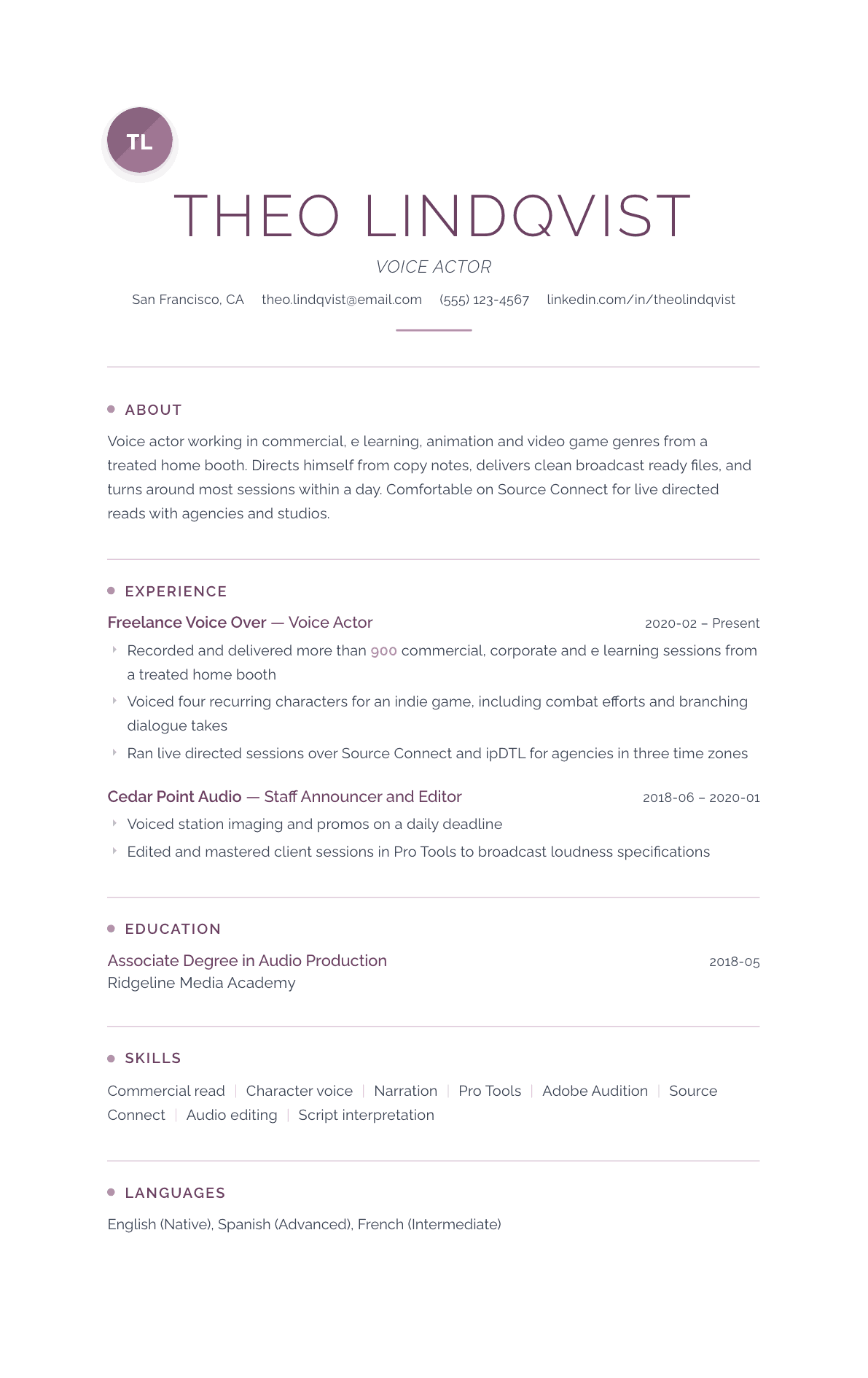
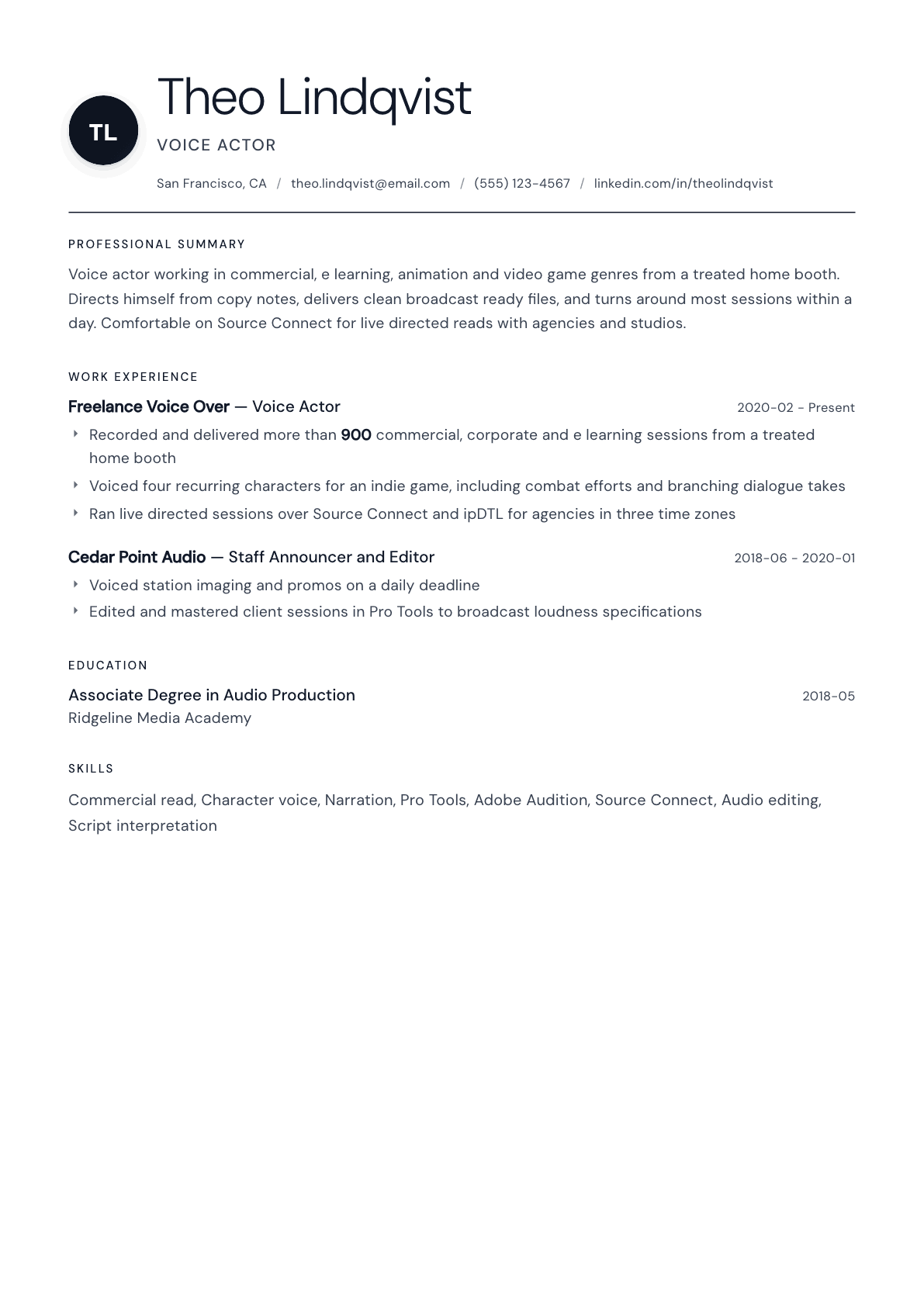
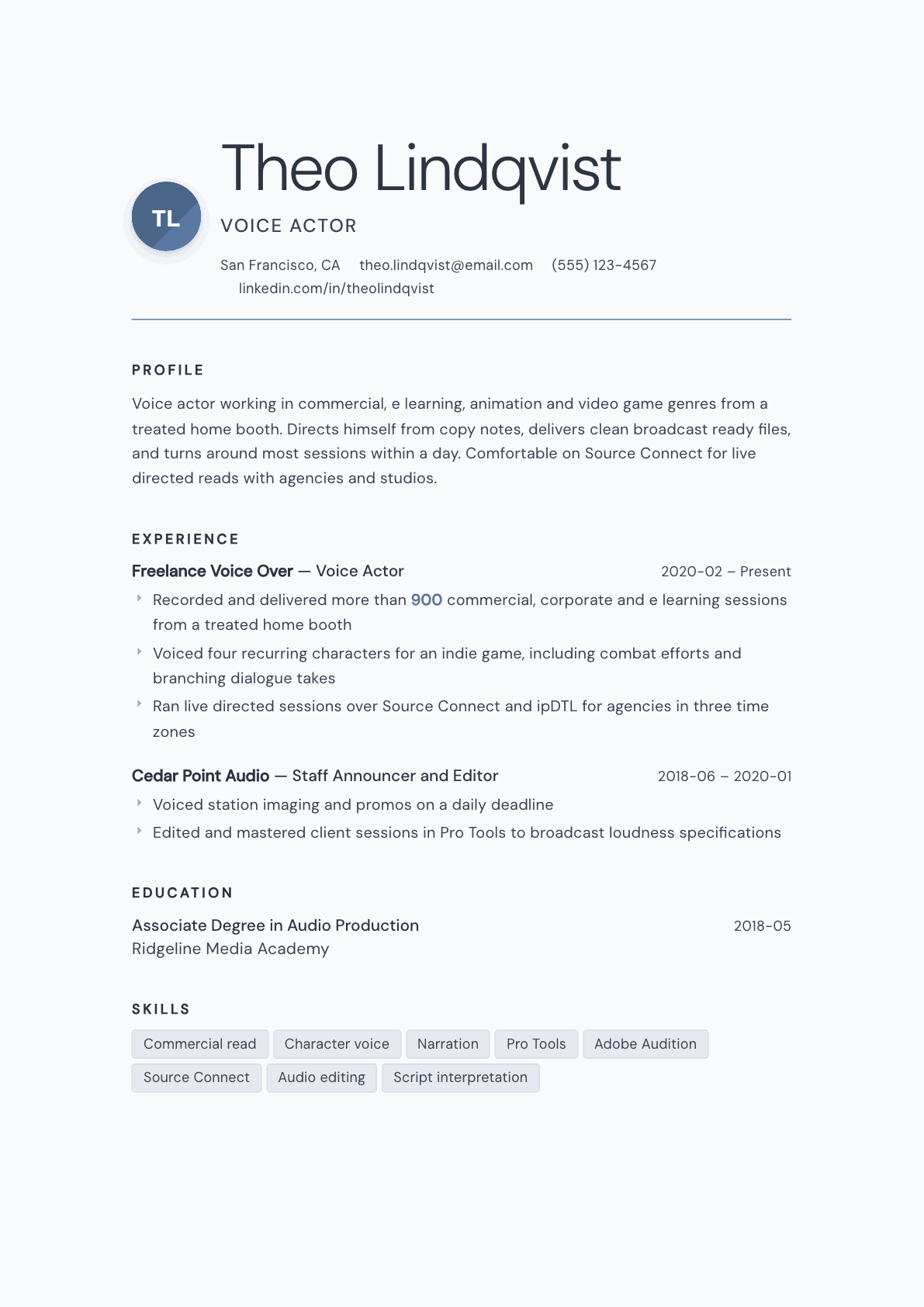
Example Voice Actor summary
Voice actor with six years of commercial, e learning, animation and video game credits, recording from a treated home booth with a broadcast microphone and interface. Self directs from copy notes, self edits to client loudness specifications, and delivers most sessions the same day. Works live over Source Connect and ipDTL, and holds four recurring game characters across two released titles.
Skills to list on a Voice Actor resume
- Commercial read
- Narration
- Character voice
- Animation voice
- Video game performance
- E learning narration
- Audiobook narration
- Pro Tools
- Adobe Audition
- Audio editing and mastering
- Source Connect
- Script interpretation
- Home studio operation
- Loudness standards
What actually gets this resume read
- Put your demo links in the header labeled by genre, because casting listens to a commercial reel and a character reel separately.
- Describe your home booth honestly: microphone, interface, treatment and the file formats you deliver.
- List remote session tools such as Source Connect, ipDTL, Session Link Pro or Zoom, since studios filter on them.
- Group credits by genre rather than by date, because buyers hire within one genre at a time.
- Say whether you self direct and self edit, since that decides how much post work the client has to budget.
- Note union status and any conflicts plainly, since a booking can fall apart over a competing category.
How to write a voice actor resume
Voice casting listens before it reads. A producer opens the demo that matches the genre they are casting, gives it fifteen seconds, and only then looks at the document to answer the questions the audio cannot: can this person record broadcast ready files without a studio, can they direct themselves off written copy notes, can they join a live session, and will the files arrive clean and correctly named.
That makes a voice actor resume a technical document as much as a creative one. The booth, the microphone, the interface, the delivery formats and the remote session tools decide whether a client can book you at all. Talent with a beautiful read and an untreated room loses jobs to talent with a good read and a quiet one.
This guide covers demo placement by genre, how to describe a home studio without exaggerating it, grouping credits by genre rather than by date, and the union and conflict lines that keep a booking from falling apart late.
Format: demos in the header, labeled by genre
One page. Put the demo links at the top, each labeled by genre: commercial, narration, character, e learning, audiobook, video game. Buyers cast one genre at a time and will not hunt through a general reel to find the thirty seconds that matter to them.
Below the demos, keep three blocks: credits by genre, studio and technical specifications, and training. Skip the classic objective statement. A producer with a session tomorrow wants specifications and genre evidence, not aspiration.
- Header: name, city and time zone, email, phone, demo links labeled by genre.
- Order: summary, credits by genre, home studio specifications, remote session tools, training.
- State union status plainly, and list current conflicts as available on request.
- Note turnaround time, because same day delivery is a selling point buyers filter on.
Summary: genres, self direction, and delivery
Name the genres you actually book in, then say whether you self direct and self edit. That single fact changes a client budget, because a talent who returns a finished, edited, correctly leveled file removes a post step that someone otherwise has to pay for.
Mention volume honestly. A voice actor who records hundreds of corporate and e learning sessions a year is telling a producer that long form fatigue and consistency across pickups are solved problems, and consistency is exactly what a long narration project fears.
Credits: group by genre, name the kind of work
Split credits under genre headings rather than listing them in date order. Under commercial, name the type of spot and the market. Under video game, name the character type and whether you recorded combat efforts, which is a distinct vocal skill with real physical demands. Under e learning, say the module length and whether you handled technical or medical terminology.
Recurring character work is the strongest credit in the animation and game genres because it proves you can match a performance months later. Say how many characters and across how many titles, and whether you also covered the walla and effort passes.
Broadcast staff work, station imaging and promo experience belongs on the page even if you now freelance. It proves daily deadline discipline and it usually means you can edit and master to a loudness specification without being asked twice.
Home studio: microphone, interface, treatment, delivery
Write the specifications like a technical rider: microphone, preamp or interface, the treatment on the room or the booth, the editing software, and the file formats and loudness targets you deliver to. Say whether you deliver raw and processed versions, and whether you can supply files split by take or by script section.
List the remote session platforms separately: Source Connect, ipDTL, Session Link Pro, Cleanfeed and video conferencing with a talkback setup. Studios filter directly on these, and a session tool you have used before means a director does not spend the first ten minutes of a paid hour on a connection test.
Training and the keywords buyers search
List coaches by name alongside the discipline, whether that is commercial copy, long form narration, character creation, improvisation or animation. Voice coaching lineage is recognized in casting circles the same way acting teachers are, and it shows the ear was trained rather than self assessed.
The recurring keywords in voice postings are narrow: conversational read, authoritative read, brand voice, narration, character voice, efficient pickups, broadcast ready audio, loudness standards, script interpretation. Use them in sentences that are true, and leave out anything you would not want tested in a live directed session.
Voice Actor resume summary examples
Building the first credits
Voice actor working in commercial and e learning genres from a treated closet booth with a large diaphragm microphone and a clean interface chain. Self edits in Adobe Audition and delivers to standard loudness targets. Trained in commercial copy and long form narration, with a same day turnaround on most sessions.
Six years of bookings
Voice actor with commercial, e learning, animation and video game credits, recording from a treated home booth. Self directs from copy notes, self edits to client loudness specifications, and works live over Source Connect and ipDTL. Holds four recurring game characters across two released titles, including combat efforts.
Full time career talent
Full time voice actor across broadcast, narration and interactive work, with a treated booth, redundant recording chain and backup connectivity for live sessions. Directs other talent on small projects, writes pronunciation guides for technical narration, and mentors newer talent on self editing and session etiquette.
Work experience bullets: before and after
Before: Recorded lots of voice over jobs.
After: Recorded and delivered more than 900 commercial, corporate and e learning sessions from a treated home booth, self editing each one to the client loudness specification.
Volume, genres and the self editing step tell a buyer exactly what they get without a follow up email.
Before: Did character voices for a game.
After: Voiced four recurring characters for an independent game, covering branching dialogue takes and a full combat effort pass across two recording blocks.
Character count, branching dialogue and efforts show real interactive session experience rather than a one off.
Before: Worked with clients remotely.
After: Ran live directed sessions over Source Connect and ipDTL for agencies in three time zones, with a hardwired backup connection for long form days.
Naming the platforms and the redundancy answers the reliability question producers ask first.
Before: Was an announcer at a radio station.
After: Voiced station imaging and promos on a daily deadline, then edited and mastered client sessions in Pro Tools to broadcast loudness specifications.
It converts a job title into two concrete competencies a buyer can price.
Before: Good at reading scripts.
After: Interpreted copy notes without a director present, delivering three distinct takes per script section so the client could edit for pace and warmth.
The take structure proves self direction, which is the difference between a talent and a booked talent.
Hard skills
- Commercial read
- Long form narration
- Character voice
- Animation performance
- Video game efforts and dialogue
- E learning narration
- Audiobook narration
- Pro Tools
- Adobe Audition
- Audio editing and mastering
- Source Connect and remote sessions
- Loudness standards
- Home booth operation
- Script markup and pronunciation research
Soft skills
- Self direction
- Taking notes without ego
- Session punctuality
- Vocal stamina management
- Client communication
- Confidentiality on unreleased projects
Mistakes that cost voice actor candidates the interview
- Posting one general demo instead of separate genre demos, so a buyer casting narration hears a commercial read first and leaves.
- Describing the booth vaguely as a home studio, when producers want the microphone, the interface, the treatment and the delivery formats.
- Leaving out remote session tools, which is often the exact filter a studio applies before it listens to anyone.
- Listing credits in date order across genres, forcing a buyer who only cares about one genre to read all of them.
- Claiming accents or languages at performance level that would not hold through a full script under direction.
- Ignoring union status and conflicts until after a booking, which is when a category clash becomes an expensive problem.
Voice Actor resume questions
How many voice over demos should I have?
One per genre you genuinely book in, kept short and current. Two strong demos beat five weak ones, and each should open with your most castable read rather than building slowly toward it.
What home studio details do clients want listed?
Microphone, interface or preamp, room or booth treatment, editing software, delivery formats and loudness targets, plus remote session platforms. That set answers whether your audio can go straight into a broadcast mix without a rerecord.
Do I need union status on the resume?
State it plainly, whether you are union, non union or eligible. It determines which projects can hire you and under what agreement, and discovering it late is the most common reason a booking collapses at contract stage.
Should I list every e learning client I have voiced?
No. Many are under confidentiality anyway. Describe the volume, the subject areas and the module lengths instead, and name only the clients you are permitted to name and that a buyer would recognize.
How do I show experience without professional credits yet?
Lead with the demos and the technical specifications, then list coached training by teacher and any volunteer narration, community radio or independent game work. Buyers hire on the sound and the reliability, and both can be evidenced early.