Singer Resume Examples: what a hiring manager reads first
Create a Singer Resume That Shows Range and Reliability
By Mustafa Tarabya, founder of CVBooster · Published · Updated
Singer resume examples with voice type, repertoire, performance credits and studio work, plus how to present training and language skills.
Sample resumes for a singer
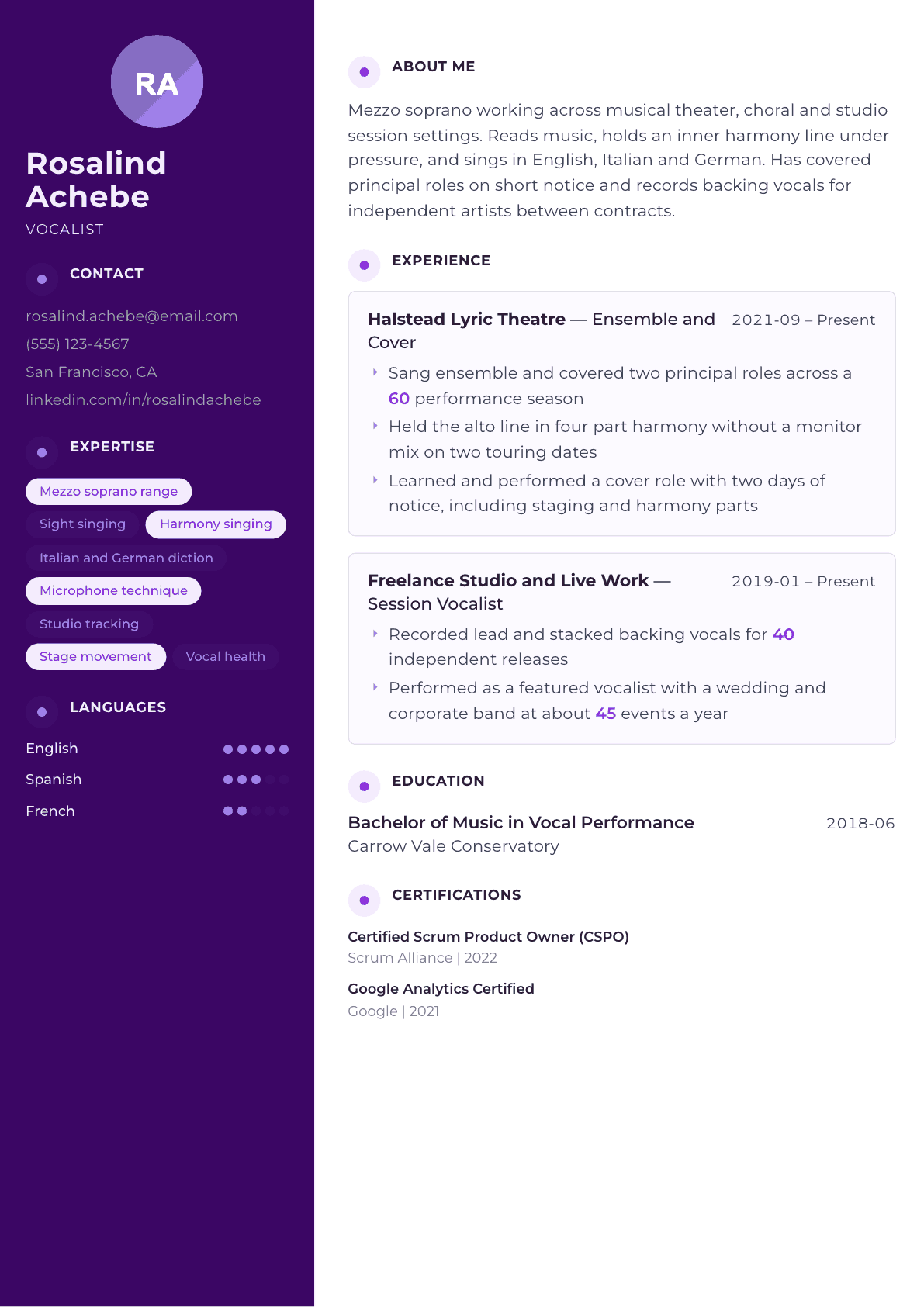
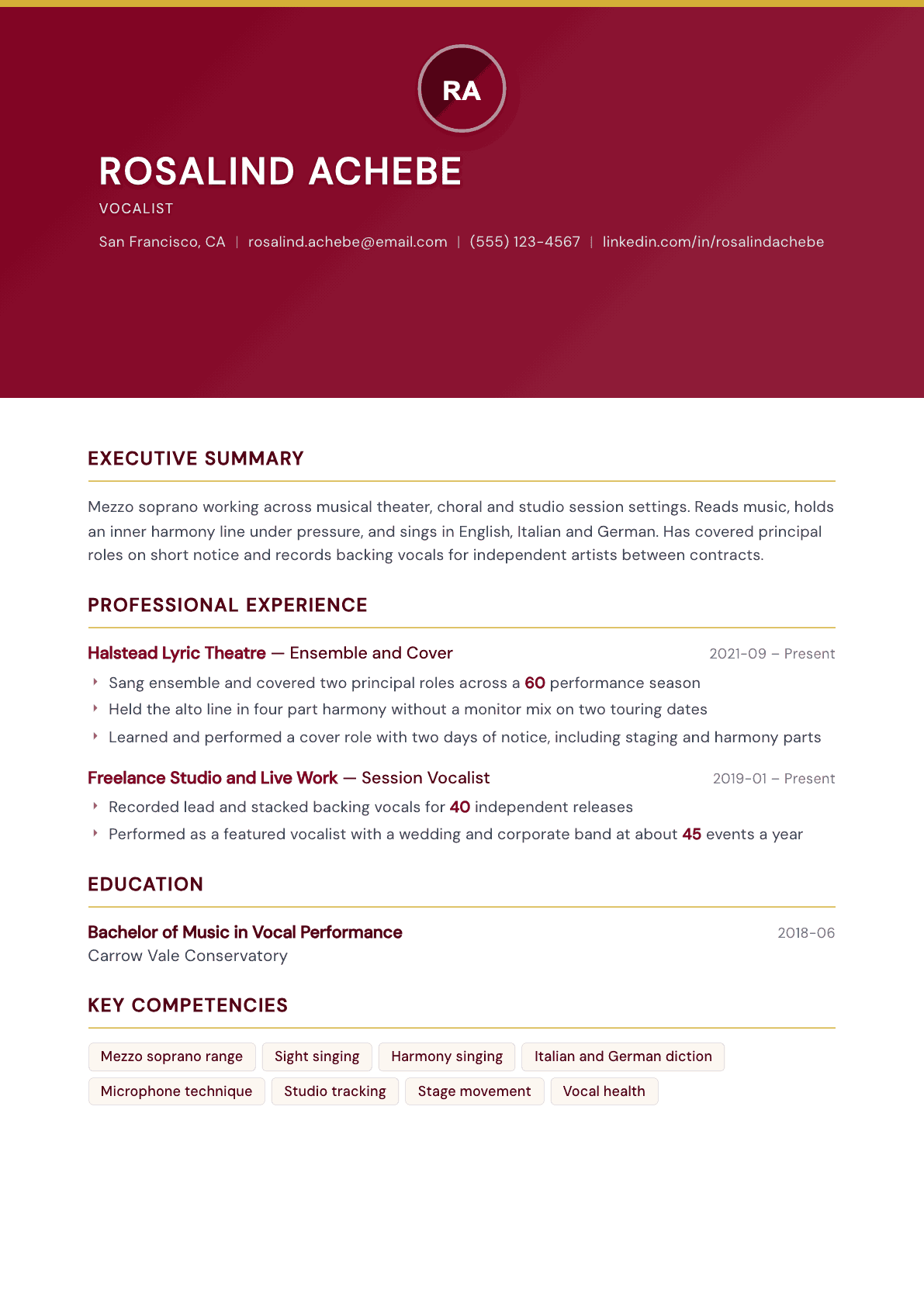
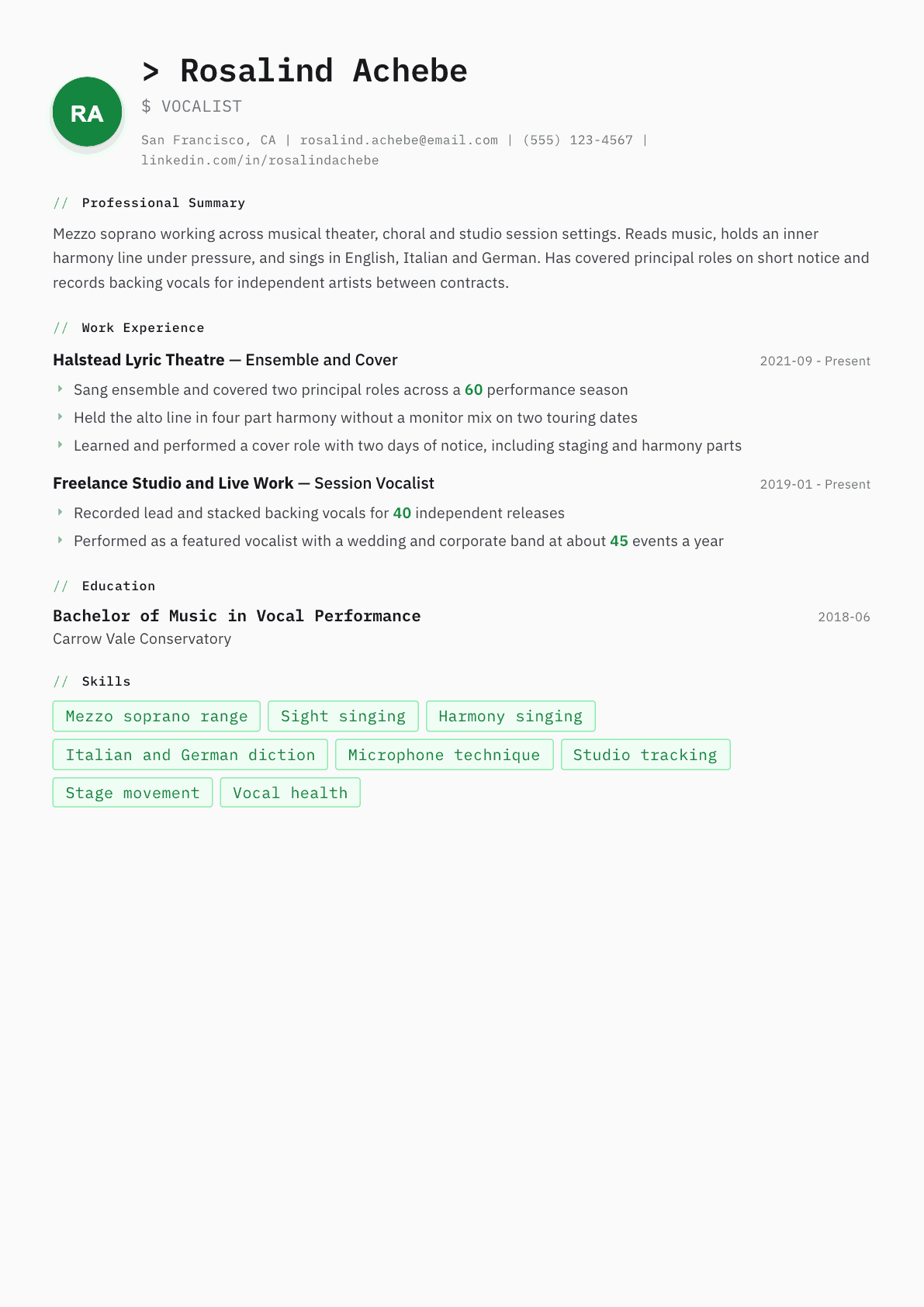
The same singer content laid out in three CVBooster templates, so you can see what the finished document looks like before you write a word.
Example Singer summary
Mezzo soprano with musical theater, choral and studio session credits, comfortable in English, Italian and German diction. Reads music fluently and holds an inner harmony line without a monitor mix. Has covered principal roles on two days of notice and records lead and stacked backing vocals for independent artists. Trained in a conservatory program with continuing study in contemporary commercial technique.
Skills to list on a Singer resume
- Vocal performance
- Sight singing
- Harmony and ensemble singing
- Repertoire preparation
- Diction in multiple languages
- Microphone technique
- Studio session vocals
- Stage movement
- Cover and understudy work
- Vocal health management
- Musical theater performance
- Choral singing
- Audition preparation
What actually gets this resume read
- Name your voice type and comfortable range in the header, because a music director casts on that before anything else.
- List repertoire by category with roles, arias, standards or set lists, and keep it to what you can sing tomorrow.
- Separate live performance from studio session work, since the two hire through completely different channels.
- Note languages you sing in and your diction training, because choral and opera contracts ask directly.
- Include harmony and sight singing ability, since ensemble work depends on holding a line nobody is doubling.
- Add teachers and coaches by name under training, because vocal lineage carries weight in casting conversations.
How to write a singer resume
The first two facts a music director wants from a singer are the voice type and the comfortable range, and the third is whether you read. Everything else, the credits, the training, the languages, is read through those three. A resume that opens with adjectives instead of a voice type makes a busy casting team guess, and guessing usually resolves against the singer.
The second thing that decides work is reliability under harmony. Holding an inner line when nobody is doubling you, and holding it without a monitor mix on a bad night, is the ability that gets a singer rehired for choral, ensemble and session work. It is a specific claim and it belongs in specific words.
This guide covers the header facts, how to separate live performance from studio session work, how to present repertoire honestly, why coaches are listed by name, and the cover and understudy detail that quietly proves you learn fast.
Format: voice type, range and reading in the header
One page. Under your name, write the voice type, the comfortable range, and your reading ability. Add the languages you sing in and any diction training. That block is the entire first decision for choral, opera and musical theater casting, and it is left off far more singer resumes than it should be.
Link one or two short recordings, labeled by style. A music director casting an ensemble wants to hear blend and tuning, not a heavily produced single, so choose the clips that answer the job rather than the ones that sound the biggest.
- Header: name, voice type, comfortable range, reading ability, languages, contact, audio links.
- Sections: performance credits, studio and session work, repertoire, training and coaches.
- Label credits with the production, the role or the part sung, and the company.
- Note cover and understudy work explicitly, including the notice you went on with.
Credits: separate the stage from the studio
Live and recorded singing hire through completely different channels. A theater company reads the stage credits, a producer reads the session credits, and the same person almost never reads both. Give them separate blocks with their own headings so neither reader has to work.
On the stage side, name the company, the production and the part, including ensemble and cover assignments. Season length and performance counts matter, because a singer who held a part across a long run has proven vocal stamina in a way a single concert cannot.
On the studio side, say what you delivered: lead vocals, stacked backing parts, harmony arrangements written on the session, and whether you comped and edited your own takes. Producers hire singers who arrive with a plan for the stack.
Repertoire: only what you could sing tomorrow
List repertoire by category, whether that is roles, arias, oratorio, standards or set lists, and keep it to material you could perform on short notice. Casting treats a repertoire list as a promise, and being asked for something you last sang in school is an avoidable bad afternoon.
Mark which pieces you hold from memory and which you would sing with the score. Choral and concert work often accepts score in hand, while musical theater and function work does not, and being precise here saves a difficult conversation at the first rehearsal.
Training: teachers and coaches by name
List the voice teacher, the coaches, and the specific study: technique, diction, style coaching, acting through song, movement. Vocal lineage carries real weight in casting conversations because a music director who knows the teacher knows how the voice was built and what habits it will have.
Include ongoing study and any masterclasses or young artist programs by name. A singer in regular lessons signals a maintained instrument, which is the quiet worry behind every long contract offer.
The practical lines that get a singer hired
Say what you can do that removes work from someone else: sight singing accurately at pitch, holding an inner harmony part, transposing on the spot, learning a cover track in days, running a sectional. These are the abilities a music director uses to fill a gap without adding rehearsal time.
Add microphone technique and studio experience if you have them. A stage trained singer who understands proximity, plosives and headphone balance is immediately more useful in a session, and it is worth stating rather than assuming.
Singer resume summary examples
Conservatory graduate
Mezzo soprano fresh from a vocal performance program, reading music fluently and singing in English, Italian and German. Choral and ensemble experience through college productions, with sight singing at pitch and steady harmony work. Available for chorus contracts, session backing vocals and function band work.
Working vocalist
Mezzo soprano across musical theater, choral and studio session settings. Reads music, holds an inner harmony line without a monitor mix, and sings in English, Italian and German. Covered two principal roles across a 60 performance season and records lead and stacked backing vocals for independent artists.
Principal and session lead
Experienced vocalist with principal stage roles, long running ensemble contracts and a steady session client list. Writes and stacks harmony arrangements on the session floor, runs vocal sectionals in rehearsal, and coaches younger singers on cover preparation and vocal health across demanding performance schedules.
Work experience bullets: before and after
Before: Sang in the ensemble of a musical.
After: Sang ensemble and covered two principal roles across a 60 performance season, learning both tracks including staging, harmony parts and dance calls.
Season length and the covered tracks show stamina and preparation instead of attendance.
Before: Good at singing harmony.
After: Held the alto line in four part harmony without a monitor mix on two touring dates, staying in tune against a loud stage and an unfamiliar room.
The missing monitor and the touring context make a common claim into a specific, verifiable feat.
Before: Stepped in when someone was sick.
After: Learned and performed a cover role with two days of notice, including staging, harmony parts and a costume track shared with another performer.
Naming the notice period and everything the track contained proves speed under real pressure.
Before: Recorded backing vocals for artists.
After: Recorded lead and stacked backing vocals for 40 independent releases, writing the harmony arrangements on the session and comping the takes before delivery.
Arranging and comping are the parts producers pay for, and they turn a singer into a session singer.
Before: Sing at weddings and corporate events.
After: Performed as featured vocalist with a wedding and corporate band at about 45 events a year, covering set lists across four decades of material from memory.
Event volume and repertoire breadth show the working reality that a genre label leaves out.
Hard skills
- Vocal performance
- Sight singing
- Harmony and ensemble singing
- Repertoire preparation
- Diction in multiple languages
- Microphone technique
- Studio session vocals
- Harmony arranging
- Stage movement
- Cover and understudy preparation
- Musical theater performance
- Choral singing
- Audition preparation
Soft skills
- Vocal health discipline
- Fast learning under notice
- Blending with a section
- Taking musical direction
- Rehearsal etiquette
- Performance stamina
Certifications worth listing
- Nationally Certified Teacher of Music (NCTM) (Music Teachers National Association)
- Vocology Certificate (National Center for Voice and Speech)
Mistakes that cost singer candidates the interview
- Leaving voice type and comfortable range off the header, which is the first thing a music director looks for.
- Listing repertoire you have not sung in years, which casting treats as a promise you can be asked to keep tomorrow.
- Mixing stage credits and studio credits into one list, when the two are read by different people for different reasons.
- Naming only the conservatory and not the voice teacher or coaches, which is the detail casting rooms recognize.
- Linking a produced single when the job needs evidence of blend, tuning and unamplified tone.
- Ignoring cover and understudy work, which is often the strongest evidence that you learn material fast and hold your nerve.
Singer resume questions
Do I need to list my voice type and range?
Yes, in the header. Voice type places you in a casting category and the comfortable range answers whether a specific part sits well. Without both, a music director has to guess or ask, and most will simply move on.
How should I present repertoire on a singer resume?
Group by category such as roles, arias, oratorio or standards, and mark what you hold from memory. Keep the list to material you could perform within a week, because casting reads it as an offer rather than a history.
Should I include session and backing vocal work?
Yes, in its own section. It proves microphone technique, harmony writing and studio discipline, all of which are distinct from stage skill and are exactly what a producer or a function band is checking for.
How do I show reliability as a singer?
Through specifics: performance counts across a run, covers learned on short notice, touring dates held without a monitor mix, and years of continuous work with an ensemble. Reliability is a claim only when it is not attached to a number.
What audio should a singer link to?
One or two short clips chosen for the job, labeled by style and setting. For ensemble and choral work include something unproduced that shows real tone and tuning, because heavy production hides the qualities the reader is trying to hear.