Talent Agent Resume Examples: free ATS score and gap list
Build a Talent Agent Resume That Reflects Your Deal-Making Prowess
By Mustafa Tarabya, founder of CVBooster · Published · Updated
Create a polished talent agent resume showcasing client roster management, deal negotiation, and entertainment industry expertise for agencies and management firms.
Sample resumes for a talent agent
The same talent agent content laid out in three CVBooster templates, so you can see what the finished document looks like before you write a word.
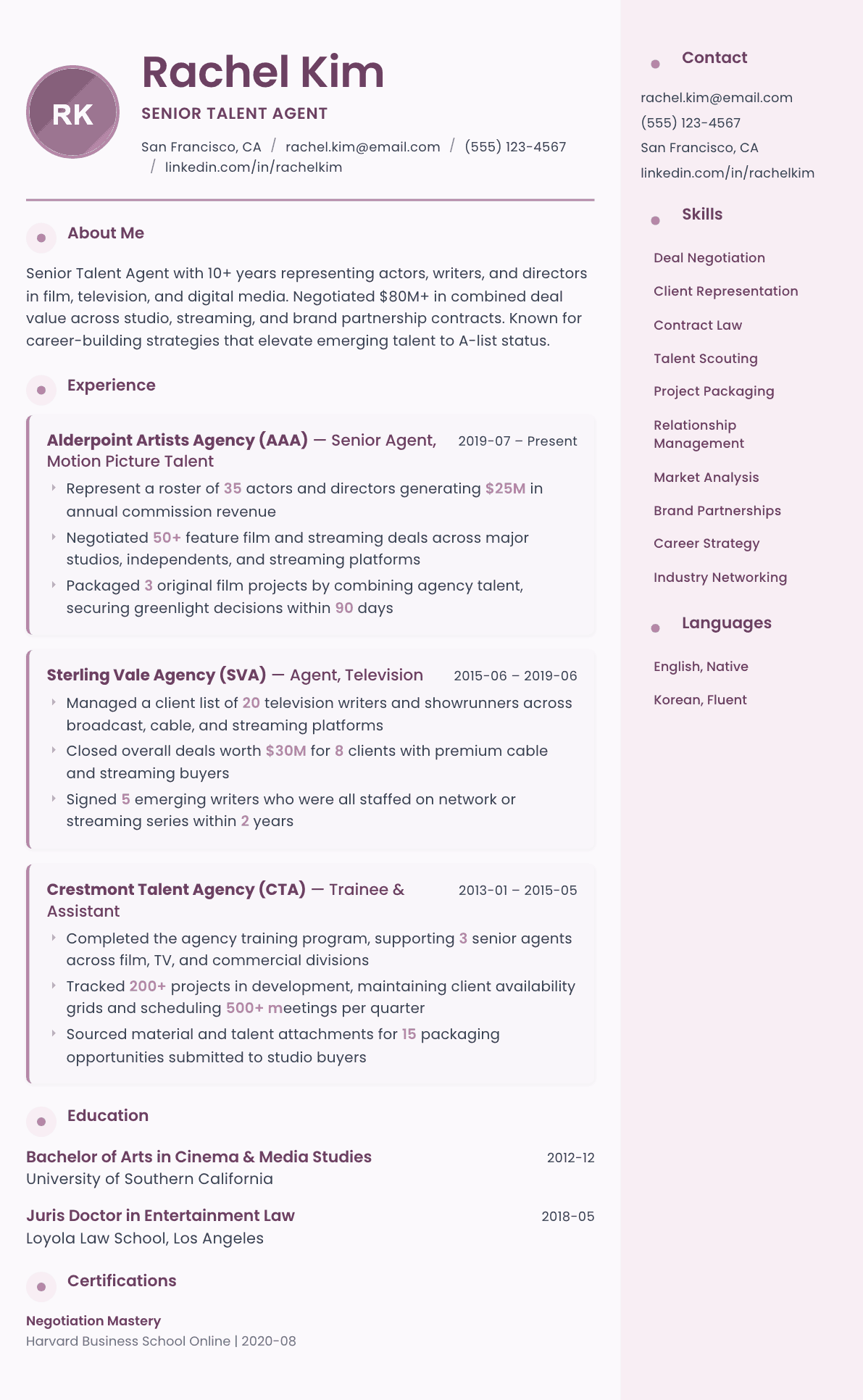
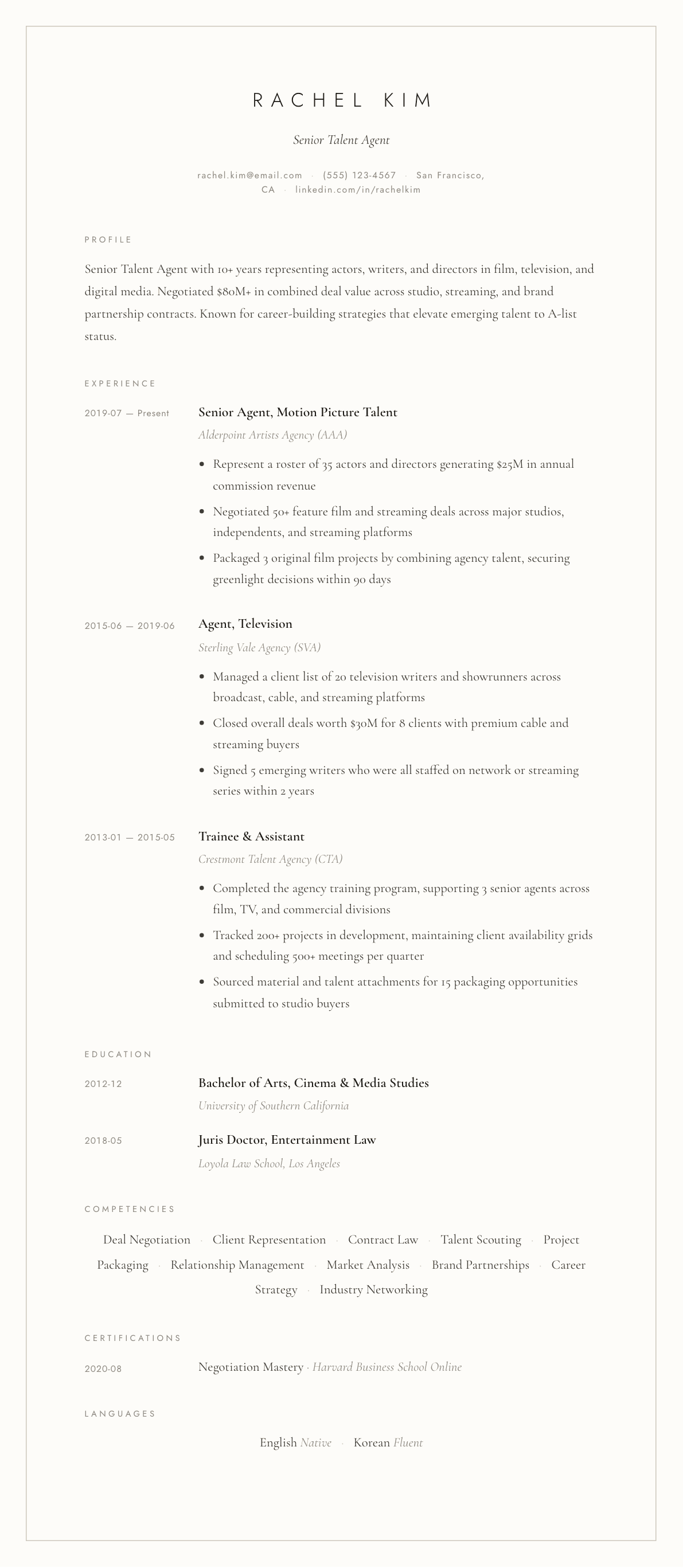
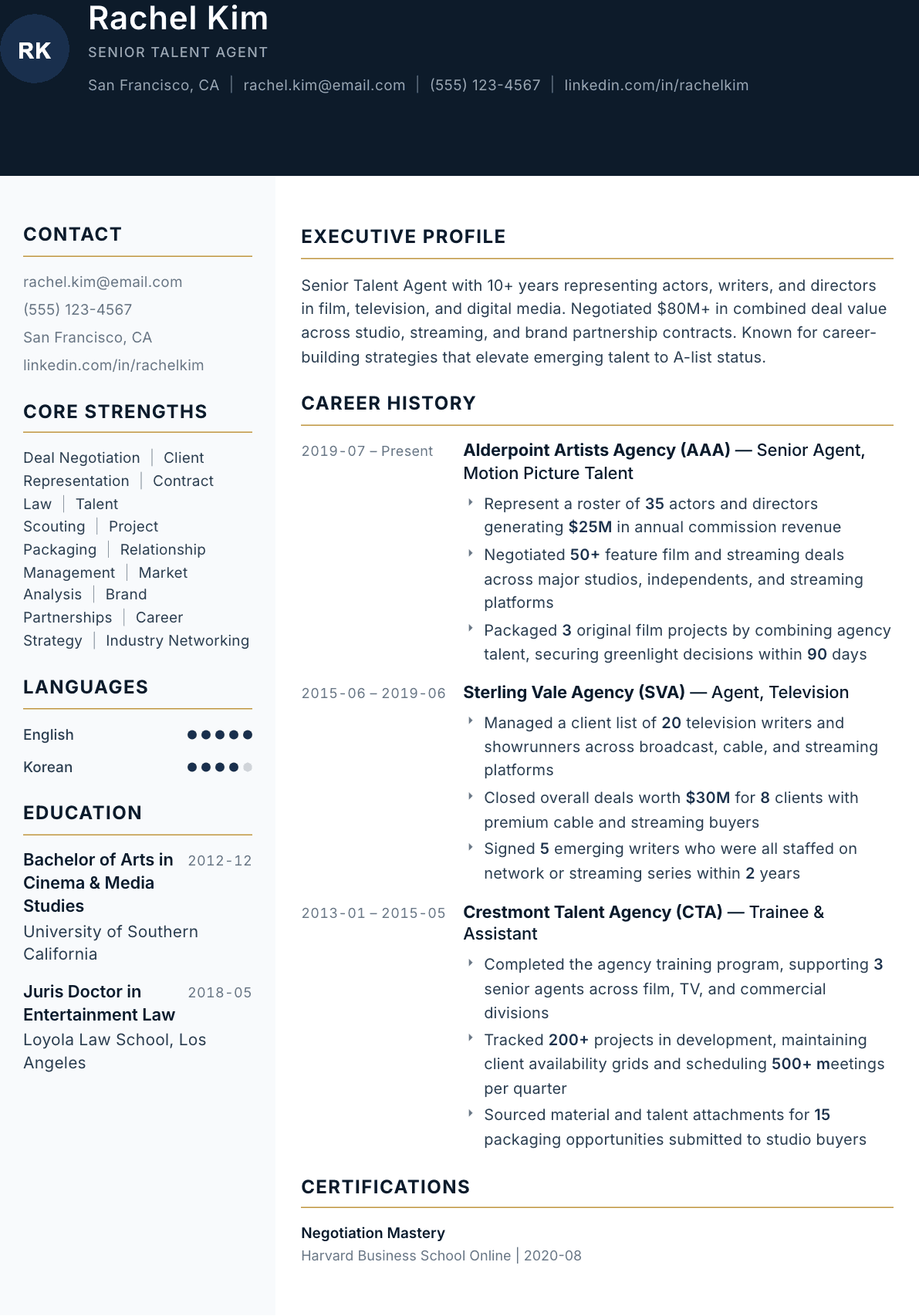
Example Talent Agent summary
Talent Agent, 10 years representing actors, writers, and directors across film, television, and digital media. Has negotiated $80M in deal value with studios and streamers, packaged 3 films to greenlight, and carries a 35-client roster worth $25M a year in commission.
Skills to list on a Talent Agent resume
- Deal Negotiation
- Client Representation
- Contract Negotiation
- Talent Scouting
- Project Packaging
- Relationship Management
- Market Intelligence
- Brand Partnerships
- Career Development
- Industry Networking
- Entertainment Law
- Business Development
What actually gets this resume read
- Highlight deal volume and total value negotiated. This is the primary measure of an agent's success.
- Showcase your client roster composition without violating confidentiality. Reference tier level and format expertise.
- Demonstrate industry relationships: studios, networks, streamers, and brand partners you work with.
- Include your ability to identify and develop emerging talent. Agencies value agents who build careers.
- Keep the tone professional and results-focused; entertainment is a business.
How to write a talent agent resume
An agency partner reading a talent agent resume is asking one thing: can this person generate revenue for the desk. Everything on the page has to serve that. Roster size and composition, deal volume, the buyers who take your calls, the clients you signed before anyone else wanted them, and whether you have carried a book alone or supported someone who did. Warmth and taste do not survive the read unless they are attached to closed deals.
The career has a hard shape. Nearly everyone starts in the mailroom or on a desk as an assistant, moves to a coordinator or junior agent title, then carries their own list. Because that ladder is universal, the resume is read against it, and a title that does not match the responsibilities described will be spotted immediately. Say plainly whether you were covering a desk, supporting an agent, or signing and servicing your own clients.
Below is how to structure the page, what to write at three career stages, before and after bullets that put deal work in agency language, and the questions agents and assistants ask when they move between agencies or from an agency to management or business affairs.
Format: one page, department and desk first, no client list dump
One page. Agency hiring is fast and referral heavy, and a partner will read the top third and then call someone who knows you. Header carries name, city, phone and email. Add a line naming the departments you have worked: talent, literary, alternative, comedy touring, commercial endorsement, digital, or below the line.
Section order: summary, agency experience, deal and roster highlights, industry relationships, education, and any bar admission or business affairs training if you have it. Coverage of a desk matters more than any skills list, so keep the experience block generous and cut anything generic.
- For every agency, name the department, the desk you covered and whether you were signing or servicing.
- Describe the roster by tier and category rather than by name, unless a client has publicly credited you.
- Say who you reported to by title, since desk lineage tells a partner where you were trained.
- Keep licensing and regulatory detail on the page when the state or the union requires it for talent representation.
Summary: department, roster shape, deal flow
Three lines. Name the department and the formats you sell into: feature, scripted television, streaming, unscripted, commercial, live touring, publishing, brand endorsement. Then describe the book you carry, in composition rather than names: number of clients, the mix of working and developing talent, and the categories they fall into. Then a deal fact you can defend, such as the volume of closed deals in a year or the number of clients you moved from unrepresented to working.
Avoid describing yourself as a relationship builder. That is the job description, not a differentiator. Say which buyers and casting offices actually pick up when you call, expressed as the studios, networks, streamers or brand categories you have closed with.
Experience: what a desk actually did
Write each agency entry around four things: the roster you carried or supported, the deals you touched, the packaging or development work you contributed to, and the coverage load. Agencies run on volume, so submission counts, meeting counts and offer counts are legitimate numbers and they read as effort, which partners reward.
Deal work should show your actual role in it. There is a difference between sourcing an offer, negotiating terms, and handing it to business affairs to paper. Say which parts you owned: quote setting, backend and bonus structure, credit and billing, exclusivity and holds, options and overall terms. An agent who understands billing and credit disputes is more valuable than one who only chases availability.
Signing is the loudest evidence on the page. If you found a client before anyone else wanted them and they went on to work, that is the story. Give the sequence: how you sourced them, what you got them, and where they ended up, without violating anything you agreed to keep private.
- Separate clients you signed from clients you inherited or serviced, because partners will ask.
- Include packaging work with your specific contribution: attaching a director, a writer, or financing.
- Note territory and format coverage, such as international sales or endorsement deals with brand categories.
- Assistants should quantify desk load: call volume, grids, submissions, travel and meeting coordination.
Relationships and market knowledge
Representation is a relationship business, and the resume should make yours visible without name dropping people who never agreed to be listed. Do it by describing coverage: the casting offices you submit to regularly, the studios and streamers you have closed with, the brand and agency side contacts you maintain for endorsement work, the festivals and markets you attend.
Market knowledge shows in the way you write. Naming the formats currently buying, understanding how streaming residual and buyout structures differ from a traditional broadcast deal, knowing what a quote is worth in a category: writing that shows this reads as an agent, and writing that avoids it reads as an outsider applying to an industry it has only watched.
Confidentiality, compliance and the things not to put on the page
Client information is confidential and agency agreements are usually explicit about it. Never publish a client roster or a specific deal value that was not publicly reported. Describe tiers, categories and totals instead. A partner will read the discretion as professionalism, and the opposite as a liability.
Compliance detail deserves a line where it applies. Talent agency licensing requirements vary by state and some categories of representation are regulated, so if you hold or have worked under a license, say so. Union and guild frameworks also shape the work, and familiarity with the applicable agreements is worth naming when the desk requires it.
Talent Agent resume summary examples
Agency assistant
Agency assistant on a talent desk supporting two agents and a list of 40 clients, handling call rolls, availability grids, submissions and coverage. Completed the agency training program, tracks 200 projects in development, and has sourced three clients later signed by the department.
Junior agent with a list
Talent agent carrying a personal list of 18 clients across scripted television, film and commercial endorsement. Signed 7 of them directly, negotiates quotes and terms with casting and business affairs, and has moved four developing actors from first credits into series regular bookings.
Department head
Senior agent and department head with twelve years representing actors, writers and directors across studio, streaming and brand work. Leads a team of five agents and assistants, owns the department's buyer relationships, and packages projects by attaching agency clients before taking them to market.
Work experience bullets: before and after
Before: Managed a roster of talent clients.
After: Carried a personal list of 18 clients across scripted television and commercial endorsement, servicing availabilities, quotes and conflicts while signing 7 of them directly out of showcases and casting referrals.
Roster size, category mix and the split between signed and inherited clients are the first things a partner tries to work out.
Before: Negotiated contracts for clients with studios.
After: Negotiated series regular and guest star deals with studio and streaming business affairs, setting quotes, credit and billing, option terms and exclusivity windows across 30 closed deals in a year.
Naming the deal points and the annual volume shows you did the negotiation rather than passing it to legal.
Before: Helped package projects for the agency.
After: Contributed to four packaged projects by attaching an agency writer and a director to existing material, then coordinating the submission strategy that took two of them to a greenlight decision.
Packaging is only credible when the specific attachment and the outcome are described.
Before: Supported senior agents as an assistant.
After: Ran a two agent desk covering 40 clients: 150 calls a day, availability grids, submission tracking across 200 projects, and coverage notes on incoming material and self tapes.
Desk load is the assistant metric everyone in the agency understands, and it proves stamina rather than proximity.
Before: Built relationships with casting directors and buyers.
After: Maintained standing coverage with casting offices across scripted and commercial work, plus direct buyer contact at three streamers, producing regular first calls on breakdowns before general release.
Access is only meaningful when it produces something, and an early call on breakdowns is a measurable advantage.
Hard skills
- Client representation and servicing
- Deal negotiation and quote setting
- Credit, billing and exclusivity terms
- Project packaging
- Talent scouting and signing
- Submission and breakdown coverage
- Availability and conflict management
- Brand and endorsement deals
- Business affairs coordination
- Guild and union agreement familiarity
- Market and buyer analysis
- Commission and billing tracking
Soft skills
- Discretion with client information
- Persistence in a rejection heavy trade
- Difficult client conversations
- Negotiation composure
- Relationship maintenance over years
- Judgment about raw talent
Mistakes that cost talent agent candidates the interview
- Publishing a client roster or a private deal value, which reads to any partner as a confidentiality risk.
- Blurring the line between clients you signed and clients you inherited, since that is the first question in the interview.
- Claiming an agent title for work that was actually assistant coverage of someone else's desk.
- Filling the page with relationship language instead of deal volume, signings and buyer coverage.
- Leaving out the department and format, so a partner cannot tell literary from talent from alternative work.
- Ignoring the business affairs side, which makes an agent look like someone who chases availability and nothing more.
Talent Agent resume questions
How do I show my client roster without breaking confidentiality?
Describe it in composition rather than names: how many clients, the split between working and developing talent, the categories and formats they work in. Name a client only when the relationship is already public and they have credited you themselves.
What numbers actually matter on a talent agent resume?
Roster size, deals closed in a year, clients signed personally, submissions and meetings generated, and the number of clients you moved to a higher tier of work. Those are the figures a partner uses to estimate what your desk will bill.
How does an agency assistant write a resume for a junior agent promotion?
Show desk ownership rather than support: the roster you effectively covered, the clients you sourced that the department signed, the deals you tracked from offer to close, and the buyer contacts who deal with you directly rather than through your agent.
Should I list the agency training program I completed?
Yes, because desk lineage matters in this business and a recognized training program tells a partner how you were taught to cover a desk, roll calls and read material. Name the department you trained in and the agents whose desks you covered by title.
How do I move from talent agency work into management or business affairs?
For management, lead with career strategy, developing talent and the long relationships rather than deal volume. For business affairs, lead with the terms you have negotiated, guild agreement familiarity and any legal training, since that side buys contract fluency over signing instinct.