Theater Director Resume Examples: the lines they read
Theater Director Resume and Directing Resume Example
By Mustafa Tarabya, founder of CVBooster · Published · Updated
Theater director and directing resume examples with a production credit list, venue scale, film credits, MFA tips and the keywords artistic directors read for.
Sample resumes for a theater director
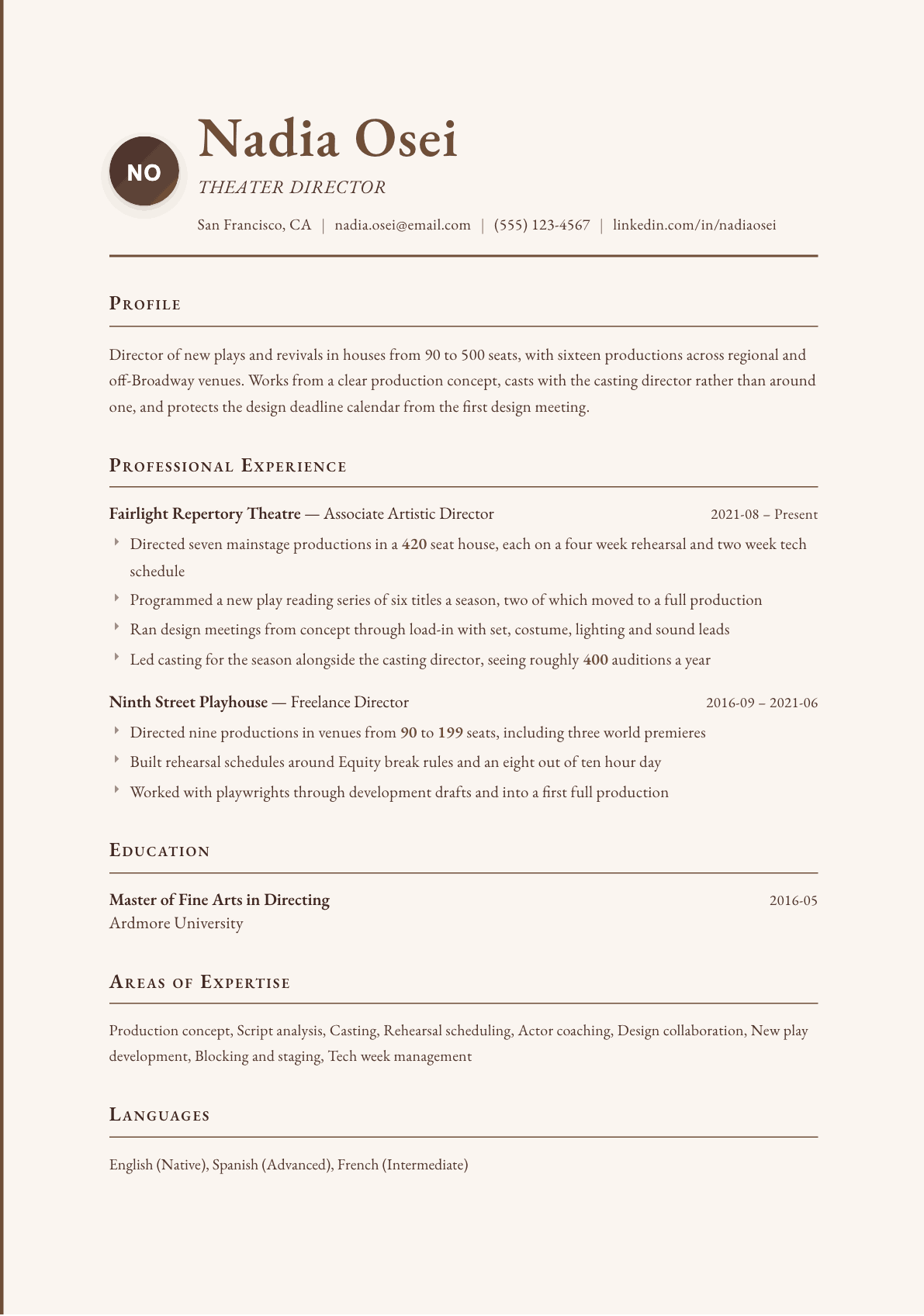
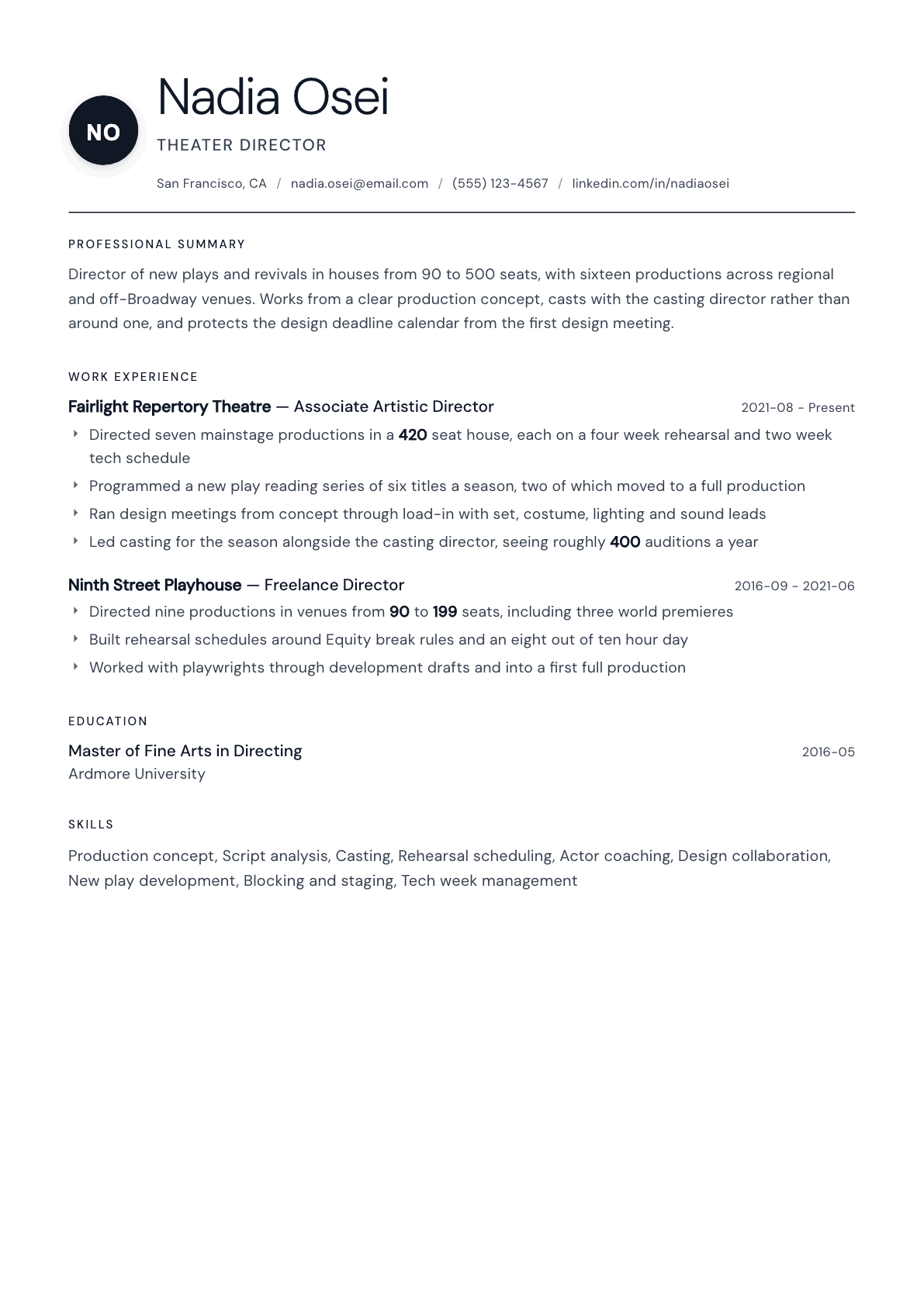
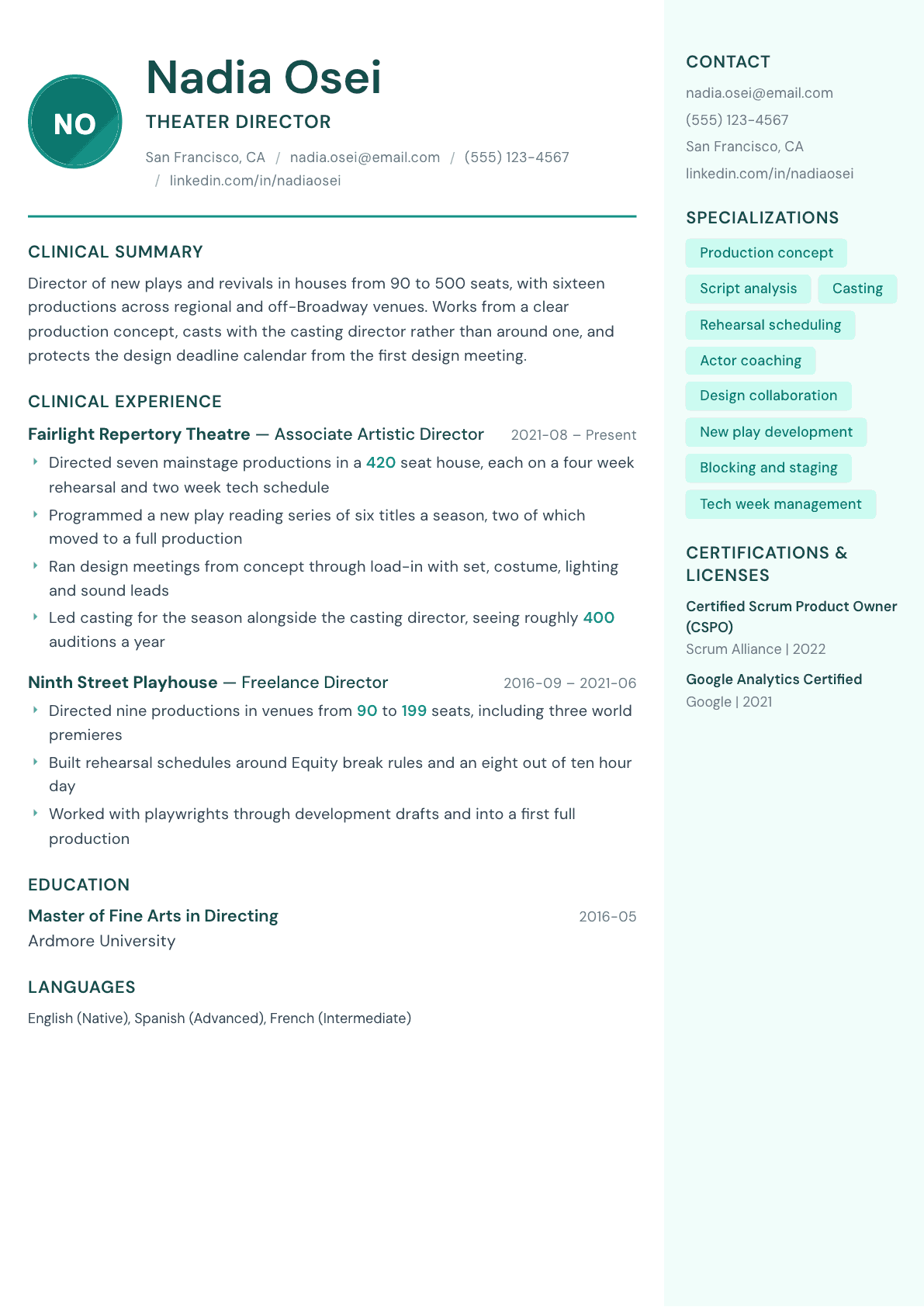
The same theater director content laid out in three CVBooster templates, so you can see what the finished document looks like before you write a word.
Example Theater Director summary
Theater director with sixteen productions in houses from 90 to 500 seats, seven of them mainstage in a regional repertory season. Builds a production concept the design team can work from on day one, casts alongside the casting director, and keeps a four week rehearsal period on schedule through tech. Seeking a resident or associate artistic post.
Skills to list on a Theater Director resume
- Script analysis
- Production concept
- Casting
- Actor coaching
- Blocking and staging
- Design collaboration
- Rehearsal scheduling
- New play development
- Dramaturgy
- Tech week management
- Season programming
- Budget planning
- Devised work
- Text and verse work
What actually gets this resume read
- Lead with a production credit table: title, playwright, venue, seat count and year.
- Mark world premieres and new play development separately, since programmers hire for that specifically.
- Name the union agreement you have worked under and the rehearsal week length you are used to.
- Show the scale you can hold, from a studio black box up to your largest house.
- Say how you run design meetings and how early you lock the concept with the design team.
- Keep assistant and associate directing credits in their own section rather than mixed with your own productions.
How to write a theater director resume
A theater director resume is really a credit list with a person attached. An artistic director or season programmer opens it, looks for the production titles, the playwrights, the venues and the seat counts, and forms a judgment about scale before reading a single line of prose. If your credits are buried under a paragraph about your artistic vision, that judgment happens without the evidence you wanted them to see.
The second thing they check is whether you have worked at their size. A director who has run a 90 seat black box and a director who has held a 500 seat mainstage through a four week rehearsal period and a two week tech are being hired for different problems. The resume has to make that range obvious: smallest house, largest house, and the rehearsal week length you are used to.
This guide covers what a directing resume is, a complete directing resume example, the credit table, the summary that programmers actually read, how to separate your own productions from assistant and associate work, and the questions directors ask when they sit down to build a resume for a season submission or a residency application.
Format: credits above everything, one page until the list forces two
Lead with a directing credits table, not a summary block. Each row carries the production title, the playwright, the producing organization, the venue seat count and the year. That is the format a literary office and an artistic director already read a hundred times a season, and deviating from it makes them work.
Keep every credit in reverse-chronological order inside its section, and let the sections do the sorting rather than mixing scales together. A director with sixteen productions can fill two pages honestly. A director with five should not stretch to two by adding readings and staged workshops into the main list.
- Header: name, city, phone, email, and the union agreements you have worked under.
- Sections in this order: directing credits, new play development, assistant and associate credits, training, awards and residencies, skills.
- Early-career directors move training up and add an assistant directing section with the lead director named.
Summary: scale, repertoire and the thing you are known for
Three lines at most, and every clause has to carry a fact. Name the number of productions, the seat range of the houses, the kind of work you direct, and one process detail a programmer can picture. A summary that promises bold, visceral, urgent storytelling describes the entire submission pile.
If you are aiming at a specific post, say which one. A freelance director going after a resident or associate artistic seat should name season programming, reading series curation and casting alongside the productions, because those are the parts of the job that are not directing.
Credits: title, playwright, venue, seat count, year
Seat count is the single most useful number on a theater director resume, and most candidates leave it off. A 420 seat regional house, a 199 seat off-Broadway venue and a 90 seat studio are three different jobs in terms of design budget, tech time and casting pool. Put the number next to the venue and let the reader do the math.
Mark world premieres and first productions of new plays. Programmers who commission and develop new work hire specifically for that experience, and it does not read from a title alone. If you took a play from a development draft through a reading series into a full production, say so in the credit line rather than in a paragraph nobody reaches.
Do not pad the list with productions you assisted on. A reader who discovers a credit was actually an associate post stops trusting the rest of the page, and every artistic director in a region talks to every other one.
Process: rehearsal weeks, design meetings, casting
Under the credits, a short process section answers the questions a production manager asks before a hire. How many rehearsal weeks are you used to? How early do you lock the concept with the design team? Do you cast with a casting director or run your own auditions? How do you handle an eight out of ten hour day and the break rules that come with a union contract?
These are not artistic questions and they are the ones that decide whether you are easy to program. A line that says you deliver a production concept the set, costume, lighting and sound leads can draft against at the first design meeting is worth more than a paragraph on your relationship to the text.
Skills and keywords a literary office scans for
Season submissions get sorted, and the sorting runs on repeated vocabulary: script analysis, production concept, casting, blocking and staging, dramaturgy, new play development, devised work, text and verse work, tech week, season programming. Use the exact phrasing that appears in the posting once in your summary and once inside a credit or process line.
Keep the skills list to things a director is actually hired for. Fight choreography, dialect coaching or intimacy direction belong here only if you hold real training in them, and then name the training body rather than claiming the skill flat.
Directing resume example for theater, film and MFA applications
A directing resume is the credit based resume directors send to theaters, festivals, residencies and MFA directing programs. It is not the general resume you would send for an office job, and it is not an acting resume with the roles swapped for productions. Graduate programs in directing usually ask for it alongside a statement and work samples, and the same credit list feeds both versions.
Film directors use the same logic with different columns: title, format such as short, feature, music video or commercial, production company, festivals or broadcast, and year. If you direct for both stage and screen, give each its own credits section rather than mixing them, so a theater reader can find the houses and a film reader can find the festivals. The invented example below shows a directing resume for a mid career stage director with some screen work.
- Header: Elena Marsh, Director, Chicago, phone, email, website with production photos, member of the directors union for the agreements worked under.
- Summary: Director of 14 productions in houses of 90 to 450 seats, including four world premieres. Known for new plays and for ensemble work built in a long table period.
- Directing credits: The Salt Year, by a commissioned playwright, regional theater mainstage, 450 seats, world premiere. Then each further credit in the same order: title, playwright, producing company, seats, year.
- New play development: four staged readings and one two week workshop, each with the playwright and the producing series named.
- Film and video: two short films as writer and director, with the festivals that screened them.
- Assistant and associate directing: three regional productions, each with the lead director named.
- Training and teaching: MFA in directing, plus guest directing at two university theater programs.
Theater Director resume summary examples
Early career
Director with five productions in houses of 60 to 120 seats, including two world premieres developed through a company reading series. Two years assisting on regional mainstage work. Builds a production concept in prep and casts from open calls. Seeking assistant and associate directing work in a regional season.
Freelance, eight years in
Freelance theater director with eleven productions in venues from 90 to 350 seats across new plays, revivals and adaptation. Works a standard four week rehearsal and one week tech, locks design concept at the first meeting, and casts alongside a casting director. Currently developing two commissioned scripts toward premiere.
Associate artistic director
Associate artistic director with sixteen productions in houses to 500 seats, seven of them mainstage in a regional repertory season. Programs a six title reading series a year, leads casting across the season, and runs design meetings from concept through load-in. Two development titles moved to full production under this reading series.
Work experience bullets: before and after
Before: Directed several plays at a regional theater.
After: Directed seven mainstage productions in a 420 seat regional house, each on a four week rehearsal and two week tech schedule.
The seat count, the number of productions and the schedule tell a programmer your exact working scale.
Before: Worked closely with the design team.
After: Ran design meetings from concept through load-in with set, costume, lighting and sound leads, delivering a locked concept before the first draft of the ground plan.
Naming the departments and the deadline turns a courtesy phrase into a description of how you actually work.
Before: Involved in casting for the season.
After: Led season casting alongside the casting director, seeing roughly 400 auditions a year and building understudy coverage into every offer.
Volume plus a specific casting decision shows the reader you have carried the whole process, not sat in on it.
Before: Developed new work with playwrights.
After: Programmed a six title new play reading series each season and carried two of those scripts from development draft into a first full production.
A development claim only counts when the reader can see how many scripts and how far they traveled.
Before: Directed shows in small venues.
After: Directed nine productions in 90 to 199 seat venues, including three world premieres, scheduling rehearsals around union break rules and an eight out of ten hour day.
The seat range, the premiere count and the contract detail replace the word small with facts a producer can price.
Hard skills
- Script analysis
- Production concept
- Casting
- Blocking and staging
- Design collaboration
- Rehearsal scheduling
- New play development
- Dramaturgy
- Tech week management
- Season programming
- Devised work
- Text and verse work
- Budget planning
Soft skills
- Actor coaching
- Room leadership
- Conflict resolution
- Note giving
- Collaboration under deadline
- Playwright relationships
Mistakes that cost theater director candidates the interview
- Opening with an artistic statement instead of the credit list a programmer came to read.
- Leaving seat counts off every venue, so nobody can tell a studio production from a mainstage one.
- Mixing assistant and associate credits into the main directing list, which reads as inflation the moment someone checks.
- Listing readings, workshops and full productions in one undifferentiated block.
- Naming a rehearsal process in the abstract without ever stating the rehearsal week length you work in.
- Sending the same page to a new play house and a classical company rather than reordering the credits that matter to each.
Theater Director resume questions
What is a directing resume and how long should it be?
A directing resume is a credit list for directors: production, playwright or format, company, venue size and year, then training. It stays one page until your credit list genuinely overflows it, then two. A director with fewer than ten productions should stay on one page and use the space for venue detail rather than adding workshops to fill a second sheet.
Should I include readings and workshops as directing credits?
Yes, but in their own new play development section with the format named. A staged reading and a full production are different jobs, and a literary office that finds them mixed together will discount the entire list.
Do I put venue seat counts on every credit?
Yes. Seat count is how a programmer reads scale, budget and tech complexity in one glance. Without it a reader cannot tell whether your largest production ran in a black box or a 500 seat house, so they assume the smaller one.
How do I list assistant directing on a director resume?
In a separate section, with the production, the lead director and the venue. Assisting a well known director is a real credential and reads as one when it is honest, but folded into your own credits it undermines everything else on the page.
What goes on a theater director resume with only student productions?
Put training first, then a credits section that labels each production as a graduate or undergraduate production with the venue and seat count. Add assistant work, reading series direction and any company you helped found, since early credits are judged on volume and initiative.