Respiratory Therapist Resume Examples: read this first
Build a Respiratory Therapist Resume That Breathes Confidence
By Mustafa Tarabya, founder of CVBooster · Published · Updated
Create a professional respiratory therapist resume with clinical examples, RT-specific templates, and tips for pulmonary care positions.
Sample resumes for a respiratory therapist
The same respiratory therapist content laid out in three CVBooster templates, so you can see what the finished document looks like before you write a word.
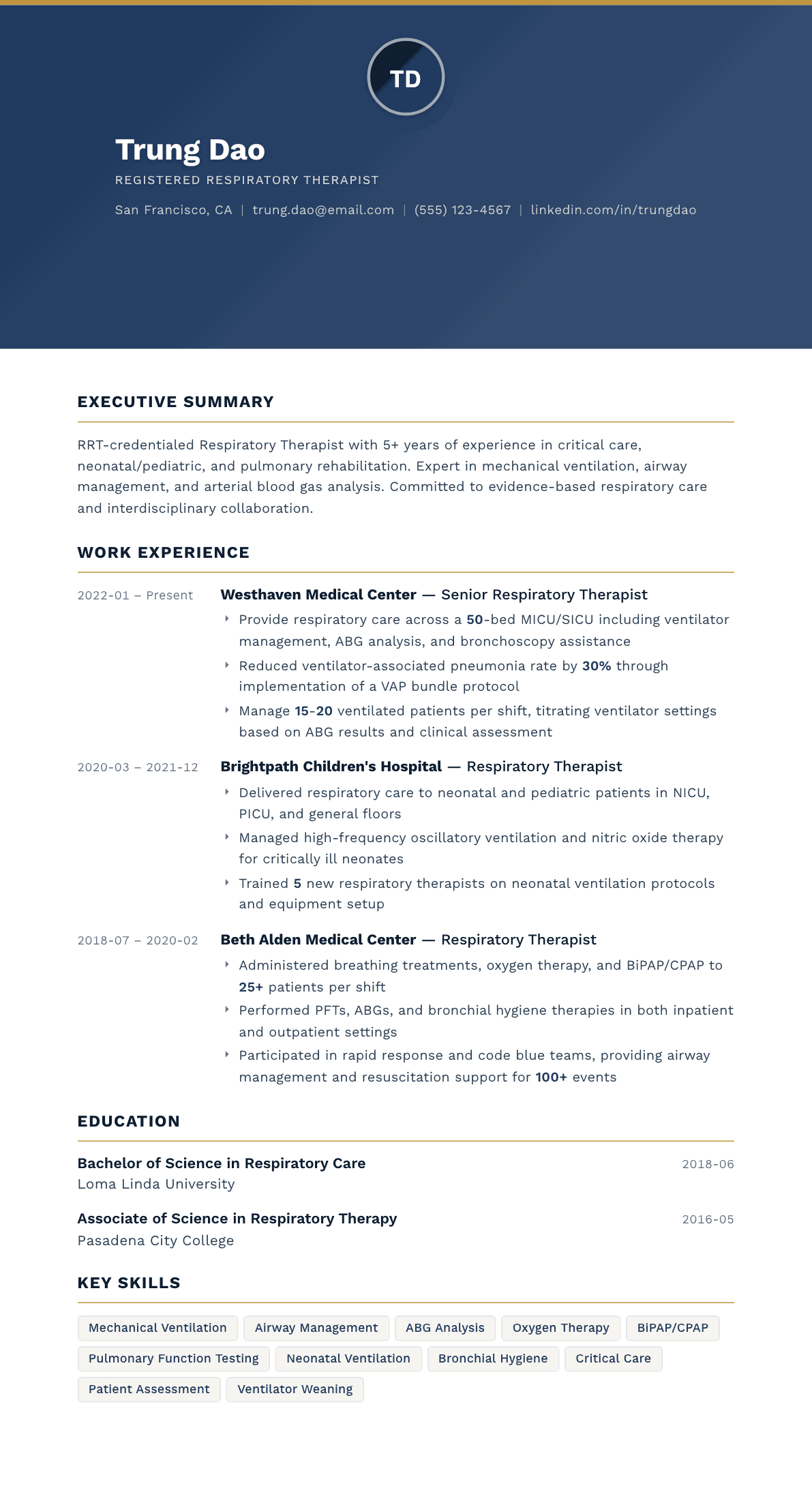
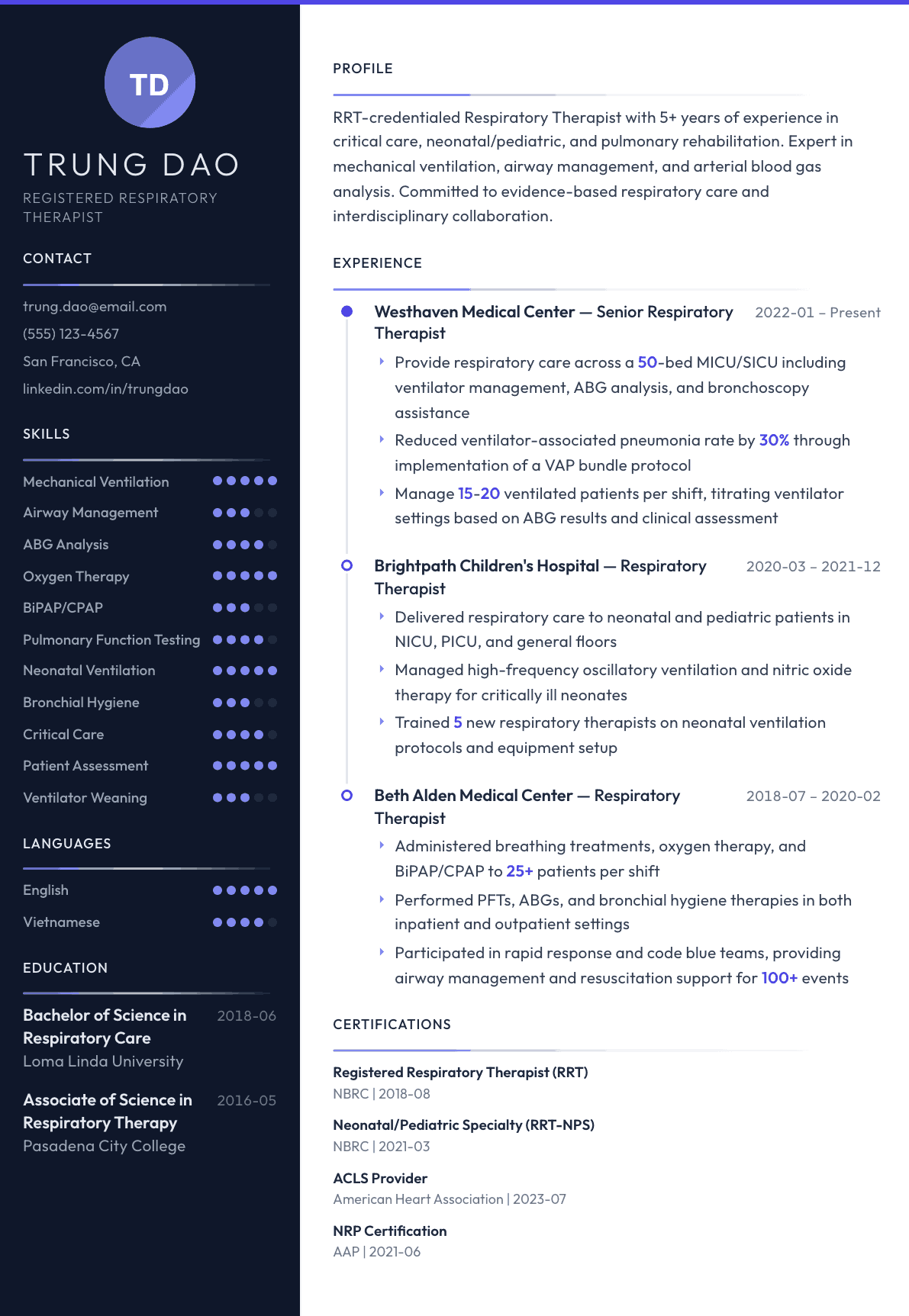
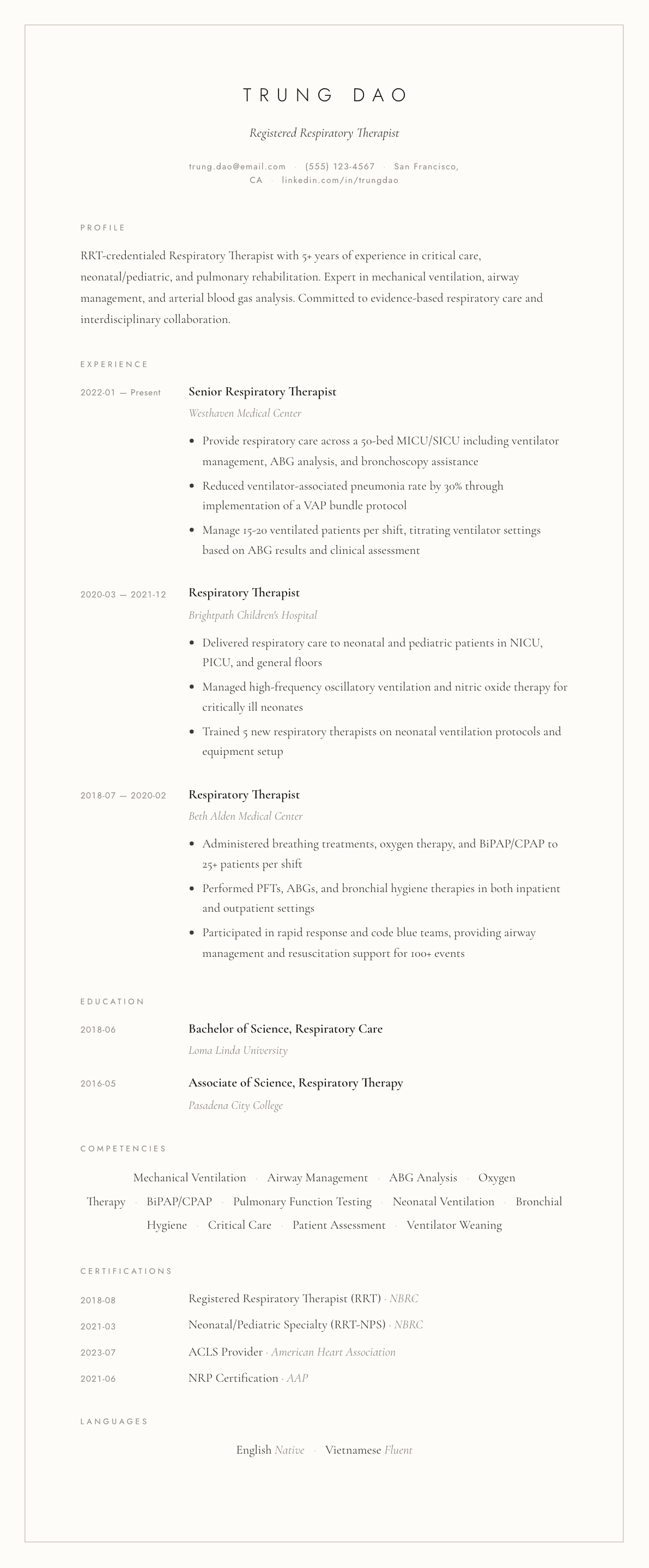
Example Respiratory Therapist summary
RRT-credentialed Respiratory Therapist with 5 years of experience in critical care, neonatal/pediatric, and pulmonary rehabilitation. Reduced VAP rates by 30% and manage 15-20 ventilated patients per shift. Seeking a senior RT position in an academic medical center with opportunities in neonatal specialty care.
Skills to list on a Respiratory Therapist resume
- Mechanical Ventilation
- Airway Management
- ABG Analysis
- Oxygen Therapy
- BiPAP/CPAP
- Pulmonary Function Testing
- Neonatal Ventilation
- Bronchial Hygiene
- Critical Care
- Ventilator Weaning
- Bronchoscopy Assistance
- Patient Education
- Rapid Response
- Pulmonary Rehabilitation
What actually gets this resume read
- Display your RRT credential and any specialty certifications (NPS, ACCS, SDS) prominently.
- Quantify patient volumes, ventilator counts, and quality improvement outcomes.
- Specify critical care, neonatal, or pulmonary rehabilitation experience.
- Highlight protocol development and evidence-based practice initiatives.
- Include rapid response and code team participation experience.
- Mention specific ventilator brands and respiratory equipment you operate.
How to write a respiratory therapist resume
A respiratory therapist resume gets sorted by credential level first. Registered therapists are separated from certified therapists, and specialty credentials in neonatal and pediatric care, adult critical care, sleep or pulmonary function move a file to the top of the pile. State licensure is checked next. Only after that does anyone read the prose.
The clinical manager reading it wants three answers. What patient populations have you managed, adult, pediatric or neonatal. What ventilators have you run, by vendor and mode. And how many patients do you carry on a shift, because a therapist who covers 15 ventilators overnight with rapid response duty is a different hire from one who runs floor treatments.
This guide lays out the section order respiratory departments read in, three summaries across career stages, before-and-after bullets built on ventilator management and protocol work, and the questions therapists ask when moving from floor care into critical care.
Format: credentials after the name, licensure block up top
Reverse chronological, one page under five years and two once you have multiple units and specialty credentials. Write the credentials the way the board writes them, so RRT, then any specialty credential such as RRT-ACCS or RRT-NPS, then the state license. That single line settles the first screening question.
Keep the layout single column. Hospital parsers scramble sidebars, and the credential dates are the part you cannot afford to have dropped.
- Header: name, RRT and specialty credentials, city and state, phone, email, state respiratory care license.
- Order: summary, credentials and licensure, clinical experience, equipment and modalities, education, skills.
- New graduates put the clinical rotation list above work history with hours by unit.
Summary: population, unit, ventilator load, protocol authority
Three sentences. Name the populations, the units, the years, and the ventilator load per shift. Neonatal experience is scarce, so if you have run high-frequency oscillatory ventilation or inhaled nitric oxide on a neonatal unit, that belongs in the first sentence rather than buried in the third job.
Then say whether you work under therapist-driven protocols. Departments that have moved to protocol-based weaning and oxygen titration want therapists who have carried that autonomy already, and the phrase is a keyword in their postings.
Experience: units covered, ventilators managed, procedures assisted
Head each job with the facility, the units you covered, the bed count and the shift. Something like respiratory therapist covering a 50-bed combined medical and surgical intensive care unit on nights, 15 to 20 ventilated patients per shift, gives a manager the scope in one line.
Then bullets on the clinical work that varies between therapists: invasive ventilation by mode, noninvasive ventilation with BiPAP and high-flow nasal cannula, arterial blood gas draws and interpretation, arterial line sampling, intubation assistance and airway management, bronchoscopy assistance, tracheostomy care and changes, extracorporeal support if your unit runs it, and transport of ventilated patients.
Include the response duties. Code blue, rapid response and difficult airway team membership are among the few bullets on a respiratory resume that separate one candidate from the rest of the department.
Equipment and modalities: name the vendors
Ventilator platforms are not interchangeable in practice. List the ones you have run, such as Servo, Puritan Bennett, Draeger, Hamilton or Avea, and the modes you are comfortable with including pressure regulated volume control, airway pressure release ventilation and high-frequency oscillation. Add the blood gas analyzer, the pulmonary function testing system and the point of care devices.
A department standardized on one vendor will move a candidate who already knows that platform ahead of one who does not, because it removes weeks of competency checkoffs.
Quality work: protocols, bundles and education
Respiratory has clear improvement targets that a hiring manager recognizes: ventilator-associated event prevention bundles, spontaneous awakening and breathing trial compliance, extubation failure rates, oxygen titration protocols, and length of ventilation. If you sat on a workgroup for one of those, put the mechanism and the result in a bullet.
Teaching also counts. Precepting students from an accredited respiratory care program, running competency checkoffs on a new ventilator platform, or leading unit education on a mode rollout are all concrete and verifiable.
Respiratory Therapist resume summary examples
New graduate therapist
Registered respiratory therapist and recent associate degree graduate with rotations across adult intensive care, the emergency department, pulmonary function testing and a 6-week neonatal placement. Comfortable with arterial blood gas draws, noninvasive ventilation and floor therapies, seeking an acute care position with a structured orientation.
Five years in critical care
Respiratory therapist with 5 years covering a 50-bed medical and surgical intensive care unit, carrying 15 to 20 ventilated patients per shift on Servo and Draeger platforms. Works under therapist-driven weaning protocols and serves on the code blue and difficult airway response teams.
Lead or clinical specialist
Lead respiratory therapist with 12 years across adult and neonatal critical care, holding both adult critical care and neonatal pediatric specialty credentials. Runs the ventilator competency program for 30 therapists and led the unit rollout of a spontaneous breathing trial protocol.
Work experience bullets: before and after
Before: Managed ventilators for critically ill patients.
After: Managed 15 to 20 ventilated patients per night shift on Servo and Draeger platforms, titrating settings from arterial blood gas results and daily spontaneous breathing trials.
Load, vendor and the actual decision cycle show a manager you can hold a critical care assignment alone.
Before: Gave breathing treatments to patients on the floor.
After: Delivered bronchodilator therapy, airway clearance and noninvasive ventilation to 25 or more floor patients per shift, converting stable patients off scheduled treatments under the assess and treat protocol.
The protocol authority turns a routine task into evidence of clinical judgment.
Before: Helped reduce ventilator-associated pneumonia.
After: Served on the ventilator bundle workgroup, rebuilt the oral care and head-of-bed audit at the bedside, and helped cut unit ventilator-associated events by roughly a third over 4 quarters.
Naming the intervention and the audit makes the improvement credible instead of borrowed.
Before: Worked with neonatal patients.
After: Managed high-frequency oscillatory ventilation and inhaled nitric oxide therapy for extremely preterm neonates, and set up and transported ventilated infants with the neonatal transport team.
These are scarce skills, and naming them precisely is what gets a neonatal posting to call back.
Before: Trained other staff on equipment.
After: Wrote and ran the competency checkoff for a new ventilator platform across 30 therapists, covering mode setup, alarm response and troubleshooting during the rollout.
Scope and deliverable turn casual training into a departmental project.
Hard skills
- Invasive mechanical ventilation
- Noninvasive ventilation and high-flow therapy
- Arterial blood gas sampling and interpretation
- Airway management and intubation assistance
- Tracheostomy care
- Pulmonary function testing
- Bronchoscopy assistance
- Neonatal and pediatric ventilation
- Ventilator weaning protocols
- Aerosol and airway clearance therapy
- Transport of ventilated patients
- Electronic charting in Epic or Cerner
Soft skills
- Rapid response under pressure
- Communication with intensivists
- Family education at the bedside
- Prioritizing across units
- Precepting students
- Handoff accuracy
Certifications worth listing
- Registered Respiratory Therapist (RRT) (National Board for Respiratory Care)
- Adult Critical Care Specialist (ACCS) (National Board for Respiratory Care)
- Neonatal/Pediatric Specialist (NPS) (National Board for Respiratory Care)
- Certified Pulmonary Function Technologist (CPFT) (National Board for Respiratory Care)
- Sleep Disorders Specialist (SDS) (National Board for Respiratory Care)
- Advanced Cardiovascular Life Support (ACLS) (American Heart Association)
- Neonatal Resuscitation Program (NRP) (American Academy of Pediatrics)
Mistakes that cost respiratory therapist candidates the interview
- Writing RT instead of the exact credential, so a screener cannot tell a registered therapist from a certified one.
- Listing units covered without the ventilator load, which is the number that tells a critical care manager whether you can hold the assignment.
- Leaving ventilator vendors and modes off the page, forcing the department to assume a full competency cycle before you are useful.
- Claiming neonatal experience without naming the therapies, when high-frequency ventilation and nitric oxide are exactly what the posting is filtering for.
- Filling bullets with treatments every respiratory therapist performs and leaving out protocol authority, response team duty and quality work.
- Omitting the state license, which several states require before a hospital can even schedule you.
Respiratory Therapist resume questions
Should I list RRT or CRT first on my resume?
List the highest credential you hold, so RRT if you have it, followed by any specialty credential such as ACCS or NPS. Write them after your name and repeat them with the issuing board in a credentials section near the top.
How do I show critical care experience as a floor therapist?
Lead each job with any intensive care coverage, rapid response and code participation, and airway assistance you have done, even occasionally. Then name the ventilator platforms you have touched and any blood gas or arterial line work, because those are the transferable pieces.
Do ventilator brands really matter on a respiratory therapist resume?
They matter more than most therapists expect. Departments standardize on one or two platforms, and a candidate who already knows the vendor and its modes shortens orientation, so name every platform you have run rather than writing mechanical ventilation alone.
What metrics belong on a respiratory therapy resume?
Ventilated patients per shift, total patients per shift on the floor, ventilator-associated event or bundle compliance results, extubation and weaning protocol outcomes, and any reduction in ventilation days your unit achieved with a project you worked on.
Is a neonatal specialty credential worth adding to my resume?
Yes, because neonatal and pediatric coverage is the hardest staffing gap in most respiratory departments. Hold the credential in the header, then support it with the therapies you have run and the transport or delivery room attendance you have logged.