Paramedic Resume Examples: free ATS score and gap list
Create a Paramedic Resume That Commands Attention
By Mustafa Tarabya, founder of CVBooster · Published · Updated
Build a powerful paramedic resume with EMS-specific templates, emergency response examples, and tips to showcase your life-saving expertise.
Sample resumes for a paramedic
The same paramedic content laid out in three CVBooster templates, so you can see what the finished document looks like before you write a word.
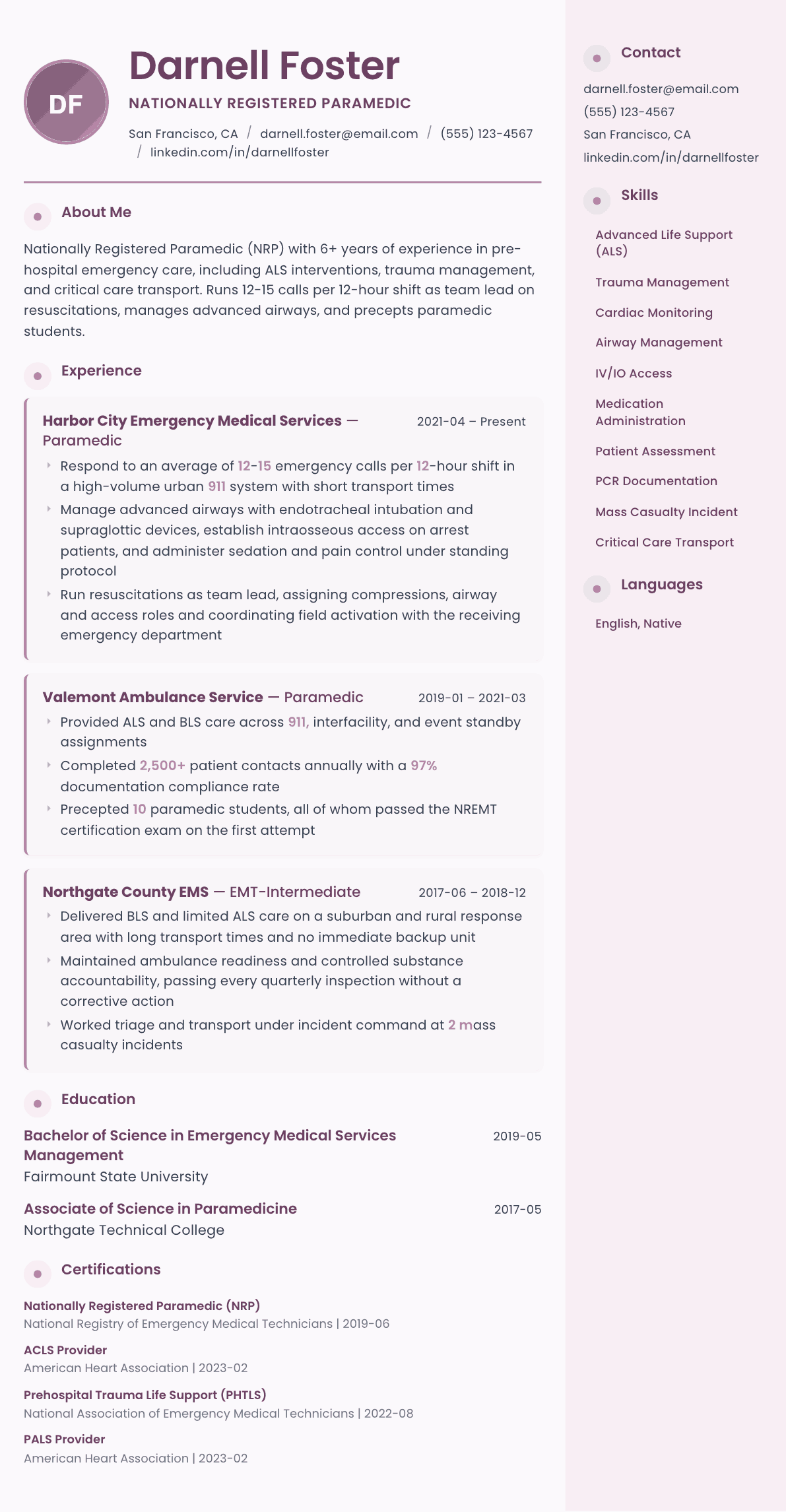
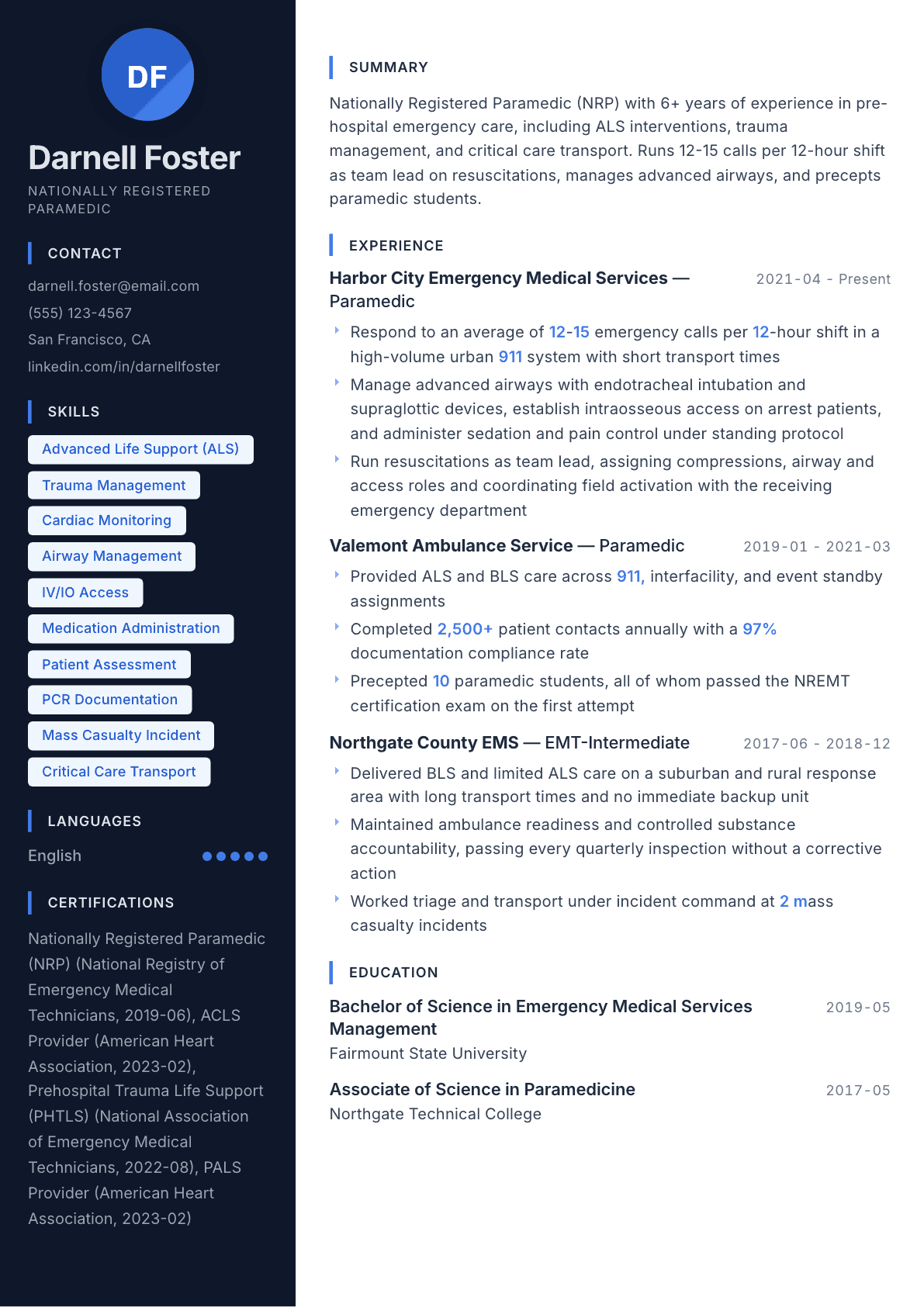
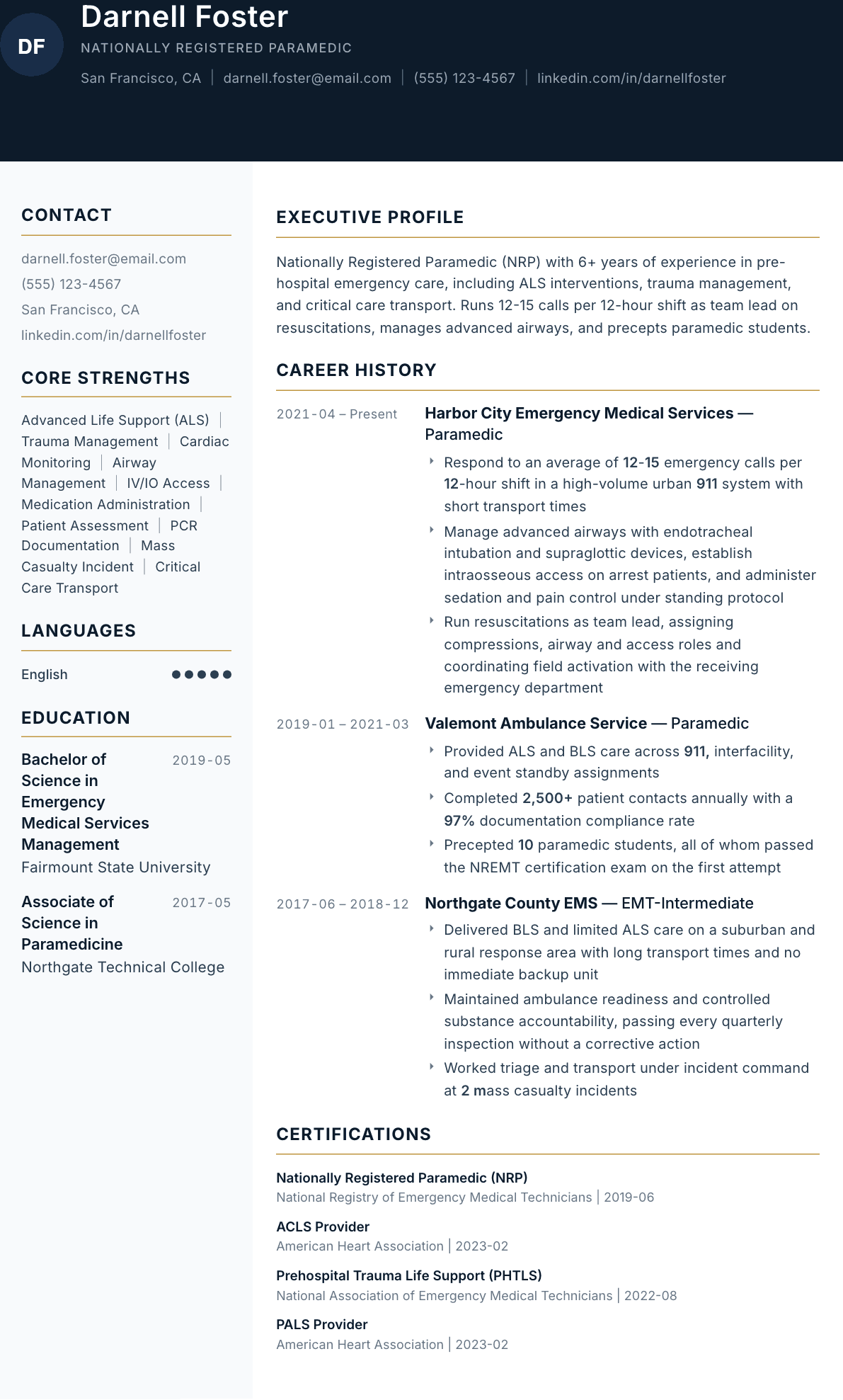
Example Paramedic summary
Nationally Registered Paramedic with 6 years of prehospital emergency care, running 12-15 calls per 12-hour shift in a high-volume urban 911 system across cardiac arrests, trauma alerts and stroke activations. Preceptor for paramedic students, current ACLS, PALS and PHTLS, and consistently at the top of agency documentation compliance review. Seeking a critical care transport or flight paramedic role.
Skills to list on a Paramedic resume
- Advanced Life Support
- Trauma Management
- Cardiac Monitoring
- Airway Management
- IV/IO Access
- Medication Administration
- Patient Assessment
- PCR Documentation
- Critical Care Transport
- Mass Casualty Incident
- Triage
- Pediatric Emergency Care
- 12-Lead ECG Interpretation
- Community Paramedicine
What actually gets this resume read
- List your NREMT certification and state license prominently at the top.
- Quantify call volume per shift, the system type and the acuity mix, and never quote a resuscitation rate your agency did not publish.
- Include advanced certifications such as ACLS, PALS, PHTLS, and ITLS.
- Highlight experience with specific ALS skills: intubation, 12-lead ECG, RSI.
- Mention special team experience such as SWAT medic, flight paramedic, or hazmat.
- Show training and preceptor experience to demonstrate leadership ability.
How to write a paramedic resume
A paramedic resume goes to an emergency medical services chief, a training officer or a hospital based transport supervisor, and the screen is fast and specific. Certification level and registry status, state license, driving record and any emergency vehicle operator training, the system you worked in, call volume, and the skills you perform under your medical director's protocols. That list decides whether you get a phone call.
The habit that hurts candidates most is writing the job description instead of the job. Every paramedic assesses patients, starts intravenous lines and transports. What distinguishes one applicant from another is the system type and volume, the acuity mix, the advanced skills performed and how often, quality assurance performance, and whether you have precepted, run a shift or held a specialty endorsement.
This guide covers the layout emergency medical services agencies expect, how to present certification and clearances so a background check moves quickly, how to write call volume and clinical skills honestly, and the questions medics ask when moving between a busy urban 911 system, a rural service, critical care transport, flight, industrial standby or a hospital emergency department role.
Format: one page, certifications block before experience
Reverse chronological, one page for most medics and two once you have supervisory or instructor history. Emergency medical services hiring runs through a background and credential check before anyone reads prose, so put every card in one block near the top with the issuing body and the expiration.
Include the driving side of the job. A commercial or specific class driver license, a clean motor vehicle record and emergency vehicle operator course completion all belong on the page, because an agency cannot put an uninsurable driver in an ambulance regardless of clinical skill.
- Header: name with certification level, city and state, phone, email, and the state license you hold.
- Sections in this order: summary, certifications and licenses, field experience, skills and clearances, training and instructor credentials, education.
- List the national registry status separately from the state license, since agencies verify them in different systems.
Summary: system type, call volume, acuity
Three lines. Name the certification level, the years, the type of system and the call volume you sustain. "Paramedic with six years in a high volume urban 911 system running twelve to fifteen calls a shift, with critical care transport and preceptor experience" tells a chief exactly what pace you are built for.
System type carries real information. A busy metropolitan system with short transport times, a rural service with a long transport and no backup, an interfacility critical care truck and a flight program all produce different medics, and hiring officers read for the match. Say which one you come from.
Field experience: volume, skills performed, outcomes
Open each position with the service type, the response area, the shift pattern and the call volume per shift or per year. Then write bullets around the advanced skills you perform under protocol and how often: advanced airway management including endotracheal intubation and supraglottic devices, intravenous and intraosseous access, cardiac monitoring and twelve lead interpretation, cardioversion and pacing, needle decompression, medication administration including sedation and pain control, and rapid sequence procedures where your protocols permit them.
Show the acuity you have run rather than the total call count alone. Cardiac arrests worked, trauma alerts, stroke and heart attack activations from the field, pediatric emergencies, obstetric calls and behavioral emergencies all describe the range you can handle.
Quality metrics belong here when your agency published them. Documentation compliance, on scene time for a time critical patient, protocol adherence review scores, twelve lead transmission rates and successful first pass airway rates are all measured by agencies. Do not manufacture a return of spontaneous circulation figure you never saw reported.
Beyond the truck: preceptor, field training and specialty roles
Emergency medical services agencies promote from within and hire people who can carry others. Precepting students, serving as a field training officer, running a shift as a crew chief or supervisor, riding as a tactical or special operations medic, and teaching resuscitation courses all belong on the page.
Instructor credentials are worth their own line. An instructor certification for basic or advanced resuscitation courses, or a status as an emergency medical services educator, tells a training officer you can fill a gap the agency already has.
If you have community paramedicine or mobile integrated health experience, describe it plainly. Home visits, readmission reduction work and treatment in place programs are a growing part of the field and few resumes explain them well.
The vocabulary every emergency medical services posting uses
Postings recycle the same terms: patient assessment, advanced life support, basic life support, scene safety, triage, mass casualty incident, incident command, protocol compliance, patient care reporting, controlled substance accountability, infection control and interfacility transport. Mirror the posting wording once in the skills block and once in a bullet where it is demonstrated.
Patient care reporting deserves attention. Documentation quality drives billing, quality assurance and legal defensibility, and a medic who writes complete narratives on time is genuinely valuable. Name the reporting platform you use and any compliance rate your agency tracked.
Paramedic resume summary examples
Newly certified paramedic
Nationally registered paramedic newly certified after completing an accredited program with 500 clinical and field internship hours, including emergency department, intensive care and operating room airway rotations. Three years of prior work as an emergency medical technician on a busy suburban transport service.
Six years on a 911 truck
Paramedic with six years in a high volume urban 911 system running twelve to fifteen calls per twelve hour shift, including cardiac arrests, trauma alerts and stroke activations. Preceptor for paramedic students and consistently at the top of the agency documentation compliance review.
Field training officer or supervisor
Senior paramedic and field training officer with eleven years across urban 911 and critical care transport, supervising a shift of four units and mentoring new medics through release to independent practice. Certified instructor for advanced resuscitation courses and lead on the agency airway quality review.
Work experience bullets: before and after
Before: Responded to emergency calls and treated patients.
After: Ran twelve to fifteen 911 calls per twelve hour shift in a dense urban response area, covering medical, trauma, pediatric, obstetric and behavioral emergencies as the lead advanced life support provider.
Call volume, system type and the range of presentations show the tempo you already work at.
Before: Performed advanced life support skills.
After: Managed advanced airways with endotracheal intubation and supraglottic devices, established intraosseous access on arrest patients, and administered sedation and pain control under standing protocol.
Named skills under protocol tell a medical director exactly what scope you have practiced.
Before: Wrote patient care reports.
After: Completed patient care reports before end of shift with a documentation compliance score near the top of the service, and rewrote the narrative template used by the crews on my shift.
A compliance standard and an artifact make documentation quality verifiable rather than assumed.
Before: Trained new paramedics.
After: Precepted ten paramedic students through field internship as a field training officer, and every one of them cleared the national registry examination on the first attempt.
A count plus a pass outcome converts a mentoring claim into measurable teaching ability.
Before: Worked well under pressure in critical situations.
After: Ran resuscitations as team lead on cardiac arrest calls, assigning roles for compressions, airway and access, and coordinating field activation with the receiving emergency department.
Composure only reads as real when the reader can see the structure you imposed on the scene.
Hard skills
- Advanced life support protocols
- Endotracheal and supraglottic airway management
- Twelve lead electrocardiogram interpretation
- Cardioversion, defibrillation and transcutaneous pacing
- Intravenous and intraosseous access
- Medication administration and dosage calculation
- Trauma assessment and hemorrhage control
- Pediatric and obstetric emergency care
- Triage and mass casualty incident response
- Patient care report documentation
- Controlled substance accountability
- Emergency vehicle operation
Soft skills
- Decision making with incomplete information
- Scene leadership
- De-escalation of agitated patients
- Clear radio and hospital handoff
- Partner communication across long shifts
- Emotional recovery after difficult calls
Certifications worth listing
- Nationally Registered Paramedic (NRP) (National Registry of Emergency Medical Technicians)
- Advanced Cardiovascular Life Support (ACLS) (American Heart Association)
- Pediatric Advanced Life Support (PALS) (American Heart Association)
- Prehospital Trauma Life Support (PHTLS) (National Association of Emergency Medical Technicians)
- International Trauma Life Support (ITLS) (International Trauma Life Support)
- Certified Flight Paramedic (FP-C) (International Board of Specialty Certification)
- Critical Care Paramedic (CCP-C) (International Board of Specialty Certification)
Mistakes that cost paramedic candidates the interview
- Listing certification cards without expiration dates, which stalls a file that human resources cannot clear.
- Leaving out call volume and system type, so a chief cannot tell a rural volunteer service from a busy city truck.
- Writing generic patient care bullets when the advanced skills under protocol are the whole point of the certification.
- Omitting the driver license class, motor vehicle record status and emergency vehicle operator training.
- Claiming a resuscitation success figure the agency never published, which unravels in the first interview question.
- Hiding preceptor, field training officer and instructor work at the bottom, when those are the promotion signals.
- Ignoring documentation quality, which is one of the few individual metrics agencies actually track.
Paramedic resume questions
How do I list my paramedic certifications on a resume?
Give each one its own line with the issuing body, the certification number where appropriate and the expiration date, grouped in a single block above experience. Keep the national registry status separate from the state license because agencies verify them in different systems.
Should I include call volume on a paramedic resume?
Yes. Calls per shift or per year, along with the system type and response area, is the fastest way for a hiring officer to judge whether you are used to their tempo. Add the acuity mix so volume does not read as routine transport.
How do I move from a rural service into a busy urban 911 system?
Lead with autonomy and long transport decision making, which rural medics have more of, then show the acuity you have handled and any critical care or interfacility work. Address volume directly rather than letting the reader assume you have never run back to back calls.
What if my agency does not publish quality metrics?
Describe the process instead of inventing a number. Say that your reports were completed before end of shift, that you passed protocol review without corrective action, or that you served on the quality committee. Process detail is credible where a fabricated rate is not.
Can a paramedic resume be used to apply for hospital or industrial jobs?
Yes, but rewrite the summary for the setting. Emergency department technician roles want assessment, procedures and teamwork under a physician, while industrial and offshore standby roles want autonomy, occupational injury care and safety program participation.