Nurse Anesthetist Resume Examples: the lines they read
Write a CRNA Resume That Anesthesia Departments Take Seriously
By Mustafa Tarabya, founder of CVBooster · Published · Updated
Nurse anesthetist resume example with CRNA case-mix wording, certification placement, ATS keywords and a full writing guide.
Sample resumes for a nurse anesthetist
The same nurse anesthetist content laid out in three CVBooster templates, so you can see what the finished document looks like before you write a word.
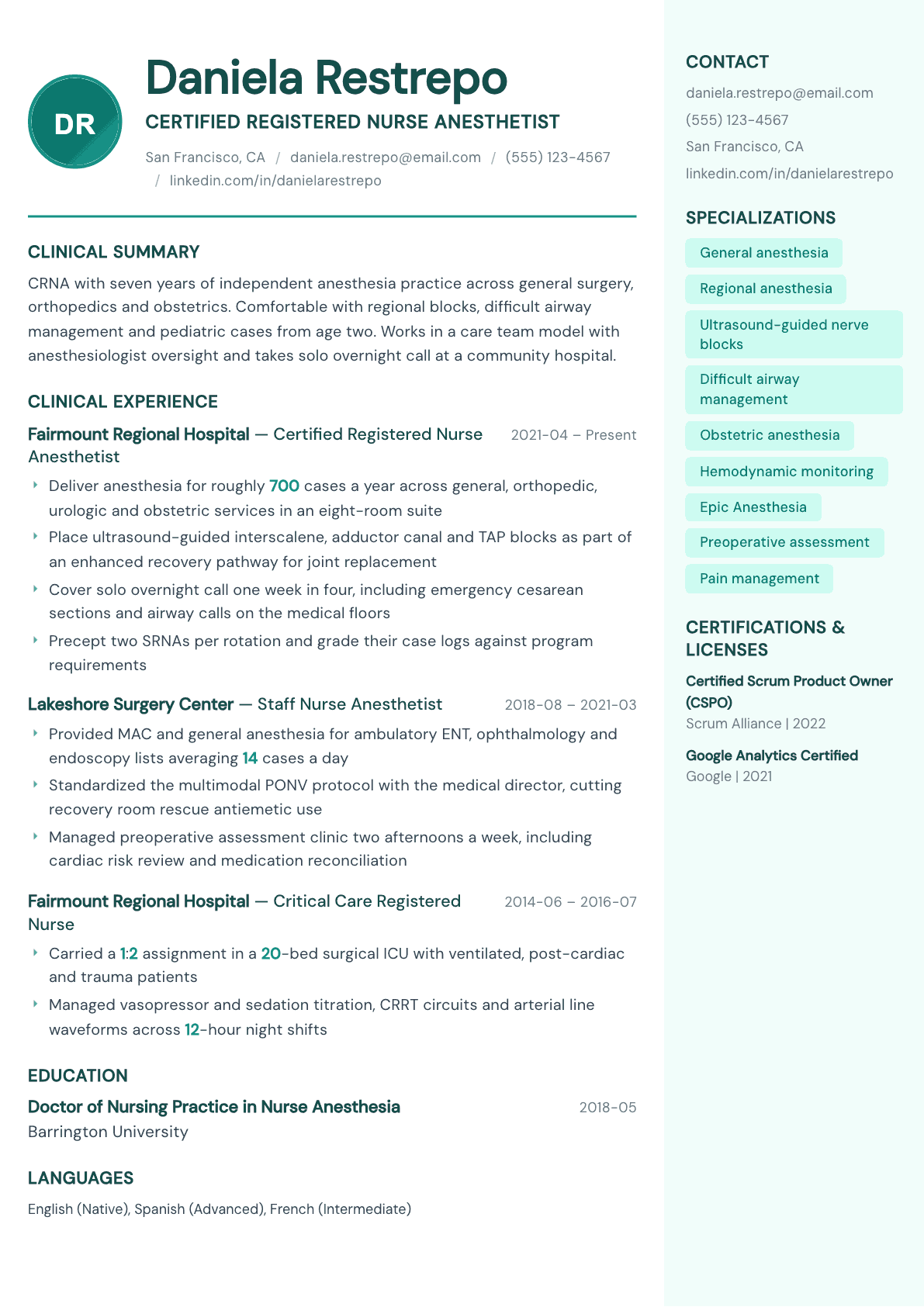
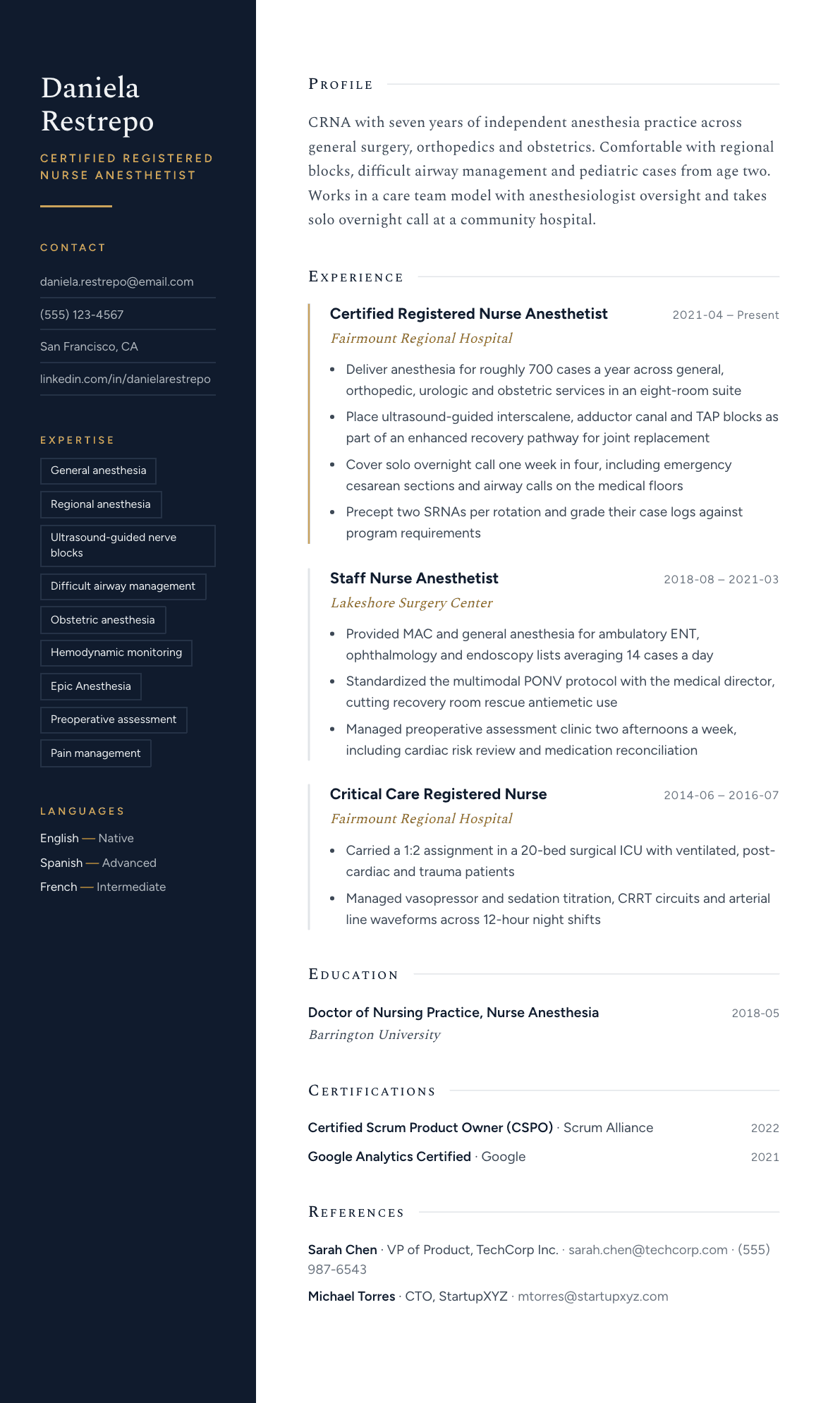
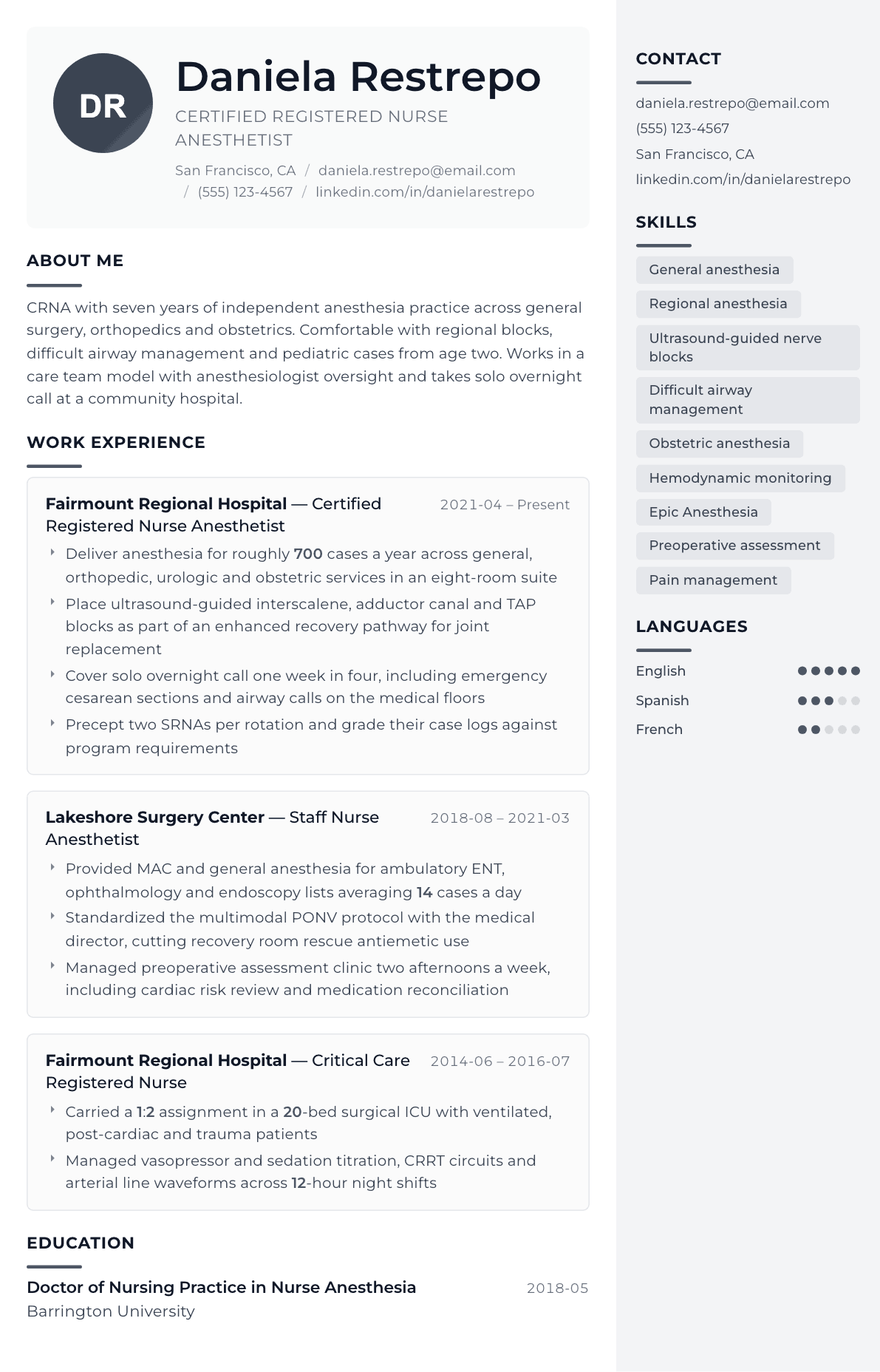
Example Nurse Anesthetist summary
Certified Registered Nurse Anesthetist with seven years of case coverage across general surgery, orthopedics and obstetrics, plus four prior years in a surgical intensive care unit. Skilled in ultrasound-guided regional blocks, difficult airway rescue and high volume ambulatory lists. Currently take solo overnight call and precept student registered nurse anesthetists. Seeking a care team position with a strong regional anesthesia service.
Skills to list on a Nurse Anesthetist resume
- General anesthesia
- Regional anesthesia
- Spinal and epidural placement
- Ultrasound-guided nerve blocks
- Difficult airway management
- Rapid sequence induction
- Obstetric anesthesia
- Pediatric anesthesia
- Monitored anesthesia care
- Invasive hemodynamic monitoring
- Central line placement
- Preoperative assessment
- ACLS and PALS response
- Anesthesia machine checkout
- Epic Anesthesia charting
- Enhanced recovery protocols
What actually gets this resume read
- Give every anesthesia job a case-mix line: services covered, annual case volume, room count, and whether you take call.
- Put NBCRNA certification, your RN license state and your DEA status in a credentials block near the top of page one.
- Name your regional block repertoire specifically, because departments hire CRNAs to fill the blocks their surgeons want.
- Say whether you practice in a care team model or independently, since staffing structure decides half of the interviews.
- Keep your critical care RN years on the resume, listed under a separate heading so they do not read as anesthesia time.
- Match the setting to the posting: an ambulatory center wants turnover speed, a trauma center wants airway and blood product experience.
How to write a nurse anesthetist resume
A CRNA resume is screened by an anesthesia chief or a lead nurse anesthetist who is trying to answer one question fast: can this person take a room tomorrow, and which rooms. Everything else on the page is secondary to case mix, call obligation and the practice model you came from.
That is why the strongest nurse anesthetist resumes read almost like a case log summary. They name the services covered, the annual volume, the room count, the block repertoire and the level of independence, then let the credentials block confirm what the hiring chief already suspects.
This guide covers the credential header, the case mix line that belongs under every job, how to write anesthesia bullets that show judgment rather than routine, three example summaries from new graduate through senior, and the questions CRNAs ask when they sit down to update the file. Academic programs, some hospital systems and credentialing committees ask for a CRNA CV instead of a resume; it carries the same credential header and case mix, then adds teaching, research, presentations and committee work, so the examples here apply to both.
Format: credentials header, then case mix, then everything else
Use reverse chronological order and expect two pages. A CRNA with a decade of practice has clinical sites, a certification history and continued professional development that do not compress into one page without losing the case mix, which is the part that matters.
The header carries your name with credentials in the standard order, your state RN license and APRN recognition, your NBCRNA certification status, and your DEA registration if you hold prescriptive authority in your state. A chief who has to hunt for licensure state puts the file down.
CRNA CV example, the header and first entry written out: Laura Kim, DNP, CRNA, APRN. National certification through the NBCRNA, state APRN license, BLS, ACLS and PALS current. Staff Nurse Anesthetist, a level one trauma center, care team model, general, trauma, obstetric and regional cases on a rotating call schedule; places interscalene, adductor canal and popliteal blocks under ultrasound guidance. A CV then continues with clinical education roles, publications and presentations, and professional committee work.
- Header: name with credentials, city and state, phone, email, licensure states, NBCRNA certification status.
- Section order: summary, licenses and certifications, anesthesia experience, prior critical care experience, education, clinical skills.
- New graduates add a clinical case numbers section pulled straight from the program case log.
The case mix line that goes under every job title
Under each anesthesia position, before the bullets, write one line describing the practice: facility type, room count, services covered, annual case volume and the staffing model. A line reading level two trauma hospital, eight operating rooms plus obstetrics, care team model with one to four supervision, roughly seven hundred cases a year tells a reader more than four bullets of prose.
Practice model is the detail candidates leave out most often and chiefs care about most. Say whether you worked in an anesthesia care team under physician supervision, in an opt out state with independent practice, or in a solo coverage arrangement at a critical access facility. Those three are different jobs with the same title.
Call belongs in the same line. Weekend obstetric coverage, in house trauma call, beeper call from home and no call are each a real answer, and the honest one saves both sides an interview.
Experience bullets: technique, acuity, and the save
Anesthesia bullets should name the techniques you own without supervision. Regional block repertoire is the clearest example: interscalene, supraclavicular, adductor canal, femoral, popliteal sciatic, transversus abdominis plane and erector spinae blocks are not interchangeable, and a department hiring for an orthopedic service is reading for the specific ones its surgeons request.
Airway work is the second thing read closely. Video laryngoscopy, awake fiberoptic intubation, double lumen tube placement for thoracic cases, and pediatric airway experience each signal a different ceiling of practice. If you have run the difficult airway cart for the whole hospital, that is a bullet.
Then add the clinical judgment bullets: a protocol you built, a complication you managed, a preoperative clinic you ran, an enhanced recovery pathway you helped design. Avoid bullets that describe anesthesia in general. Inducing, maintaining and emerging patients is the definition of the job, not evidence of skill in it.
- Name the surgical services: general, orthopedic, obstetric, urologic, ENT, vascular, cardiac, neuro, thoracic, pediatric.
- Give the youngest and oldest populations you take, since pediatric floors are a hard staffing gap.
- Include SRNA precepting, committee work and equipment or drug formulary projects.
Credentials and the critical care years
List NBCRNA initial certification and your current Continued Professional Certification cycle status. Add ACLS, BLS and PALS with the issuing body, plus any state prescriptive authority. Where you hold licenses in more than one state, list them all, because locum and travel postings screen on exactly that.
Keep your intensive care nursing years, but put them under their own heading such as prior critical care experience so no reader mistakes them for anesthesia time. Name the unit type, the ratio and the therapies you managed, because that is what admissions committees and hiring chiefs both use to judge your physiology foundation.
Keywords anesthesia postings repeat
Anesthesia job descriptions are written from a small vocabulary: care team model, independent practice, regional anesthesia, ultrasound guided blocks, difficult airway, obstetric coverage, monitored anesthesia care, preoperative assessment, enhanced recovery after surgery, invasive monitoring and point of care ultrasound. Use the same words the posting uses, once in your summary and once inside a bullet where the claim is proven.
Do not build a keyword block at the bottom of the page and call it done. A hiring chief reads this resume within a day of the software scoring it, and an unattached keyword list reads as padding to a clinician.
Nurse Anesthetist resume summary examples
New graduate CRNA
DNP graduate in nurse anesthesia with 750 documented cases, including 60 regional blocks, 40 obstetric anesthetics and pediatric cases from age three. Four years of prior surgical ICU experience with ventilated and post-cardiac patients. NBCRNA board eligible and seeking a care team position with a structured first-year mentorship.
Five years in
CRNA with five years in a community hospital covering general, orthopedic, urologic and obstetric services across six rooms and roughly 600 cases a year. Independent with ultrasound-guided upper and lower extremity blocks, spinals and epidurals. Takes in-house call one week in four and precepts student registered nurse anesthetists.
Lead CRNA
Lead nurse anesthetist with twelve years of practice and four years directing a nine-provider group at a level two trauma hospital. Built the regional block service for total joints, wrote the difficult airway protocol, and owns scheduling, credentialing files and quality review. Practiced in both care team and independent settings.
Work experience bullets: before and after
Before: Provided anesthesia care for surgical patients.
After: Delivered general, spinal and monitored anesthesia for roughly 700 cases a year across general, orthopedic, urologic and obstetric services in an eight-room suite.
Technique, volume, services and room count let a chief picture your day; the original sentence describes every CRNA alive.
Before: Performed nerve blocks for postoperative pain.
After: Placed ultrasound-guided interscalene, adductor canal and TAP blocks as the regional provider for a total joint pathway averaging 12 cases a week.
Naming the specific blocks and the service they support proves the exact repertoire an orthopedic department is hiring for.
Before: Managed difficult airways when needed.
After: Handled hospital difficult airway calls including awake fiberoptic intubation and video laryngoscopy rescues, and maintained the airway cart contents and check schedule.
The techniques and the ownership of the cart turn a vague claim into a described responsibility.
Before: Worked with anesthesiologists in a team setting.
After: Practiced in a care team model at one-to-four supervision, running rooms independently with anesthesiologist availability for induction and emergence on high-acuity cases.
The supervision ratio answers the staffing model question that decides whether your experience transfers.
Before: Helped improve patient recovery times.
After: Co-wrote the multimodal analgesia and PONV protocol with the medical director, replacing routine opioid dosing on ambulatory ENT and general lists.
A named protocol with the services it changed is verifiable; improved recovery times is not.
Before: Taught students during clinical rotations.
After: Precepted two student registered nurse anesthetists per rotation, reviewing case logs against program requirements and signing weekly clinical evaluations.
The count, the cadence and the documentation show real teaching load rather than incidental supervision.
Hard skills
- General anesthesia
- Spinal and epidural anesthesia
- Ultrasound-guided regional blocks
- Difficult airway management
- Awake fiberoptic intubation
- Obstetric anesthesia
- Pediatric anesthesia
- Monitored anesthesia care
- Invasive hemodynamic monitoring
- Central and arterial line placement
- Preoperative assessment
- Anesthesia machine checkout
- Enhanced recovery protocols
- Point of care ultrasound
Soft skills
- Rapid decision making under pressure
- Surgeon communication
- Preoperative patient reassurance
- Handoff to recovery staff
- Precepting and clinical teaching
- Room turnover coordination
Certifications worth listing
- Certified Registered Nurse Anesthetist (CRNA) (National Board of Certification and Recertification for Nurse Anesthetists)
- Advanced Cardiovascular Life Support (ACLS) (American Heart Association)
- Pediatric Advanced Life Support (PALS) (American Heart Association)
- Basic Life Support (BLS) (American Heart Association)
Mistakes that cost nurse anesthetist candidates the interview
- Leaving out the practice model, so a reader cannot tell whether you have ever run a room without an anesthesiologist in the building.
- Burying the block repertoire inside a skills list instead of tying each technique to the service where you performed it.
- Merging critical care nursing years into the anesthesia section, which inflates your apparent anesthesia experience and gets caught in the interview.
- Omitting call obligation, which is the single detail most likely to end an otherwise strong conversation at the offer stage.
- Writing bullets that restate the definition of anesthesia rather than the techniques, populations and protocols you personally own.
- Listing only the certification name without the current recertification cycle status, which makes a credentialing office chase you.
- Using a heavily formatted two-column template, since hospital credentialing systems often parse the columns out of order.
Nurse Anesthetist resume questions
Is a CRNA CV different from a nurse anesthetist resume?
The core is the same: credentials, practice model, case mix and anesthesia bullets. A CV adds clinical teaching, research, publications, presentations and committee work, and has no page limit, so it suits academic and credentialing requests. For a staff or locum position, send a two page resume unless the posting asks for a CV.
Should I include my student case log numbers?
Yes, for the first two years after graduation. Summarize the totals by category: total anesthetics, regional blocks, obstetric cases, pediatric cases and airway techniques. Once you have real practice volume behind you, replace the student log with your annual case mix.
Where do I put my critical care nursing experience?
Under its own heading below your anesthesia positions, labeled as prior critical care experience. Give the unit type, bed count, nurse to patient ratio and the therapies you managed. Keeping it separate prevents any impression that you are counting it as anesthesia time.
Does the anesthesia practice model really need to be on the resume?
It does, because a department staffing an opt out independent site and one running a care team at one-to-four supervision are hiring different levels of autonomy. Stating your model up front makes the screening call faster and stops you being ruled out for the wrong reason.
How do I show regional anesthesia skill without a case log?
Name each block you place independently, attach it to the surgical service that requested it, and add rough frequency. A line saying you place adductor canal and popliteal blocks weekly for a total joint pathway is specific enough for a chief to believe without seeing your numbers.