Cardiovascular Technologist Resume Examples: free score
Craft a Cardiovascular Technologist Resume for Cath Lab Hiring
By Mustafa Tarabya, founder of CVBooster · Published · Updated
Cardiovascular technologist resume example covering cath lab procedures, echo and vascular modalities, RCIS credentials, keywords and a writing guide.
Sample resumes for a cardiovascular technologist
The same cardiovascular technologist content laid out in three CVBooster templates, so you can see what the finished document looks like before you write a word.
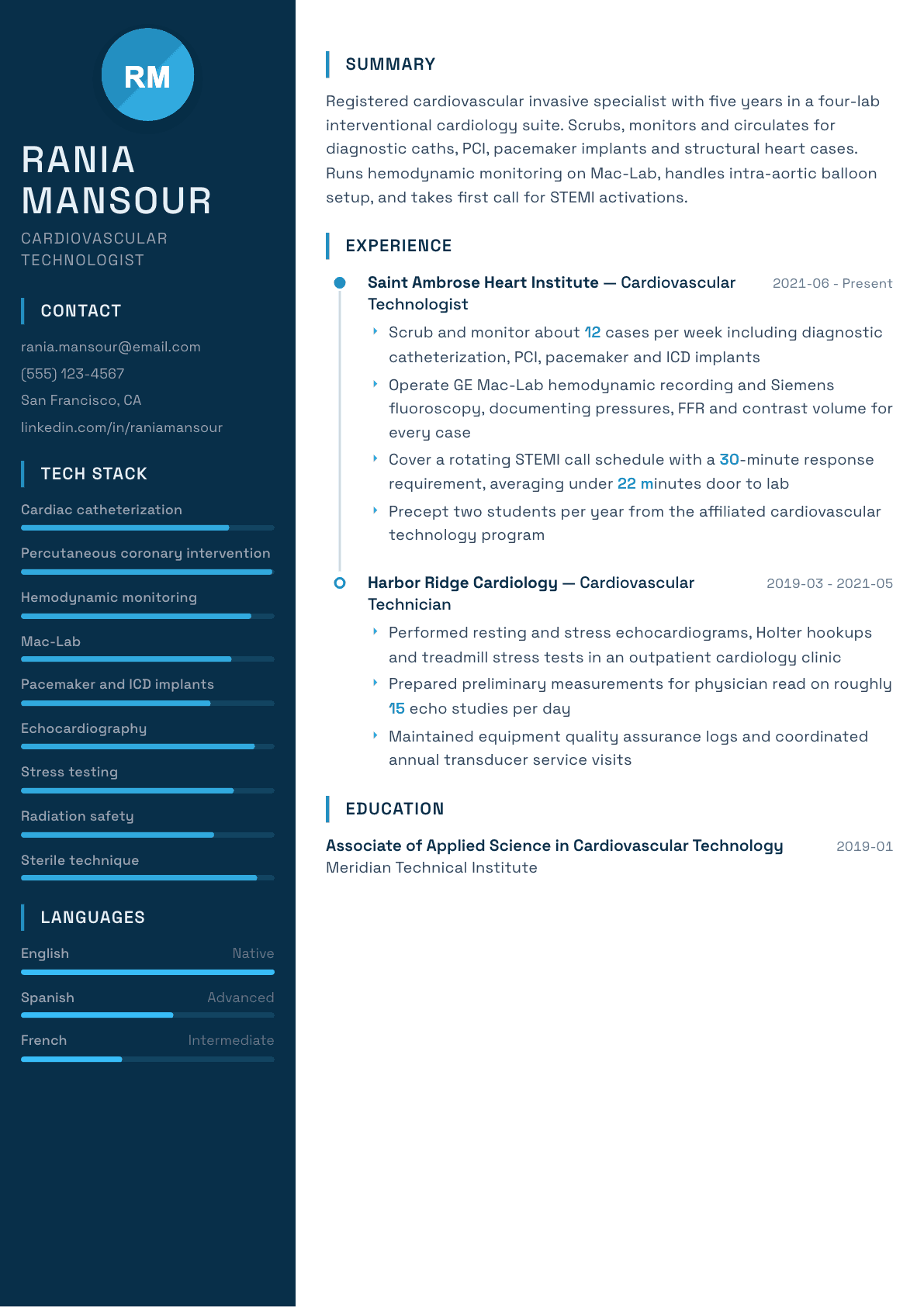
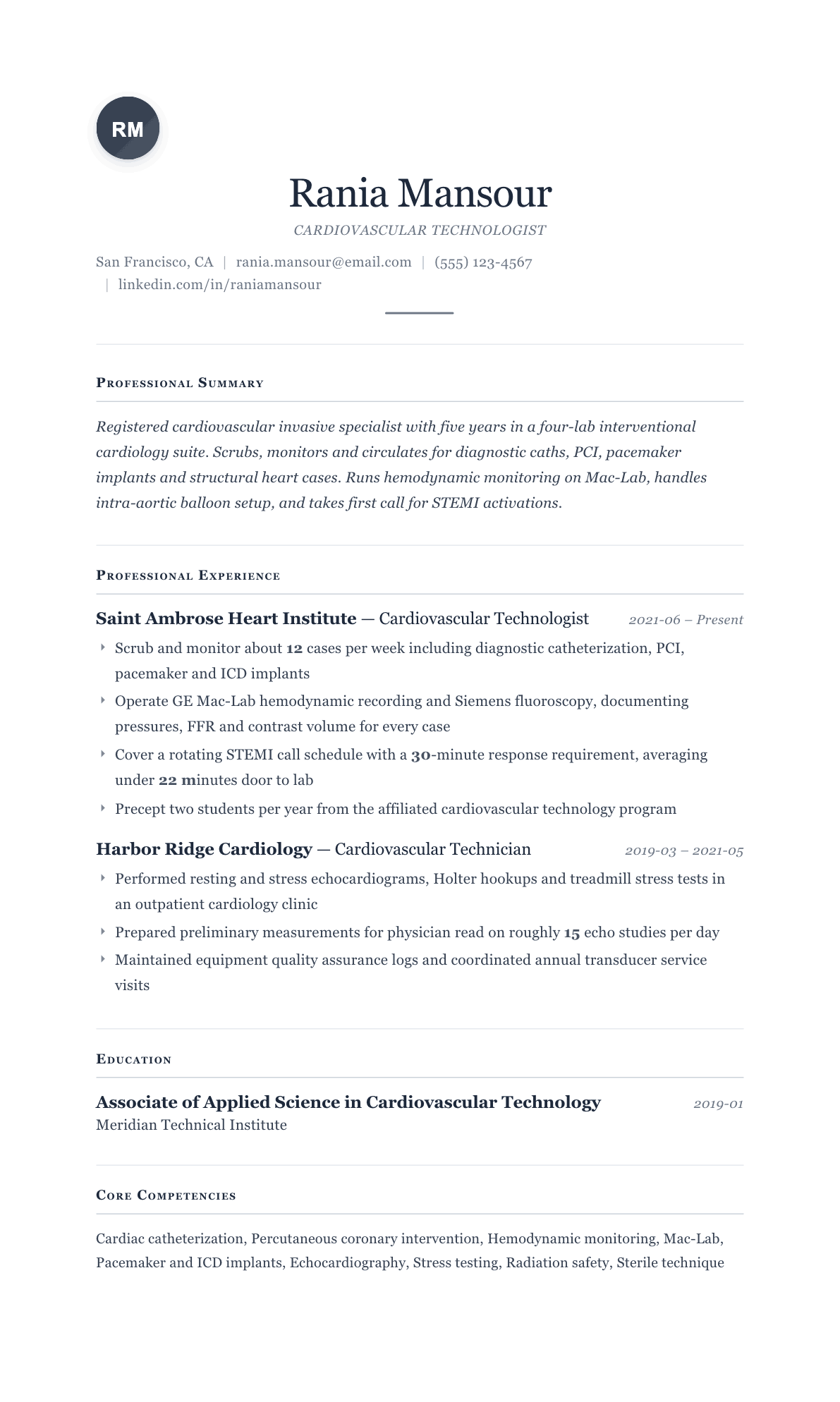
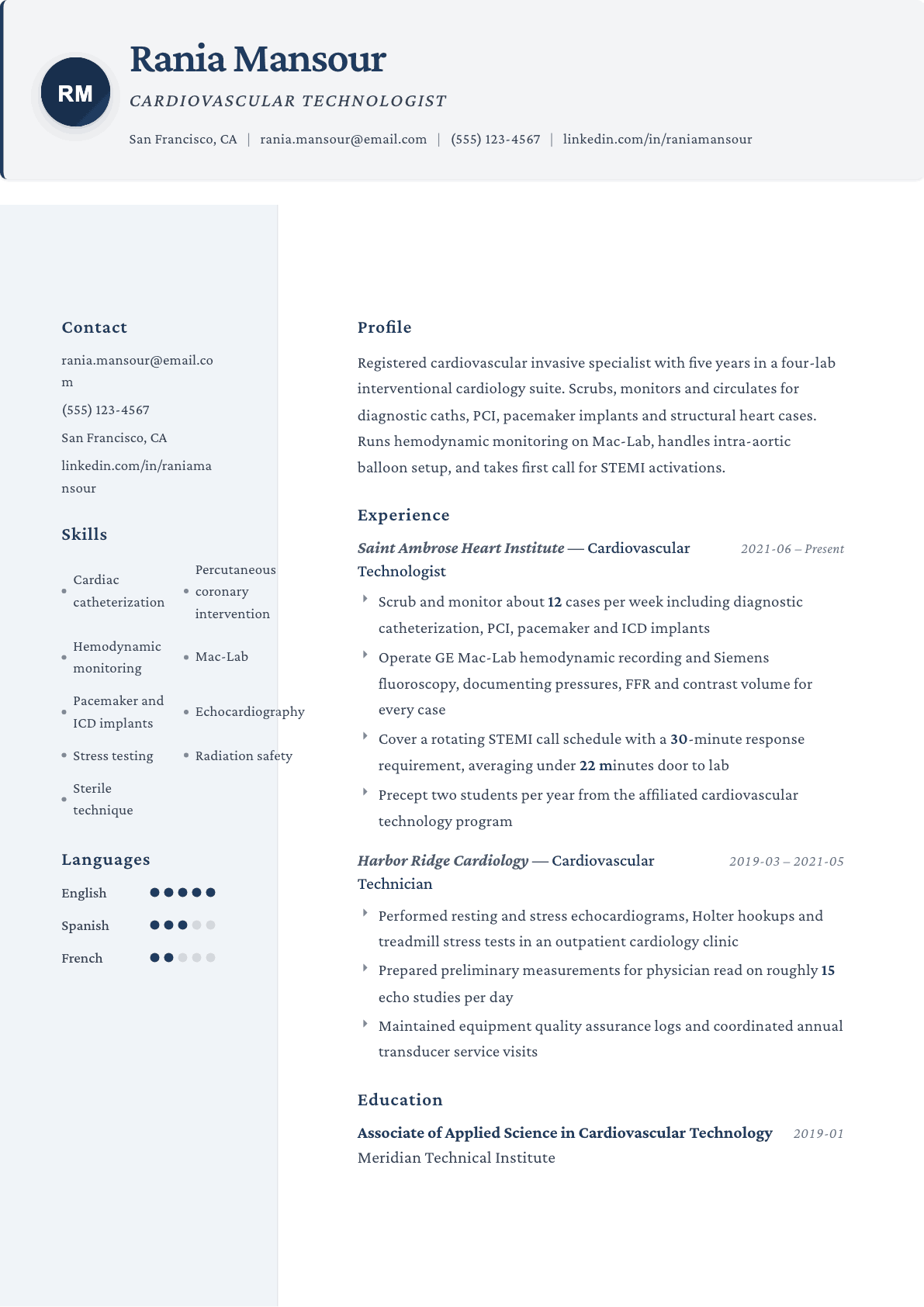
Example Cardiovascular Technologist summary
Registered cardiovascular invasive specialist with five years in a four-lab interventional suite, scrubbing and monitoring roughly a dozen cases each week across diagnostic catheterization, PCI and device implants. Skilled on Mac-Lab hemodynamics and Siemens fluoroscopy, with STEMI call coverage averaging under 22 minutes door to lab. Earlier outpatient background in echocardiography and stress testing.
Skills to list on a Cardiovascular Technologist resume
- Cardiac catheterization
- Coronary intervention
- Hemodynamic monitoring
- Electrophysiology support
- Pacemaker implantation
- Echocardiography
- Vascular ultrasound
- Stress testing
- Holter monitoring
- Fluoroscopy
- Radiation safety
- Sterile technique
- Emergency response
- Patient assessment
- Equipment quality assurance
What actually gets this resume read
- State your registry credential and the number after it, because cath labs screen on RCIS, RCES or the vascular registry before anything else.
- Break experience down by role in the room: scrub, monitor and circulate are three different skill sets to a lab manager.
- Name the hemodynamic system and imaging equipment you have run, since a lab wants someone who can work day one on its hardware.
- List case types with volume, from diagnostic caths to structural heart, so the reader can judge the acuity you have handled.
- Include your call coverage and response time expectation, because STEMI call availability is often the deciding factor in an offer.
- Keep radiation safety and sterile technique visible, and note any fluoroscopy permit your state requires for the role.
How to write a cardiovascular technologist resume
Cardiovascular technologist covers three different jobs that share a title: invasive work in the catheterization laboratory, noninvasive echocardiography and stress testing, and vascular studies. A lab manager scanning resumes is sorting into those buckets within the first five seconds, so the top of your document has to say which one you are and which registry you hold.
Beyond the bucket, the questions are practical. Can you scrub, monitor and circulate, or only one of the three? Which hemodynamic recording system have you run? What case types have you covered, and are you available for call? Interventional labs live on call coverage, and a resume that never mentions it leaves the manager wondering.
This guide sets out the section order cardiology departments expect, the equipment and procedure vocabulary that survives keyword screens, summary examples from a new graduate through a lead technologist, and bullet rewrites that replace vague procedure lists with case volume and responsibility.
Format: credentials in the header, procedures near the top
One page for under eight years. Single column, plain font, and dates on the right. Cardiology departments sit inside hospital systems with strict parsers, so decorative layouts cost you more than they gain.
Put your registry credential after your name and give it a dedicated block with the credentialing body and status. Add state fluoroscopy permits where the role requires one, along with your current life support cards.
- Header: name with registry credential, city and state, phone, email.
- Credentials block: registry, issuing body, life support cards, fluoroscopy permit.
- Sections: summary, credentials, procedural experience, equipment, education.
Summary: modality, lab size, case mix, call
State the modality first. Invasive, noninvasive or vascular, then the number of labs or rooms, then the weekly case volume and the case mix. Close with call availability if you have carried it, because a lab that needs a rotation filled reads that line as the answer to its problem.
A technologist crossing between modalities should name the shared ground: anatomy, sterile technique, patient monitoring and emergency response transfer well, while the imaging skill does not. Saying so directly is stronger than hoping the manager infers it.
Experience: role in the room, procedure types, volume
For invasive work, list which of scrub, monitor and circulate you perform, since those are three separate competencies and labs staff around them. Then give procedure types with volume: diagnostic catheterization, percutaneous coronary intervention, pacemaker and defibrillator implants, electrophysiology studies and ablations, structural heart cases, intra-aortic balloon pump and temporary pacing.
For noninvasive work, name the study types and the daily volume: transthoracic echocardiograms, stress echo, treadmill and pharmacologic stress, Holter and event monitor hookups, ankle brachial index and carotid duplex. Say whether you take preliminary measurements for physician read.
Add the emergency side. Door to lab times for STEMI activation, response requirements for call, and participation in codes or rapid response show a manager you function when the schedule stops mattering.
Equipment: the section that matches the posting
Name the hemodynamic recording system, the imaging equipment and the adjunct technologies. Mac-Lab, Sensis and Xper appear by name in postings, as do fluoroscopy vendors and ultrasound platforms. Add intravascular ultrasound, optical coherence tomography, fractional flow reserve, activated clotting time analyzers and radiofrequency ablation generators where you have run them.
Include radiation safety concretely: dosimetry monitoring, shielding practice, collimation and dose reduction habits. A lab manager treats casual language about radiation as a training gap.
- Hemodynamic recording systems and fluoroscopy equipment.
- Intravascular imaging and physiology tools you have operated.
- Ultrasound platforms and stress testing systems for noninvasive work.
- Radiation safety practice, dosimetry and contrast handling.
Keywords cardiology postings reuse
The same terms recur across job descriptions: cardiac catheterization, coronary intervention, hemodynamic monitoring, sterile field, device implantation, electrophysiology, echocardiography, stress testing, vascular duplex, radiation safety, conscious sedation monitoring and emergency response. Mirror the ones you can defend once in the summary or equipment block and again inside a bullet.
Cardiovascular Technologist resume summary examples
New graduate
Cardiovascular technology graduate with 1,000 clinical hours across an invasive laboratory, echocardiography and vascular studies. Observed and assisted with diagnostic catheterization, monitored hemodynamic tracings, and performed supervised transthoracic studies. Registry eligible, current in basic and advanced life support, seeking an invasive laboratory position with structured orientation.
Five years in
Registered cardiovascular invasive specialist in a four-lab interventional suite, scrubbing and monitoring roughly twelve cases per week across diagnostic catheterization, coronary intervention and device implants. Runs hemodynamic recording, documents pressures, fractional flow reserve and contrast volume, and covers STEMI call averaging under 22 minutes door to lab.
Lead technologist
Lead cardiovascular technologist coordinating staffing and inventory for a six-room laboratory covering coronary, peripheral, electrophysiology and structural heart services. Built the vendor consignment process, precepts students from an accredited program, and serves on the radiation safety committee reporting quarterly dose trends to the medical director.
Work experience bullets: before and after
Before: Assisted physicians with cardiac procedures.
After: Scrubbed and monitored about 12 cases per week including diagnostic catheterization, percutaneous coronary intervention and pacemaker implants in a four-lab interventional suite.
Weekly volume, named procedures and lab size answer the three questions a manager asks before an interview.
Before: Monitored patients during procedures.
After: Recorded hemodynamic data on GE Mac-Lab, documenting chamber pressures, fractional flow reserve values, activated clotting times and contrast volume for every case in the record.
The system name and the specific data points show a technologist who owns the record rather than watching a screen.
Before: Took call for emergencies.
After: Covered a rotating STEMI call schedule with a 30-minute response requirement, averaging under 22 minutes from activation to patient on the table across the year.
Call is a hiring lever, so the requirement and the actual response time carry real weight.
Before: Performed echocardiograms in the clinic.
After: Performed roughly 15 transthoracic and stress echocardiograms per day, taking preliminary chamber measurements and Doppler values for physician read and flagging urgent findings before the patient left.
Daily volume plus the preliminary read and escalation habit prove independent clinical judgment.
Before: Followed radiation safety rules.
After: Maintained monthly dosimetry compliance, used collimation and low frame rate settings during long peripheral cases, and reported quarterly dose trends to the radiation safety committee.
Concrete practices and a reporting duty demonstrate radiation stewardship instead of stating a rule.
Hard skills
- Cardiac catheterization support
- Percutaneous coronary intervention
- Hemodynamic monitoring and recording
- Pacemaker and defibrillator implantation
- Electrophysiology study support
- Transthoracic echocardiography
- Stress testing
- Vascular duplex imaging
- Holter and event monitoring
- Fluoroscopy operation
- Radiation safety and dosimetry
- Sterile field and scrub technique
Soft skills
- Composure during emergencies
- Clear communication in the sterile field
- Patient reassurance
- Physician collaboration
- Precision under time pressure
- Student preceptorship
Certifications worth listing
- Registered Cardiovascular Invasive Specialist (RCIS) (Cardiovascular Credentialing International)
- Registered Cardiac Electrophysiology Specialist (RCES) (Cardiovascular Credentialing International)
- Registered Cardiac Sonographer (RCS) (Cardiovascular Credentialing International)
- Registered Diagnostic Cardiac Sonographer (RDCS) (American Registry for Diagnostic Medical Sonography)
- Advanced Cardiovascular Life Support (ACLS) (American Heart Association)
Mistakes that cost cardiovascular technologist candidates the interview
- Leaving the modality unclear, so a manager cannot tell an invasive technologist from an echocardiographer within the first lines.
- Listing procedures without volume, which reads as exposure rather than competence.
- Omitting the hemodynamic and imaging systems, the single easiest keyword match a cardiology posting offers.
- Never mentioning call availability when interventional labs hire specifically to fill a rotation.
- Treating radiation safety as a checkbox instead of naming dosimetry, collimation and dose reduction practice.
- Skipping the registry status, since credentialing bodies and hospital privileging both turn on it.
Cardiovascular Technologist resume questions
Which registry should a cardiovascular technologist hold?
It depends on the work. Invasive laboratory roles look for the invasive specialist credential, electrophysiology roles want the electrophysiology registry, and echocardiography roles want a cardiac sonography registry. Hold the one matching the job you want and list any second registry as evidence of range.
How do I show cath lab experience without procedure logs?
Estimate honestly and describe the mix instead of inventing precision. Cases per week, the split between diagnostic and interventional work, the device implants you have supported and the roles you cover in the room give a manager everything a log would, in a form they can question at interview.
Can I move from echocardiography into the catheterization laboratory?
Yes, and many technologists do. Lead with anatomy knowledge, hemodynamic understanding, patient monitoring and emergency response, then be explicit that you are seeking invasive training. Labs will orient a candidate who names the gap rather than papering over it.
Should I list the number of procedures I have performed?
Give weekly or annual volume rather than a career total, because a manager is judging current pace and recency. Break it down by case type where you can, since a hundred diagnostic catheterizations and a hundred structural heart cases are not comparable experience.
Do I need to list life support certifications?
Yes. Basic and advanced cardiovascular life support are expected in any laboratory or stress testing setting, and an expired card can hold up scheduling. List them with the issuing body and keep them current, but place them under credentials rather than leading the resume with them.