Appointment Setter Resume Examples: the lines they read
Build an Appointment Setter Resume Around Dials and Booked Meetings
By Mustafa Tarabya, founder of CVBooster · Published · Updated
Appointment setter resume examples with call volume, show rate and CRM keywords, plus a guide to writing bullets a sales manager believes.
Sample resumes for a appointment setter
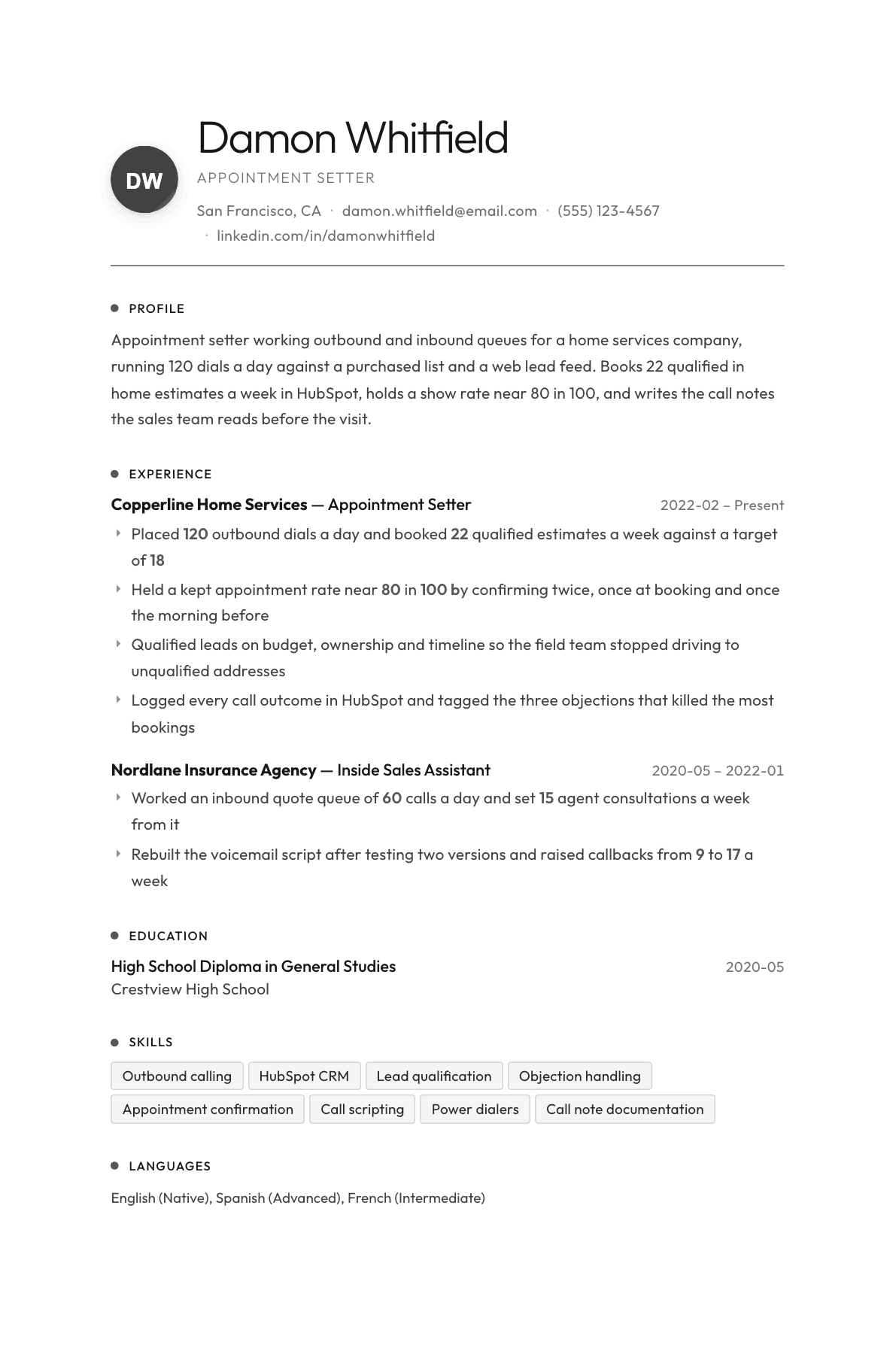
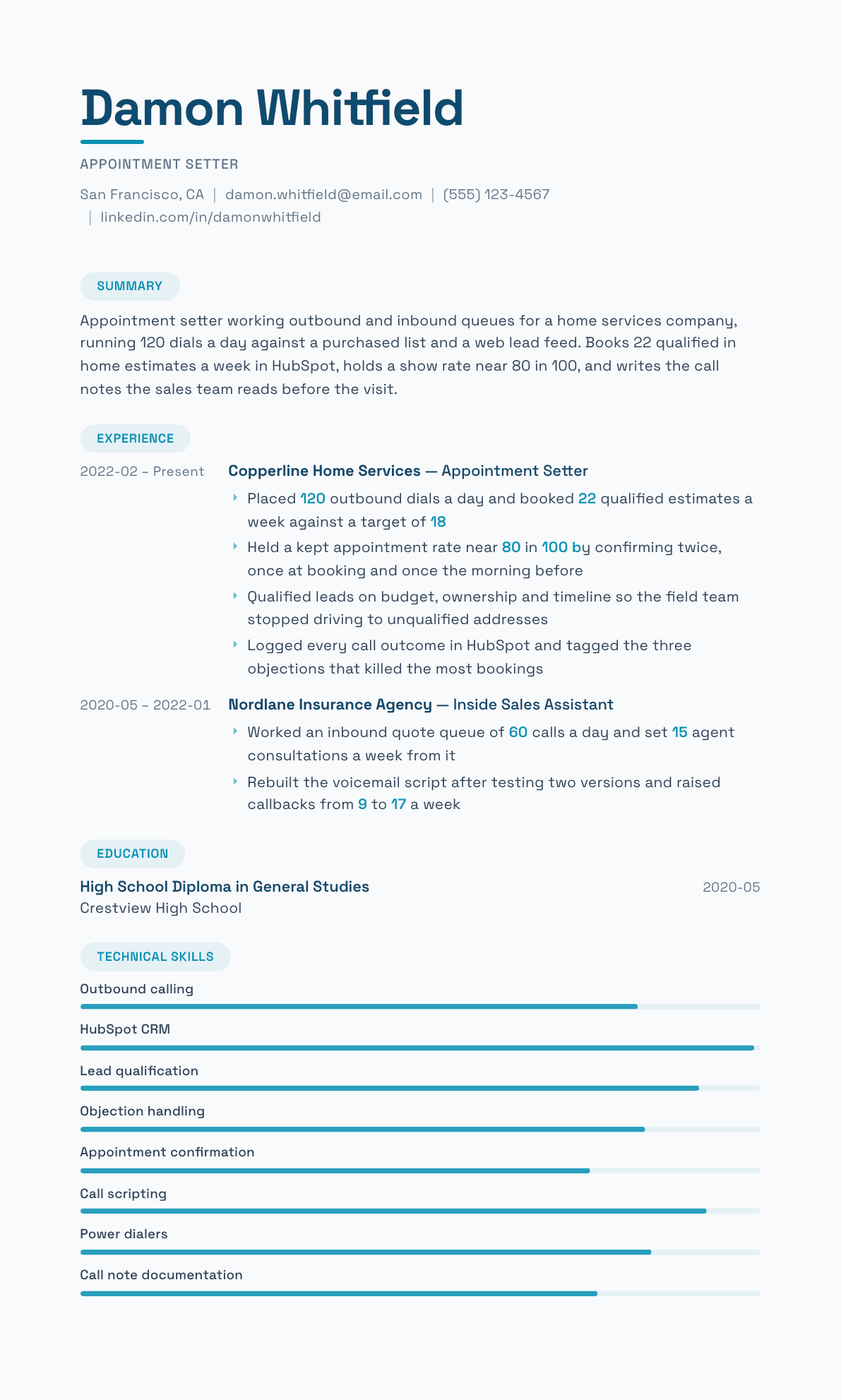
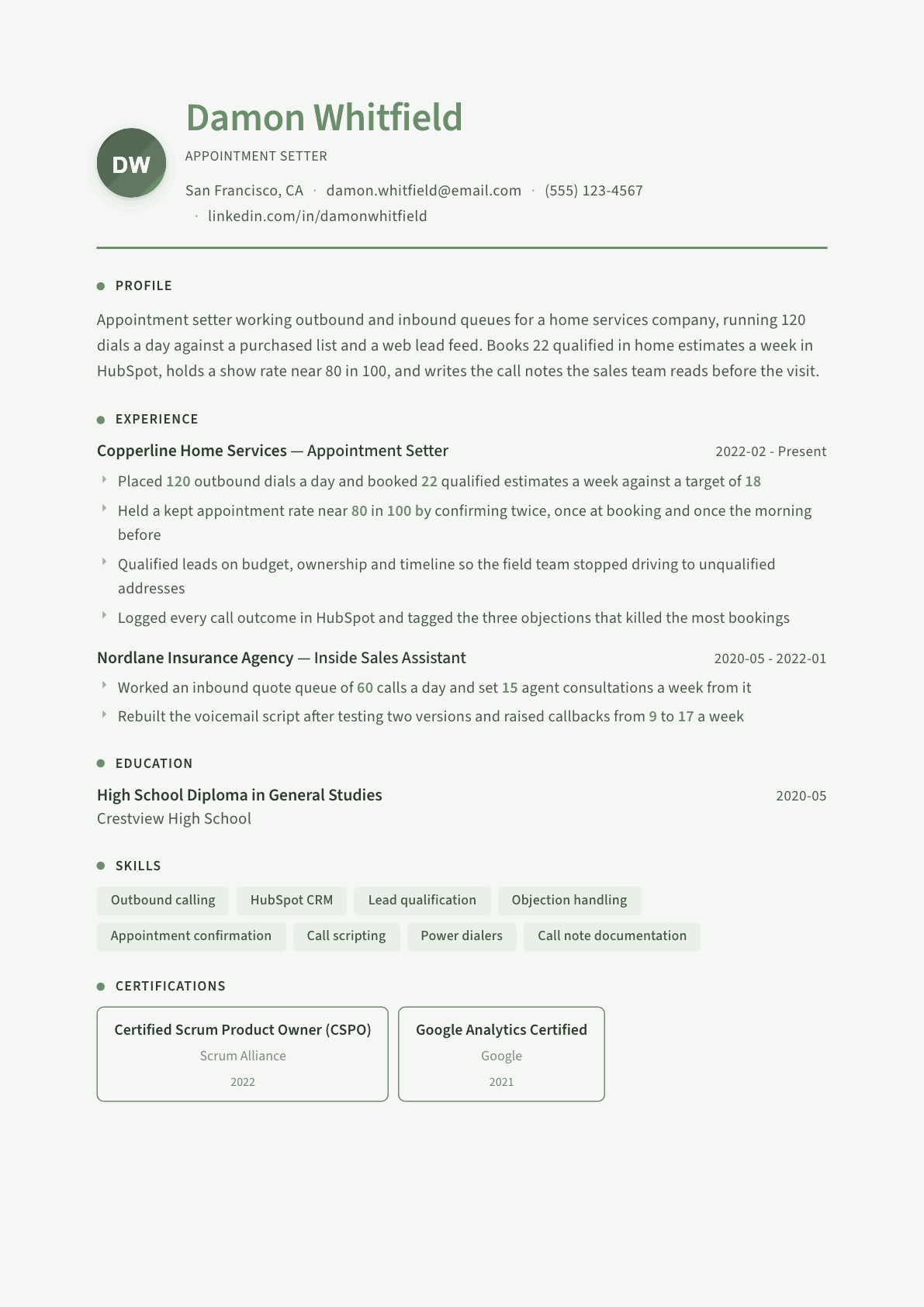
The same appointment setter content laid out in three CVBooster templates, so you can see what the finished document looks like before you write a word.
Example Appointment Setter summary
Appointment setter with three years on outbound and inbound queues in home services and insurance, running 120 dials a day and booking 22 qualified estimates a week against a target of 18. Holds a kept appointment rate near 80 in 100 through a two step confirmation routine, and logs clean call notes in HubSpot. Looking for a setter seat on a team with a real qualification standard.
Skills to list on a Appointment Setter resume
- Outbound cold calling
- Inbound lead response
- Appointment setting
- Lead qualification
- Objection handling
- HubSpot CRM
- Salesforce
- Power dialer software
- Call scripting
- Follow up cadences
- Calendar coordination
- Text and email confirmation
- Pipeline note taking
- Quota tracking
What actually gets this resume read
- Put the numbers in the first bullet: dials per day, appointments set per week and the target you were measured on.
- Report the kept appointment or show rate, since a booked meeting nobody attends is worth nothing to the sales team.
- Name the CRM and the dialer, because a manager wants to know how little ramp time you will need on their stack.
- Explain the qualification criteria you applied so the reader sees judgment rather than a body reading a script.
- Say whether the list was cold, warm inbound or reactivation, because those three jobs demand different nerves.
- Add one bullet on script or objection work to show you improved the process rather than only working inside it.
How to write a appointment setter resume
An appointment setter resume is read by a sales manager who has been burned by a hire who booked plenty of meetings that nobody attended. So the number he cares about is not appointments set. It is appointments kept, and the qualification standard that stood behind them. A resume that reports dials and bookings without a show rate answers half his question and gets set aside.
The second thing he is checking is nerve. Cold outbound against a purchased list, warm inbound from a web form, and reactivation of dead accounts are three different jobs with three different rejection rates. Candidates who do not name which one they worked leave the manager to assume the easiest version.
This guide lays out how to build the page around dials, bookings, kept rate and the customer relationship system you worked in, with summaries for three stages, before and after bullets from real outbound work, and the questions setters ask when they want the next seat to pay better than the last one.
Format: one page, numbers in the first six lines
One page, always. A sales manager reads this resume the way he reads a pipeline report, top down and fast, and a second page signals someone who has not learned to lead with results. Reverse chronological, single column, no graphics.
Put the quota next to the result everywhere you can. Twenty two appointments a week means nothing until the reader knows the target was eighteen. That single comparison is the most persuasive structure available to a setter, and most candidates never use it.
- Header: name, city and state, phone, email, and whether you are seeking on site, hybrid or remote work.
- Section order: summary, experience, systems and skills, certifications, education.
- Experience is first for this role because the numbers are the argument.
Summary: dials, bookings, kept rate, queue type
Four facts, one sentence each at most. Daily dial volume, appointments booked in a week against target, kept appointment rate, and whether the queue was cold, inbound or reactivation. That summary tells a manager everything he needs to decide whether to keep reading.
Name the industry too. Home services, insurance, medical device and software all set appointments, but the call length, the objections and the buying cycle are different enough that a manager prefers a candidate who has already survived his version.
Experience: the funnel, in order
Write each job as a small funnel. Contacts attempted, conversations reached, appointments set, appointments kept. Even two of those four in sequence is more convincing than a paragraph about building rapport, because the reader can see where your strength sits.
Then the qualification criteria you applied. Budget, ownership of the property, decision maker present, timeline: naming the specific screens shows judgment and explains why the field team stopped wasting trips. This is the bullet that separates a setter from a body reading a script.
Add one bullet on process improvement. Rewriting a voicemail script and testing two versions, tagging the objections that killed the most bookings, or changing the confirmation cadence are all things a setter can own. A manager reads them as someone who will make the team better rather than only hitting a number.
Systems and skills: the stack and the motion
Name the customer relationship system and the dialer separately, because they are different competencies. Logging clean call outcomes and tagging objections in HubSpot is a discipline; working a power dialer at volume is a tolerance. Managers plan ramp time around both.
List the outreach channels you actually ran. Many setter seats now mix calling with text and email follow up, and a candidate who has run a multi step cadence rather than only dialing is easier to place on a modern team.
- Systems: HubSpot, Salesforce, a power dialer, and the text or email tool used for confirmations.
- Motion: cold outbound, inbound speed to lead, reactivation of aged records, follow up cadences.
- Craft: call scripts, objection handling, qualification criteria, call note quality for the closer who runs the meeting.
Education and credentials: keep it short, prove it elsewhere
A high school diploma is the usual requirement, and further education is neither expected nor a disadvantage. Nobody is hired into a setter seat on a degree, so give education two lines and spend the space on the funnel numbers instead.
Free platform certifications carry a little weight because they show you learned the system on your own time. Sales software credentials from the vendors themselves are the only ones a manager reliably recognizes, and one or two are plenty.
Appointment Setter resume summary examples
First calling job
Inside sales assistant with one year on an inbound quote queue, taking 60 calls a day and setting 15 agent consultations a week from them. Rebuilt the voicemail script after testing two versions and raised callbacks from 9 to 17 a week. Seeking a full outbound appointment setter seat.
Two to three years in
Appointment setter working outbound and inbound queues for a home services company, placing 120 dials a day against a purchased list and a web lead feed. Books 22 qualified in home estimates a week against a target of 18 and holds a kept appointment rate near 80 in 100.
Senior setter
Senior appointment setter and informal team trainer, running the cold queue while onboarding new setters on the script, the qualification standard and call note quality. Consistently above quota on booked estimates, and rewrote the confirmation cadence that lifted the team kept rate by double digits over a quarter.
Work experience bullets: before and after
Before: Made outbound calls to potential customers.
After: Placed 120 outbound dials a day against a purchased list and a web lead feed, booking 22 qualified in home estimates a week against a team target of 18.
Dials, bookings and the target together let a sales manager rank you against his current team in one line.
Before: Booked appointments for the sales team.
After: Held a kept appointment rate near 80 in 100 by confirming twice, once at the moment of booking and again on the morning of the visit.
Kept rate is the number the field team lives with, and naming the confirmation routine shows it was engineered rather than lucky.
Before: Qualified leads before booking them.
After: Qualified every lead on budget range, property ownership and buying timeline, which stopped the field team from driving to addresses that could not proceed.
Naming the three screens and the waste they prevented turns a vague claim into evidence of judgment.
Before: Used the CRM to track calls.
After: Logged every call outcome in HubSpot the same day and tagged objections by type, which surfaced the three objections that were killing the most bookings.
Clean data plus an insight drawn from it shows a setter who improves the process rather than only feeding it.
Before: Improved the voicemail message.
After: Tested two voicemail scripts across a full month on the same list, kept the version that produced more returned calls, and lifted weekly callbacks from 9 to 17.
A controlled comparison with a result reads as method, which is rare on a setter resume and lands hard.
Hard skills
- Outbound cold calling
- Inbound lead response and speed to lead
- Lead qualification criteria
- Objection handling
- HubSpot
- Salesforce
- Power dialer operation
- Call script writing and testing
- Multi step follow up cadences
- Text and email confirmation
- Call note documentation
- Quota and activity tracking
Soft skills
- Tolerance for rejection at volume
- Listening for the real objection
- Consistency across a full shift
- Coachability on script changes
- Handoff discipline to the closer
- Composure with hostile pickups
Certifications worth listing
- Sales Software Certification (HubSpot Academy)
- Salesforce Certified Associate (Salesforce)
- Inbound Sales Certification (HubSpot Academy)
Mistakes that cost appointment setter candidates the interview
- Reporting appointments set with no kept or show rate, which leaves the reader assuming the meetings did not hold.
- Omitting the quota, so a strong result reads as an average one because there is nothing to compare it against.
- Never saying whether the queue was cold, inbound or reactivation, which invites the manager to assume the easiest.
- Leaving the customer relationship system and dialer unnamed, when both determine how quickly you can ramp.
- Writing about building rapport instead of the qualification screens that stopped the field team wasting visits.
- Padding to two pages, which on a setter resume reads as someone who has not learned to lead with numbers.
Appointment Setter resume questions
What is the most important number on an appointment setter resume?
The kept or show rate, followed by bookings against quota. A manager assumes anyone can set meetings if the standard is loose, so the rate that proves those meetings were real and qualified is what earns the interview.
What if my employer never gave me a quota?
Report what was tracked instead: dials per day, conversations reached, bookings per week and any rate you can defend. Then say the target was informal. Managers prefer an honest number without a quota to a quota that cannot survive a follow up question.
Does appointment setting experience transfer between industries?
The mechanics transfer completely and the objections do not. A home services setter moving to medical device should lead with dial volume, qualification discipline and kept rate, then name the longer buying cycle directly rather than hoping the reader bridges it.
Should I include call center or customer service work?
Yes if it involved volume, scripts or scheduling. Frame it in setter terms: calls handled per day, outcomes logged, appointments or callbacks generated. What you should not do is describe it as general customer service and leave the numbers out.
How do I show I write good call notes?
Give it a bullet of its own describing what the closer received: qualification answers, stated objection, timeline and the reason for the visit. Sales teams complain constantly about thin notes, so a candidate who addresses it directly stands out.
Related resume examples
- Scheduling Coordinator Resume example
- Receptionist Resume example
- Customer Service Resume example
- Call Center Representative Resume example
- Reservation Agent Resume example
- Admissions Coordinator Resume example