Scheduling Coordinator Resume Examples: read this first
Write a Scheduling Coordinator Resume That Shows Real Throughput
By Mustafa Tarabya, founder of CVBooster · Published · Updated
Scheduling coordinator resume examples, calendar and staffing keywords, and a guide to writing bullets about utilization and no show rates.
Sample resumes for a scheduling coordinator
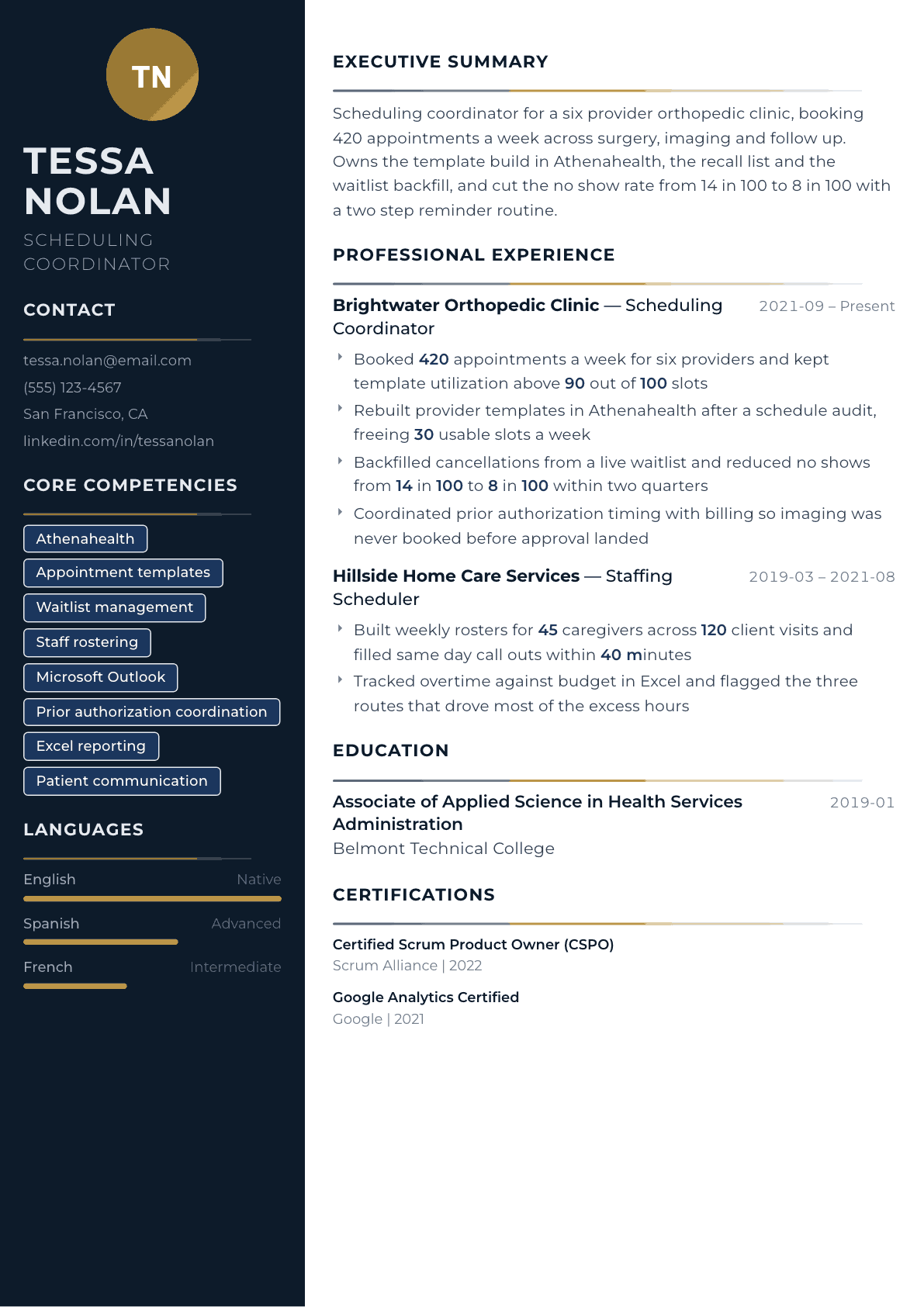
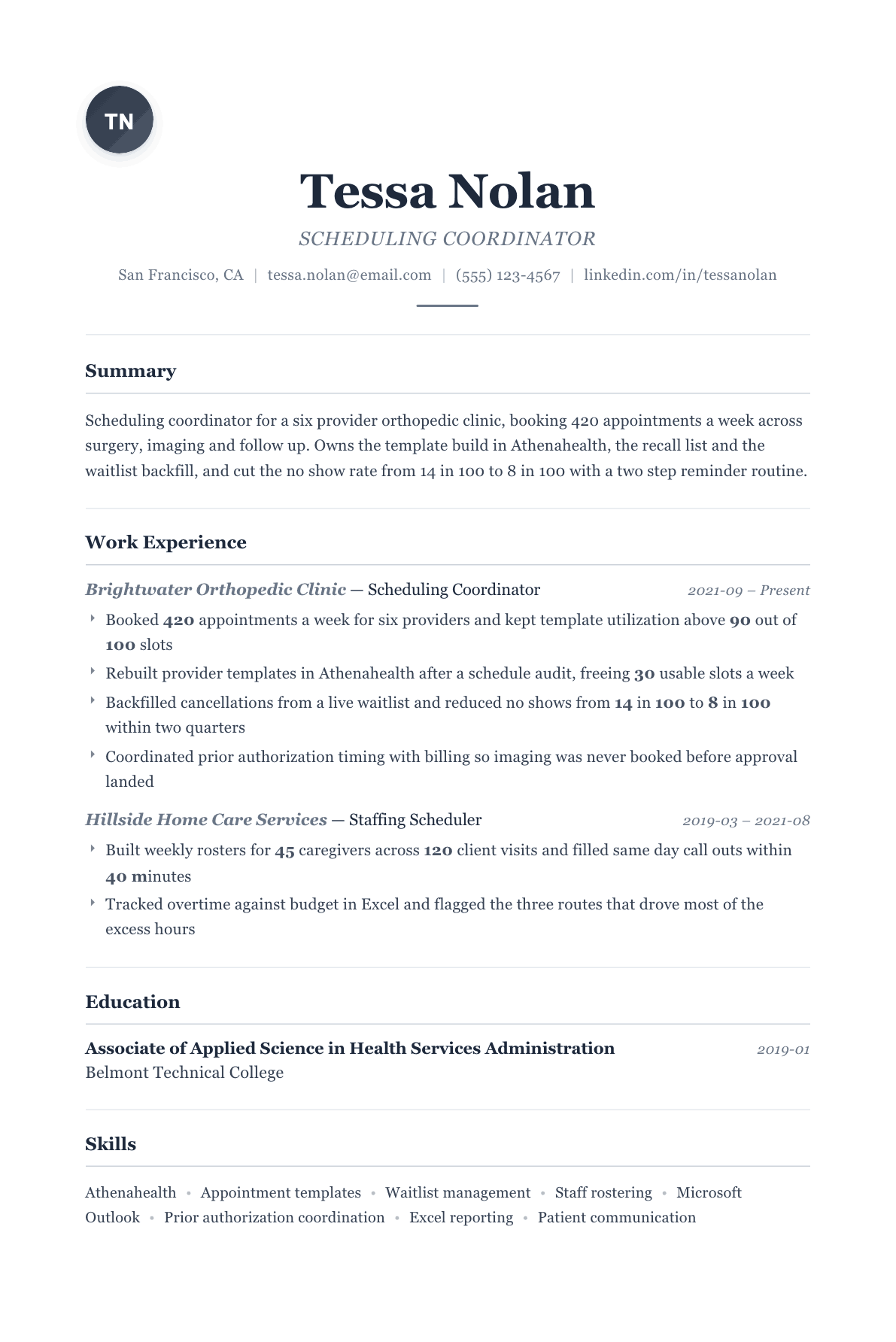
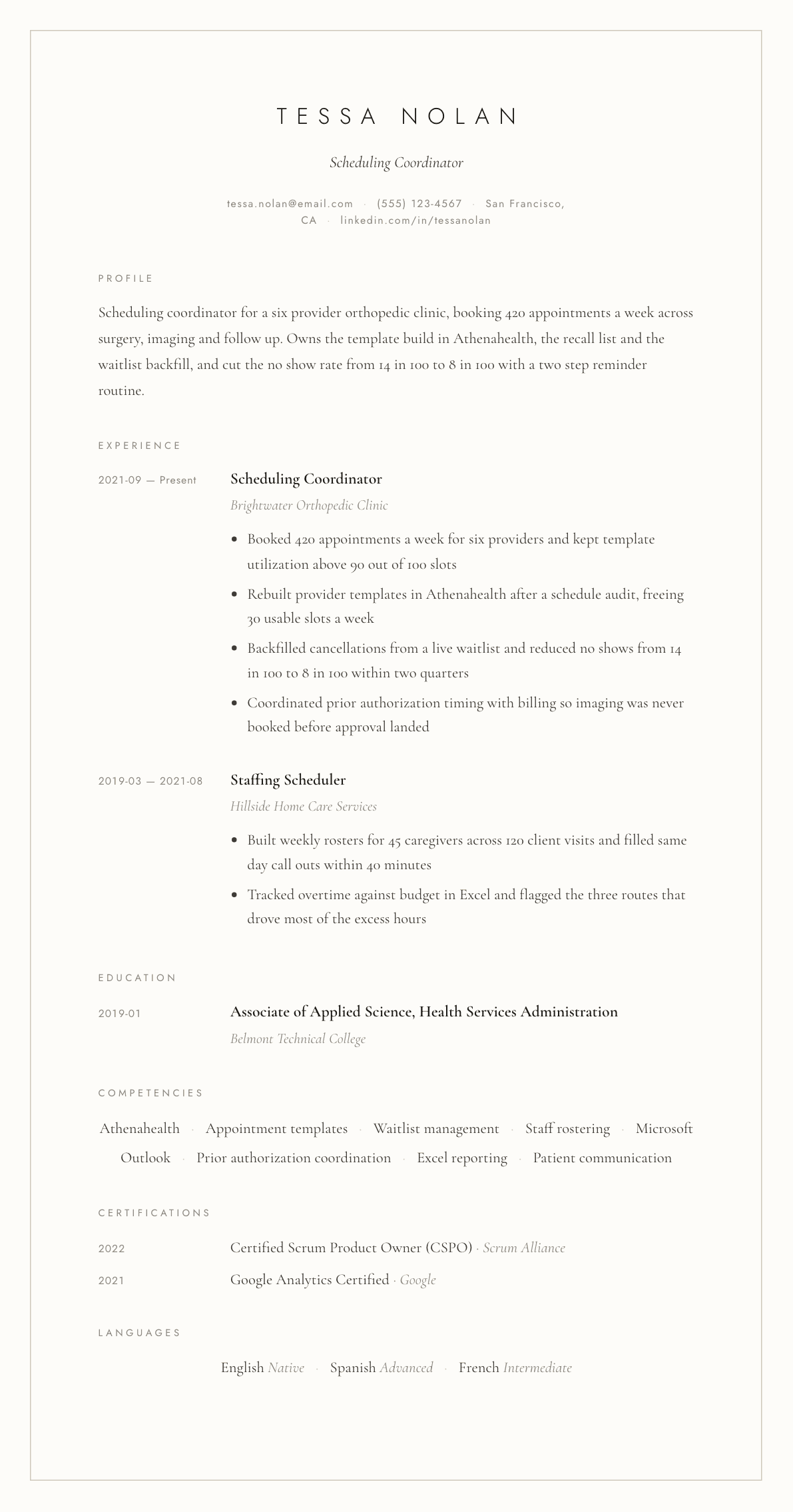
The same scheduling coordinator content laid out in three CVBooster templates, so you can see what the finished document looks like before you write a word.
Example Scheduling Coordinator summary
Scheduling coordinator with five years across clinic and home care settings, booking 420 appointments a week for six providers and rostering 45 caregivers. Rebuilt provider templates in Athenahealth to free 30 usable slots a week and cut no shows from 14 in 100 to 8 in 100. Seeking a coordinator role in a multi site practice where schedule design sits with one owner.
Skills to list on a Scheduling Coordinator resume
- Appointment scheduling
- Provider template management
- Waitlist and recall lists
- Staff rostering
- Epic Cadence
- Athenahealth
- Microsoft Outlook
- Shift coverage planning
- No show reduction
- Prior authorization coordination
- Excel reporting
- Conflict resolution
- Multi line phone systems
- Referral coordination
What actually gets this resume read
- Say how many appointments or shifts you schedule in a week, because volume is the first thing a manager checks.
- Name the scheduling system, whether that is Epic Cadence, Athenahealth, Kronos or a shared Outlook calendar set.
- Report a utilization, fill rate or no show number, since those are the metrics a scheduling supervisor is judged on.
- Describe how you handle same day cancellations, because backfill skill separates a coordinator from a booking clerk.
- Mention the people you coordinate between, such as providers, billing, referral sources and anxious families.
- Include template or roster building if you have done it, since that is planning work rather than reactive booking.
How to write a scheduling coordinator resume
A scheduling coordinator is measured on whether the calendar filled and whether the people on it showed up. Everything else is process. That is why the resumes that get called back read like an operations document: appointments booked in a week, template utilization, no show rate, and how same day cancellations were backfilled before the slot went cold.
Most candidates write the opposite. They describe answering phones, confirming appointments and being organized, which describes a booking clerk and prices the candidate accordingly. The distinction a practice manager cares about is whether you only worked inside the schedule or whether you designed it, because rebuilding provider templates is what recovers capacity that was never being used.
This guide covers the layout a clinic or staffing office expects, three summaries from first scheduling seat to lead coordinator, before and after bullets drawn from template rebuilds and waitlist backfill, and the questions coordinators ask when they want to move from a single site to a multi site practice.
Format: one page, metrics visible without scrolling
One page, reverse chronological, single column. A practice manager reviewing candidates between clinic sessions gives the page a short first pass, and the numbers need to survive that pass. Put the volume figure in the summary and again in the first bullet of the current job.
If your background mixes clinical scheduling with staff rostering, keep both but label the setting clearly in each job header. Booking patients against provider templates and rostering caregivers against client visits use the same instincts and completely different systems.
- Header: name, city and state, phone, email, and the scheduling system you know best.
- Section order: summary, then systems and skills, then experience, certifications and education last.
- Each job header: setting, number of providers or staff scheduled, and weekly appointment or shift volume.
Summary: volume, providers, system, and one rate
Say how many appointments or shifts you schedule in a week, for how many providers or staff, in which system, and then give one rate. Utilization, fill rate or no show rate all work. One credible rate does more than three sentences about being detail focused and reliable.
Name the setting precisely. A six provider orthopedic clinic, a home care agency covering 120 client visits, and a hospital radiology department are three different jobs, and a manager screens for the one closest to hers before reading anything else.
Experience: booking, backfill, template design, coordination
The first bullet carries the load: weekly volume, provider count, and the utilization you held. From there, write the parts of the job that are invisible in a duty list. Backfilling cancellations from a live waitlist is the skill that separates a coordinator from a booking clerk, because it recovers revenue that would otherwise evaporate on the day.
Give template or roster design its own bullet if you have done it. Auditing a schedule and rebuilding provider templates is planning work, and freeing usable slots a week is the kind of result a practice manager repeats to her director. Reactive booking never produces that sentence.
Close with coordination. Scheduling sits between providers who want protected time, billing that needs authorization in place before imaging is booked, referral sources who want a date today, and families who are worried. Name those relationships, because handling them is most of what makes the seat difficult.
Systems and skills: the scheduling stack
Name the scheduling module rather than the vendor alone where you can, since these are configured very differently and a manager wants to know how much ramp time to plan. Add the surrounding tools you use to run the day: the shared calendar, the reminder platform, the spreadsheet where you track overtime or authorization expiry.
Keep soft skills out of the list and into the bullets. Nobody has ever been hired because a resume claimed excellent communication, but a bullet describing how you told a surgeon his block was being reduced proves the same thing.
- Scheduling systems: Epic Cadence, Athenahealth, a home care platform, a workforce system, or a shared Outlook calendar set.
- Processes: provider template build, recall lists, waitlist backfill, reminder cadence, same day call out coverage.
- Supporting tools: Excel reporting for utilization and overtime, and the authorization tracker that keeps imaging from being booked early.
Certifications and education: helpful, rarely required
Most scheduling coordinator postings ask for a high school diploma and relevant experience, with an associate degree preferred in clinical settings. If you hold a medical administrative or patient access credential, list it, since those confirm you understand insurance basics and patient privacy rather than only calendars.
System training counts as evidence even when it is not a credential. If your employer certified you on the scheduling module you use, say so in the skills block and name the module, because that is a concrete claim rather than a general one.
Scheduling Coordinator resume summary examples
First scheduling seat
Front desk assistant moving into scheduling after two years booking follow up visits and managing a recall list for a two provider family practice. Comfortable on a multi line phone, trained on appointment templates and reminder calls, and looking for a scheduling coordinator seat in a specialty clinic.
Clinic coordinator
Scheduling coordinator for a six provider orthopedic clinic, booking 420 appointments a week across surgery, imaging and follow up. Owns the template build in Athenahealth, the recall list and the waitlist backfill, and cut no shows from 14 in 100 to 8 in 100 with a two step reminder routine.
Lead coordinator
Lead scheduling coordinator across two clinic sites and a home care division, responsible for template design, roster coverage for 45 caregivers, and the utilization report the practice director reviews weekly. Rebuilt provider templates after a schedule audit and freed 30 usable slots a week without adding clinic hours.
Work experience bullets: before and after
Before: Scheduled appointments for the clinic.
After: Booked 420 appointments a week for six providers across surgery, imaging and follow up, holding template utilization above 90 of every 100 available slots.
Volume, provider count and a utilization figure let a practice manager compare you against her own clinic instantly.
Before: Reduced patient no shows.
After: Cut no shows from 14 in 100 to 8 in 100 over two quarters by confirming at booking and again the morning before, and by calling every second missed visit to reschedule on the spot.
The before and after with the method behind it shows a process you can repeat rather than a lucky quarter.
Before: Filled canceled appointments when possible.
After: Backfilled same day cancellations from a live waitlist, working the list by procedure type and travel distance so slots were refilled rather than lost to the day.
Describing how the waitlist was worked proves judgment, since a list nobody triages refills nothing.
Before: Worked with billing on insurance issues.
After: Coordinated authorization timing with the billing team so imaging was never scheduled before approval landed, which removed the rescheduling that had followed denied studies.
It names the failure being prevented, which is how a manager recognizes real scheduling judgment.
Before: Made staff schedules each week.
After: Built weekly rosters for 45 caregivers across 120 client visits and covered same day call outs within 40 minutes by keeping a ranked list of available staff by district.
The coverage time and the ranked list turn rostering into a measurable service level rather than a weekly chore.
Hard skills
- Appointment scheduling
- Provider template design
- Waitlist and recall management
- Epic Cadence
- Athenahealth
- Staff rostering and shift coverage
- No show reduction routines
- Prior authorization coordination
- Microsoft Outlook calendar management
- Excel utilization reporting
- Multi line phone handling
- Referral coordination
Soft skills
- Calm handling of upset callers
- Negotiating with providers over protected time
- Triage under a ringing phone
- Clear handoffs to clinical staff
- Persistence on confirmations
- Discretion with patient detail
Certifications worth listing
- Certified Medical Administrative Assistant (CMAA) (National Healthcareer Association)
- Certified Healthcare Access Associate (CHAA) (National Association of Healthcare Access Management)
- Certified Administrative Professional (CAP) (International Association of Administrative Professionals)
- Microsoft Office Specialist: Excel Associate (Microsoft)
Mistakes that cost scheduling coordinator candidates the interview
- Describing the phone instead of the calendar, which prices you as a receptionist rather than a scheduling coordinator.
- Leaving out weekly volume and provider count, the two numbers a practice manager uses to size your experience.
- Reporting no rate at all, when utilization, fill rate and no show rate are the metrics the seat is graded on.
- Skipping template or roster design work, which is the planning evidence that justifies the higher paying postings.
- Naming no scheduling system, leaving the reader to assume a paper book and a long training period.
- Claiming excellent communication in a skills list instead of showing it in a bullet about a difficult conversation.
Scheduling Coordinator resume questions
What metrics belong on a scheduling coordinator resume?
Appointments or shifts booked per week, providers or staff covered, template utilization or fill rate, no show rate, and time to cover a same day call out. Use whatever your employer already reported so every figure is defensible in the interview.
Is scheduling coordinator a clinical role?
No, but in healthcare settings it sits close enough to clinical work that privacy training and basic insurance knowledge are expected. You are not making clinical decisions, though you are protecting provider time and making sure authorization is in place before imaging is booked.
How do I move from a single clinic to a multi site practice?
Show design work rather than booking volume alone. Template audits, recall list rebuilds, reminder routines and cross site coverage rules all demonstrate that you can set up a schedule someone else will run, which is what a multi site role requires.
Does staffing or rostering experience count for a clinic scheduling job?
Yes, and it is often undersold. Covering same day call outs against a caregiver roster demands the same triage, negotiation and speed as backfilling a clinic slot. Label the setting clearly and translate the metrics into the clinic vocabulary the posting uses.
Should I list the scheduling system if I only used it briefly?
List it with honest depth, such as trained on templates or day to day booking only. Managers plan training around your answer, and overstating a module you cannot navigate surfaces in the first week rather than staying hidden.
Related resume examples
- Office Coordinator Resume example
- Appointment Setter Resume example
- Administrative Assistant Resume example
- Intake Coordinator Resume example
- Medical Front Desk Resume example
- Medical Administrative Assistant Resume example