Admissions Coordinator Resume Examples: read this first
Shape an Admissions Coordinator Resume Around Census and Conversion
By Mustafa Tarabya, founder of CVBooster · Published · Updated
Admissions coordinator resume examples with census, tour and enrollment keywords, plus a guide to writing bullets an admissions director rewards.
Sample resumes for a admissions coordinator
The same admissions coordinator content laid out in three CVBooster templates, so you can see what the finished document looks like before you write a word.
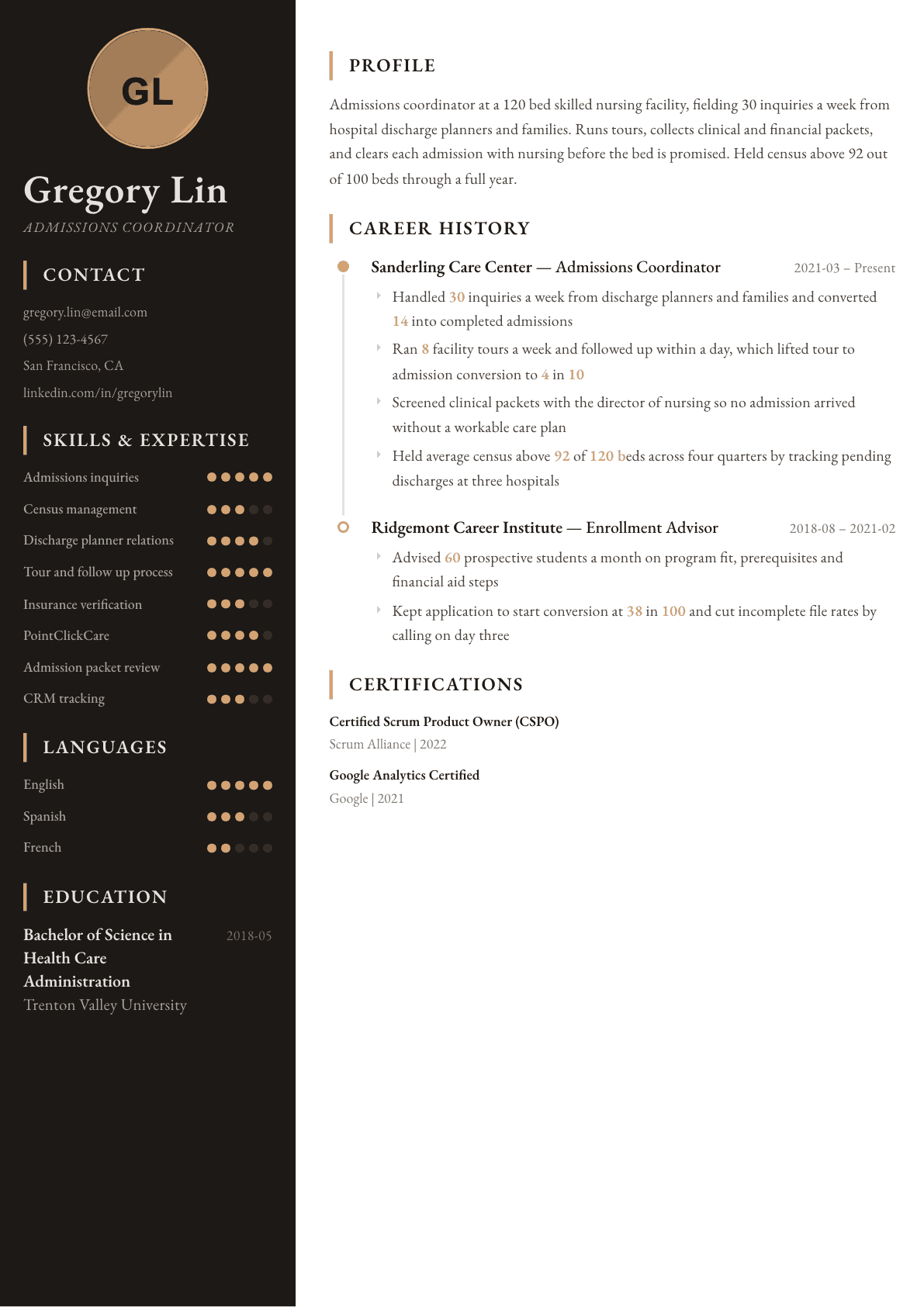
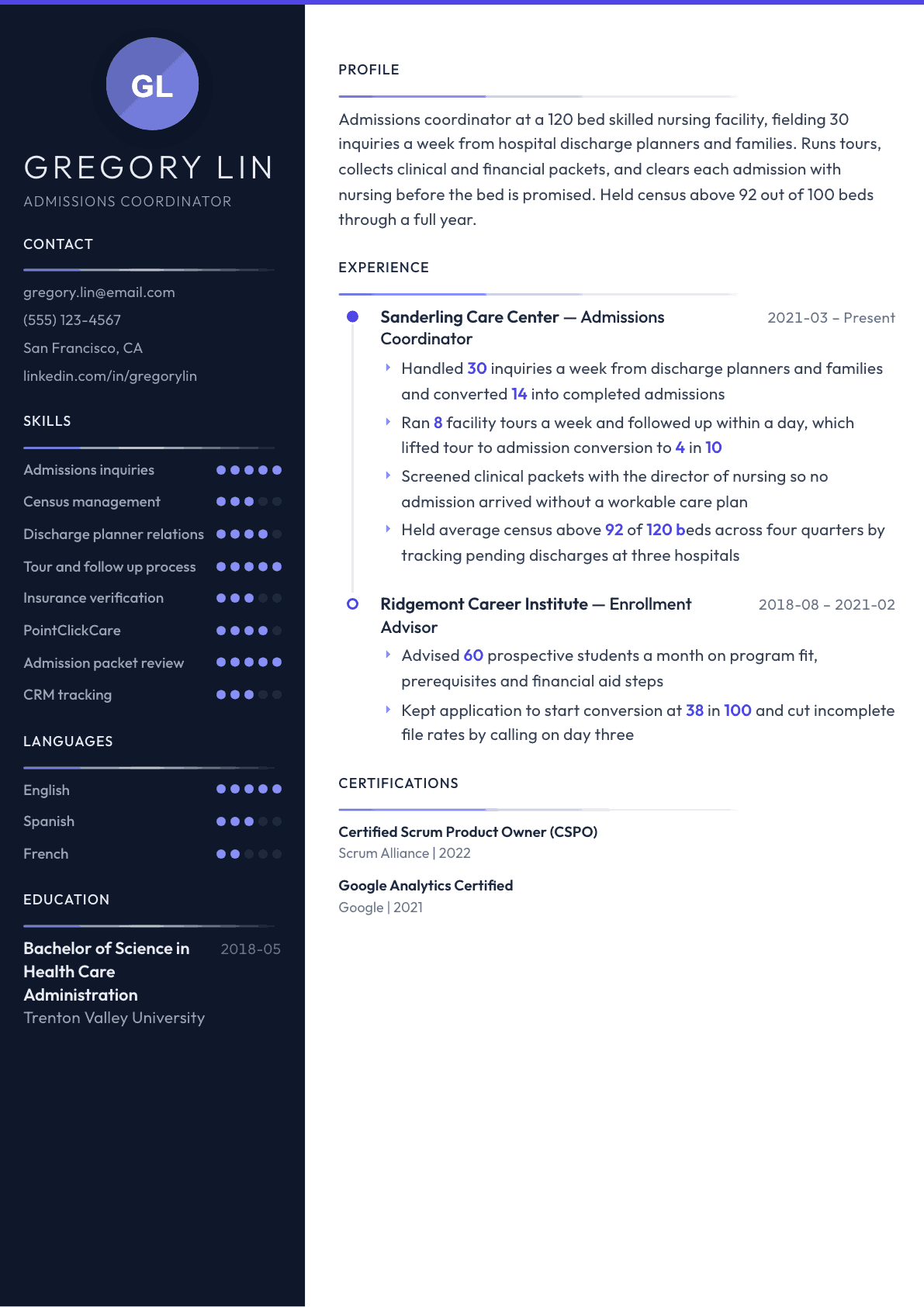
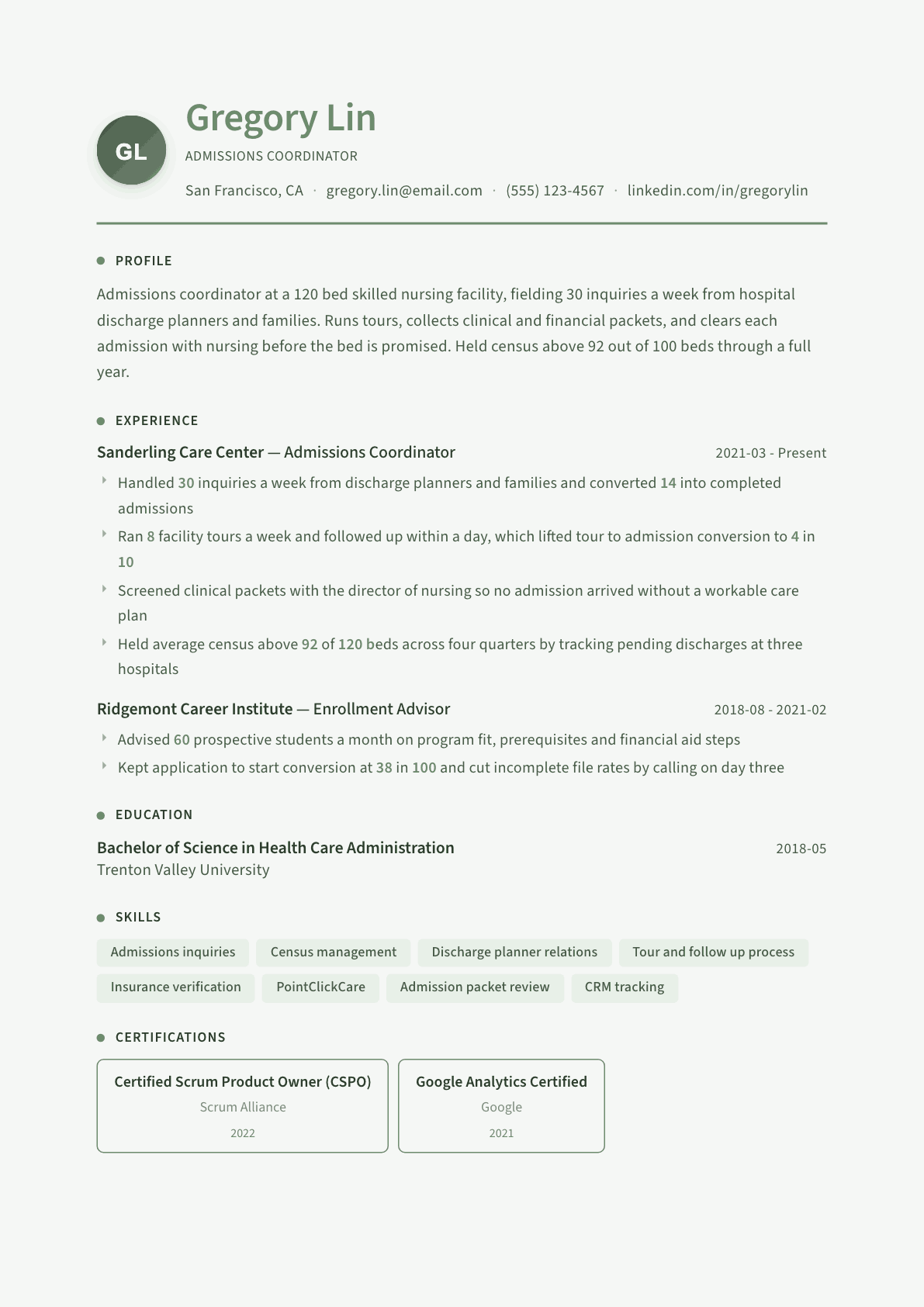
Example Admissions Coordinator summary
Admissions coordinator with six years across skilled nursing and career education, converting 30 weekly inquiries into 14 completed admissions. Built discharge planner relationships at three hospitals and held census above 92 of 120 beds for four straight quarters. Comfortable in PointClickCare and Slate. Seeking an admissions role where referral development and clean clinical screening are both valued.
Skills to list on a Admissions Coordinator resume
- Admissions inquiries
- Census and occupancy tracking
- Referral source development
- Tour and open house coordination
- Insurance verification
- Financial aid guidance
- PointClickCare
- Slate CRM
- Admission packet review
- Discharge planner outreach
- Enrollment reporting
- Family communication
- Regulatory documentation
- Follow up cadences
What actually gets this resume read
- Open with the setting and its size, since a 120 bed nursing facility and a small college draw very different candidates.
- Give inquiry volume and conversion together, because an admissions seat is judged on what closes, not what calls.
- Name census, occupancy or enrollment numbers you influenced, and state the period so the figure carries weight.
- Describe the referral relationships you own, whether that is discharge planners, high school counselors or agencies.
- Show the clinical or academic screening step, since admissions that fall apart later cost more than they earned.
- Name the system of record, such as PointClickCare, Slate or a Salesforce admissions build, so the tools match.
How to write a admissions coordinator resume
An admissions coordinator is hired to keep a building or a program full, and the resume is read against that single accountability. In a skilled nursing facility the number is census. In career education it is starts. Either way the reader is an admissions director whose own review is written from the same figure, and she is looking for a candidate who talks in those terms without being prompted.
What loses the job is writing the resume as customer service. Answering inquiries, giving tours and completing paperwork is a description of the tasks, not of the outcome. The version that converts pairs inquiry volume with what closed, names the referral relationships you owned, and shows that admissions you accepted did not fall apart afterward.
This guide covers the structure an admissions director expects, three summaries across settings and stages, before and after bullets built from tour follow up and census work, and the questions coordinators ask when moving between healthcare and education admissions.
Format: one page, setting and size in the first line
One page for most candidates, reverse chronological, single column. Open every job with the setting and its size, because a 120 bed skilled nursing facility, a memory care unit and a small career institute draw completely different candidate pools and the reader is matching on that first.
Keep the census or enrollment figure in the summary and repeat it inside the experience. It is the one number an admissions director will quote when she recommends you to her administrator, so make it easy to find twice.
- Header: name, city and state, phone, email, and the admissions system of record you know best.
- Section order: summary, experience, referral and systems skills, certifications, education.
- Each job header: facility or school, size in beds or enrollment, and weekly inquiry volume.
Summary: inquiries, conversions, census, referral base
Give inquiry volume and what closed in the same breath. Thirty inquiries a week converting to fourteen completed admissions describes the seat far better than either figure alone, because an admissions role is judged on what closes rather than on what calls.
Then the census or occupancy you held and over what period. A single strong month is noise; four quarters is a track record. Finish with the referral base you own, since a coordinator who arrives with working relationships at three hospitals is worth more than one who waits for the phone.
Experience: inquiry, tour, screen, admit
Follow the admission through the job. Inquiry volume and source first. Then tours: how many a week, and the follow up window you held, because tour to admission conversion is largely decided by how fast the second contact happens. Then the screening step, then the census result.
The clinical or academic screen deserves its own bullet and is the one most candidates skip. Clearing an admission with the director of nursing before the bed is promised, or checking prerequisites before a start date is confirmed, prevents the admissions that unravel later and cost more than they earned. Directors notice a candidate who volunteers that discipline.
Finish with referral development. Naming the discharge planners, high school counselors or agency partners you called on, and what changed in referral volume from a named account, turns a relationship claim into evidence.
Systems and skills: the admissions stack
Name the system of record. In post acute care that is usually a clinical and billing platform with an admissions module; in education it is an admissions customer relationship system. These are different worlds, and naming yours tells the reader which one you came from and how quickly you will learn hers.
Add the verification skills that sit under the seat: insurance verification and benefit checks in healthcare, financial aid steps and prerequisite checks in education. Both are the reason a promising inquiry stalls, and both are the work a coordinator is trusted to complete without supervision.
- Systems: PointClickCare, Slate, or a Salesforce based admissions build, plus the reporting spreadsheet you maintained.
- Verification: insurance and benefit checks, admission packet review, prerequisite or financial aid guidance.
- Development: discharge planner outreach, open house and tour coordination, follow up cadences, enrollment or census reporting.
Certifications and education: useful, not decisive
A bachelor degree in health care administration, business or a related field is common in this seat and worth listing plainly. It is rarely the deciding factor, because directors hire on conversion evidence and referral relationships far more readily than on a transcript.
Patient access and revenue cycle credentials fit the healthcare side of admissions, since they certify the eligibility and registration knowledge the role uses daily. List only credentials you actually hold and name the issuing body in full.
Admissions Coordinator resume summary examples
First admissions seat
Enrollment advisor with two years guiding 60 prospective students a month through program fit, prerequisites and financial aid steps. Held application to start conversion at 38 in 100 and cut incomplete files by calling on day three. Seeking an admissions coordinator role in a post acute or education setting.
Facility coordinator
Admissions coordinator at a 120 bed skilled nursing facility, fielding 30 inquiries a week from discharge planners and families and converting 14 into completed admissions. Runs eight tours a week, screens clinical packets with the director of nursing, and held average census above 92 beds for four quarters.
Admissions lead
Admissions lead with eight years across skilled nursing and career education, owning referral development at three hospital systems as well as the daily inquiry queue. Built the tour follow up standard that lifted tour to admission conversion to four in ten, and reports census and pipeline weekly to the administrator.
Work experience bullets: before and after
Before: Answered inquiries from families and referral sources.
After: Handled 30 inquiries a week from hospital discharge planners and families and converted 14 of them into completed admissions.
Pairing volume with what closed is the structure an admissions director uses to judge the seat.
Before: Gave tours of the facility to prospective residents.
After: Ran eight facility tours a week and followed up within one day of each visit, lifting tour to admission conversion to four in every ten.
The follow up window explains the conversion, since the second contact is where tours are won or lost.
Before: Worked with nursing on new admissions.
After: Screened every clinical packet with the director of nursing before a bed was promised, so no admission arrived without a workable care plan in place.
It shows the discipline that prevents failed admissions, which is the risk directors most want covered.
Before: Helped keep the facility census up.
After: Held average census above 92 of 120 beds across four consecutive quarters by tracking pending discharges daily at three referring hospitals.
A census figure with a period and the referral routine behind it reads as a repeatable method, not a good stretch.
Before: Advised students on programs and financial aid.
After: Advised 60 prospective students a month on program fit, prerequisites and financial aid steps, and cut incomplete application files by calling every applicant on day three.
The volume and the specific intervention show a pipeline being actively worked rather than passively processed.
Hard skills
- Admissions inquiry management
- Census and occupancy tracking
- Tour and open house coordination
- Referral source development
- Insurance verification
- Admission packet review
- PointClickCare
- Slate CRM
- Financial aid and prerequisite guidance
- Enrollment and pipeline reporting
- Follow up cadence design
- Regulatory admission documentation
Soft skills
- Warmth with families making a hard decision
- Fast rapport with discharge planners
- Saying no to an unsafe admission
- Follow up persistence
- Coordination with clinical leadership
- Composure during a full building
Certifications worth listing
- Certified Healthcare Access Associate (CHAA) (National Association of Healthcare Access Management)
- Certified Revenue Cycle Representative (CRCR) (Healthcare Financial Management Association)
- Certified Medical Administrative Assistant (CMAA) (National Healthcareer Association)
Mistakes that cost admissions coordinator candidates the interview
- Writing the role as customer service, which hides the fact that the seat is accountable for census or starts.
- Giving inquiry volume without conversion, so the reader learns how busy you were but not how effective.
- Reporting a census figure with no period attached, which makes a single good month look like a record.
- Leaving out the clinical or academic screen, the step that prevents admissions from unraveling after the sale.
- Describing referral relationships in general terms instead of naming the accounts and what changed at them.
- Omitting the system of record, when post acute and education admissions platforms are entirely different worlds.
Admissions Coordinator resume questions
What numbers matter most on an admissions coordinator resume?
Inquiries per week, admissions or starts closed from them, tour to admission conversion, and the census or enrollment level you held with the period attached. Those four give a director everything she needs to compare you to her current team.
Does education admissions experience transfer to healthcare admissions?
The pipeline discipline transfers well: inquiry handling, tours, follow up cadence and conversion tracking are the same craft. What does not transfer is insurance verification and clinical screening, so name the gap and any healthcare exposure you already have.
How do I write about census when the building was struggling?
Give the direction rather than only the level. Moving occupancy up from a low base with a named method is more impressive than holding a high census in a full market, and a director who has run a struggling building will recognize the work immediately.
Should I list the hospitals and referral sources by name?
Name the type and the count rather than every account, such as three referring hospital systems and a network of physician offices. That gives credible scale without turning your resume into a client list your former employer would rather you did not publish.
Is a degree required for an admissions coordinator role?
Many postings prefer a bachelor degree in health care administration or business, but plenty of coordinators come from patient access, sales or front office backgrounds. Conversion evidence and referral relationships usually outweigh the degree line in the decision.
Related resume examples
- Intake Coordinator Resume example
- Office Coordinator Resume example
- Healthcare Administrator Resume example
- Records Manager Resume example
- Appointment Setter Resume example
- Travel Coordinator Resume example