Receptionist Resume Examples: free ATS score and gap list
Welcome Your Way to a Great Receptionist Resume
By Mustafa Tarabya, founder of CVBooster · Published · Updated
Receptionist resume examples with expert tips, ATS keywords, and professional templates. See exactly what a winning front desk receptionist resume looks like.
Sample resumes for a receptionist
The same receptionist content laid out in three CVBooster templates, so you can see what the finished document looks like before you write a word.
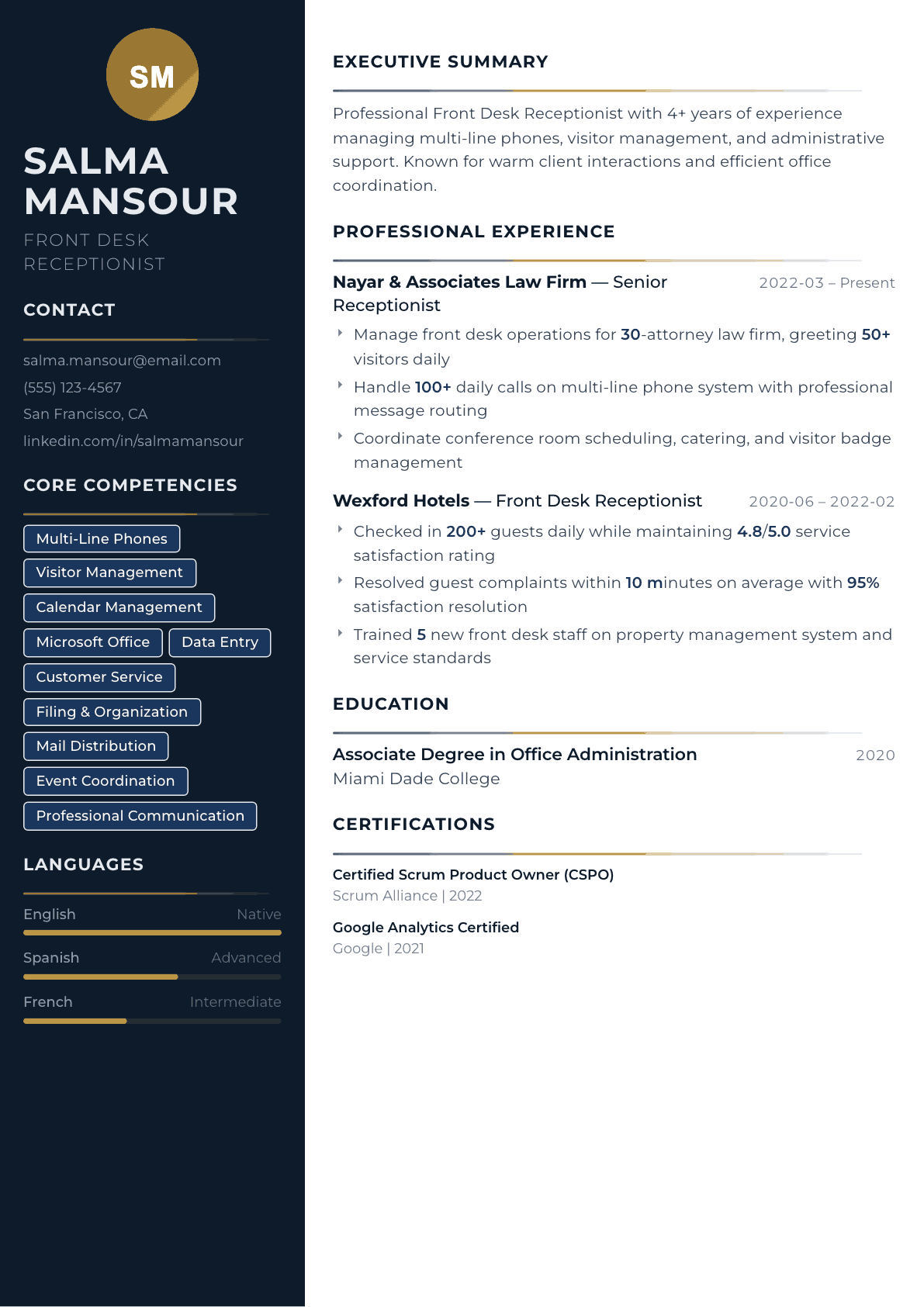
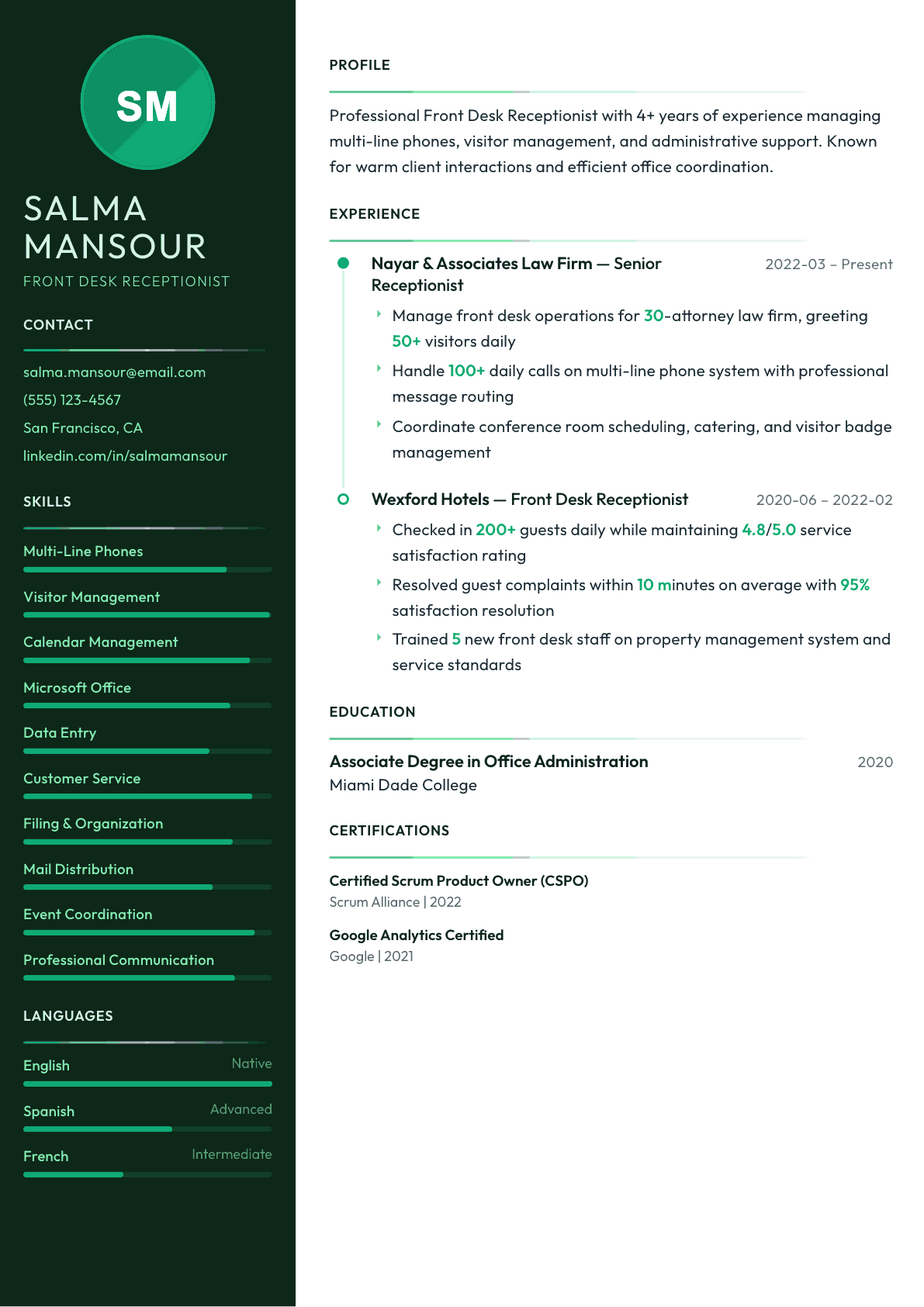
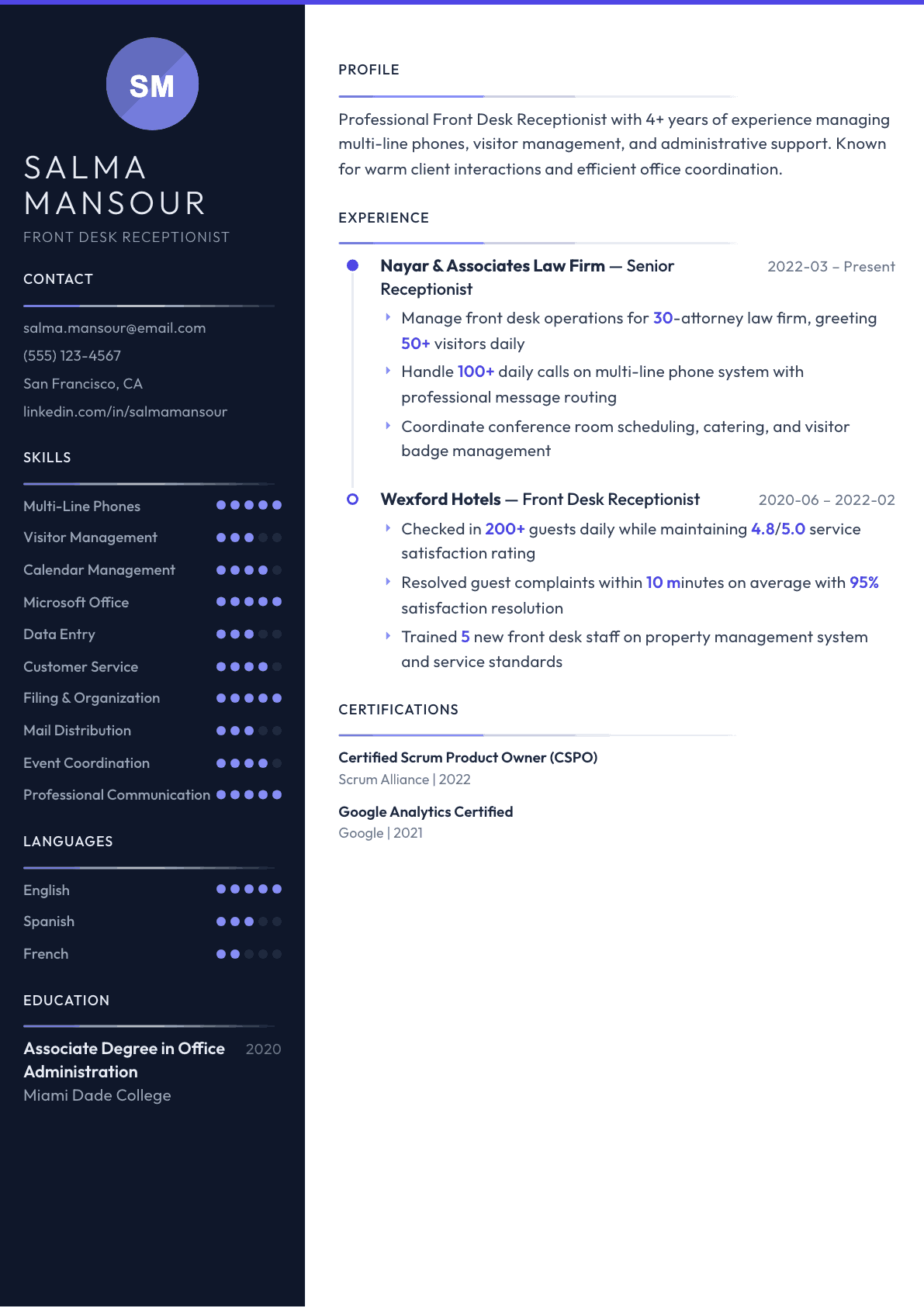
Example Receptionist summary
Front desk receptionist, 4 years across a law firm and a hotel, currently greeting 50 visitors and routing 100 calls a day for 30 attorneys. Books conference rooms, orders catering, issues visitor badges, and has trained five new front desk staff on the property system and service standards.
Skills to list on a Receptionist resume
- Multi-Line Phones
- Visitor Management
- Calendar Management
- Microsoft Office
- Data Entry
- Customer Service
- Filing & Organization
- Mail Distribution
- Event Coordination
- Professional Communication
What actually gets this resume read
- Highlight volume metrics: calls handled, visitors greeted daily.
- Show proficiency with office systems and phone technology.
- Include customer service ratings or recognition.
- Demonstrate multitasking and organizational abilities.
- Mention any software or scheduling tools you use.
How to write a receptionist resume
A receptionist resume is judged on composure at volume. The hiring manager, often an office manager or a practice administrator, is picturing her own front desk at eleven in the morning: three lines ringing, a courier waiting, a candidate arriving early for an interview, and a partner asking where the conference room catering is. She is reading to find out whether you have stood in that spot before.
That means the two most useful things you can put on the page are volume and setting. Calls handled a day, visitors greeted a day, and the kind of front desk it was. A 30 attorney law firm lobby, a hotel front desk, a manufacturing plant gate and a pediatric clinic waiting room ask for very different behavior, and the closer your setting is to hers the more real your experience becomes.
This guide covers the layout, how to write phone and visitor work so it does not read as filler, what to do with the administrative work that fills the quiet hours, and the questions people ask when reception is either their first job or their route into an office career.
Format: one page, clean, and free of decoration
One page, reverse chronological, single column. Reception is a role where a designed template with photos and colored sidebars actively hurts, because these postings attract very high application volume and get filtered by software before a person ever sees them. Plain formatting with clear headings survives that filter.
Proofread it twice more than you think is necessary. This is the one job where a typo is read as evidence about the work itself, since the receptionist is the person who takes messages, writes emails on behalf of others and produces the first impression of the company.
- Header: name, city and state, phone, email. Add languages spoken if the front desk serves a mixed language public.
- Order: summary, experience, skills and software, education, certifications.
- Every job: the type of front desk, the daily call volume, and the daily visitor count.
Summary: the desk you ran and the volume it carried
Three lines that name the setting, the volume and one thing beyond greeting. Reception summaries collapse into identical sentences about being friendly and professional, so the differentiator is always concrete: the phone system you operated, the industry, the number of people at the site, or the administrative work you absorbed for the team.
If you are applying with no reception experience, name the transferable volume instead. A retail worker who served a hundred customers a shift and handled cash and returns has done the hardest part of the job already, and saying so is stronger than a paragraph about a passion for helping people.
Experience: phones, visitors, and everything between the two
Start with the phone. Number of lines, calls per day, and what you did with them: routing, screening, taking accurate messages, scheduling, and handling the callers nobody else wanted. Screening deserves its own mention when you have done it, because filtering sales calls away from executives is a judgment task rather than a switchboard task.
Then visitors. Daily count, check in procedure, badge issuance, escorting or host notification, deliveries and couriers, and how you kept the lobby correct when several people arrived at once. Add security duties honestly, because in many buildings the receptionist is the access control point and the employer needs to know you understand that.
The third strand is the work that fills the rest of the day: conference room booking and setup, catering orders, mail and courier handling, supply ordering, calendar support, expense forms, data entry, filing and document preparation. This is where a receptionist resume either shows range or reads as thin, and most candidates undersell it badly.
Give one bullet to a moment of pressure. A day when the system went down, a difficult visitor you managed without security, or a period when you covered the desk alone while the office grew. That single bullet tells the reader more about your composure than any adjective.
- Daily call volume with the phone system named, plus routing and screening duties.
- Daily visitor count, check in method and any badge or access responsibility.
- Room booking, catering and event support with the volume you handled.
- Administrative support: calendars, data entry, filing, expense forms, correspondence.
- Any service rating, recognition or repeat coverage request you received.
Software: the part most receptionist resumes skip
Name the phone platform, the visitor management system, the calendar and mail environment, the room booking tool and the industry system behind the desk, whether that is a property management system in a hotel, a practice system in a clinic or a case management system in a law firm. Front desk software is exactly what makes one receptionist faster to onboard than another.
Add your typing speed and any data entry accuracy figure in the skills block. Reception involves a large amount of transcription and form entry, and a defensible number is worth more than the phrase "strong computer skills" that appears on almost every resume for this role.
Using reception as a route into the office
Reception is the most reliable entry point into administrative, human resources and office management work, and the resume should already point that way. Every time you took on something outside the desk, whether that was onboarding paperwork, invoice coding, event help or scheduling for a team, it belongs on the page with its own bullet.
Training or covering for others is the other signal. A receptionist who trained new front desk staff or built the desk manual has shown the ownership that turns into a coordinator or office manager title, and it is the thing hiring managers look for when promoting from the lobby.
Receptionist resume summary examples
First office job
Retail associate with two years serving 100 customers a shift, handling payments, returns and complaints at a service counter. Types 65 words per minute, comfortable with calendar and email tools, and seeking a front desk receptionist role in a professional office.
Four years at the front desk
Front desk receptionist for a 30 attorney law firm, greeting 50 visitors daily and handling 100 calls on a multi-line system with accurate routing and message taking. Coordinates conference room scheduling, catering and visitor badges, and supports three paralegals with document preparation.
Lead receptionist
Lead receptionist covering a corporate lobby with 200 daily guests, holding a 4.8 out of 5 service rating and resolving visitor and booking issues within ten minutes on average. Trained five new front desk staff on the visitor system and wrote the desk coverage manual.
Work experience bullets: before and after
Before: Answered phones and directed calls to the right person.
After: Handled 100 daily calls on a multi-line system, screening sales calls away from partners, routing client calls to the correct practice group and taking messages with full contact and matter details.
Volume, screening judgment and what went into the message show a desk that protects people's time rather than transferring calls.
Before: Greeted visitors when they came into the office.
After: Greeted 50 daily visitors, issued badges through the visitor system with automatic host notification, and kept couriers, candidates and client arrivals moving without any wait exceeding a few minutes.
The system, the notification and the wait standard turn a greeting into a managed lobby.
Before: Booked meeting rooms and ordered lunch for meetings.
After: Managed booking for six conference rooms, resolving double bookings before the meetings arrived, and ordered and set up catering for client meetings and monthly firm lunches.
Room count and conflict resolution show the part of the job that fails loudly when it is done badly.
Before: Trained new receptionists on how the front desk works.
After: Trained five new front desk staff on the phone system, visitor software and service standards, then wrote a desk manual that made single-person coverage possible during absences.
The written manual proves the training created a lasting asset instead of a shadowing session.
Before: Did administrative work when the desk was quiet.
After: Supported three attorneys with document preparation, expense submission and calendar changes between desk duties, absorbing roughly ten hours a week of administrative work.
Naming who you supported and the hours involved shows range beyond the lobby rather than idle time filled.
Hard skills
- Multi-line phone systems
- Call screening and routing
- Visitor management and badge issuance
- Conference room booking and setup
- Calendar management in Outlook and Google Calendar
- Microsoft Office and document preparation
- Data entry and form processing
- Mail and courier handling
- Catering and event coordination
- Filing and records organization
- Expense report submission
- Typing at 65 words per minute
Soft skills
- Composure under interruption
- Professional telephone manner
- Discretion with confidential information
- Reading a visitor's urgency
- Reliability and punctuality
- Warmth without oversharing
Certifications worth listing
- Microsoft Office Specialist (Microsoft)
- Certified Administrative Professional (CAP) (International Association of Administrative Professionals)
- Adult First Aid, CPR and AED (American Red Cross)
- Notary Public commission (State commissioning authority)
Mistakes that cost receptionist candidates the interview
- Filling the summary with friendly and professional adjectives that appear on every other resume in the stack.
- Leaving out call and visitor volume, which are the only figures that let a manager compare your desk to hers.
- Skipping the administrative work you did between arrivals, which is where the range of the role actually shows.
- Using a designed template with a photo and sidebar for a role that attracts high application volume and heavy software screening.
- Never naming the phone system, visitor platform or industry software, so the reader assumes you will need training on all of them.
- A single typo or inconsistent date format on the resume, which is read as a comment on your accuracy at the desk.
Receptionist resume questions
What should a receptionist resume include with no work experience?
Lead with any role that involved serving people at volume, including retail, food service, volunteering or a school office. Add typing speed, the software you can use, and your availability, then keep the education section short and factual.
How do I make a receptionist resume stand out when the duties are the same everywhere?
Use setting and scale. A law firm lobby, a manufacturing gate, a medical waiting room and a hotel desk demand different behavior, so naming yours plus your call and visitor volume separates you from a page of identical duty lists.
Should I put a photo on a receptionist resume?
Not in the United States and most English speaking markets. Employers there generally discard resumes with photos to avoid bias claims, and the space is better used on volume figures and the software you know.
Is typing speed still relevant for a receptionist?
Yes, because the job involves constant message taking, form entry and correspondence. List speed with accuracy, since an error rate matters more than raw speed when the text is a client message or a patient record.
How do I use a receptionist role to move into office administration?
Give every task outside the desk its own bullet: onboarding paperwork, invoice handling, event support, scheduling for a team, training new staff. Those bullets are what an administrative assistant or office coordinator posting screens for.
Related resume examples
- Administrative Assistant Resume example
- Office Manager Resume example
- Customer Service Resume example
- Front Desk Receptionist Resume example
- Office Assistant Resume example
- Medical Receptionist Resume example