Assistant Director Resume Examples: the lines they read
Write an Assistant Director Resume That Gets You Hired
By Mustafa Tarabya, founder of CVBooster · Published · Updated
Assistant director resume examples with call sheet and scheduling credits, unit sizes, format range and the keywords line producers look for.
Sample resumes for a assistant director
The same assistant director content laid out in three CVBooster templates, so you can see what the finished document looks like before you write a word.
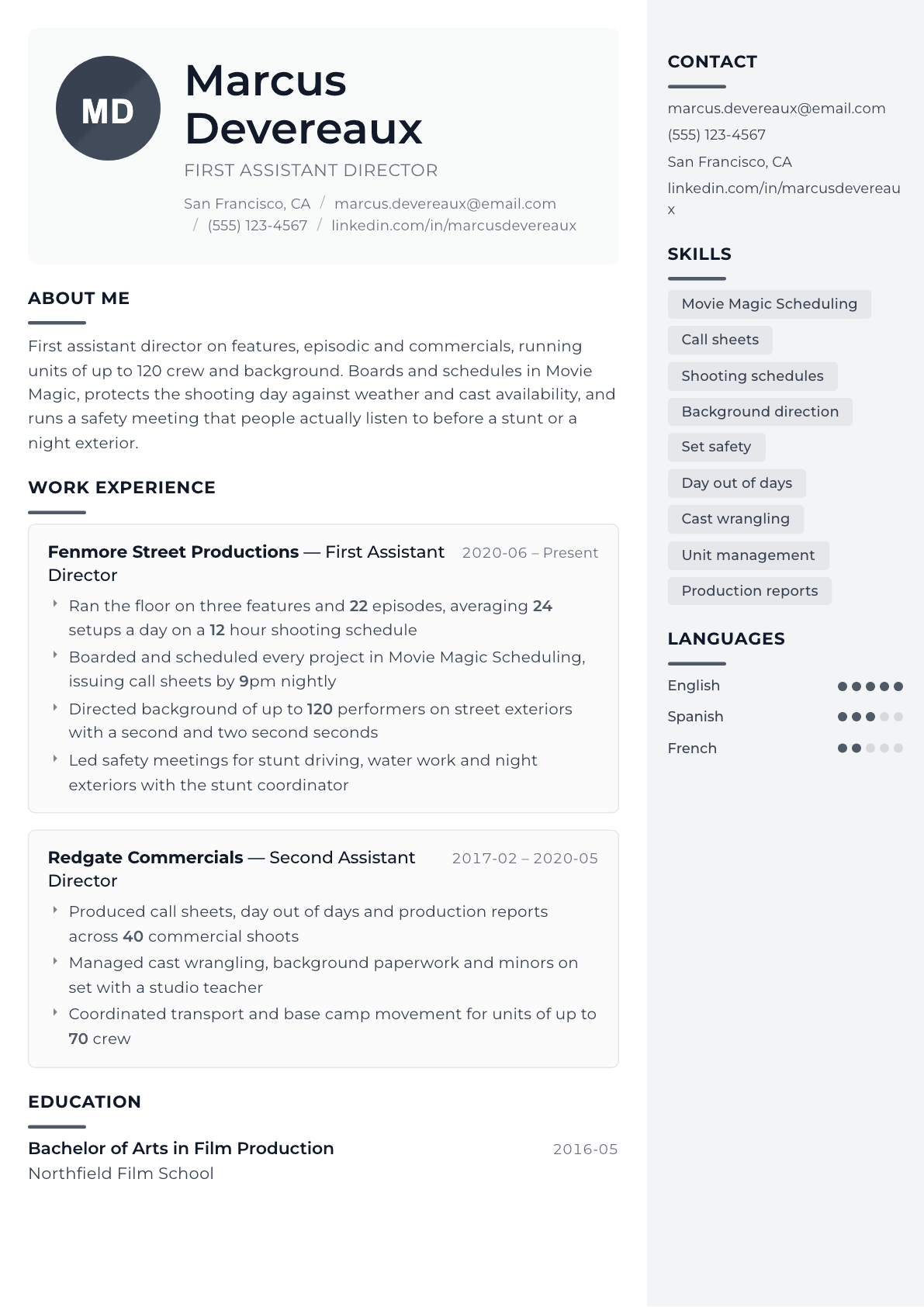
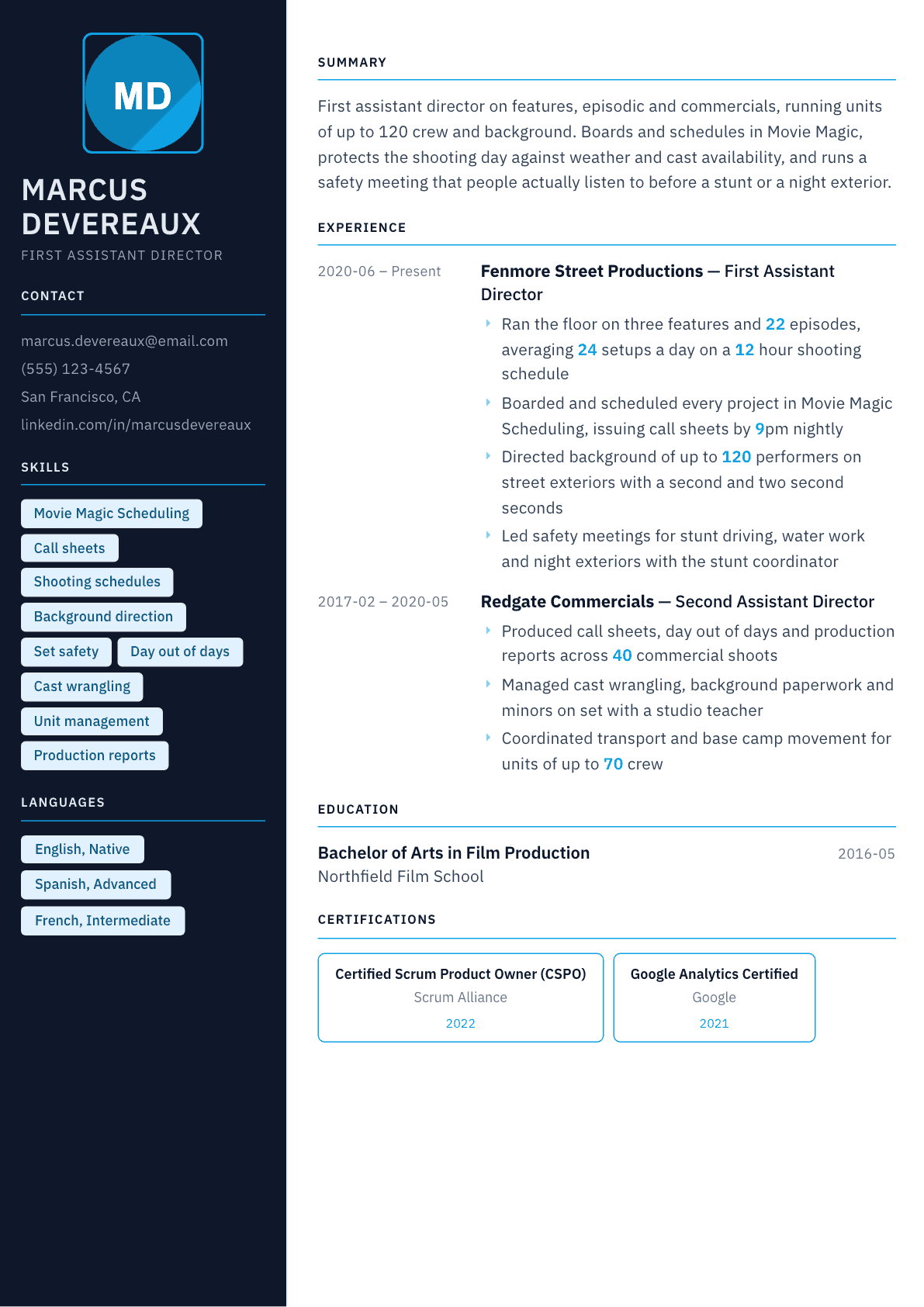
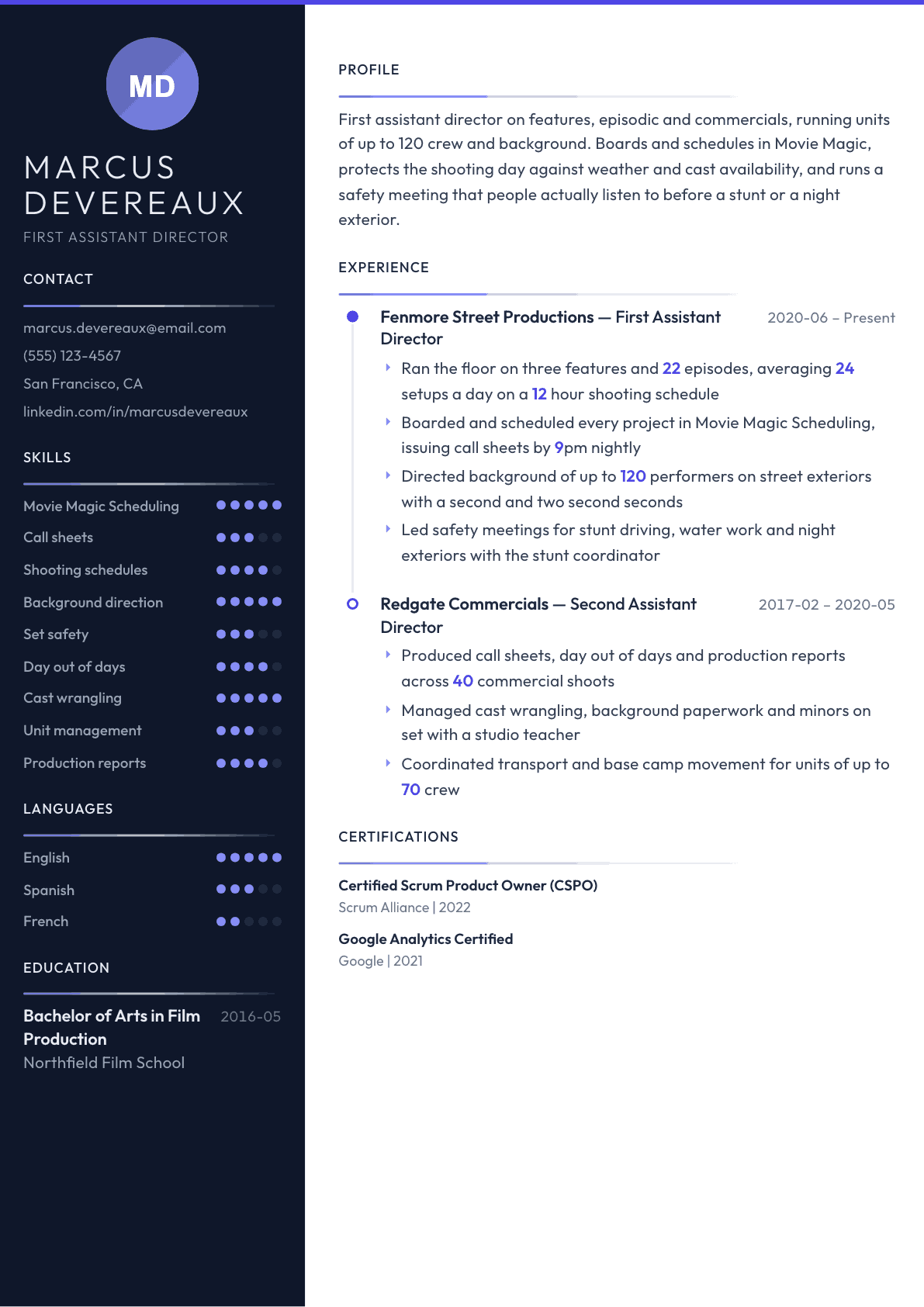
Example Assistant Director summary
First assistant director on features, episodic and commercials, running floors of up to 120 crew and background. Boards a script in Movie Magic within days of a first read, sustains 24 setups on a 12 hour day, and issues call sheets by 9pm. Runs safety meetings for stunts, water and night exteriors with the coordinators involved.
Skills to list on a Assistant Director resume
- Shooting schedules
- Movie Magic Scheduling
- Call sheets
- Day out of days
- Script breakdown
- Background direction
- Set safety protocols
- Cast wrangling
- Unit management
- Production reports
- Stunt coordination support
- Location logistics
- Crew communication
- Time management
What actually gets this resume read
- State your grade clearly: first, key second, second second or additional, on every credit.
- Give the format, the shoot length and the crew size, because those set the job you are being hired for.
- Name your scheduling software and how fast you can board a script from a first read.
- Show the setups per day you have sustained, since a line producer reads that as pace.
- List union status and the safety training you hold, and name the issuing body for each.
- Add the specialty days you have run: stunts, minors, animals, water, night exteriors, crowd.
How to write a assistant director resume
An assistant director is hired to protect the shooting day, so the resume is judged on evidence of pace and control. A line producer reads it looking for three numbers: the crew and background size you have run, the setups per day you have sustained, and the shooting day length you worked to. Everything else on the page is context for those three.
The grade you held on each credit matters just as much. First assistant director, key second, second second and additional are four different jobs with four different pay grades, and a resume that lists them all as assistant director gets set aside by someone who checks call sheets for a living. State the grade on every line.
This guide covers the credit format production offices expect, how to show scheduling and boarding speed, how to list the specialty days that actually distinguish one first from another, and the questions assistant directors ask when a job comes up on short notice.
Format: grade, format, crew size, one page
Reverse-chronological credits in fixed columns: production, format, production company, director, shoot length and your grade. One page. An assistant director whose resume runs long has answered the reliability question badly before anyone read a word, because compressing information is the entire job.
Group by format so a reader can find what they need: features, episodic, commercials, and anything else in a fourth group. A line producer staffing a commercial does not want to read three features first, and an episodic producer wants the episode counts, not a list of spots.
- Header: name, city, phone, email, union status, driver license class and whether you travel.
- Sections in this order: credits by format, scheduling and software, specialty days, safety training, training and references.
- Early-career candidates list production assistant and additional assistant director work in a separate labeled group.
The three numbers: crew, setups, day length
Give the crew and background size you ran on your largest days. Directing background of 120 performers on a street exterior is a specific competence, and the number is how a producer prices your experience against their crowd day.
State the setups per day you have sustained and the shooting day length that came with it. Twenty four setups on a twelve hour day is a pace claim a line producer immediately understands, and it is far more persuasive than saying you are efficient. Pair it with the format, because commercial setups and episodic setups are not the same unit of work.
Scheduling: boarding speed and the software you board in
Name your scheduling package and say how quickly you can break down and board a script from a first read. Prep is where an assistant director earns the job, and a producer who has waited a week for a board remembers it. Add the paperwork you produce: script breakdown, board, shooting schedule, day out of days, call sheets and production reports.
Then say when call sheets go out. Issuing a call sheet by a fixed hour every night is the single habit that tells a crew whether the coming shoot will be organized, and it is a claim you can make on the resume and be held to.
- State whether you board from a locked script or work through ongoing rewrites.
- Note how many units you have run at once, and whether you have handled a second unit board.
- Say which distribution and production management systems you have used for paperwork.
Specialty days and safety: the lines that separate two firsts
Most experienced assistant directors can run a dialogue day. The credits that decide a hire are the difficult ones: stunt driving, water work, fire, night exteriors, minors with a studio teacher, animals with a wrangler, large crowd, aerial, and any day with a firearms professional present. List the ones you have actually run and name the coordinator discipline involved.
Safety belongs in its own block, with the issuing body for every training you hold. An assistant director runs the safety meeting, and a producer wants to see that the person calling it has training behind the words rather than a template read aloud.
Keywords and skills line producers scan for
The language is standard across postings and crew calls: shooting schedule, call sheet, script breakdown, day out of days, background direction, set safety, production report, unit management, night exterior, stunt day. Mirror the exact terms once in your skills block and once inside a credit so both passes find them.
Leave the adjectives out. Calm, organized and hardworking are claimed by every applicant for this job, and the space is better spent on a setup count, a crowd size or a specialty day you have genuinely run.
Assistant Director resume summary examples
Second assistant director
Second assistant director on commercials and independent features, producing call sheets, day out of days and production reports across 40 shoots. Manages cast wrangling, background paperwork and minors with a studio teacher, and coordinates transport and base camp movement for units of up to 70 crew.
Key second moving to first
Key second assistant director on episodic television, running second unit call sheets and background of up to 60 performers. Boards in Movie Magic Scheduling from a first read within days, issues call sheets by a fixed hour nightly, and has firsted eight days of second unit including two night exteriors.
First assistant director
First assistant director on features, episodic and commercials, running floors of up to 120 crew and background at 24 setups on a 12 hour day. Boards every project in Movie Magic Scheduling, issues call sheets by 9pm, and leads safety meetings for stunt driving, water work and night exteriors with the coordinators involved.
Work experience bullets: before and after
Before: Ran the set on several productions.
After: Ran the floor on three features and 22 episodes, averaging 24 setups a day on a 12 hour shooting schedule.
Format counts plus a setup rate and a day length turn a job description into a measurable pace claim.
Before: Created schedules and call sheets.
After: Boarded and scheduled every project in Movie Magic Scheduling and issued call sheets by 9pm nightly, including through two rounds of script revisions.
The software, the nightly deadline and the rewrite condition show a producer what your prep discipline is worth.
Before: Directed background performers.
After: Directed background of up to 120 performers on street exteriors with a second and two second seconds, staging crowd movement in three waves per setup.
Crowd size, the team under you and the staging method describe an actual method rather than a duty.
Before: Held safety meetings on set.
After: Led safety meetings for stunt driving, water work and night exteriors alongside the stunt coordinator, walking the crew through the plan before each rehearsal.
Naming the specialty days and the coordinator makes safety a credential rather than a checkbox.
Before: Worked with minors and handled paperwork.
After: Managed minors on set with a studio teacher across 40 commercial shoots, tracking hours and schooling blocks against permit conditions on every call sheet.
The compliance detail is the part a producer worries about, and stating it removes their main risk question.
Hard skills
- Shooting schedules
- Movie Magic Scheduling
- Script breakdown
- Call sheets
- Day out of days
- Background direction
- Set safety protocols
- Cast wrangling
- Unit management
- Production reports
- Second unit coordination
- Location logistics
Soft skills
- Crew communication
- Composure under pressure
- Time management
- Delegation
- Diplomacy with cast
- Escalation judgment
Certifications worth listing
- OSHA 10-Hour General Industry (Occupational Safety and Health Administration)
- First Aid, CPR and AED (American Red Cross)
- Basic Life Support (BLS) (American Heart Association)
Mistakes that cost assistant director candidates the interview
- Listing every credit as assistant director without stating whether you were first, key second, second second or additional.
- Leaving out setups per day and day length, which are the pace numbers a line producer is reading for.
- Running past one page, which contradicts the compression skill the job is built on.
- Mixing commercials and features into one list so the reader has to sort the credits themselves.
- Claiming safety training without naming the issuing body for it.
- Describing yourself as calm and organized instead of naming a crowd size, a night exterior or a stunt day you ran.
Assistant Director resume questions
How do I show the difference between first and second assistant director credits?
Put the grade in its own column on every line and use the exact title from the call sheet. Producers verify grades through crew lists and other assistant directors, so an unclear line costs more trust than the credit was worth.
Should an assistant director resume list setups per day?
Yes, alongside the format and the shooting day length. Setups per day is the closest thing the job has to a performance number, and a resume that omits it leaves the producer to assume a slower pace than you actually held.
Do I need union status on the resume?
State it plainly near the top, because it is a hard filter for most union productions and a question the office has to answer before anything else. If you are not a member, say which agreements you have worked adjacent to rather than leaving it blank.
How do I move from second to first assistant director on paper?
Show the firsting you have already done, even a handful of second unit days or a low budget feature, in its own labeled group. Then lead with boarding, scheduling and safety meeting experience, since those are the parts of firsting a second rarely gets to prove.
What specialty days are worth listing?
Stunts, water, fire, night exteriors, minors, animals, large crowds, aerial work and any day requiring a specialist coordinator. Those are the days that go wrong, so a producer staffing one wants an assistant director who has already run it.