Film Producer Resume Examples: free ATS score and gap list
Produce a Film Producer Resume That Gets You on Set
By Mustafa Tarabya, founder of CVBooster · Published · Updated
Build a compelling film producer resume showcasing your production credits, budget management, and creative leadership in the entertainment industry.
Sample resumes for a film producer
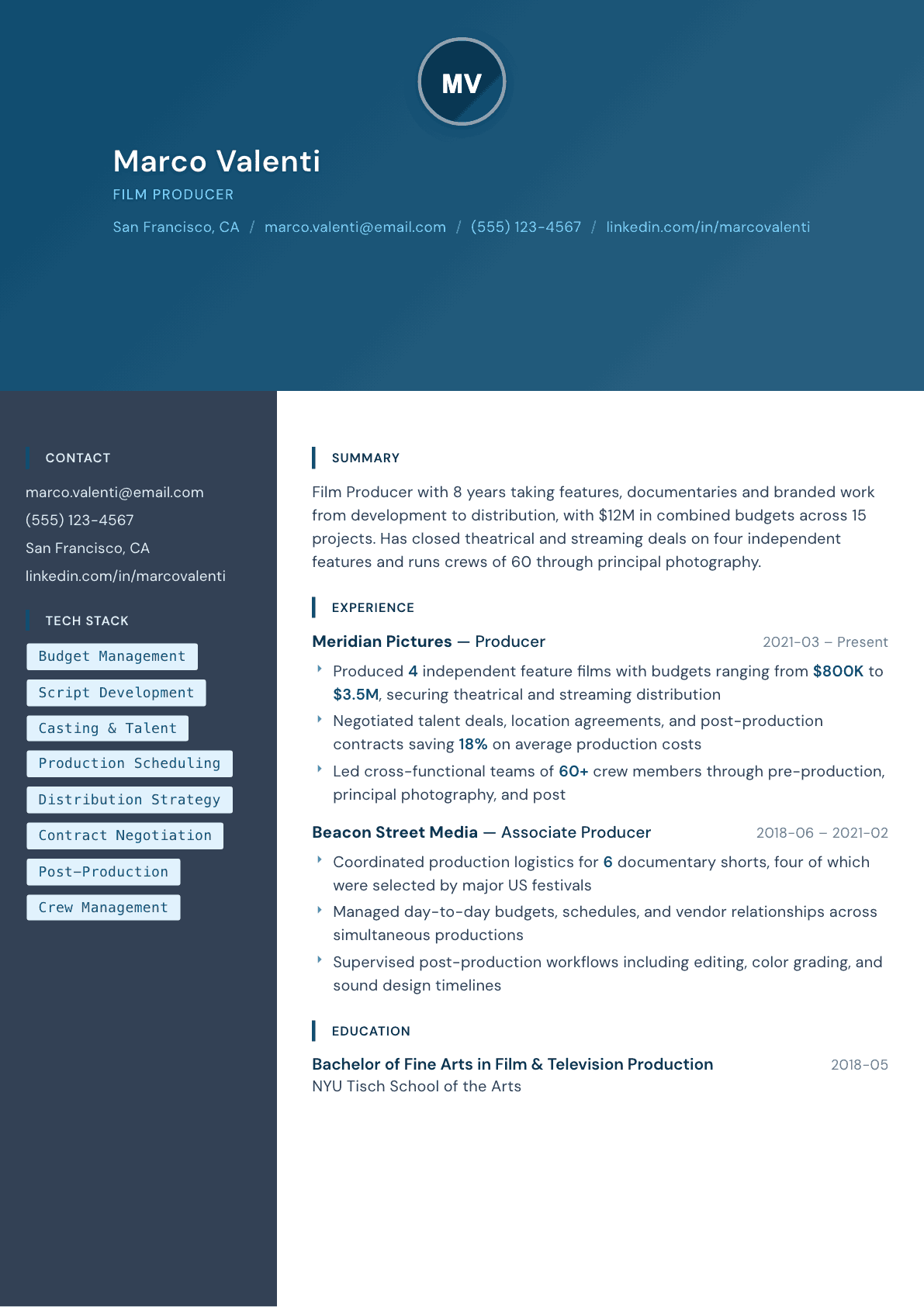
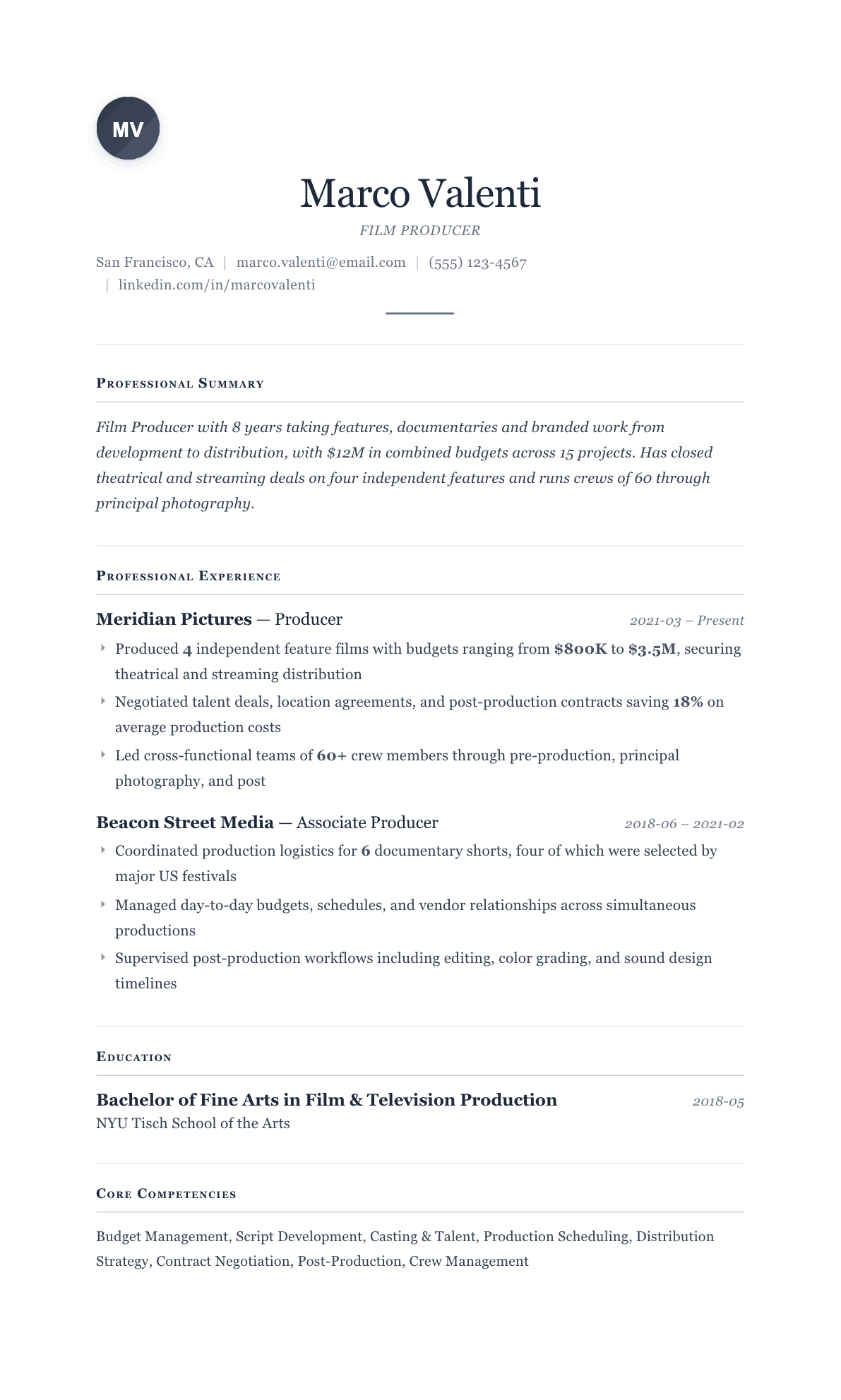
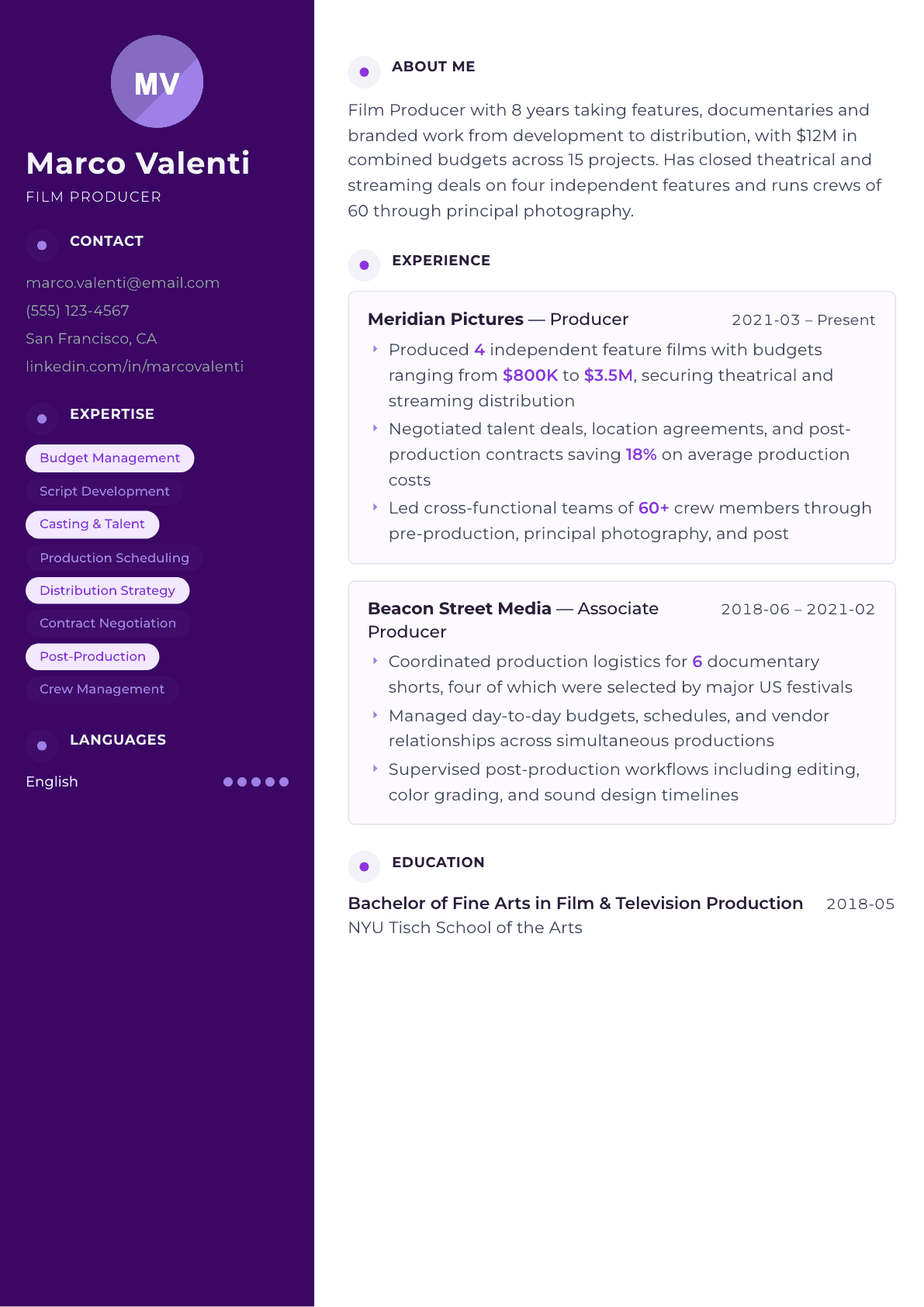
The same film producer content laid out in three CVBooster templates, so you can see what the finished document looks like before you write a word.
Example Film Producer summary
Producer, 8 years, four independent features between $800K and $3.5M delivered on budget and sold into theatrical and streaming. Handles the deals as well as the schedule, from talent and location agreements to post contracts, and has festival-selected documentary credits from the associate producer years.
Skills to list on a Film Producer resume
- Budget Management
- Script Development
- Casting & Talent Relations
- Production Scheduling
- Distribution & Sales
- Contract Negotiation
- Post-Production Supervision
- Crew Management
- Location Scouting
- Fundraising & Financing
What actually gets this resume read
- Lead with your most notable production credits and their distribution outcomes.
- Quantify budgets managed, team sizes led, and festival selections earned.
- Highlight relationships with distributors, sales agents, and financing sources.
- Include any awards, festival laurels, or audience metrics for completed projects.
How to write a film producer resume
A film producer resume is unusual because the credits do most of the talking. An executive, a financier or a production company head scans for titles she recognizes, the format and length, the budget tier, the role you held on each and what happened to the picture afterward. Distribution, a festival premiere, a broadcaster or streamer acquisition, an award: that outcome is the difference between a credit and a completed project.
The second thing read is scope. Producers are hired against a budget band and a format. Someone who has closed six figure documentary budgets is not automatically the right hire for a seven figure scripted feature with a completion bond, a union crew and a delivery schedule to a distributor. Say the band, say the format, say whether the productions were union or nonunion, and say what you were responsible for: financing, physical production, or both.
This guide covers the credit-first structure producers use, three summaries from coordinator to executive producer, before-and-after bullets that replace vague creative language with schedules and deliverables, and the questions producers ask when moving between formats.
Format: a credits section, not a duties section
Lead with selected credits. Each entry gets the title, the format and running length, your producing credit, the budget tier described in words rather than exact figures if you prefer discretion, and the outcome: theatrical, streaming, broadcast, festival premiere, award. Keep it to the strongest ten to fifteen, ordered by relevance rather than strictly by date when you are targeting a specific company.
Then a shorter experience section for staff roles at production companies, studios or agencies, where a title and duties structure does apply. Two pages is normal for a film producer with a real filmography, and a separate one page credit list is common as an attachment.
- Header: name, city, phone, email, and a link-free mention that a reel or credit list is available.
- Order: summary, selected credits, staff experience, development and financing highlights, education, skills.
- Early career producers put coordinator and production management credits in the same list with the exact title held.
Summary: format, budget band, and what you actually do
Producers do very different jobs under the same word. Some raise money and package talent. Some run the physical production, the schedule, the crew and the cost report. Some do post and delivery. Say which one you are in the first sentence, because a company hiring for a line producing function will not read a paragraph of development language to find out you cannot run a board.
Then name the formats and the budget band: independent features, documentary, branded content, series, commercials. Finish with the credential that travels, such as an established relationship with sales agents, experience closing a soft money or tax incentive package, or a record of delivering on schedule.
Credits: title, format, role, outcome
Write each credit so a reader who has never heard of the film still learns something. The genre and running length, the shoot length in days and the locations, the crew size, the budget tier in plain words, and where it ended up. A festival selection, a distributor, a broadcaster, a platform, an award nomination: this is the line that turns a title into evidence.
Be exact about the credit you held. Producer, executive producer, co-producer, line producer, production manager and associate producer are not synonyms in this industry, and inflating one is the fastest way to lose credibility with a reader who can check.
The producing work that belongs in bullets
Under staff roles and larger credits, write bullets about the mechanics: financing structure assembled, equity, presales, grants, tax incentive and rebate programs used, guild agreements negotiated, cast deals closed, insurance and completion arrangements, location permitting, schedule and board built from the script breakdown, the cost report and how far from budget the picture landed, and the post and delivery pipeline through picture lock, color, sound mix and deliverables to the distributor.
Producers commonly write about vision and storytelling. Keep one line for that if the job is creative producing, and spend everything else on the operational record, because that is what the person hiring is exposed to if you cannot do it.
Skills, tools and the vocabulary of the trade
Name the tools. Movie Magic Scheduling and Budgeting or Showbiz, StudioBinder, Final Draft for script work, Frame.io and Avid or Premiere for post review, and a payroll and accounting service for the production entity. A production company that runs one budgeting package prefers a producer who already knows it.
Use the words the job postings use: development, packaging, script breakdown, scheduling, budgeting, cost reporting, physical production, post supervision, deliverables, clearances, chain of title, errors and omissions insurance, distribution and sales.
Film Producer resume summary examples
Coordinator moving up
Production coordinator with 3 years across 9 independent short films, branded content and a documentary feature, moving into associate producing. Handled call sheets, crew and vendor bookings, location permitting and payroll paperwork on shoots running 5 to 22 days with crews up to 30.
Producing features
Film producer with 8 years delivering independent features, documentary shorts and branded content from development through delivery. Produced 4 features in the low seven figure band, secured theatrical and streaming distribution on 3 of them, and led crews of 60 through principal photography and post.
Executive producer
Executive producer with 15 years across scripted features, documentary and series, responsible for financing, packaging and greenlight decisions. Closed equity, presale and tax incentive structures on 11 pictures, oversaw 3 concurrent productions, and brought every title in on or under the approved cost report.
Work experience bullets: before and after
Before: Produced several independent films with great creative results.
After: Produced 4 independent features in the low seven figure band, all delivered on the approved schedule, with 3 securing theatrical and streaming distribution after festival premieres.
Count, budget band, delivery record and outcome are the four things a financier checks before reading further.
Before: Managed the production budget.
After: Built the budget and board from the script breakdown, ran weekly cost reports across a 24-day shoot, and closed the picture within the approved contingency after two weather days.
The cost report and the weather recovery show a producer who controls money in motion, not one who reads a spreadsheet.
Before: Negotiated deals with talent and vendors.
After: Negotiated cast deals under a guild low budget agreement, closed location and equipment vendor terms, and cut roughly a fifth from the original quote across camera, lighting and transportation.
Naming the agreement type and the departments proves you know where savings actually exist.
Before: Worked with the post-production team.
After: Supervised post from picture lock through color, sound mix and conform, managed the deliverables package for the distributor, and cleared music and archival rights before the delivery date.
Delivery and clearances are where independent pictures fail, so naming them signals real experience.
Before: Raised money for the film.
After: Assembled the financing structure from private equity, a presale to an international sales agent and a state production incentive, and delivered the completion documents required to close.
The specific sources tell a reader you have actually closed a stack rather than pitched one.
Hard skills
- Script breakdown and scheduling
- Budgeting and cost reporting
- Financing and packaging
- Tax incentive and rebate programs
- Guild and union agreements
- Talent and vendor negotiation
- Location scouting and permitting
- Post-production supervision
- Deliverables and quality control
- Clearances and chain of title
- Distribution and festival strategy
- Movie Magic Scheduling and Budgeting
Soft skills
- Crew leadership on set
- Decision making under a shooting clock
- Investor and financier communication
- Conflict resolution between departments
- Relationship building with agents and distributors
Mistakes that cost film producer candidates the interview
- Listing titles with no format, length, budget tier or outcome, which leaves the reader unable to judge the scale of anything.
- Inflating the credit held, when producer, co-producer, line producer and associate producer are checkable and mean different things.
- Writing about creative vision for a role that is clearly physical production, financing or post supervision.
- Omitting whether productions were union or nonunion, which changes the entire cost and compliance picture for a hiring company.
- Burying distribution and festival outcomes at the end of a paragraph instead of attaching them to each credit.
- Leaving out the budgeting and scheduling software, which is the practical competence a production company screens for.
Film Producer resume questions
Should a film producer resume lead with credits or with jobs?
Lead with selected credits. Producing is judged by what got made and what happened to it, so the credit list belongs directly under the summary, with staff production company roles in a shorter section underneath.
How many credits should I list?
Ten to fifteen of the strongest and most relevant, reordered for the company you are approaching. Keep a full filmography as a separate attachment and mention it, rather than turning the resume into an unranked list of everything you touched.
Do I have to state budget figures on a producer resume?
You do not need exact numbers, but you do need a band, because producers are hired against budget tiers. Describing a picture as a low seven figure independent feature or a six figure documentary gives the reader scale without disclosing a confidential cost report.
How do I show producing experience when the films were not released?
Show the operational record instead of the outcome: shoot days completed, crew size managed, budget delivered against, guild agreements used and the deliverables package finished. Completion on schedule is a real credential even when distribution did not follow.
How do I move from commercials or branded content into features?
Translate the work into feature vocabulary: shoot days, crew size, script breakdown, board and budget ownership, and vendor negotiation. Then say in the summary that you are moving into narrative or documentary features and lead with the longest form projects you have completed.
Related resume examples
- Video Editor Resume example
- Creative Director Resume example
- Content Creator Resume example
- Farm Manager Resume example
- Production Supervisor Resume example
- Line Supervisor Resume example