Second Interview Questions: 8 Answers and Questions to Ask
By Mustafa Tarabya, founder of CVBooster · Published · Updated
10 min read
Second interview questions go deeper than the first round: how you would do the actual job, how you would fit the team, what you would do in your first months, and the practical points of salary, notice period and start date. The one constraint: the panel has already heard your best examples, so bring new ones, or go one level deeper on the old ones, with names, numbers and what you would do differently. The National Careers Service describes an interview as "a conversation between you and an employer to see if you're the right fit for a role." At a second interview, that conversation gets specific. Below are eight complete sample answers, tagged by level, and the questions worth asking back. Written by Mustafa Tarabya, who hired for his own company, read every application himself and now writes CVBooster's guides.
They liked you enough to invite you back. Now you have to be that person again, with fresh stories, in front of someone more senior who has the notes from last time and has underlined the bit where you said "I am a fast learner".
How a second interview is different from the first
The first interview checks whether you can do the job. The second usually checks how you would do it here, with these people, starting on a real date. In the UK it often means one or more of:
- A more senior panel, such as the hiring manager's manager, a director or a future colleague.
- A task or presentation. The Civil Service Jobs guidance warns that "You may also be asked to prepare a presentation on a specific subject area. This will be provided to you in advance of the interview." Private employers do the same.
- Strengths or values questions about what motivates you, not only what you have done.
- Practical questions about salary, notice period and start date.
Why do you still want this job now you know more about it?
This often opens a second interview. It checks whether the first round put you off. Show you listened and that what you learned made the role more attractive, not less.
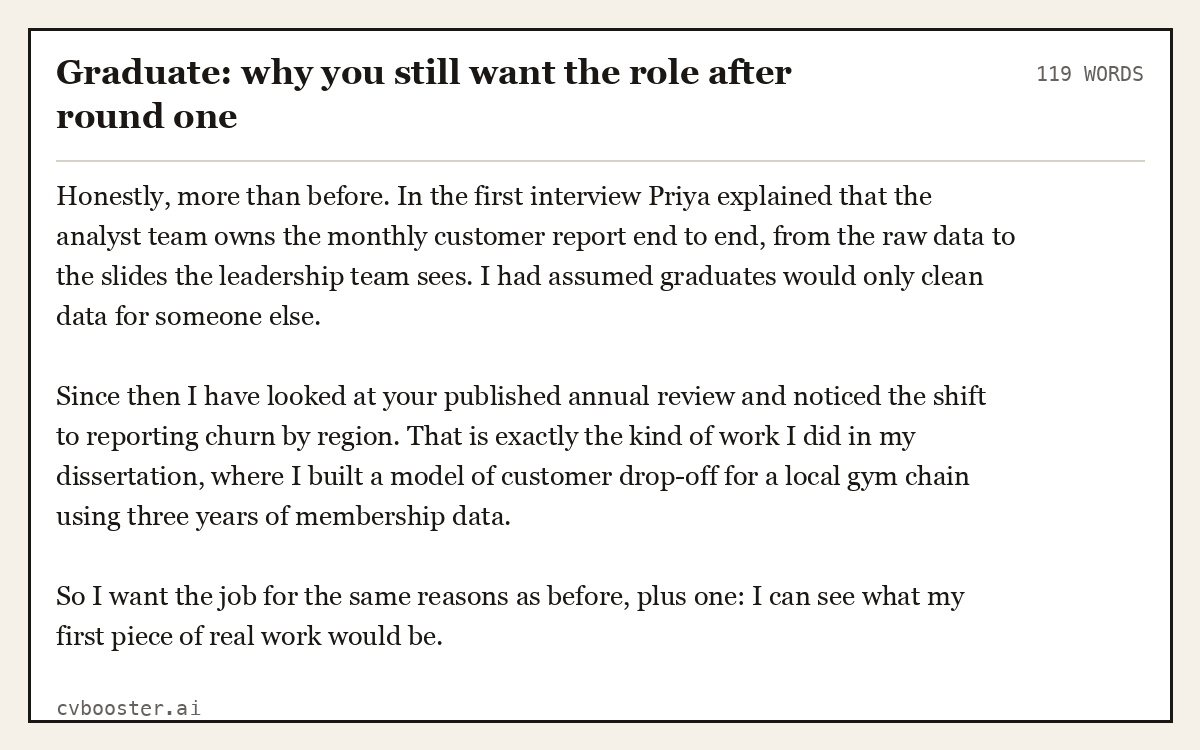
Graduate: why you still want the role after round one (119 words)
Honestly, more than before. In the first interview Priya explained that the analyst team owns the monthly customer report end to end, from the raw data to the slides the leadership team sees. I had assumed graduates would only clean data for someone else.
Since then I have looked at your published annual review and noticed the shift to reporting churn by region. That is exactly the kind of work I did in my dissertation, where I built a model of customer drop-off for a local gym chain using three years of membership data.
So I want the job for the same reasons as before, plus one: I can see what my first piece of real work would be.
What would you do in your first 90 days?
A standard second interview question for experienced hires. Do not promise to change everything. Show that you would learn first, then deliver something small and visible, then plan.
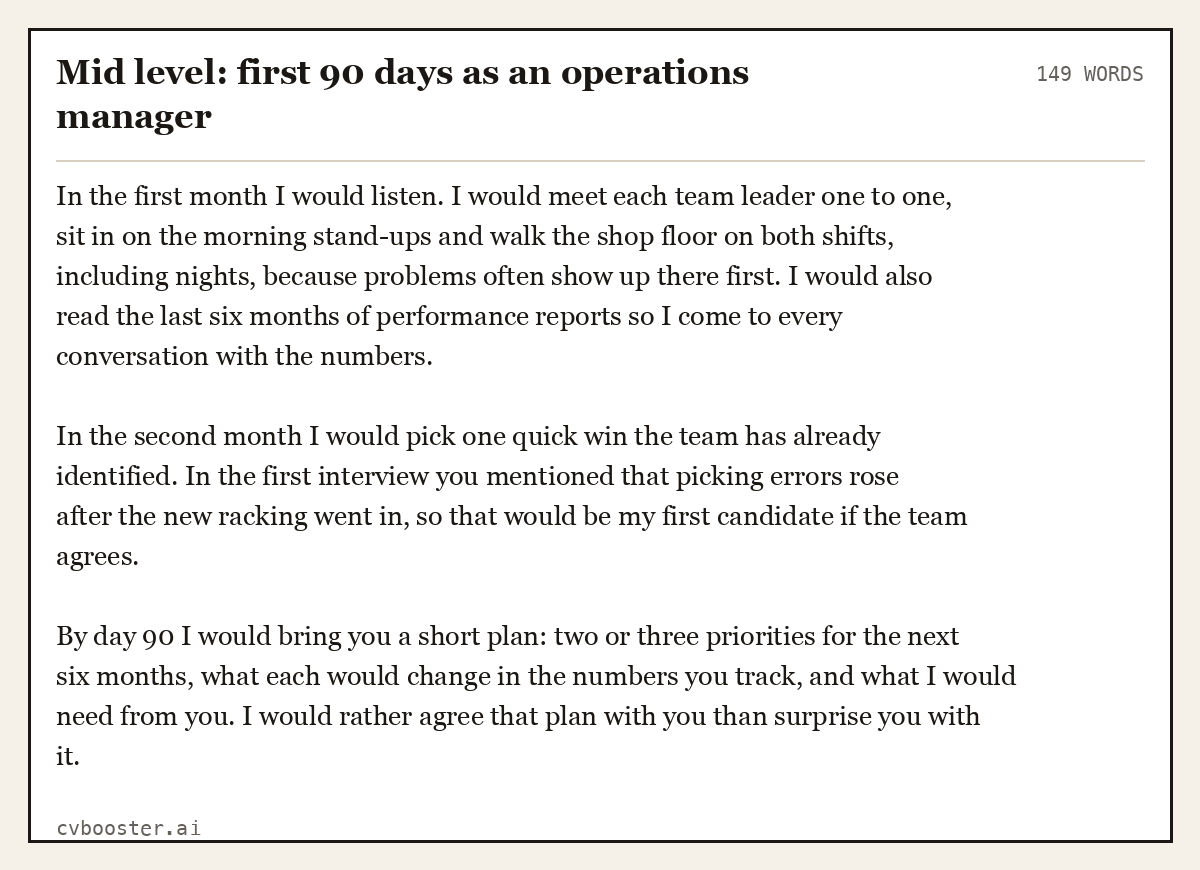
Mid level: first 90 days as an operations manager (149 words)
In the first month I would listen. I would meet each team leader one to one, sit in on the morning stand-ups and walk the shop floor on both shifts, including nights, because problems often show up there first. I would also read the last six months of performance reports so I come to every conversation with the numbers.
In the second month I would pick one quick win the team has already identified. In the first interview you mentioned that picking errors rose after the new racking went in, so that would be my first candidate if the team agrees.
By day 90 I would bring you a short plan: two or three priorities for the next six months, what each would change in the numbers you track, and what I would need from you. I would rather agree that plan with you than surprise you with it.
Talk us through your presentation
If you were set a task, the panel will ask you to present it and then question it. The structure below works for a ten minute slot.
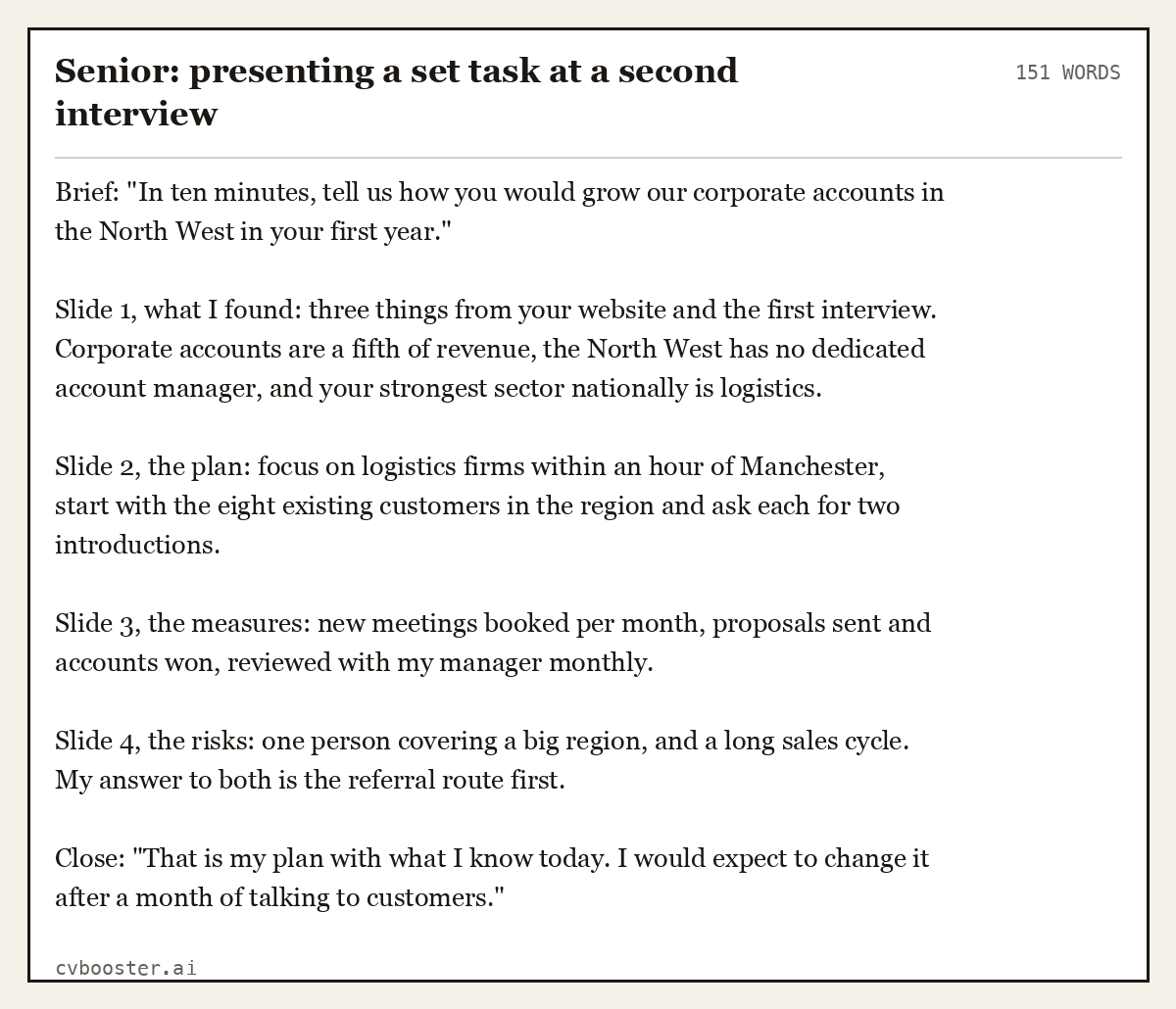
Senior: presenting a set task at a second interview (151 words)
Brief: "In ten minutes, tell us how you would grow our corporate accounts in the North West in your first year."
Slide 1, what I found: three things from your website and the first interview. Corporate accounts are a fifth of revenue, the North West has no dedicated account manager, and your strongest sector nationally is logistics.
Slide 2, the plan: focus on logistics firms within an hour of Manchester, start with the eight existing customers in the region and ask each for two introductions.
Slide 3, the measures: new meetings booked per month, proposals sent and accounts won, reviewed with my manager monthly.
Slide 4, the risks: one person covering a big region, and a long sales cycle. My answer to both is the referral route first.
Close: "That is my plan with what I know today. I would expect to change it after a month of talking to customers."
Keep to the time you were given, bring a printed copy, and expect the hardest question to be about the slide you spent least time on.
Tell us about a mistake you made at work
A first interview might accept a light answer. At a second interview, expect follow up questions on what you would do differently. Use STAR and keep the mistake real.
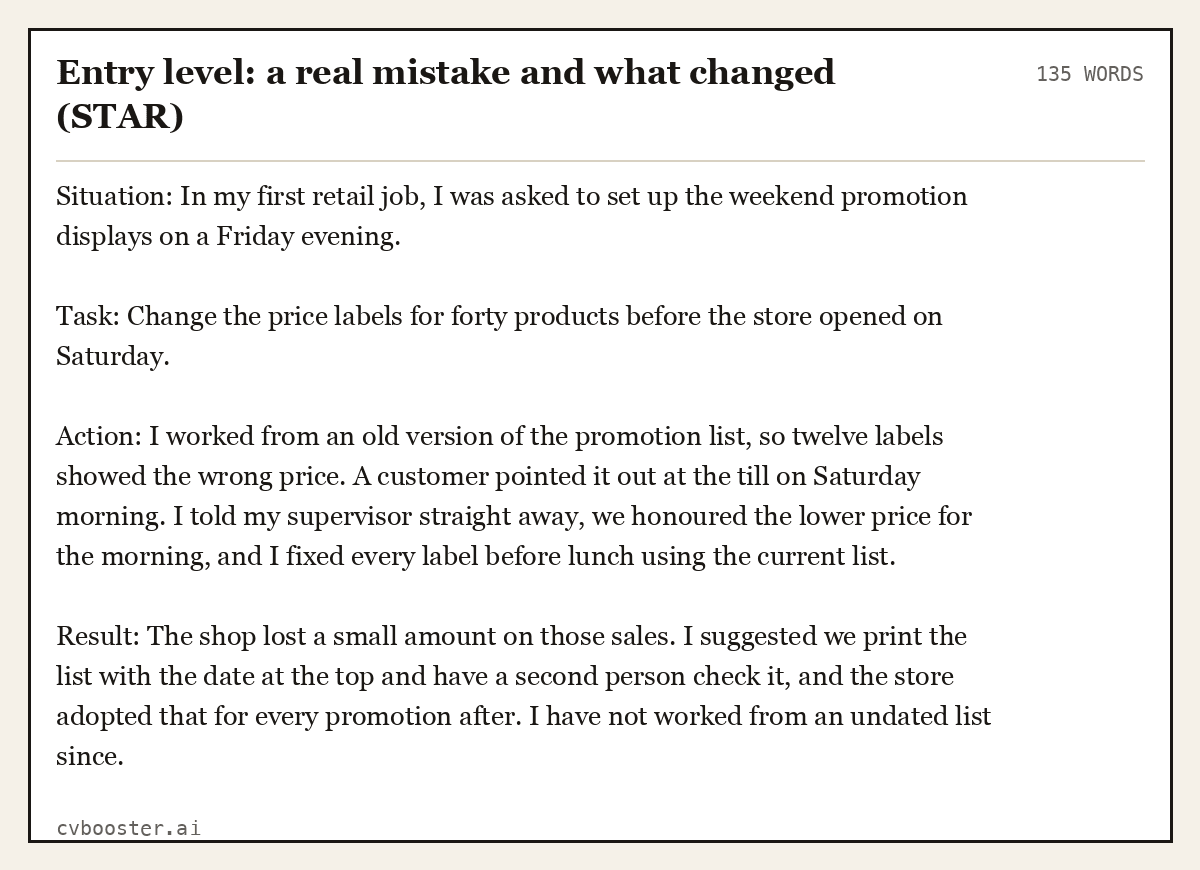
Entry level: a real mistake and what changed (STAR) (135 words)
Situation: In my first retail job, I was asked to set up the weekend promotion displays on a Friday evening.
Task: Change the price labels for forty products before the store opened on Saturday.
Action: I worked from an old version of the promotion list, so twelve labels showed the wrong price. A customer pointed it out at the till on Saturday morning. I told my supervisor straight away, we honoured the lower price for the morning, and I fixed every label before lunch using the current list.
Result: The shop lost a small amount on those sales. I suggested we print the list with the date at the top and have a second person check it, and the store adopted that for every promotion after. I have not worked from an undated list since.
Our STAR interview questions guide has more on the format.
What gives you energy at work?
Strengths questions turn up at second interviews, especially in the Civil Service and on graduate schemes. The Civil Service defines strengths in its Success Profiles as "the things we do regularly, do well and that motivate us." Answer quickly and honestly, with a short example. There is no prepared perfect answer.
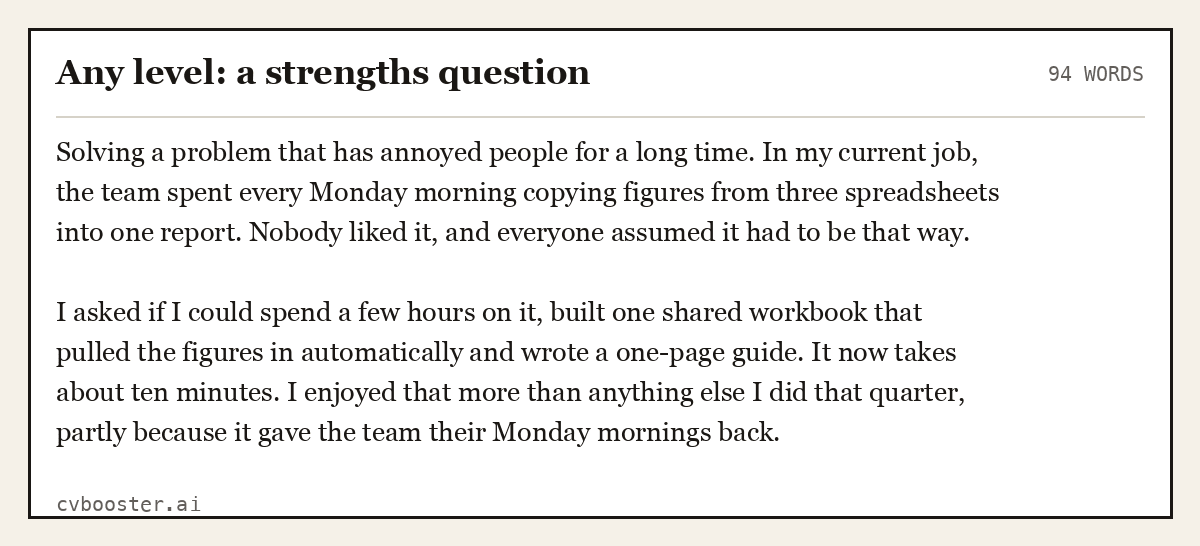
Any level: a strengths question (94 words)
Solving a problem that has annoyed people for a long time. In my current job, the team spent every Monday morning copying figures from three spreadsheets into one report. Nobody liked it, and everyone assumed it had to be that way.
I asked if I could spend a few hours on it, built one shared workbook that pulled the figures in automatically and wrote a one-page guide. It now takes about ten minutes. I enjoyed that more than anything else I did that quarter, partly because it gave the team their Monday mornings back.
Why should we choose you over the other candidates?
You cannot know who else is in the room, so do not compare yourself with them. Tie two or three things from your experience to the problems they described in the first interview.
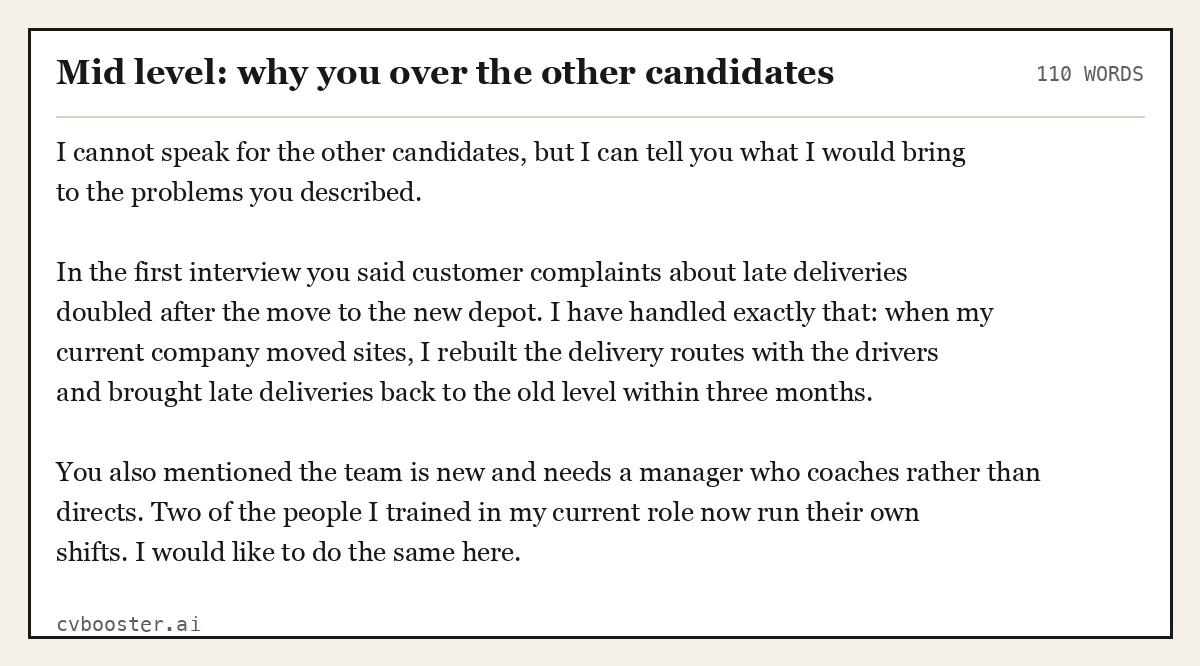
Mid level: why you over the other candidates (110 words)
I cannot speak for the other candidates, but I can tell you what I would bring to the problems you described.
In the first interview you said customer complaints about late deliveries doubled after the move to the new depot. I have handled exactly that: when my current company moved sites, I rebuilt the delivery routes with the drivers and brought late deliveries back to the old level within three months.
You also mentioned the team is new and needs a manager who coaches rather than directs. Two of the people I trained in my current role now run their own shifts. I would like to do the same here.
What are your salary expectations?
Many UK adverts give a salary range, so refer to it. If it does not, give a range based on research for the role and region, and say you are open to the full package.
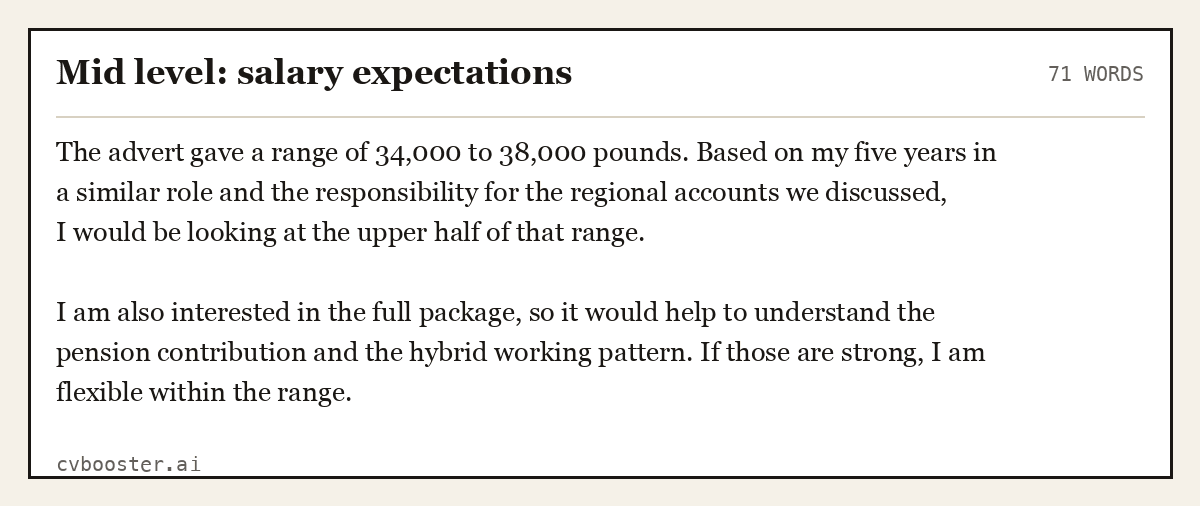
Mid level: salary expectations (71 words)
The advert gave a range of 34,000 to 38,000 pounds. Based on my five years in a similar role and the responsibility for the regional accounts we discussed, I would be looking at the upper half of that range.
I am also interested in the full package, so it would help to understand the pension contribution and the hybrid working pattern. If those are strong, I am flexible within the range.
When could you start, and are you interviewing elsewhere?
Two practical questions that often arrive together near the end. Be accurate about your notice period and honest, without detail, about other processes.
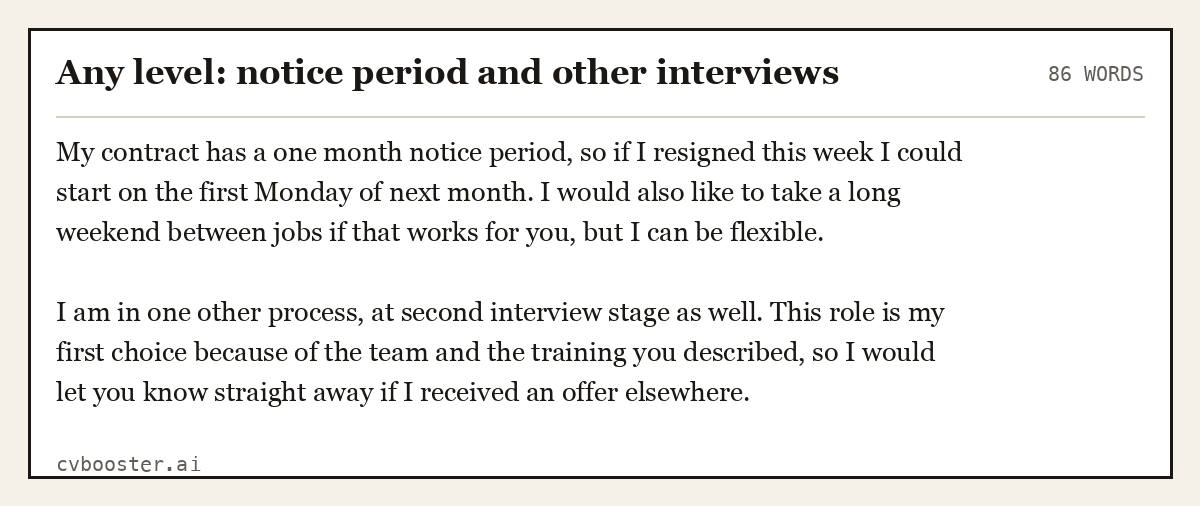
Any level: notice period and other interviews (86 words)
My contract has a one month notice period, so if I resigned this week I could start on the first Monday of next month. I would also like to take a long weekend between jobs if that works for you, but I can be flexible.
I am in one other process, at second interview stage as well. This role is my first choice because of the team and the training you described, so I would let you know straight away if I received an offer elsewhere.
Questions to ask in a second interview
The National Careers Service notes that "You’ll usually have some time towards the end of the interview to ask some of your own questions." At a second interview, those questions should be sharper than in round one, because you know more. Civil Service guidance puts it well: "This is also your chance to see if the role and the recruiting organisation are right for you."
Pick three or four:
- What would success look like in this role after six months?
- What is the biggest problem you would want the new person to solve first?
- How does this team work with the teams around it, and where is the friction?
- Who would I work with most closely, and could I meet them?
- How is performance reviewed, and how often?
- What training or development would I get in the first year?
- Why is the role vacant?
- Is there anything from my first interview you would like me to expand on?
- What are the next steps, and when do you expect to decide?
The last two matter most. The first lets you fix a weak answer from round one. The second tells you when to follow up. More ideas are in our guide to questions to ask in an interview.
How to prepare for a second interview
- Write down every question from the first interview and how you answered it. Plan a stronger version of your weakest answer.
- Prepare two or three new examples, so you are not repeating the same stories to someone who has read the notes.
- Research the people on the panel and the latest news about the organisation.
- Know your notice period, the earliest date you could start and the salary range you would accept.
- If there is a task, practise it out loud with a timer.
For public sector roles, read our Civil Service Success Profiles guide. After the interview, send a short note the same day; our thank you letter examples include a follow up after a second interview.
Frequently asked questions
What questions are asked in a second interview?
Expect deeper questions about how you would do the job: your first 90 days, a task or presentation, a mistake and what you learned, strengths or values questions and how you would fit the team. Near the end come the practical questions about salary, notice period, start date and whether you are interviewing elsewhere.
What questions should I ask in a second interview?
Ask what success looks like after six months, the biggest problem the new person should solve first, who you would work with most closely, how performance is reviewed and what the next steps are. Also ask whether there is anything from your first interview they would like you to expand on, so you can fix a weak answer.
Is a second interview a good sign?
Yes. It means the employer thinks you could do the job and wants to check fit, motivation and the practical details. It is not an offer, and other candidates are usually still in the process, so prepare as carefully as for the first round and bring new examples rather than repeating old ones.
How long does a second interview last?
It varies by employer and level. The Civil Service Jobs guidance says its interviews can last between 30 and 60 minutes; second rounds elsewhere may be longer if they include a task, a presentation or meetings with several people. Ask the recruiter for the format and the names of the panel when you confirm the date.
Should I use the same examples as in my first interview?
Use mostly new ones. The panel may have the notes from round one, and repeating the same stories suggests you have no more. You can reuse a strong example if you go deeper, with more detail on what you did, what went wrong and the result, but prepare two or three fresh ones.
Related articles
- Accountancy CV Example: 6 UK Accounts CVs by Career Level
- Accounting Interview Questions and Answers: 7 Full Examples
- Activity Resume Example: 6 Samples for College Applications
- Administration CV Example: 6 Admin CVs from Entry to Senior
More articles
- Seeing the Big Picture Civil Service Example: AO to G7
- Selection Criteria Examples: 10 Full 250-Word Responses
- Selection Criteria Examples Administration: 3 Answers
Looking for a worked example for your job title? Browse the resume examples by job title.