Production Designer Resume Examples: what gets the call
Craft a Production Designer Resume for Film and Television
By Mustafa Tarabya, founder of CVBooster · Published · Updated
Production designer resume examples with department scale, build and location credits, budget scope and the keywords producers screen for.
Sample resumes for a production designer
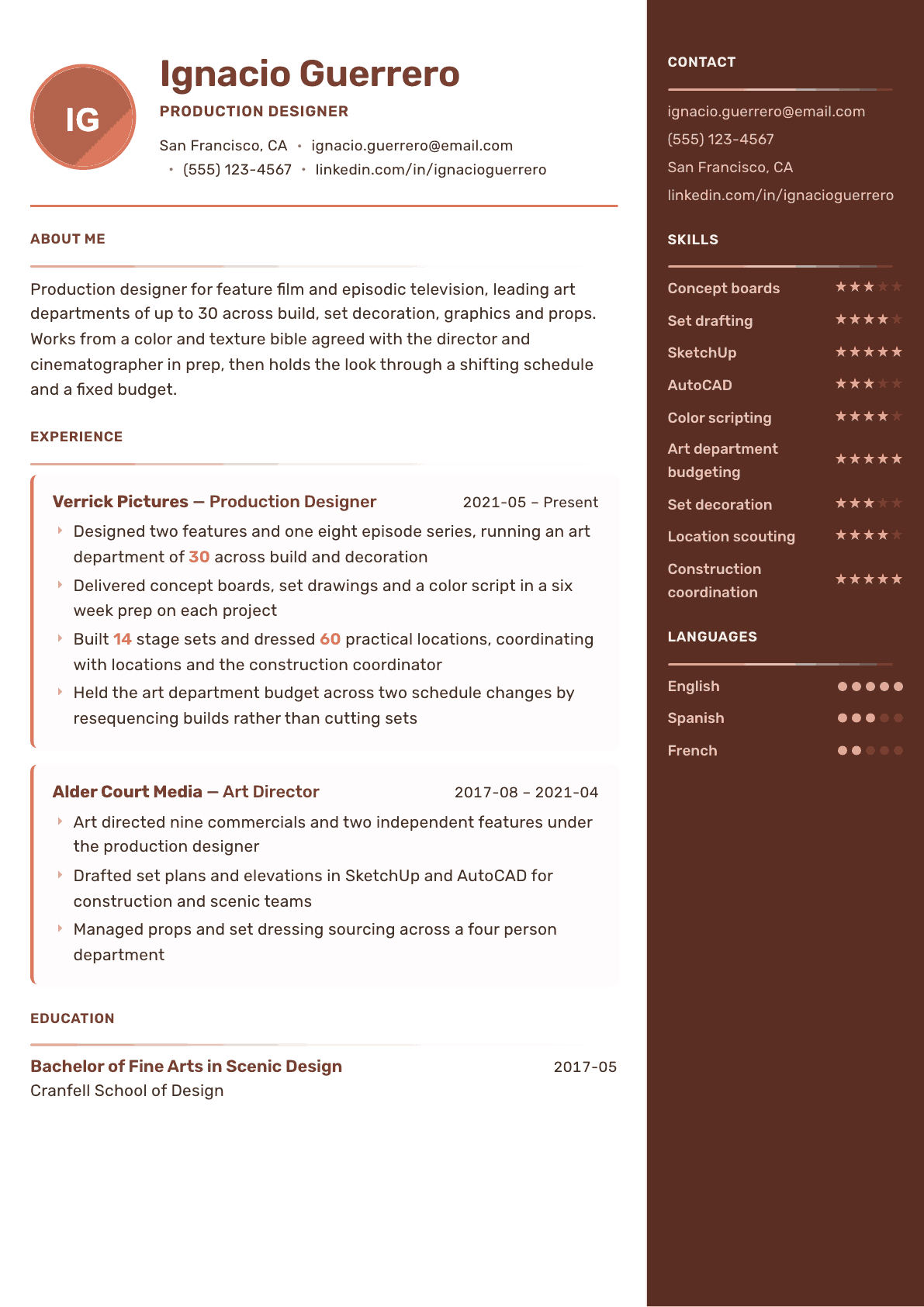
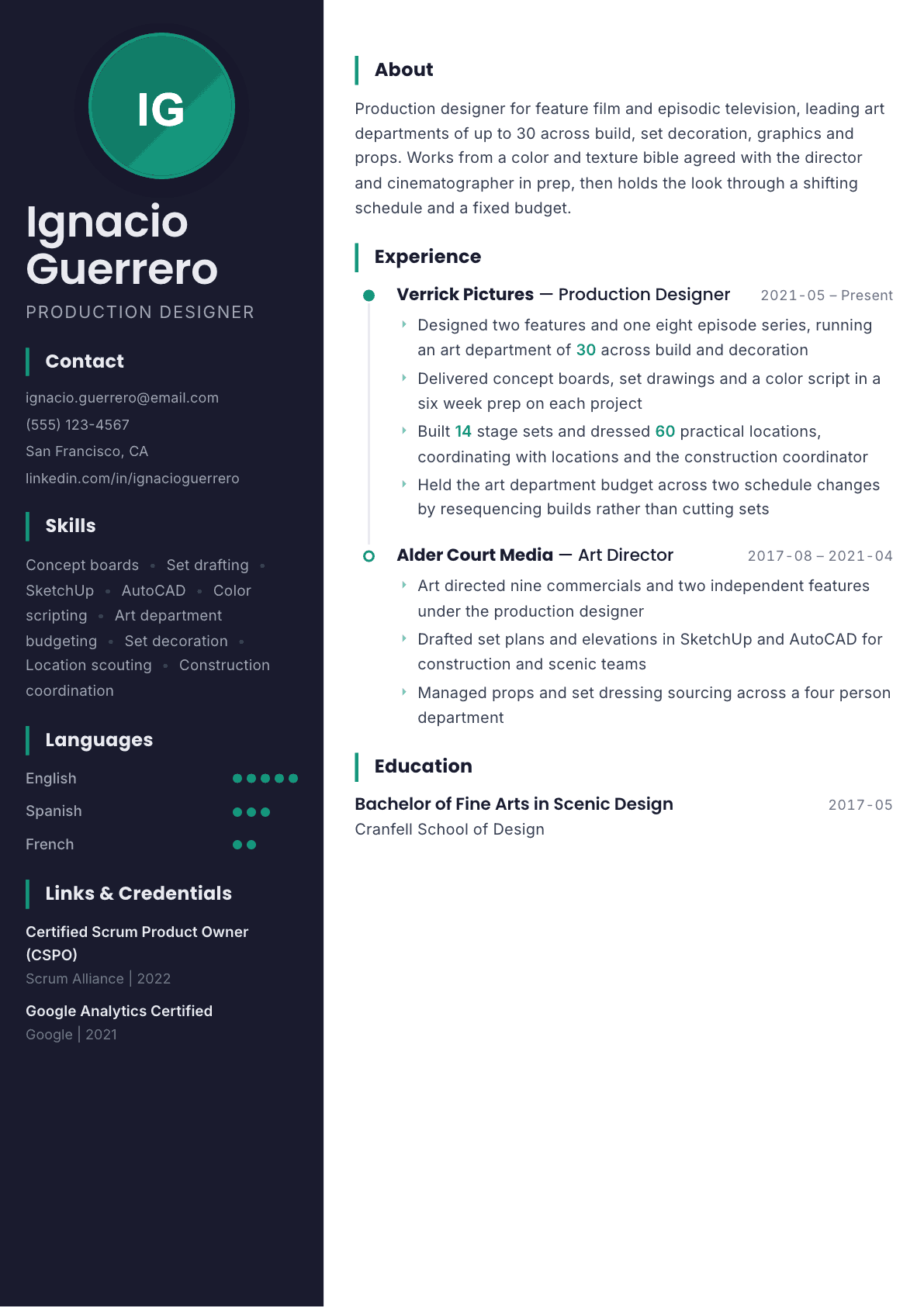
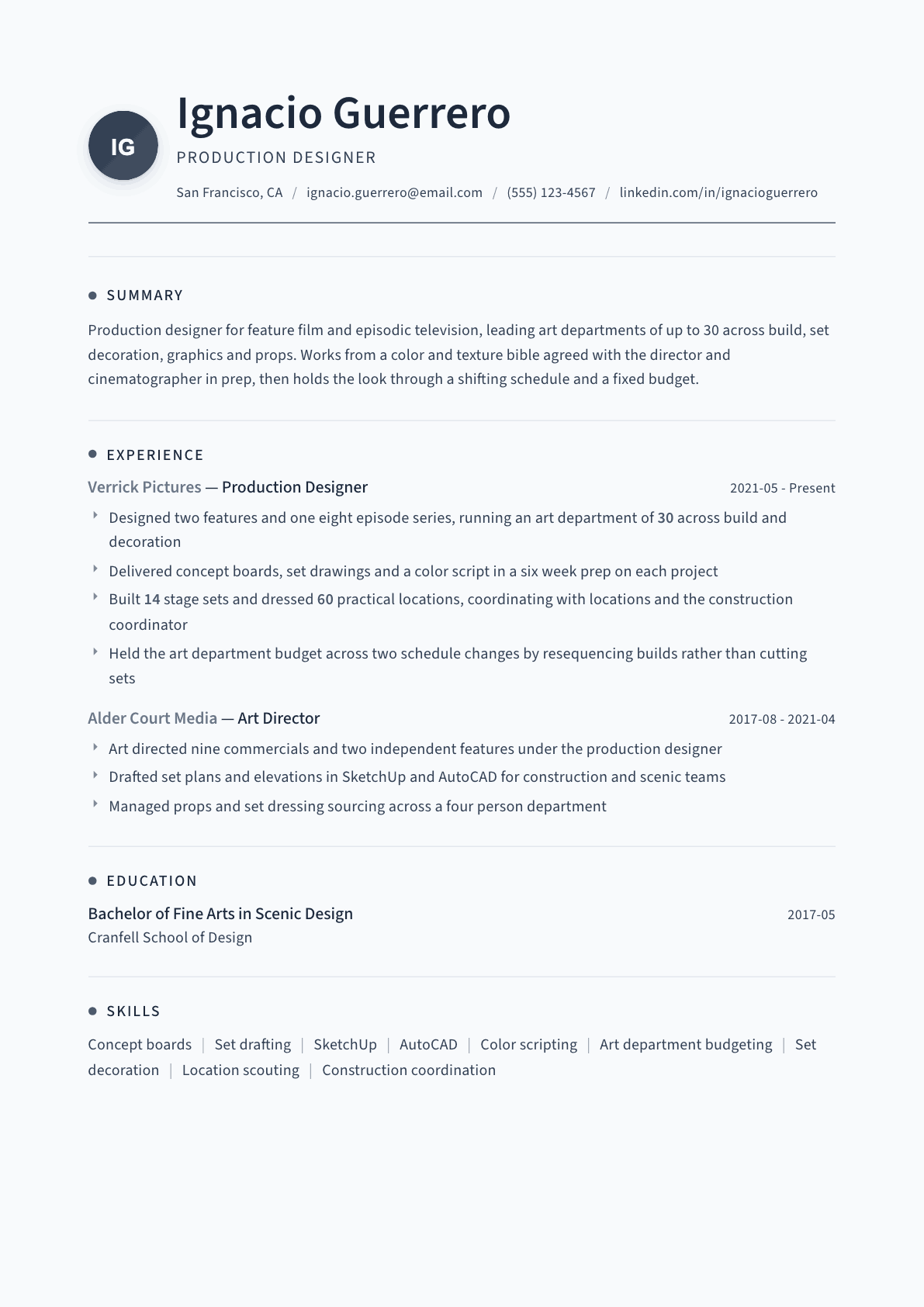
The same production designer content laid out in three CVBooster templates, so you can see what the finished document looks like before you write a word.
Example Production Designer summary
Production designer for features and episodic television, leading art departments of up to 30 across build, decoration, props and graphics. Delivers concept boards and a color script inside a six week prep, then holds the design through schedule changes by resequencing builds. Recent work covers 14 stage sets and 60 dressed practical locations.
Skills to list on a Production Designer resume
- Concept development
- Set drafting
- SketchUp
- AutoCAD
- Vectorworks
- Color scripting
- Set decoration
- Props management
- Construction coordination
- Location scouting
- Art department budgeting
- Prep scheduling
- Graphics and signage
- Period research
What actually gets this resume read
- List credits by format: feature, episodic, commercial or short, with the director and the shoot length.
- Say how large an art department you have led and which heads reported to you.
- Name the budget band you have designed inside, without publishing a figure you were asked to keep private.
- Show the split between stage builds and practical locations, since those are different production problems.
- Name your drafting and visualization tools so a construction coordinator knows what files arrive.
- Keep art director and set decorator credits in a separate section from your production design credits.
How to write a production designer resume
A production designer resume is read by a line producer and a producer before it ever reaches a director. They are not looking for beauty, which is what the portfolio is for. They are looking for whether you have run an art department at their size, on their format, inside a prep window as short as theirs, and whether the design survived a schedule change without the budget moving.
That means the two facts most designer resumes bury are the two that matter most: how many people reported to you, and how the work split between stage builds and practical locations. Thirty people across construction, set decoration, props and graphics is a different job from a designer working with one art director and a swing crew, and a producer needs to know which one you have actually done.
This guide covers the credit format film and television offices expect, how to describe department scale and budget band without publishing a figure you were asked to keep private, how to keep art director credits separate from design credits, and the questions production designers ask when a package goes out.
Format: credits by format, one page until the list earns two
Group credits by format rather than mixing them: feature, episodic, commercial, short. Inside each group, reverse-chronological with the title, the production company, the director, the shoot length and your position. A producer looking for someone who can carry an eight episode series wants to find your episodic credits without reading past nine commercials.
Keep the layout plain and printable. Your visual judgment is proven by the portfolio link in the header, not by a resume with a designed masthead, and a decorated resume is the one that arrives at the production office looking like it needs interpreting.
- Header: name, city, phone, email, portfolio address, union status and whether you travel or work locally.
- Sections in this order: production design credits, art direction credits, department and budget scale, software, training, awards.
- Early-career designers put short films and music videos in their own group rather than folding them into features.
Department scale: name the heads who reported to you
Say how many people the art department carried at its peak and which heads reported to you: art director, set decorator, construction coordinator, prop master, graphic designer, set dresser. That list tells a producer exactly which parts of the job you have delegated and which parts you were still doing yourself.
If you have designed at more than one scale, show the range. A designer who has run a department of 30 and also delivered a project with an art director and a two person swing crew is more employable than a designer who has only done one, because most schedules need both.
Budget and schedule: describe the band, not the number
Producers want to know whether you have designed inside their budget band without needing you to breach a confidentiality agreement. Describe it in production terms instead: the number of stage sets built, the number of practical locations dressed, the length of prep, the crew size and whether construction ran in house or through a shop. Those figures are usually not confidential and they say more.
Then show that you held the design through change. A schedule that moves is the normal condition of a shoot, and a designer who resequenced builds rather than cutting sets is telling a producer something no portfolio image can. That single line is often the reason a designer is hired for a second project.
- Give the prep length on your recent projects, since prep is where a design succeeds or fails.
- Split stage builds from practical locations, because they are different production problems.
- Note period, contemporary and effects heavy work separately, since research load differs sharply.
Deliverables and software: what construction receives
Name the drafting and visualization tools you work in, because the construction coordinator and the scenic shop need files they can build from. Say what the package contains: concept boards, references, set drawings, elevations, a color script and a graphics package where the story needs one.
Say when the package lands. Delivering concept boards, drawings and a color script inside a six week prep is a schedule claim, and schedule claims are what a line producer is reading for. A designer who names a prep deliverable date has separated themselves from most of the pile.
Keywords a production office scans for
The wording recurs across postings and crew lists: art department, set design, set decoration, concept boards, color script, construction coordinator, practical locations, props, prep schedule, period research, episodic. Mirror the exact phrasing from the posting once in your summary and once inside a credit so both the scan and the human read find it.
Keep art direction credits in their own section. Art directing under another production designer is valuable experience and reads as such when it is labeled, but folded into your design credits it makes a producer question every other line, and crew lists are easy to check.
Production Designer resume summary examples
Early credits
Production designer for short films, music videos and independent features, working with an art director and a two person swing crew. Delivers concept boards and set drawings in SketchUp inside a three week prep, dresses practical locations, and sources props against a fixed budget. Seeking art department work on episodic television.
Art director moving up
Art director on nine commercials and two independent features, now designing shorts and low budget features. Drafts set plans and elevations in SketchUp and AutoCAD for construction and scenic teams, manages props and set dressing across a four person department, and works directly with the construction coordinator through build.
Feature and episodic designer
Production designer leading art departments of up to 30 across build, set decoration, graphics and props. Delivers concept boards, set drawings and a color script inside a six week prep, then holds the look through schedule changes by resequencing builds. Recent work covers 14 stage sets and 60 dressed practical locations.
Work experience bullets: before and after
Before: Designed the look of a feature film.
After: Designed a feature and an eight episode series back to back, running an art department of 30 across build, set decoration, props and graphics.
Format, volume and department headcount tell a producer the scale you have actually carried.
Before: Worked with the director on the visual concept.
After: Agreed a color and texture bible with the director and cinematographer in prep, then delivered concept boards, set drawings and a color script inside a six week window.
Naming the collaborators, the artifact and the prep length turns a vague relationship into a delivery record.
Before: Built sets and dressed locations.
After: Built 14 stage sets and dressed 60 practical locations, coordinating with the locations department and the construction coordinator on every changeover.
Separating stage builds from practical locations shows a producer both halves of the job with real counts.
Before: Managed the art department budget.
After: Held the art department budget through two schedule changes by resequencing builds rather than cutting sets, keeping every scripted set in the picture.
Surviving change without losing scope is the specific evidence producers hire on, and the outcome makes it verifiable.
Before: Drafted plans for construction.
After: Drafted set plans, elevations and construction details in SketchUp and AutoCAD, issuing revisions to the scenic shop on a fixed weekly drop.
The tools plus the delivery rhythm tell a construction coordinator exactly what working with you looks like.
Hard skills
- Concept development
- Set drafting
- SketchUp
- AutoCAD
- Vectorworks
- Color scripting
- Set decoration
- Props management
- Construction coordination
- Location scouting
- Art department budgeting
- Prep scheduling
- Graphics and signage
- Period research
Soft skills
- Director collaboration
- Department leadership
- Vendor negotiation
- Working under schedule change
- Clear delegation
- Note tracking
Certifications worth listing
- OSHA 10-Hour General Industry (Occupational Safety and Health Administration)
- Autodesk Certified Professional, AutoCAD (Autodesk)
- Vectorworks Certified Professional, Spotlight (Vectorworks)
Mistakes that cost production designer candidates the interview
- Writing about atmosphere and visual language while never stating how many people were in the art department.
- Mixing art direction credits into the production design list, which crew databases make easy to catch.
- Publishing a budget figure a production asked you to keep private instead of describing the scale in set counts.
- Leaving out prep length, which is the window a line producer is actually assessing you against.
- Listing no drafting software, so a construction coordinator has no idea what files to expect.
- Sending one page for a period feature and a contemporary commercial when the research load makes them different jobs.
Production Designer resume questions
How long should a production designer resume be?
One page while your credits fit, two once features and episodic work fill it. Keep the second page to credits and department scale rather than descriptive paragraphs, since producers read the top third and skim the rest.
Can I put budget figures on a production designer resume?
Only when the production has made them public. Otherwise describe scale through set counts, location counts, department headcount and prep length, which are rarely confidential and give a line producer more useful information anyway.
Do I need a portfolio link on the resume?
Yes, in the header, and it must go to a page that loads on a phone with the same projects the resume names. A producer checks the images after the credits convince them, so a broken or mismatched link kills a file that had already passed.
How do I list art direction if I want production design work?
Give art direction its own labeled section under your design credits, naming the production designer you worked for. That reads as genuine progression, while blending the two makes a reader doubt every credit on the page.
What do I put on a production designer resume with only short films?
Lead with the shorts as design credits, add music videos and commercials in their own groups, and state the department size and prep length even when both were tiny. Small numbers stated honestly beat no numbers, because they show you think in production terms.