Creative Producer Resume Examples: the lines they read
Write a Creative Producer Resume That Wins Bigger Briefs
By Mustafa Tarabya, founder of CVBooster · Published · Updated
Creative producer resume examples, budget and crew keywords, sample bullets and a full writing guide for agency and in-house studio roles.
Sample resumes for a creative producer
The same creative producer content laid out in three CVBooster templates, so you can see what the finished document looks like before you write a word.
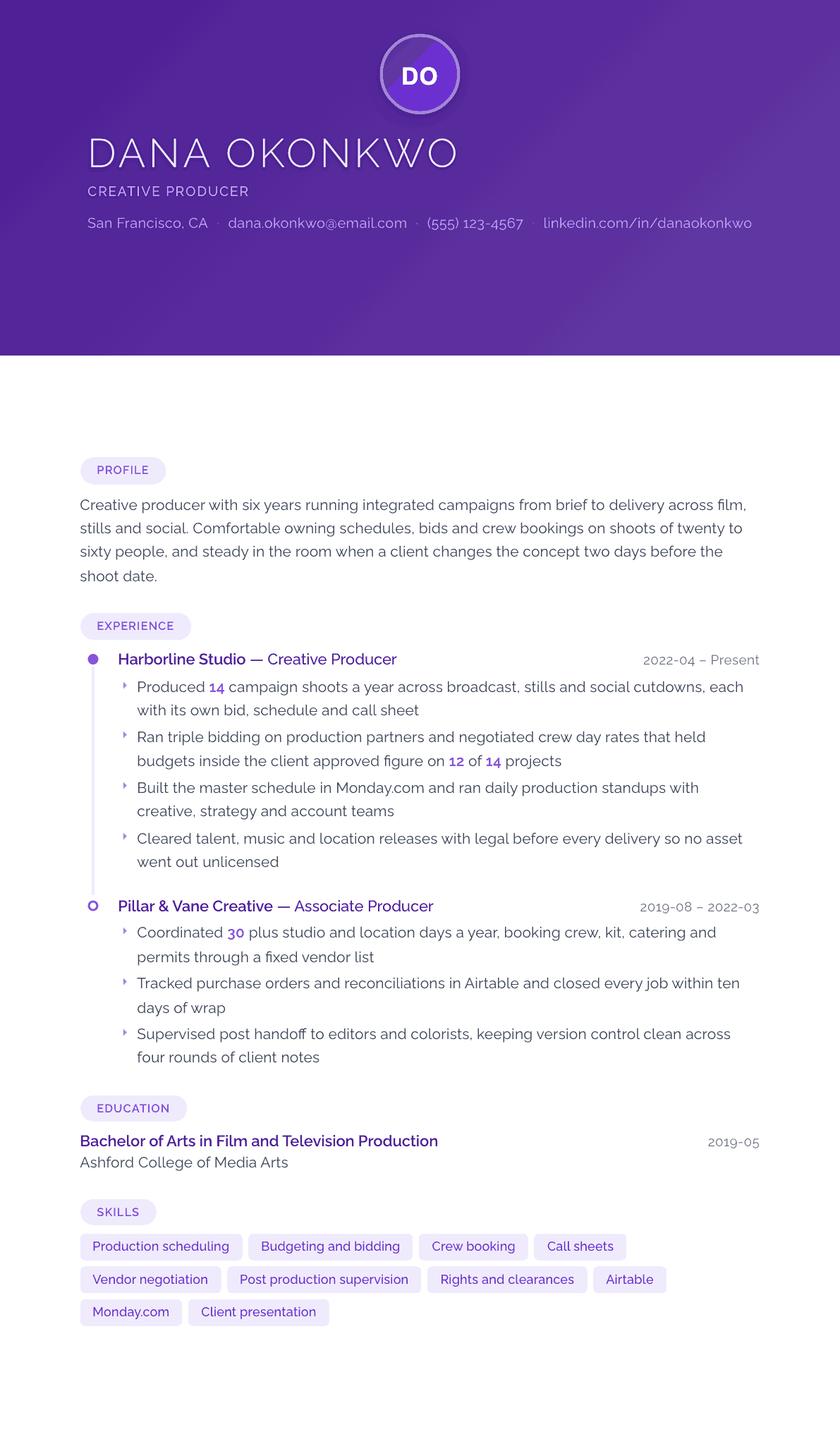
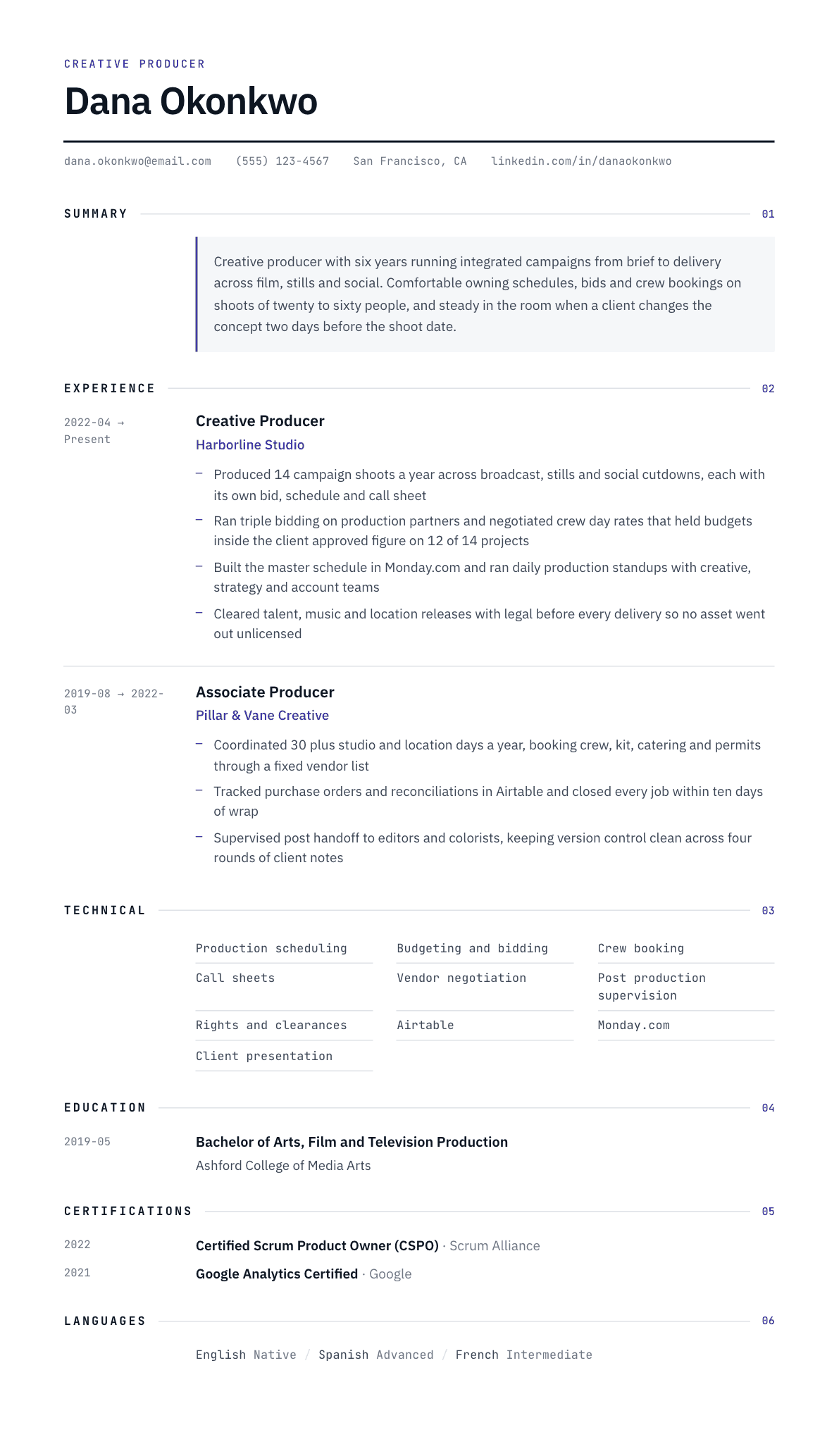
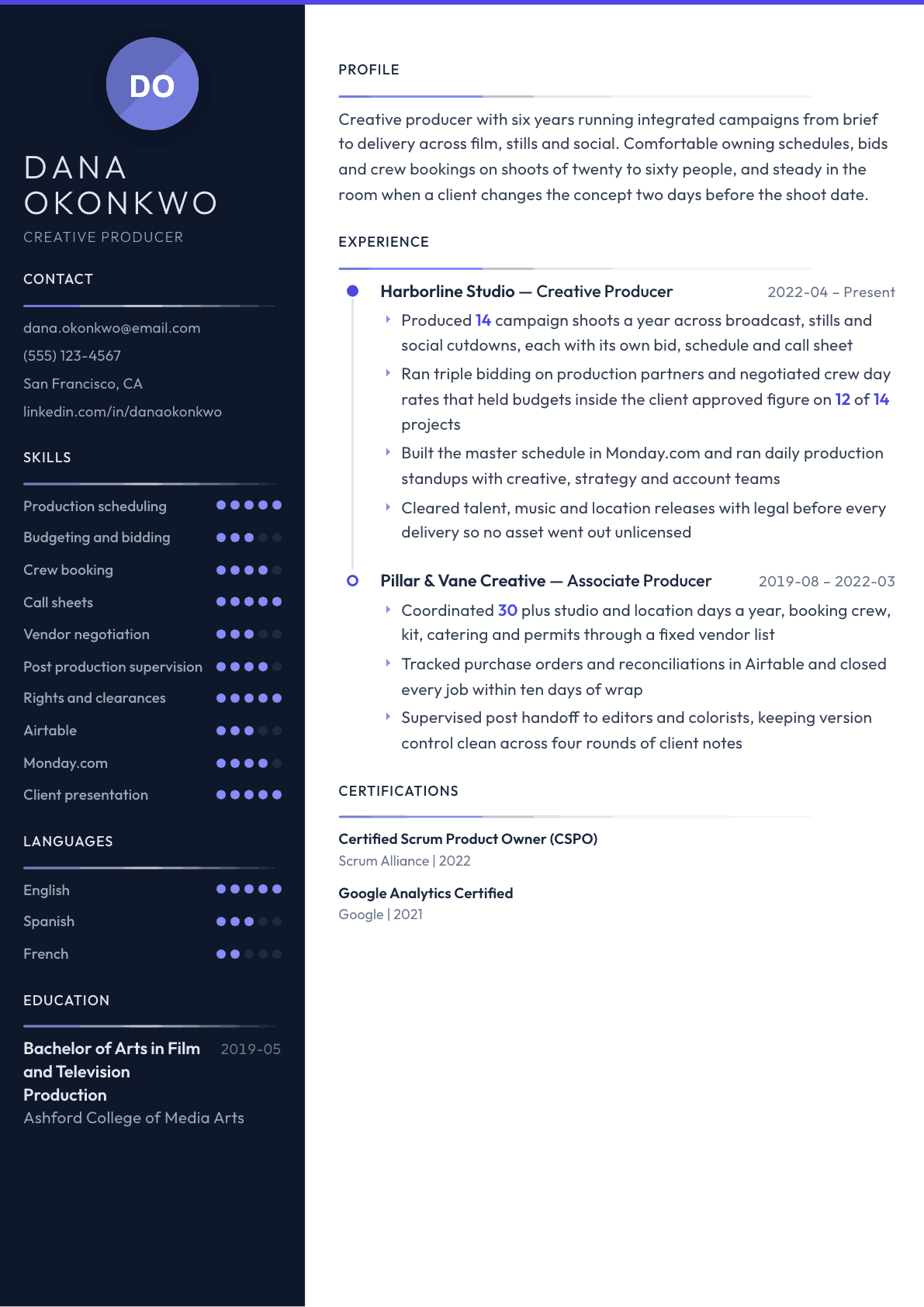
Example Creative Producer summary
Creative producer with six years delivering integrated brand campaigns across film, stills and social. Owns the bid, the schedule and the crew from concept lock through final delivery, and keeps creative intact when the brief moves. Recent work includes a four day multi location shoot with a crew of forty, delivered on budget with full talent and music clearance in place.
Skills to list on a Creative Producer resume
- Production scheduling
- Budget management
- Bidding and triple bids
- Crew and talent booking
- Call sheet preparation
- Location scouting and permits
- Post production supervision
- Rights, usage and clearances
- Vendor negotiation
- Client and stakeholder management
- Risk assessment
- Airtable
- Monday.com
- Frame.io
- Asset delivery specs
What actually gets this resume read
- Open each job with the format mix you produced: film, stills, social, motion, live, so the reader places you fast.
- Give budget scale as a band or a project count rather than a vague claim that you managed large productions.
- Name the crew size and shoot day count for your biggest jobs, because that is the number producers are hired on.
- List the production tools you actually run, from call sheet software to the tracker where purchase orders live.
- Show one bullet per job where you protected the creative idea while the schedule or the budget moved under you.
- Add rights, usage and talent clearance work explicitly, since brand clients screen for producers who close that loop.
How to write a creative producer resume
A creative producer resume is judged on whether the reader believes you can be handed a signed concept and a budget and return finished assets on the delivery date. Executive producers and heads of production do not read for adjectives. They read for format mix, crew size, shoot day count, budget band and whether the clearances closed, because those five facts predict how much of their week you will consume.
Most producer resumes fail on scope. They say the candidate managed productions from concept to completion without ever saying whether that meant a one camera studio day with four people or a four day multi location job with a crew of forty, a bid against three production partners and a music license to negotiate. The reader cannot place you, so the file goes to the maybe pile.
This guide covers the sections in the order a production head reads them, with summaries for an assistant producer, a working producer and a senior producer, before and after bullets drawn from bidding, scheduling and delivery, and the questions producers ask most when they update their resume between jobs.
Format: one page freelance, two pages staff
Reverse chronological, single column, no icons. Production hiring often runs through an agency applicant tracking system that reads columns out of order and drops your dates, and dates matter here because a reader is checking whether your gaps are freelance jobs or unemployment.
Freelancers should add a short credits block under the header listing the strongest jobs as client, format, role and year. Staff producers at an agency or in house studio should skip the credits block and let the employment history carry it, since a staff reader wants to see who you reported to and how long you stayed.
- Header: name, city, phone, email, portfolio or reel link, and union status if you carry one.
- Order for staff roles: summary, experience, selected productions, education, tools.
- Order for freelance: summary, selected credits, experience by client or production company, tools.
Summary: format mix, budget band, crew scale
Three lines. Name the formats you produce, film, stills, social cutdowns, motion, live or experiential, then the years, then the largest scale you have run and one thing you are known for. A summary that opens with a passion for storytelling is on every producer resume in the stack and moves nobody.
Give budget as a band or a project count rather than a single top figure, because a reader wants your normal, not your best day. Saying you run four to six figure campaign budgets across roughly a dozen shoots a year is more useful than naming one large job you supported once.
Experience: the bid, the schedule, the crew, the delivery
Each job opens with the company, the role, and one orienting line: the client types, the formats and the annual volume. Then three to five bullets that walk the reader through the production spine. Bidding and triple bidding, the master schedule and who reported into it, crew and vendor booking, the shoot itself, then post supervision and delivery to spec.
Producers get hired on the failure cases, so put one bullet in each job where something moved and you held the line. A concept change two days before the shoot, a location permit pulled, weather cover on a hero day, talent falling out. Say what you changed and what you protected, usually the creative idea, the delivery date or the approved figure.
Close the loop on rights. Talent releases, music licensing, stock usage terms and location agreements are the part brand clients screen for hardest, because an unlicensed asset in market is their legal problem and not yours. A bullet that says every asset went out with cleared usage in place carries more weight than another bullet about teamwork.
Selected productions: the section that does the real work
Under the employment history, list four to eight productions as short structured lines: client, format, role, crew size, shoot days, and one detail that shows the difficulty. Multi country, underwater, minors on set, live animals, practical effects, a talent with a two hour window. This is the section a production head actually reads twice.
Keep the lines uniform so the eye can compare them. If one entry gives crew size and shoot days, every entry should, even when the number is small. A two person stills day stated plainly reads as honest scope, not as a weakness.
Tools and delivery specs: name them exactly
List the trackers and platforms you genuinely run rather than the ones you have seen. Scheduling and task tools such as Monday.com, Airtable or a shared production calendar, review platforms such as Frame.io, call sheet and crew tools, and the finance side where purchase orders and reconciliations live. Add the delivery spec knowledge that keeps assets out of rejection: aspect ratios, broadcast clock formats, platform cutdown lengths and caption files.
Producers who have run petty cash, purchase orders and job reconciliations should say so explicitly. Production accounting exposure is the difference between a producer who can be handed a budget and one who needs a line producer beside them.
Creative Producer resume summary examples
Assistant producer
Assistant producer with two years supporting studio and location shoots across stills and social. Booked crew, kit and catering to a fixed vendor list, built call sheets and permits packs, and tracked purchase orders in Airtable. Closed 30 plus shoot days a year with no reconciliation left open past wrap.
Working producer
Creative producer with six years running integrated campaigns from brief lock to final delivery across film, stills and social cutdowns. Owns bidding, master schedule and crew booking on jobs of twenty to sixty people, and cleared talent, music and location rights on every delivery across three years.
Senior producer
Senior creative producer with eleven years across agency and in house studio production. Runs a slate of 18 campaigns a year, negotiates production partner bids and crew rates, and mentors three producers. Held 12 of 14 recent projects inside the client approved figure while absorbing two late concept changes.
Work experience bullets: before and after
Before: Managed productions from concept to completion.
After: Produced 14 campaign shoots a year across broadcast, stills and social cutdowns, each carrying its own bid, master schedule, call sheet and delivery matrix.
Volume, format mix and the actual production artifacts tell a reader what the job weighed; concept to completion says nothing measurable.
Before: Worked with vendors to keep costs down.
After: Ran triple bidding across production partners and negotiated crew day rates that held budgets inside the client approved figure on 12 of 14 projects.
Naming the bidding method and a hit rate against an approved figure proves commercial control rather than claiming thrift.
Before: Handled scheduling for the team.
After: Built and owned the master schedule in Monday.com and ran daily production standups with creative, strategy and account leads through prep, shoot and post.
The tool, the cadence and the departments attending show who reported into your schedule.
Before: Made sure legal requirements were met.
After: Cleared talent, music and location releases with legal before every delivery, so no asset entered market without documented usage terms on file.
Rights work is the clearest risk a brand client screens for, and the bullet now names the categories and the outcome.
Before: Supervised the post production process.
After: Supervised post handoff to editors and colorists across four rounds of client notes, holding version control in Frame.io so no superseded cut reached the client.
Round count, the platform and the specific failure avoided turn supervision into evidence.
Hard skills
- Production scheduling
- Budgeting and triple bidding
- Crew and talent booking
- Call sheet preparation
- Location scouting and permits
- Post production supervision
- Rights, usage and clearances
- Vendor negotiation
- Purchase orders and reconciliation
- Delivery specs and asset matrices
- Airtable
- Monday.com
- Frame.io
- Risk assessment and weather cover
Soft skills
- Calm under a moving brief
- Client and stakeholder handling
- Crew leadership on set
- Prioritization across parallel jobs
- Clear written briefing
- Negotiation
Mistakes that cost creative producer candidates the interview
- Listing productions without crew size, shoot days or format, which leaves the reader unable to place your scale.
- Claiming budget ownership when you only tracked purchase orders, a gap the first interview question exposes immediately.
- Burying rights and clearance work at the bottom when brand clients screen for it before craft.
- Filling the resume with client logos and no description of what you personally produced on each account.
- Sending a broadcast heavy resume to a social first studio without reordering the formats in the summary.
- Using a heavily designed two column layout that agency parsers scramble, losing the dates freelancers most need read.
Creative Producer resume questions
Should a creative producer resume include a credits list?
Freelancers should, because the client, format and year of each job is the evidence a reader trusts most. Keep it to four to eight entries with uniform detail. Staff producers can skip it when the employment history already names the accounts and volume.
How do I show budget experience without naming figures?
Use bands and outcomes instead of a single number. Say you produce jobs in the mid five figure to low six figure range, or that you held twelve of fourteen projects inside the approved figure. That reads as normal practice rather than one flattering high point.
Do I list a reel or portfolio on a producer resume?
Yes, one link in the header. A producer reel is different from a director reel: it should show range of format and scale rather than craft authorship. Keep the resume factual so the reader is not asked to grade taste from prose.
How do I move from coordinator to producer on paper?
Lead each job with the pieces of producing you already own, usually scheduling, vendor booking and reconciliation, then add the first job where you carried a bid or a client relationship. Name the producer you deputized for and what you ran unsupervised.
What do in house studio employers want that agencies do not?
In house teams hire for repeatable volume, brand guideline discipline and asset delivery at scale, so emphasize annual output, template driven cutdowns and the delivery matrix. Agency readers weight bidding, pitch support and handling a client whose brief keeps moving.