Stage Manager Resume Examples: free ATS score and gap list
Write a Stage Manager Resume Production Offices Trust
By Mustafa Tarabya, founder of CVBooster · Published · Updated
Stage manager resume examples covering calling cues, prompt books, Equity paperwork and the venue details a production manager checks first.
Sample resumes for a stage manager
The same stage manager content laid out in three CVBooster templates, so you can see what the finished document looks like before you write a word.
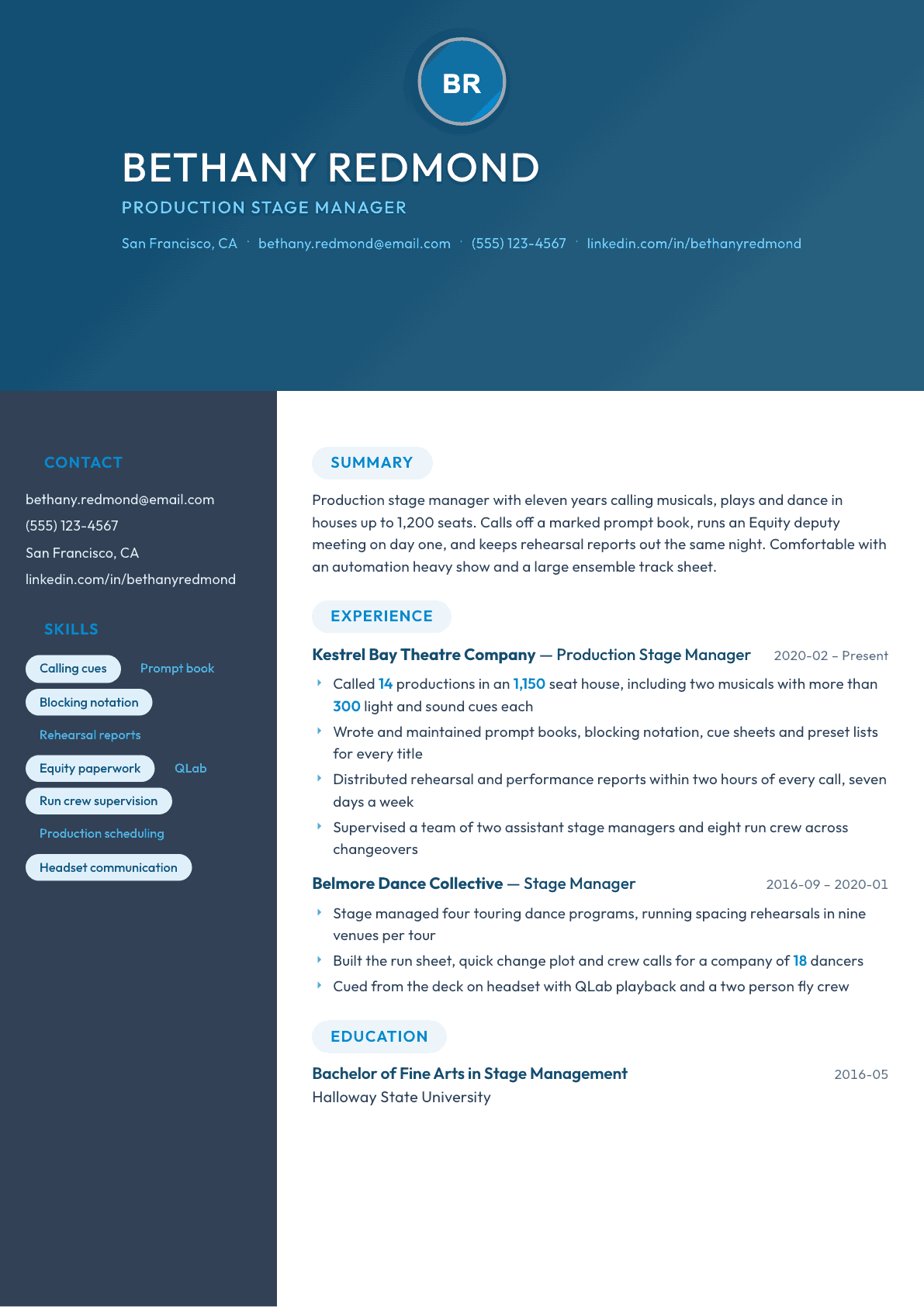
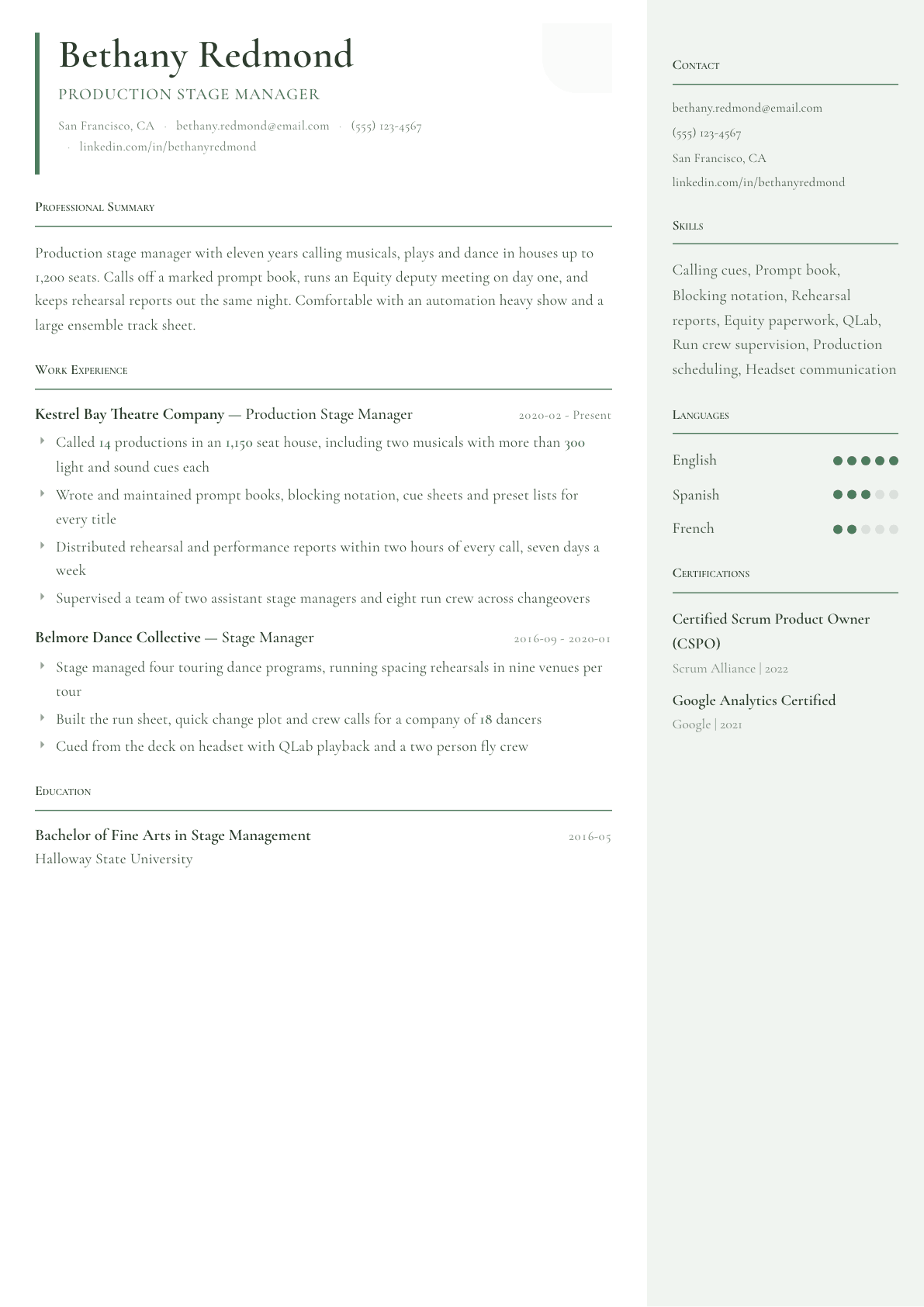
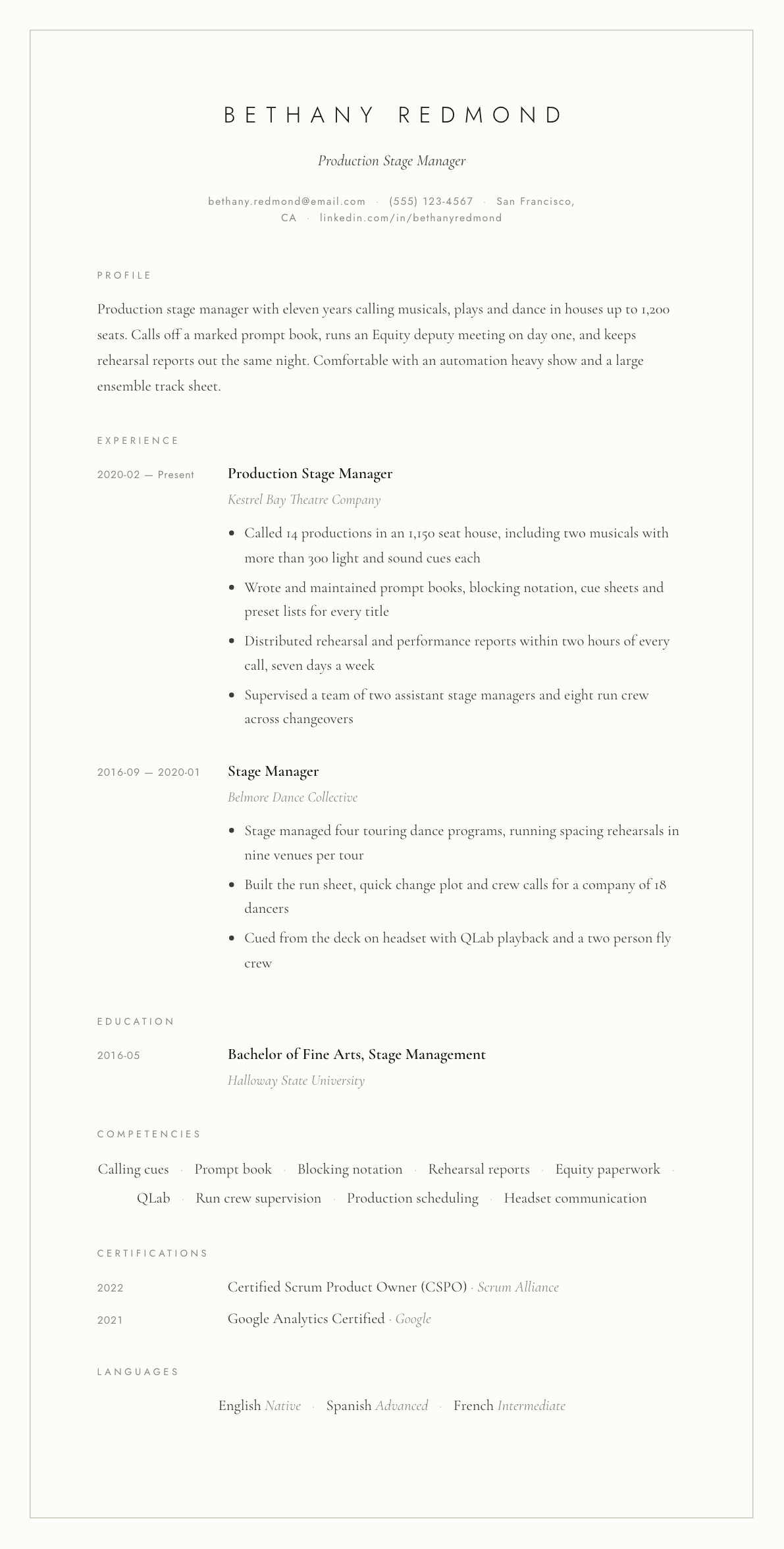
Example Stage Manager summary
Production stage manager with eleven years calling plays, musicals and dance in houses up to 1,200 seats, including musicals carrying more than 300 cues. Runs a clean prompt book, files rehearsal reports the same night, supervises two assistants and eight run crew, and keeps a touring company on schedule through nine venue spacing calls.
Skills to list on a Stage Manager resume
- Calling cues
- Prompt book preparation
- Blocking notation
- Rehearsal reports
- Production scheduling
- Equity paperwork
- Run crew supervision
- QLab
- Clear-Com
- Quick change plots
- Load-in coordination
- Understudy rehearsals
- Touring logistics
- Conflict resolution
What actually gets this resume read
- List each credit with the show, the venue, the seat count and whether you called it or assisted.
- Say how many cues you have called in your biggest show, because that number sets your ceiling.
- Name the union agreement, since a production office screens for it before anything else.
- Include the paperwork you produce: prompt book, reports, track sheets, run sheets, preset lists.
- Name the playback and communication systems you have run, such as QLab and a Clear-Com setup.
- Keep a separate line for touring, since load-in speed and spacing rehearsals are a different job.
How to write a stage manager resume
A production office hires a stage manager on evidence of reliability, and the resume is the first sample of it. If the page is cleanly organized, every credit carries the same fields in the same order, and the dates line up, the reader has already learned something true about how you will run a rehearsal room. A messy resume from a stage manager is a self-answering application.
The specific things a production manager checks are the grade you held on each show, the venue and its seat count, whether you called the show or assisted, the cue count on your largest title, and your union status. Those five facts decide whether your file moves forward, and most resumes leave two or three of them out.
This guide covers the credit format production offices expect, how to show paperwork and calling experience without listing every document you have ever made, how touring reads differently from a sit-down production, and the questions stage managers ask when the season hiring emails go out.
Format: a credit table, one page, no decoration
Reverse-chronological, one page for most careers, two only once you are past roughly a decade of calling. Use a plain table or aligned columns: production, company, venue and seat count, director, your position. Every row identical. A production manager reading forty files in an afternoon should be able to scan one column and find the position on every line without hunting.
Resist the temptation to design the page. Icons, color blocks and two-column layouts make a stage manager look like someone who values presentation over legibility, which is exactly the wrong signal for this job.
- Header: name, city, phone, email, union status and whether you hold a valid driver license for touring.
- Sections in this order: stage management credits, related credits, skills and software, training, references.
- Early-career candidates add an assistant stage management section and keep academic credits labeled as such.
Credits: grade, venue, seat count, and who called it
Say plainly whether you were production stage manager, stage manager, assistant stage manager or a substitute, and say who called the show. A stage manager who ran a deck track and one who sat at the calling desk with a marked prompt book have done different work, and running those two together is the fastest way to lose a reader.
Include the seat count with the venue. Calling an 1,150 seat house with a fly crew and automation is not the same as calling a 120 seat studio, and the number is the shorthand everyone in the field already uses. Genre matters too: label musicals, plays, dance and opera, since cue density and paperwork differ across them.
Calling and paperwork: give the cue count and the documents
Somewhere on the page state the largest number of light and sound cues you have called in a single production. That number sets your ceiling in the reader mind more than any adjective, and a musical carrying more than 300 cues is a different resume from a two-hander with a dozen.
List the paperwork you produce rather than describing your organizational skills: prompt book, blocking notation, cue sheets, preset and shift plots, quick change plots, run sheets, rehearsal and performance reports, contact sheets, understudy tracking. Then say how fast reports go out, because same-night reports are the habit every production office is checking for.
- Name the playback and communication systems you have run, such as QLab and a Clear-Com headset setup.
- Say how many assistants and run crew you have supervised on your largest production.
- Note automation, fly, pyro or flying effects experience separately, since those change the safety brief.
Touring and union: two lines that change who calls you
Touring is its own job. Spacing rehearsals in a new venue every few days, a fresh local crew each stop, load-in and load-out speed and a travel schedule are skills a sit-down credit does not prove. Give touring its own line with the number of venues and the length of the run.
Union status belongs near the top because it is a hard filter. Name the agreement you have worked under and whether you have run the deputy election and the paperwork that goes with it. If you are not a member, say what agreements you have worked adjacent to rather than leaving the field blank and inviting a guess.
Skills and keywords production offices scan for
The vocabulary is consistent across postings: calling cues, prompt book, blocking notation, rehearsal reports, run crew supervision, load-in coordination, quick change plot, preset list, tech rehearsal, understudy rehearsal. Mirror the exact terms once in the skills block and once inside a credit line, because both a keyword scan and a human read happen in the same minute.
Software matters more each season. Name your calling and playback tools, your scheduling and paperwork tools, and the drafting package you use for ground plans and spike marks. A stage manager who can open the drawing the designer sent saves the production office a phone call.
Stage Manager resume summary examples
First seasons
Assistant stage manager with six productions in houses of 120 to 300 seats across plays and one musical. Maintains blocking notation and preset lists, runs the deck on quick changes, and files rehearsal reports the same night. Trained on QLab playback and Clear-Com. Seeking an assistant post in a full regional season.
Six years in
Stage manager with fourteen credits across plays, musicals and dance in venues to 700 seats. Has called a musical carrying more than 200 light and sound cues from a marked prompt book, supervised a run crew of six, and toured a dance program through nine houses with spacing calls at each stop.
Production stage manager
Production stage manager with eleven years calling in houses up to 1,200 seats, including two automation heavy musicals above 300 cues each. Supervises two assistants and eight run crew, runs the deputy meeting on day one, and issues rehearsal and performance reports within two hours of every call, seven days a week.
Work experience bullets: before and after
Before: Stage managed a large musical.
After: Called a musical of more than 300 light and sound cues in an 1,150 seat house from a marked prompt book, with two assistants and eight run crew on deck.
Cue count, seat count and crew size give a production manager the exact scale that the word large hides.
Before: Kept the rehearsal room organized.
After: Maintained blocking notation, spike plots and daily line notes for a cast of 22, distributing rehearsal reports within two hours of every call.
A stage manager is hired on paperwork discipline, so name the documents and the turnaround instead of claiming to be organized.
Before: Worked on a touring production.
After: Stage managed a touring dance program through nine venues in one run, resetting spacing rehearsals, crew calls and quick change plots for each house grid.
The venue count and the per-house reset show the reader the part of touring that is actually difficult.
Before: Handled communication between departments.
After: Ran the daily production meeting and the tech table with lighting, sound, wardrobe and automation leads, tracking every note to a named owner and a closing date.
Replacing communication with a meeting, a list of departments and a tracking method makes the claim testable.
Before: Supervised crew during performances.
After: Supervised two assistant stage managers and eight run crew across a nine truck changeover, calling deck cues on headset while the fly crew ran three counterweight moves.
Naming the crew count, the changeover and the simultaneous calling shows the load you carried rather than a job title.
Hard skills
- Calling cues
- Prompt book preparation
- Blocking notation
- Rehearsal and performance reports
- Production scheduling
- Run crew supervision
- QLab
- Clear-Com
- Quick change plots
- Preset and shift plots
- Load-in coordination
- Understudy rehearsals
- Touring logistics
Soft skills
- Calm under load
- Handoff communication
- Conflict resolution
- Note tracking
- Discretion
- Room diplomacy
Certifications worth listing
- Basic Life Support (BLS) (American Heart Association)
- First Aid, CPR and AED (American Red Cross)
- ETCP Certified Entertainment Electrician (Entertainment Technician Certification Program)
- OSHA 10-Hour General Industry (Occupational Safety and Health Administration)
Mistakes that cost stage manager candidates the interview
- Not stating whether you called the show or ran the deck, which forces the reader to assume the smaller job.
- Leaving out venue seat counts, so a reader cannot tell a studio credit from a 1,200 seat house.
- Describing yourself as detail oriented instead of naming the prompt book, reports and plots you actually produce.
- Using a designed two-column template with icons, which reads as the wrong instinct for this particular job.
- Mixing academic productions into professional credits without labeling them.
- Omitting union status entirely, which reads as evasive to a production office that has to check it anyway.
Stage Manager resume questions
Should a stage manager resume be one page?
Yes for almost every career stage. Move to two pages only once a decade of calling credits genuinely overflows the first, and even then keep the second page to credits rather than adding descriptive paragraphs nobody reads.
How do I show the difference between calling and assisting?
Put your position in its own column on every credit line and use the exact title you held: production stage manager, stage manager, assistant stage manager or substitute. Never let the reader infer it, because they will infer the lower grade.
Do I list every production I have ever worked on?
No. Keep the credits that show your top scale, your genre range and your most recent seasons, then cut the rest. A long list of tiny credits pulls the reader eye away from the two or three that prove you can hold their house.
Where do references go on a stage manager resume?
At the bottom, with three names, roles and phone numbers, and only people who have actually watched you run a room. This is one of the few fields where references get called before an interview, so listing them saves a round of email.
What if I have only academic stage management credits?
List them with the school named as the producing organization and the venue seat count included, then add any summer stock, community or festival work separately. Volume of productions and the range of genres you have covered matter more than prestige at that stage.