Athletic Director Resume Examples: the lines they read
Score an Athletic Director Resume That Wins the Hiring Game
By Mustafa Tarabya, founder of CVBooster · Published · Updated
Build an athletic director resume showcasing program management, compliance, and student-athlete development with budget and championship metrics.
Sample resumes for a athletic director
The same athletic director content laid out in three CVBooster templates, so you can see what the finished document looks like before you write a word.
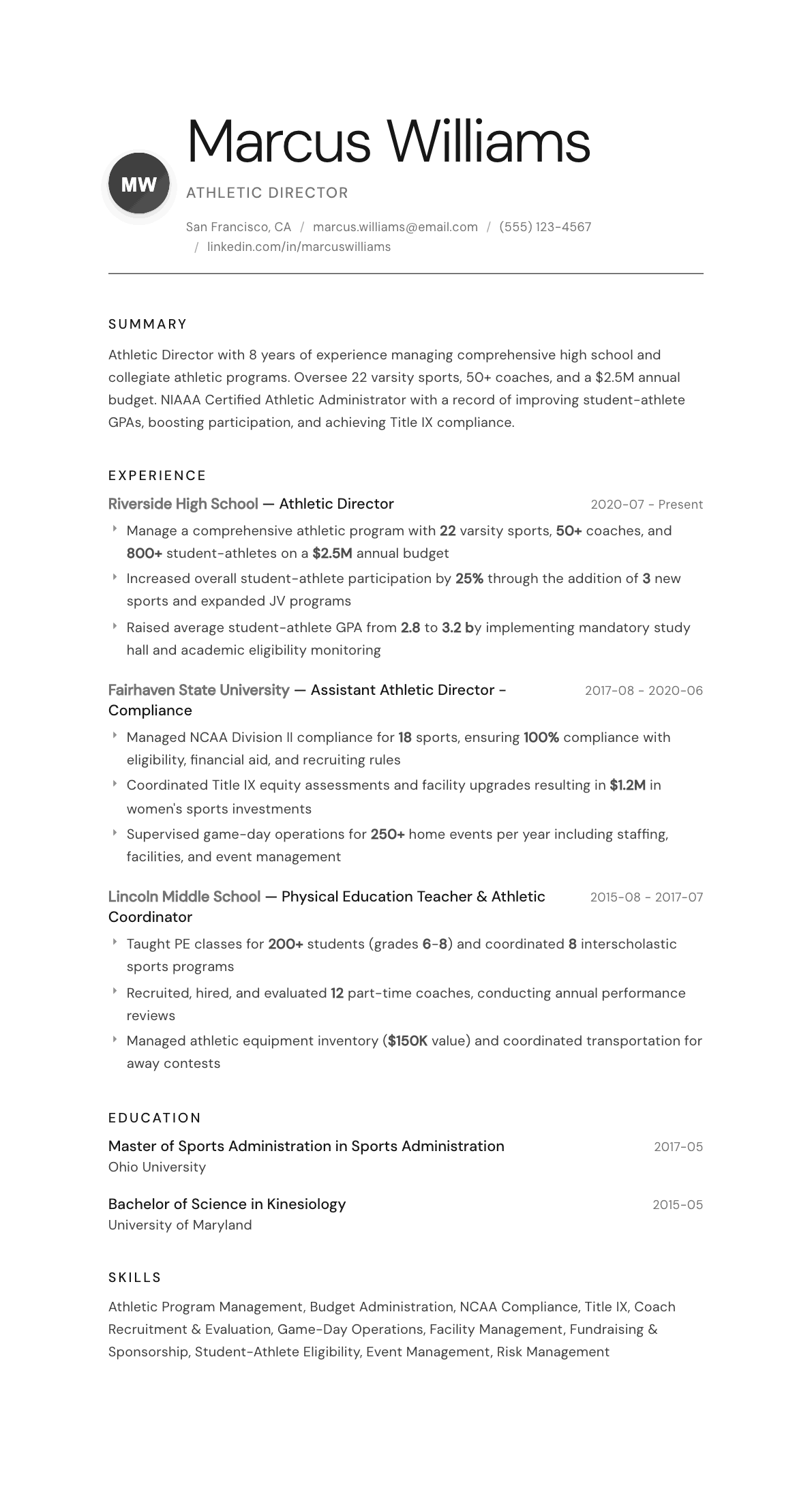
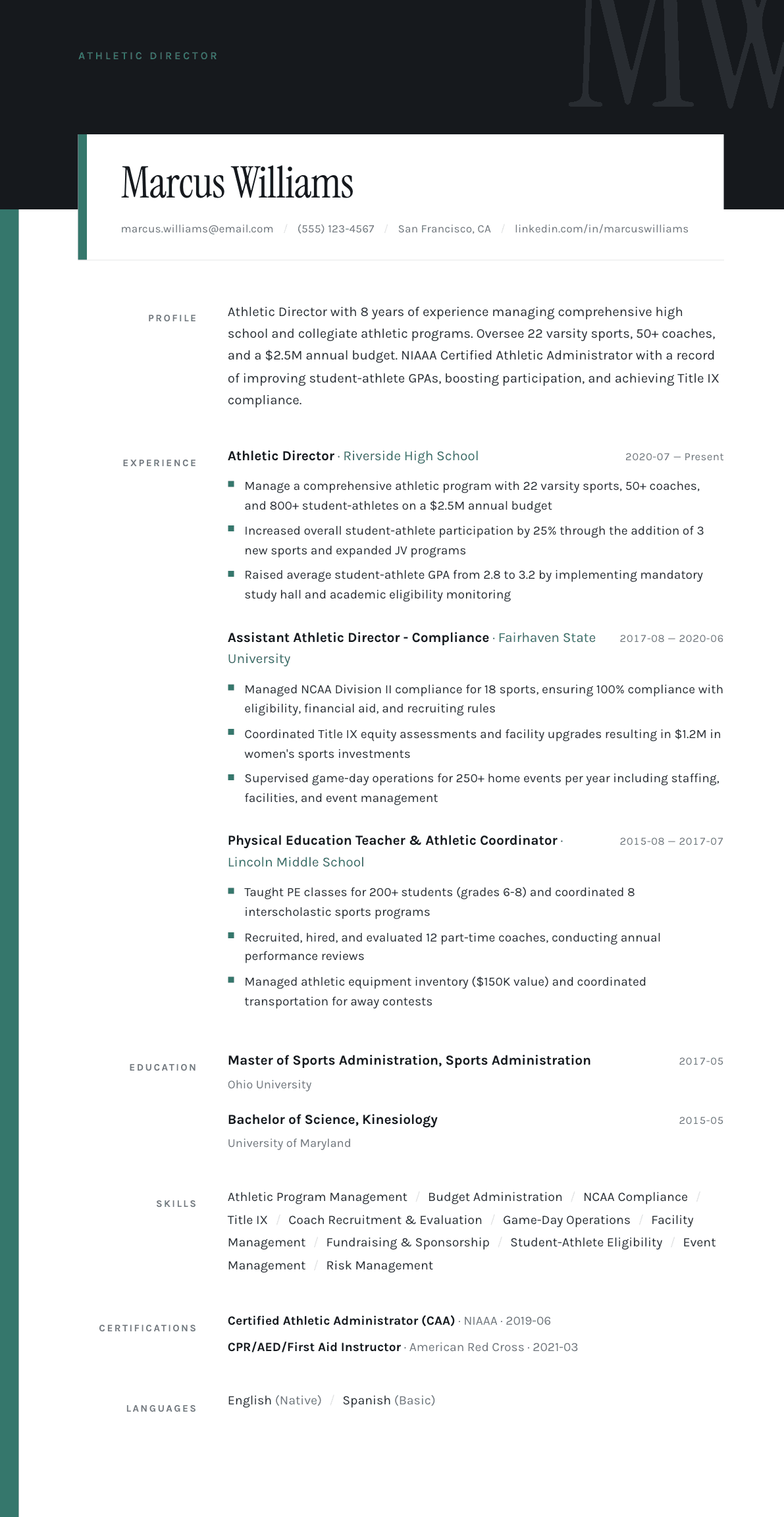
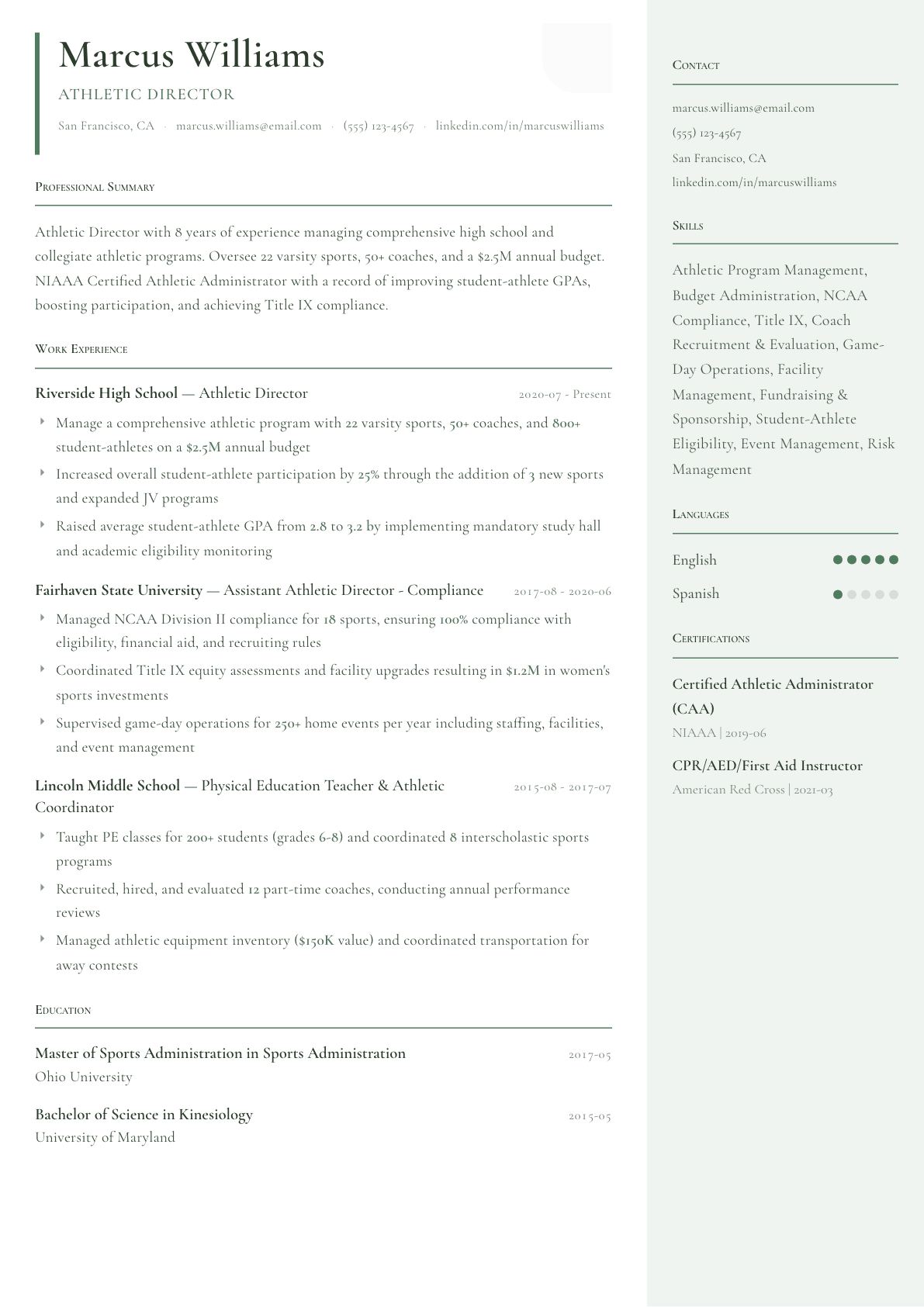
Example Athletic Director summary
Certified Athletic Administrator with 8 years of experience managing comprehensive school athletic programs. Oversee 22 sports, 50+ coaches, and $2.5M annual budgets. Increased participation by 25%, raised student-athlete GPAs from 2.8 to 3.2, and maintained 100% compliance with NCAA and Title IX requirements.
Skills to list on a Athletic Director resume
- Athletic Program Management
- Budget Administration ($2M+)
- NCAA / State Compliance
- Title IX Equity
- Coach Recruitment & Development
- Game-Day Operations
- Facility Planning & Management
- Fundraising & Sponsorships
- Student-Athlete Eligibility
- Risk Management
- Event Coordination
- Booster Club Relations
- Media & Public Relations
- Transportation Logistics
What actually gets this resume read
- Highlight program scope: number of sports, coaches, student-athletes, and annual budget.
- Include compliance experience: NCAA, NAIA, state athletic association rules, Title IX.
- Quantify achievements: participation growth, GPA improvements, championship records, fundraising.
- Mention certifications: NIAAA CAA, CMAA, coaching certifications, CPR/AED.
- Describe facilities management and capital improvement projects.
- Reference community engagement: booster clubs, sponsorships, alumni relations, media.
How to write a athletic director resume
An athletic director resume is read by a superintendent or a college vice president who is hiring for risk as much as for wins. The first thing they look for is whether you can run a compliant program: eligibility certified, physicals on file, transportation arranged, officials paid, concussion protocol followed, and no gap in gender equity that turns into a complaint. Championships are the pleasant part of the conversation, not the screening criterion.
The second thing they look for is scale. An athletic director over 22 sports, 60 coaches and a facility with a stadium and a pool holds a very different job from one over eight sports at a small private school. Every part of the resume should make that scope obvious, because a search committee is trying to work out whether your last program was bigger or smaller than theirs.
This guide covers the scope line, compliance language that a committee actually checks, budget and facility work, coach supervision, and the questions athletic directors ask when they move between interscholastic and intercollegiate athletics.
Format: two pages, scope at the top, certifications visible
Two pages is normal at this level and expected once you have run a program. Lead with a short scope block under the summary: sports sponsored, student athletes, coaches supervised, facilities managed, and the operating budget expressed in scale rather than a precise figure. A committee reading fifty applications wants that block to save them ten minutes.
Put certifications where they are found in a first pass. The Certified Athletic Administrator and Certified Master Athletic Administrator designations from the National Interscholastic Athletic Administrators Association are the recognized credentials at high school level, alongside first aid, CPR and automated external defibrillator instruction. In college athletics, name the association rules examination or compliance training you have completed.
- Header: name, city and state, phone, email, and administrative or teaching license if the district requires one.
- Section order: summary, program scope, administrative experience, coaching experience, certifications, education.
- Coaches moving into administration keep coaching experience but subordinate it to any administrative or assistant director work.
Summary: sports, athletes, coaches, and the standard you held
Give the numbers in the first line: sports sponsored, student athletes served, coaches supervised, and the level, whether that is a public high school, a private school, a junior college or a division of intercollegiate athletics. Then one line on what you are known for, which should be operational rather than a record: participation growth, a facility project completed, a compliance record without a violation, or an academic standard raised.
Avoid the language of team spirit and passion for athletics. Every applicant for this job loves sport. The differentiator is whether the program ran clean, solvent and full.
Compliance, eligibility and safety: write this like an auditor reads it
This section is where the hire is won. Name the governing bodies you operated under: your state high school athletic association, the National Federation of State High School Associations rules, or the intercollegiate association and division. Then show the processes you owned: eligibility certification each season, transfer and residency rules, physical examinations and pre-participation clearance, insurance verification, and amateurism where it applies.
Gender equity deserves a direct statement. Show participation review under Title IX, equitable scheduling and facility access, and any interest survey or self-study you completed. A committee that has been through a complaint reads this section first.
Add safety and risk management: concussion protocol and return-to-play policy, emergency action plans by venue, heat and lightning policy, automated external defibrillator placement and drills, athletic trainer coverage, and incident reporting. These are the lines that survive a school board question.
Budget, facilities, scheduling and the money you brought in
Describe the operating budget by what it covered rather than by a number: officials, transportation, uniforms on a rotation, equipment reconditioning, entry fees, and coaching stipends. Show the levers you pulled, such as a uniform replacement cycle, a transportation consolidation, or bringing officials assigning in house.
Facilities and scheduling are the other half of the job. Master calendar building across shared spaces, field and gym allocation, turf and track replacement projects, capital improvement planning, game contracts, officials assignment, and event staffing. Include revenue work as well: ticketing, gate receipts, corporate sponsorship, booster club oversight and fundraising campaigns, with a note on the financial controls you kept over booster funds.
Coach supervision and student athlete outcomes
Show the personnel work: hiring and vetting coaches, background checks, coach evaluation on a written instrument, professional development, mandatory training completion, and the harder cases of nonrenewal and parent complaint resolution. A committee wants proof that you can supervise adults, not just schedule buses.
Then the student athlete outcomes that a superintendent quotes to a board: participation rate as a share of enrollment, team grade point averages, academic eligibility rates, sportsmanship citations, graduation and college signing numbers, and community service hours. These are the measures that justify the athletics budget when it is questioned.
Athletic Director resume summary examples
Coach moving into administration
Head varsity coach and athletic coordinator with eight years coaching and two years as assistant athletic director, supporting eligibility certification, scheduling and game-day operations for 14 sports. Certified Athletic Administrator candidate with first aid, CPR and automated external defibrillator instructor credentials.
High school athletic director
Certified Athletic Administrator with six years directing a 3A high school program of 18 sports, 42 coaches and 620 student athletes. Raised participation from 41% to 53% of enrollment, completed a turf replacement project on schedule, and maintained a clean state association compliance record.
District director of athletics
District director of athletics with fifteen years across four high schools, overseeing 22 sports, 130 coaches and 2,400 student athletes. Built the district emergency action plan and concussion protocol, led a Title IX participation self-study, and grew sponsorship and gate revenue by 35% over three seasons.
Work experience bullets: before and after
Before: Managed the athletic department and all school sports.
After: Directed a program of 18 varsity and junior varsity sports, 42 coaches and 620 student athletes across a stadium, two gymnasiums and four practice fields.
Sport, coach, athlete and facility counts give a committee the scope comparison they are actually making.
Before: Ensured compliance with state and Title IX rules.
After: Certified eligibility for every athlete each season against state association academic, residency and transfer rules, and completed a participation and facilities review under Title IX that closed a scheduling gap in girls softball.
Naming the process and one concrete gap closed proves compliance work rather than asserting it.
Before: Handled the athletic budget.
After: Managed the operating budget covering officials, transportation, uniform rotation and equipment reconditioning, and cut annual transportation cost by 12% by consolidating bus routes for co-scheduled away contests.
Showing what the budget covered and one saving with its method turns custody into management.
Before: Hired and supervised coaches.
After: Hired 19 coaches over four years with background checks and reference verification, evaluated each on a written instrument twice a season, and required completion of concussion, heat illness and sportsmanship modules before the first practice.
Hiring volume, a written evaluation instrument and mandatory training show real supervision of adults.
Before: Improved student athlete academics.
After: Introduced a weekly academic eligibility check with study hall for any athlete below a 2.0, lifting the combined team grade point average from 2.9 to 3.2 and cutting midseason ineligibility by half.
The intervention, the threshold and the two measures make the academic claim verifiable.
Hard skills
- Athletic program administration
- Eligibility certification
- State association and Title IX compliance
- Concussion protocol and return-to-play policy
- Emergency action planning by venue
- Operating budget management
- Facility scheduling and capital projects
- Game contracts and officials assignment
- Transportation logistics
- Coach hiring and evaluation
- Sponsorship and gate revenue
- Booster club financial oversight
- Event and game-day operations
- Risk management and incident reporting
Soft skills
- Parent complaint resolution
- Supervision of veteran coaches
- Public communication and media handling
- Decision making under weather and safety pressure
- Board and superintendent reporting
- Community and alumni relations
Certifications worth listing
- Certified Athletic Administrator (CAA) (National Interscholastic Athletic Administrators Association)
- Certified Master Athletic Administrator (CMAA) (National Interscholastic Athletic Administrators Association)
- Adult and Pediatric First Aid, CPR and AED (American Red Cross)
- Concussion in Sports Course (National Federation of State High School Associations)
Mistakes that cost athletic director candidates the interview
- Opening with won-loss records and championships when the committee is screening for compliance, safety and solvency.
- Omitting the scope block, so nobody can tell whether you ran eight sports or twenty-two.
- Treating Title IX as a checkbox instead of showing a participation or facilities review you actually completed.
- Leaving out emergency action plans and concussion protocol, the two safety items a school board asks about by name.
- Listing coaching history in full detail while giving the administrative work a single generic line.
- Skipping booster club and fundraising oversight, which is where athletic directors most often get into financial trouble.
Athletic Director resume questions
Do I need to be a teacher or coach first to become an athletic director?
Most high school athletic directors come through coaching, and many districts require a teaching or administrative license because the role includes supervisory duties. Coaching is not strictly required at college level, where compliance, business operations and fundraising experience often matter more.
How much coaching history should stay on the resume?
Keep it, but compress it. Two or three lines per coaching role covering the sport, the level, the roster size and any program building result is enough once you are applying for administration. The space belongs to budget, compliance, facilities and personnel work.
What certifications matter most for an athletic director?
The Certified Athletic Administrator credential from the National Interscholastic Athletic Administrators Association is the recognized standard in high school athletics, with the master designation above it. First aid, CPR and defibrillator training plus a concussion course are expected in every program.
How do I show results when the teams did not win much?
Report the measures a superintendent cares about instead. Participation as a share of enrollment, team grade point averages, eligibility rates, coach retention, sponsorship and gate revenue, facility projects delivered, and a season completed without a compliance finding all count as results.
Can a high school athletic director move into college athletics?
Yes, most often into operations, compliance or a small college directorship. Rewrite the resume around the transferable systems, budget management, facility scheduling, event operations and rules compliance, and learn the specific association and division rules before the interview because they will be tested.