School Principal Resume Examples: the lines they read
Lead With a School Principal Resume That Commands Attention
By Mustafa Tarabya, founder of CVBooster · Published · Updated
Principal resume samples for first time, experienced and district principals, with a principal resume sample written out in full and a guide to showing results.
Sample resumes for a school principal
The same school principal content laid out in three CVBooster templates, so you can see what the finished document looks like before you write a word.
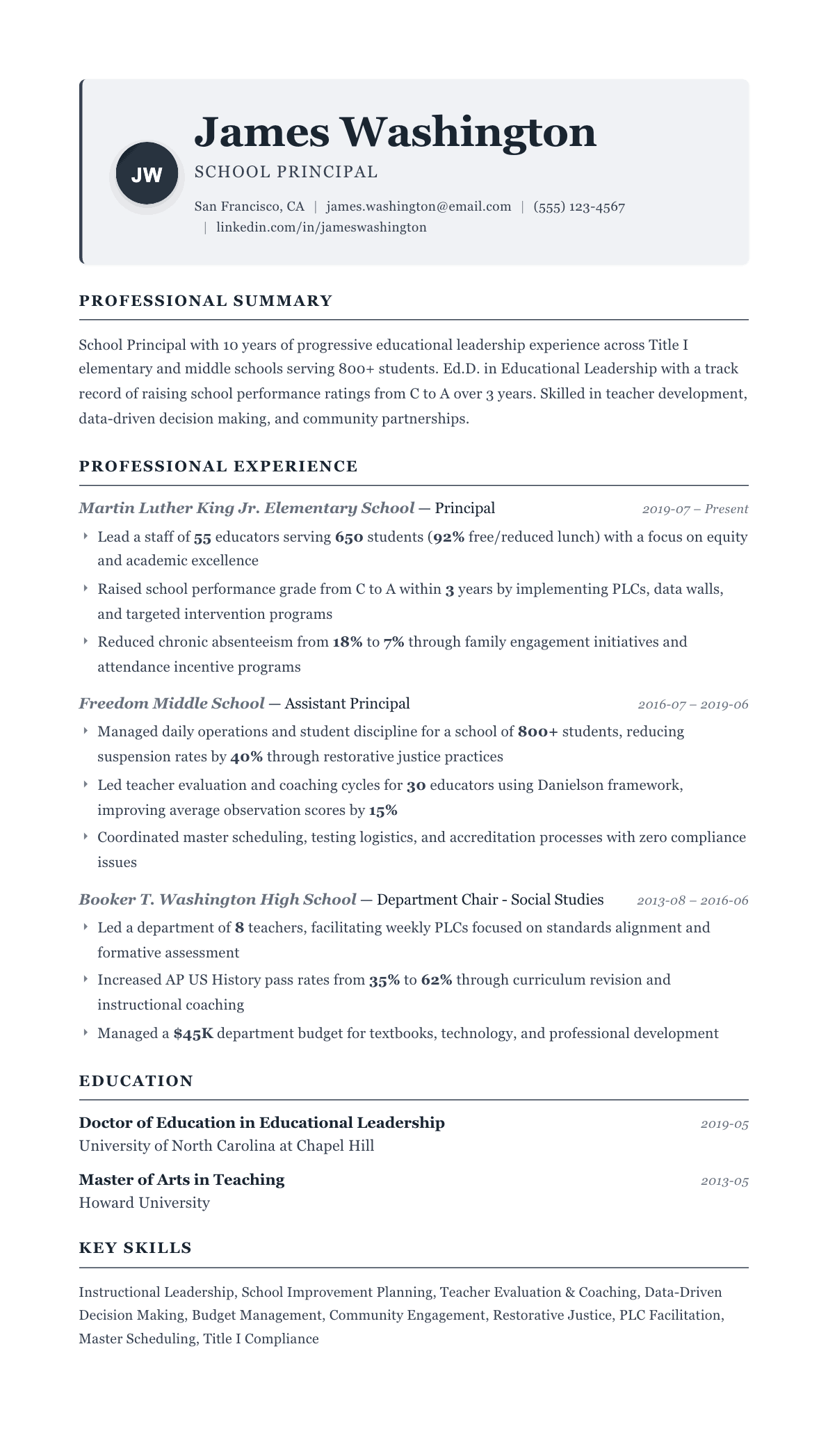
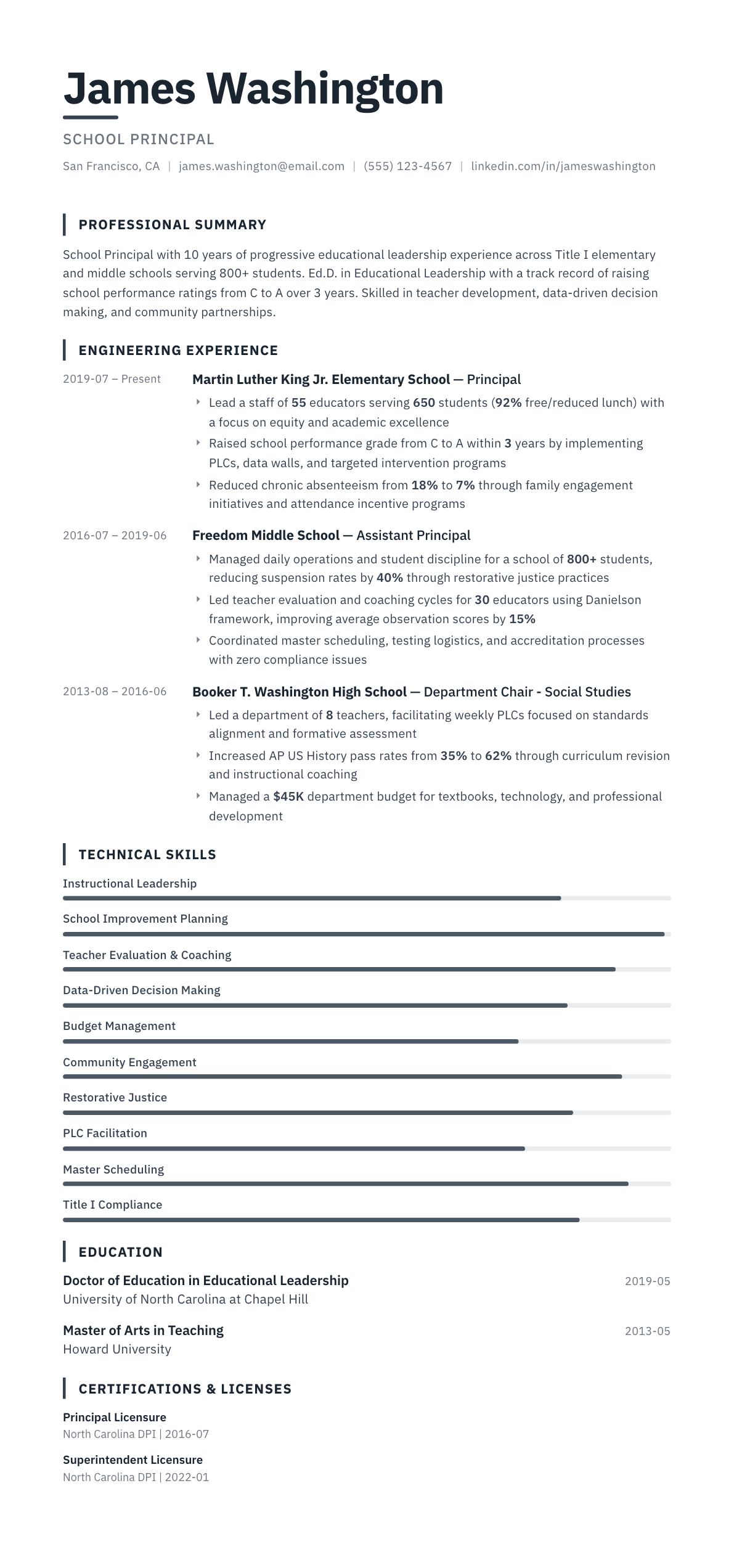
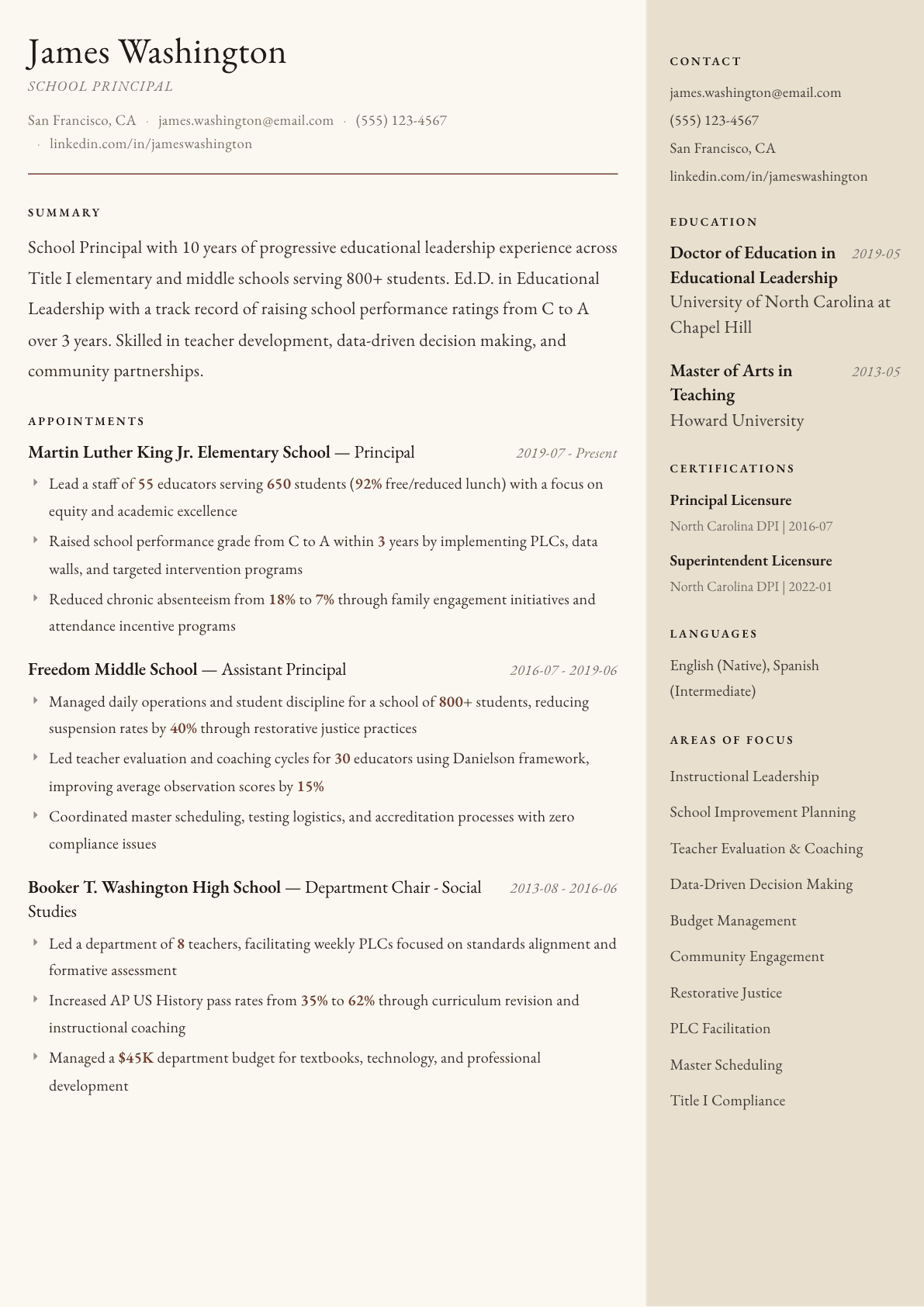
Example School Principal summary
School principal with 10 years of leadership across Title I elementary and middle schools serving 800+ students. Holds an Ed.D. in Educational Leadership and raised a school performance rating from C to A in three years. Focused on teacher coaching, attendance, and family partnerships.
Skills to list on a School Principal resume
- Instructional Leadership
- School Improvement Planning
- Teacher Evaluation (Danielson)
- Data-Driven Decision Making
- Budget & Resource Management
- Community Engagement
- Restorative Justice
- Professional Learning Communities
- Master Scheduling
- Title I Compliance
- Strategic Planning
- Equity & Inclusion
- Crisis Management
- Stakeholder Communication
What actually gets this resume read
- Lead with school improvement outcomes: test score growth, graduation rates, school ratings.
- Highlight leadership scope: school size, staff count, budget, demographics.
- Include teacher development experience: evaluation frameworks, coaching, PLCs, mentoring.
- Reference compliance and accreditation: Title I, IDEA, AdvancED/Cognia, state standards.
- Describe community and stakeholder engagement strategies.
- Mention advanced degrees (Ed.D., Ph.D.) and administrative licensure prominently.
How to write a school principal resume
A principal application is a hiring decision made in public. A superintendent shortlists, a screening committee of teachers and parents interviews, and in many districts the appointment goes to the school board. That audience is why a principal resume has to work as a case rather than a history: here is the kind of school I lead, here is what happened to it, and here is the way I lead that produced it.
The question underneath every principal search is whether the candidate can hold the whole building. Instruction, staffing, budget, safety, family and community relations, and the board and district relationship all land on one desk, and a candidate who has only ever carried one portfolio as an assistant principal has to show that she has reached beyond it.
This guide covers the file a superintendent expects, how to write school results without overclaiming, three summaries from a first principalship to a veteran leader, and the questions assistant principals ask when they prepare to apply for a building of their own.
Format: two pages of substance, with a short leadership profile at the top
Two pages, reverse-chronological, with a three or four line leadership profile instead of a generic summary. The profile should say the type and size of school you lead, your approach to improving one, and the results that approach produced. Everything below it is evidence for that claim.
State your principal credential and your state under the header, plus any superintendent credential, since some boards read it as a signal of trajectory. If you are applying across state lines, add a line on reciprocity, because a board that has to wonder about licensure will move to the next file.
- Header: name, city and state, phone, email, principal credential with state, and highest degree.
- Order: leadership profile, credentials, school leadership experience, results, teaching experience, education, service.
- A first-time applicant gives the assistant principal role full detail and adds an entry plan or leadership philosophy as a separate document, not on the resume.
Profile: school type, enrollment, staff, and the shape of your leadership
Name the school type and the community: elementary, middle, high, magnet, charter, rural, or a school under a state improvement designation. Give enrollment and staff size, since a superintendent is judging whether you have led at her scale, and add the demographic realities you have led through, such as a high mobility population or a large multilingual enrollment.
Then say how you lead in one clause that is specific enough to be false. Distributed leadership through instructional teams, a tight cycle of observation and feedback, a rebuild of the schedule around intervention time: any of these tells a board something. A phrase about high expectations for all students tells them nothing they have not read twenty times that morning.
Experience: what you inherited, what you changed, what moved
Write each principalship as a short case. The state of the school when you arrived, the two or three changes you made, and what moved as a result over how long. Boards understand that turning a school takes several years, and a candidate who shows a three-year arc is more credible than one who reports a single good year.
Cover the whole desk. Staffing and hiring, including how many teachers you selected and what you did about retention. Budget and resource allocation tied to the improvement plan. Safety, crisis management and the drills nobody thinks about until they are needed. Facilities and operations. Special education and services for multilingual learners, where compliance failures become public quickly.
Then the human systems: how you built leadership in others, the assistant principals and teacher leaders you developed and where they went, the culture work you did with a staff that had lost trust, and the relationship you maintained with the union representative in the building. Superintendents hire principals who reduce the number of calls they receive.
Results: be complete, including the parts that did not move
Give a results section with the indicators a board follows: proficiency and growth by subject, graduation and course completion rates, attendance and chronic absenteeism, discipline and suspension, staff retention, enrollment, and family and staff survey results. Report baselines and the years covered, and name the initiative that drove each change.
Include an honest note where an indicator stayed flat or fell and say what you did about it. Interview panels ask about the hard year, and a candidate who has already accounted for it on the page arrives with credibility instead of a defensive answer.
Community, board and district relationships
A principal is a public figure in the attendance area. Show the outward-facing work: family engagement structures, the site council or parent organization, partnerships with local agencies and employers, communications during a difficult event, and any bond, referendum or facility campaign where the school was involved.
Show the upward-facing work too. Serving on district committees, leading a district-wide initiative, mentoring another principal, and presenting to the board are all evidence that you can operate in the system a superintendent runs, which is the difference between a good building leader and one who can be trusted with a difficult assignment.
Principal resume sample: one complete page
Principal resume examples that get interviews share one shape: the school, its size and its starting point at the top, then what changed under your leadership, then how you led the staff who changed it. The principal resume sample below is an elementary principal with six years in the role applying for a larger school, written out as the first page.
Profile: Gregory Adeyemi, Elementary School Principal. Six years leading a Title I elementary school of 640 students and 52 staff, after five years as assistant principal and eight as a classroom teacher. Holds a state administrator license and an EdS in educational leadership, and led the school out of state targeted support status in four years.
- Current role, Principal, Riverside Elementary School, six years.
- Inherited a school identified for targeted support; built a schoolwide reading block and coaching cycle, and the school exited that status after four years.
- Raised third grade reading results on the state assessment in four of five years, as reported on the state school report card.
- Hired 19 teachers and kept first year teacher retention above the district average for four consecutive years.
- Managed the site budget, including Title I funds, and passed every federal programs monitoring visit without findings.
- Earlier roles, Assistant Principal, Lakeview Middle School, five years; Grade 4 Teacher, eight years.
- Education and licensure: EdS Educational Leadership; MEd Curriculum and Instruction; state administrator license.
School Principal resume summary examples
Ready for a first principalship
Assistant principal for five years at a 1,100-student middle school, holding discipline, the master schedule and evaluation of 30 teachers, and serving as acting principal for one semester. Led the multi-tiered support redesign that reduced course failures across sixth and seventh grade for two consecutive years.
Principal, second building
Elementary principal for six years across two schools, most recently a 640-student building with 48 staff and high family mobility. Moved third grade reading proficiency from 41% to 63% over four years by protecting a daily intervention block and rebuilding grade level data cycles.
Veteran principal
High school principal of a 1,900-student comprehensive campus with 130 staff and a departmental leadership structure. Raised the graduation rate for three straight cohorts, opened two career pathway programs with local employers, and developed four assistant principals who now lead their own buildings.
Work experience bullets: before and after
Before: Led a school and improved student achievement.
After: Led a 640-student elementary school with 48 staff, moving third grade reading proficiency from 41% to 63% over four years by protecting a daily intervention block and rebuilding grade level data meetings.
Scale, the indicator with a baseline, the interval and the two mechanisms make the achievement claim checkable.
Before: Hired and retained quality staff.
After: Selected 34 teachers over five years using a demonstration lesson in the interview, and raised staff retention to more than nine in ten returning after a year when the district average sat well below that.
The hiring method and a retention figure with a comparison show a staffing practice, not luck.
Before: Managed the school budget responsibly.
After: Realigned the site budget to fund two intervention teachers and an attendance liaison by reducing three underused elective sections, and defended the change to staff and the site council before it took effect.
A trade-off, its funding source and the fact you argued for it publicly is what budget leadership looks like.
Before: Improved school culture and climate.
After: Rebuilt staff meetings around teacher-led instructional rounds, cut administrative announcements to a weekly written bulletin, and lifted the staff survey item on being heard by leadership across two administrations of the survey.
Concrete changes to how time was used, tied to a survey item, replace an unmeasurable word.
Before: Handled parent concerns and community relations.
After: Held monthly open office hours and a quarterly community forum with interpretation, and communicated directly with families through the first week of a facility closure that displaced 200 students.
A routine plus a hard event shows communication practice tested under real pressure.
Hard skills
- School improvement planning and execution
- Instructional supervision and evaluation
- Teacher hiring, induction and retention
- Site budget development and allocation
- Master schedule design
- Data cycles and assessment systems
- Multi-tiered systems of support
- Special education and multilingual services oversight
- School safety and crisis management
- Family and community engagement structures
- Board and district reporting
- Accreditation and state improvement designations
- Professional learning community leadership
Soft skills
- Building trust with a wary staff
- Public communication under pressure
- Decisiveness with incomplete information
- Developing other leaders
- Conflict resolution
- Holding a long-term plan through a hard year
Certifications worth listing
- State principal or building administrator license (State department of education)
- Superintendent license (State department of education)
- National Principal Certification (National Association of Elementary School Principals)
- Certified Master Principal or state leadership academy completion (State principals association)
Mistakes that cost school principal candidates the interview
- Opening with a summary of values that could belong to any candidate in the pool instead of a profile of the school you lead.
- Reporting a single strong year rather than a multi-year arc, which reads as a spike rather than a turnaround.
- Listing only the portfolio you carried as an assistant principal, leaving a superintendent unsure you can hold the whole building.
- Omitting staff retention and hiring, two indicators a district office watches as closely as achievement.
- Presenting results with no baselines and no attribution, which invites a panel to test every number in the interview.
- Putting an entry plan or leadership philosophy into the resume, when those belong in the separate documents the posting asks for.
School Principal resume questions
How do I show I am ready for my first principalship?
Give the assistant principal role the detail a principal entry would get: enrollment, staff supervised, portfolio, and any period you served as acting principal. Then show reach beyond your portfolio, such as leading the improvement plan, chairing the leadership team, or running a district initiative.
Which school results belong on a principal resume?
The indicators your board already watches: proficiency and growth, graduation or promotion rates, attendance and chronic absenteeism, discipline, staff retention, and survey results. Give baselines and the years covered, and name the initiative behind each change so the number has a cause attached.
Should I mention a school that did not improve under my leadership?
Do not hide the assignment, and do not pretend the numbers moved. State the context, what you changed, what improved, and what did not, along with your read on why. Panels respect a leader who can analyze a hard assignment more than one who avoids the subject.
How do I apply for a principal position in another district or state?
Address licensure on the page, including reciprocity status if you are crossing state lines. Then translate your school context to theirs: enrollment, community characteristics, funding and improvement designation, so a superintendent can see that you have led in conditions like her own.
What should a principal resume sample include?
The school type, enrollment and staff count, the state the school was in when you arrived, two or three results with their source such as the state report card, and how you led the adults: hiring, coaching and retention. Add the budget you managed and your administrator license, and keep it to two pages.