School Administrator Resume Examples: what gets the call
Lead with Purpose Using a School Administrator Resume
By Mustafa Tarabya, founder of CVBooster · Published · Updated
Create a school administrator resume demonstrating your instructional leadership, budget management, community engagement, and commitment to student achievement.
Sample resumes for a school administrator
The same school administrator content laid out in three CVBooster templates, so you can see what the finished document looks like before you write a word.
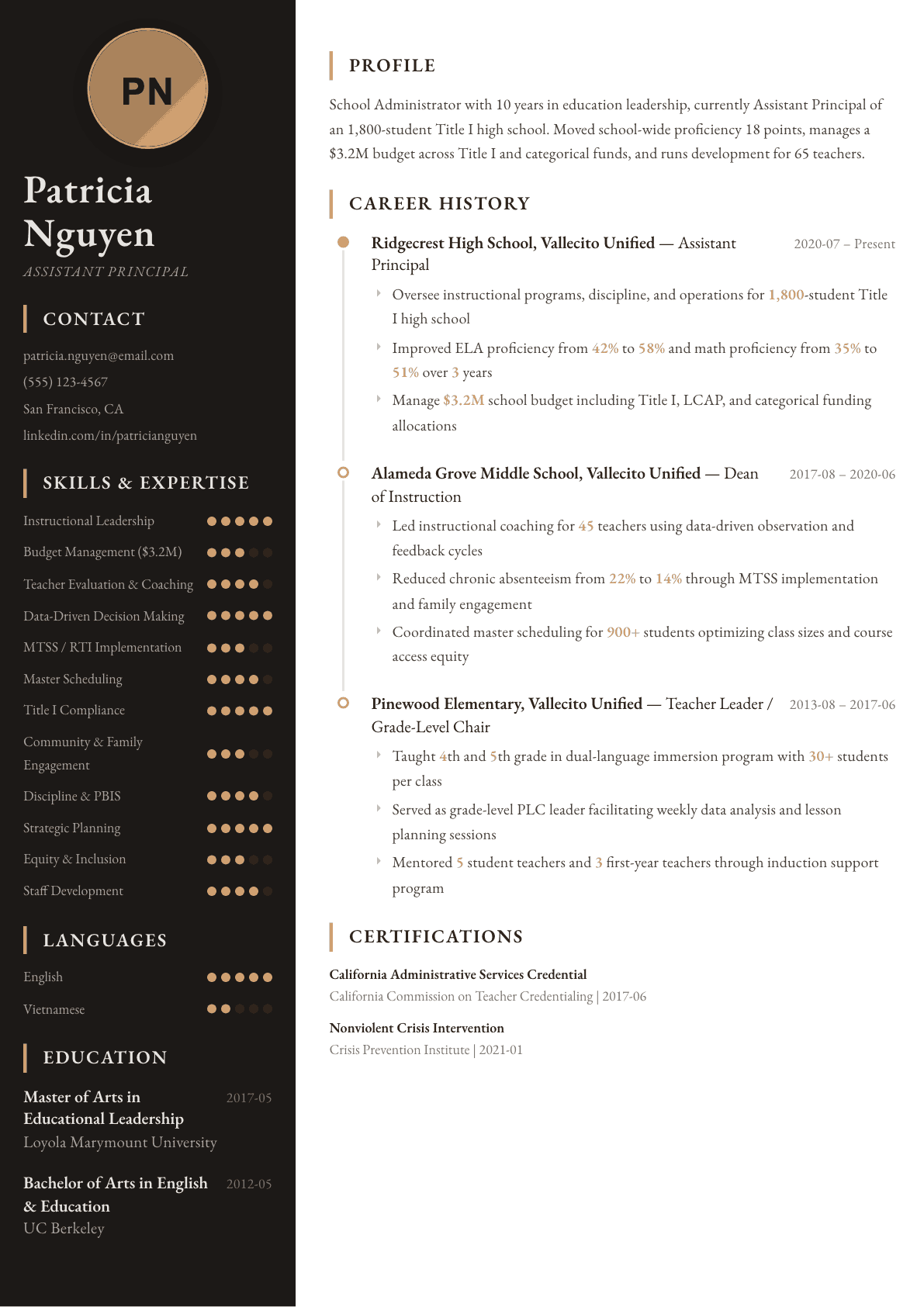
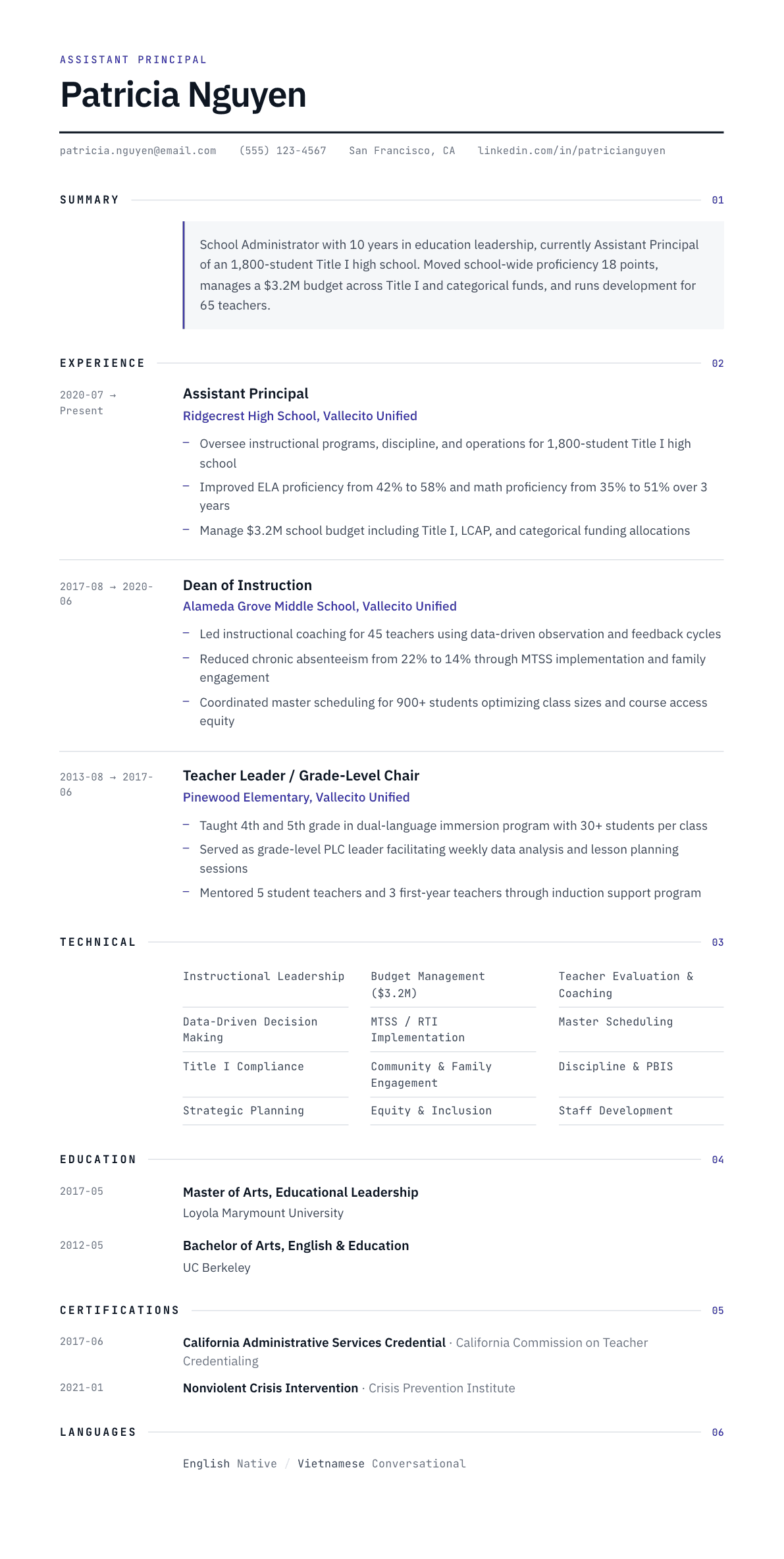
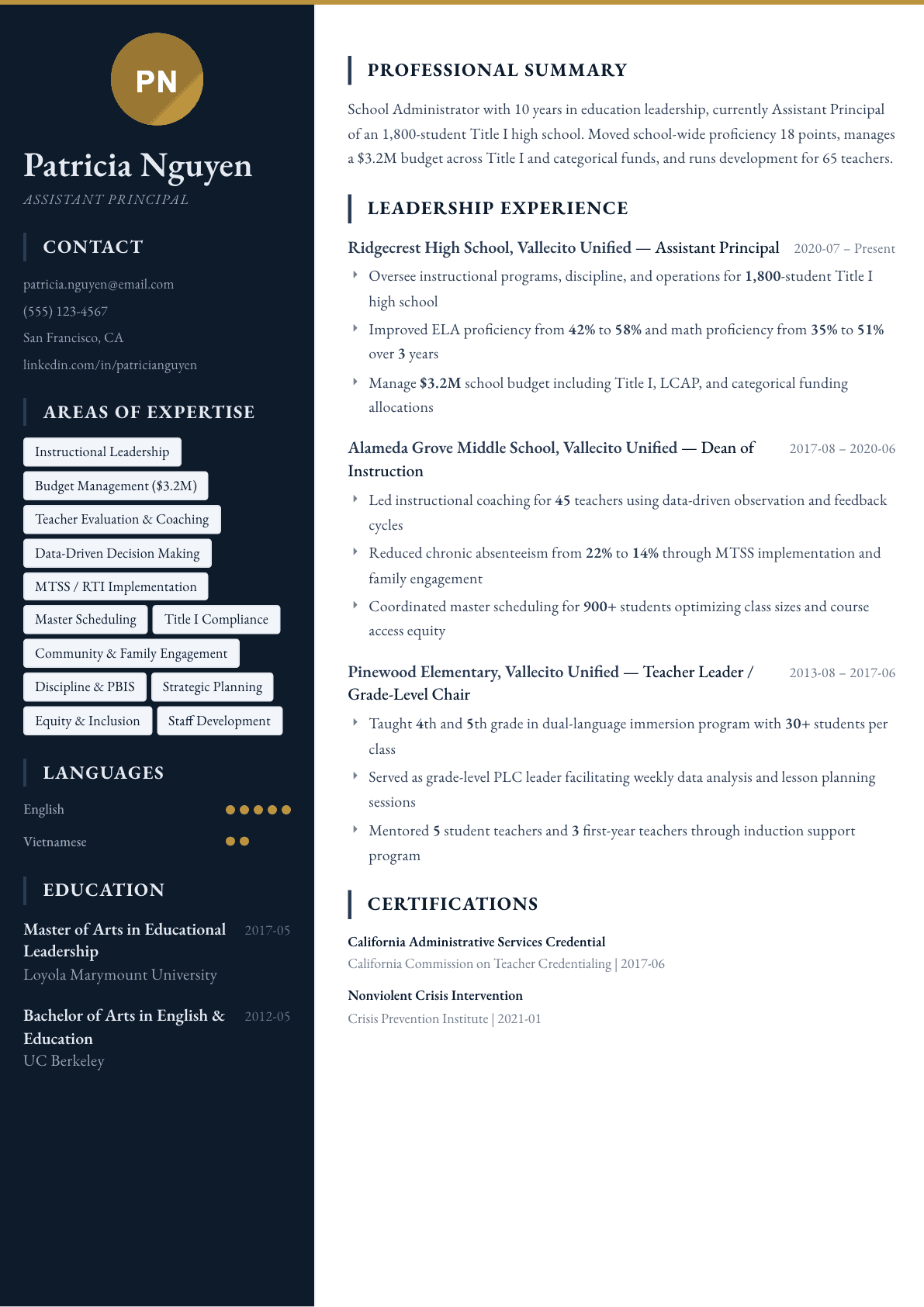
Example School Administrator summary
School Administrator with 10 years of education leadership improving proficiency rates by 18% in Title I schools with 1,800+ students. Manages $3.2M budget, leads 65+ teachers, and reduces chronic absenteeism through MTSS implementation.
Skills to list on a School Administrator resume
- Instructional Leadership
- Budget & Finance Management
- Teacher Evaluation & Coaching
- Data Analysis & Accountability
- MTSS / RTI
- Master Scheduling
- Title I / Federal Compliance
- Community Engagement
- PBIS / Discipline
- Strategic Planning
- Equity & Access
- Staff Recruitment & Retention
What actually gets this resume read
- Lead with student achievement data: proficiency improvements, graduation rates, test score gains.
- Include budget management experience with specific dollar amounts and funding sources.
- Highlight teacher development: observation cycles, coaching, PLC facilitation, professional development.
- Mention school size, demographics, and Title I status to contextualize your leadership environment.
- Include administrative credential/licensure as it is a non-negotiable requirement.
How to write a school administrator resume
School administrator is an umbrella title, and a resume that leaves it vague pays for it. Assistant principal, dean of students, director of curriculum and instruction, athletic director, special education administrator and district coordinator all sit under it, and each is screened by a different person against a different list. The first job of the resume is to declare which of these you are applying for and to make the evidence match.
The people reading are a superintendent, a human resources director, and often a screening committee that includes teachers and parents. They check three things in order: the administrative credential, whether you have supervised and evaluated adults, and whether you have carried operational responsibility that could not be handed back to someone else. Teaching excellence alone does not answer any of those.
This guide covers how to structure an administrative file, how to write supervision, operations and compliance work so it reads as leadership rather than task management, three summaries across the leadership ladder, and the questions teachers and coordinators ask when they step into administration.
Format: two pages, credential first, leadership before teaching
Two pages, reverse-chronological, with the administrative credential and its state stated under your header alongside your teaching license. Human resources verifies the credential before anything else, and an applicant without it is usually screened out unless the posting allows a candidate in progress.
Put a leadership experience section above your classroom teaching. A resume that opens with eight years of teaching bullets before the assistant principal entry makes a superintendent work to find the relevant part, and screening committees do not work hard for anyone.
- Header: name, city and state, phone, email, administrative credential with state, teaching license.
- Order: summary, credentials, administrative experience, teaching experience, education, leadership training, service.
- A teacher leader moving up creates a leadership section for department chair, coach, and committee roles held while teaching.
Summary: the level, the scale, the portfolio, one outcome
Say the level you serve, the enrollment of the school or the number of buildings, the staff you supervise, and the portfolio you own. Portfolio is the word that matters: discipline and attendance, master schedule, special education compliance, instructional coaching, testing, facilities, transportation or budget. Administrative jobs are defined by which slice you carry.
Then one outcome from that slice, stated so a superintendent can check it. Administrators are hired to take a problem off a leader's desk, and the fastest way to show you can is to name a problem you already took off someone else's.
Experience: supervision, systems and the operational load
Lead each administrative entry with the scope: enrollment, staff size, the number of certified staff you evaluated, the grade levels, and the demographic realities of the community you served. Then write about supervision honestly. How many formal observation cycles you completed a year, the evaluation framework you used, how you supported a struggling teacher, and whether you have carried a plan of improvement to its conclusion. That last item is the one superintendents probe, because most candidates have never done it.
Operations are the second half. Master scheduling, staffing and section allocation, budget administration across categorical funds, testing coordination, safety and emergency drills, facilities and transportation, and the daily discipline and attendance work. Say what you built or changed in a system, not just that you ran it, because running a system someone else designed is a different level of contribution.
Compliance is where administrators get audited, and where evidence of competence is convincing. Special education timelines and meetings, services for multilingual learners, civil rights obligations, mandated reporting, records, state reporting deadlines and accreditation cycles all belong here when you have owned them.
Instructional leadership, in evidence rather than adjectives
Almost every administrative resume claims instructional leadership, and almost none show it. Show it with mechanisms: the observation and feedback cycle you ran and how often, the professional learning community structure you supported, the data cycle you facilitated with grade level or department teams, the curriculum adoption you led, and the professional learning you designed and delivered to adults.
Then attach movement to those mechanisms. Proficiency, growth, course pass rates, attendance and discipline referrals are the indicators a school board sees. Give the baseline and the interval, and be clear about what you personally led rather than what happened in the building while you worked there.
Families, staff and the political half of the job
Administrators spend a large share of their week on relationships that have nothing to do with instruction: an angry parent, a union grievance, a board member with a question, a community partner, a vendor and a local agency. Evidence that you can hold those conversations without escalating them is worth space on the page.
Name specifics: family engagement events you organized and the attendance they drew, a site council or parent organization you advised, a restorative or behavior framework you implemented with staff buy-in, translation and interpretation services you arranged, and any negotiated agreement or grievance you resolved at the site level.
School Administrator resume summary examples
Moving into administration
Teacher leader with a new administrative credential, seven years teaching and four as department chair supervising six teachers, the master schedule for a 900-student middle school, and the multi-tiered support team. Completed a 300-hour administrative internship covering discipline, evaluation cycles and testing coordination.
Assistant principal
Assistant principal at a 1,200-student comprehensive high school, responsible for discipline, attendance, the master schedule and evaluation of 28 certified staff. Reduced chronic absenteeism from 24% to 15% over two years by rebuilding the attendance team and the family outreach sequence.
District administrator
Director of curriculum and instruction for a district of 11 schools and 6,000 students, supervising eight coordinators and coaches. Owns the adoption cycle, the assessment calendar and the professional learning plan, and led the elementary literacy adoption that moved third grade proficiency for three consecutive cohorts.
Work experience bullets: before and after
Before: Assisted the principal with daily operations of the school.
After: Held the discipline, attendance and master schedule portfolio for a 1,200-student high school, supervising 28 certified staff and three classified employees while serving as the administrator on duty three days a week.
A named portfolio and supervision counts show ownership rather than assistance.
Before: Evaluated teachers using the district framework.
After: Completed 52 formal observation cycles a year under the district evaluation framework, coached two teachers through improvement plans, and led calibration sessions so the leadership team scored the same lesson consistently.
Cycle volume, an improvement plan and calibration work show evaluation practice with teeth.
Before: Managed the school budget.
After: Administered site allocations across general, categorical and grant funds, aligned spending to the school improvement plan, and closed three consecutive years with no audit findings.
Fund types, the planning link and a clean audit record are what a business office reads for.
Before: Improved student behavior at the school.
After: Implemented a school-wide behavior framework with staff-built expectations, cutting out-of-class referrals from 1,900 to 1,050 a year and reducing repeat suspensions by more than half.
Referral volume before and after, with the mechanism named, converts a claim into a result.
Before: Worked with parents and community members.
After: Rebuilt the family engagement calendar around four evening events with interpretation in two languages, raising conference attendance to more than three quarters of families and reviving a dormant parent advisory group.
The design decisions and the attendance shift show engagement work that actually landed.
Hard skills
- Teacher supervision and evaluation frameworks
- Master scheduling and staffing allocation
- Site budget and categorical fund administration
- Discipline and attendance systems
- Multi-tiered systems of support
- Special education compliance and timelines
- Services for multilingual learners
- Assessment coordination and data analysis
- School improvement planning
- Professional learning design for adults
- Emergency operations and safety drills
- Student information systems
- Accreditation and state reporting
- Curriculum adoption processes
Soft skills
- Difficult conversations with staff
- Decision making under time pressure
- De-escalation with families
- Delegation
- Written communication to a community
- Confidentiality in personnel matters
Certifications worth listing
- State administrative or principal credential (State department of education)
- National Board Certification in a teaching field (National Board for Professional Teaching Standards)
- Superintendent or district administrator credential (State department of education)
- Certified Administrator of School Finance and Operations (SFO) (Association of School Business Officials International)
- Certified Emergency Manager (CEM) (International Association of Emergency Managers)
Mistakes that cost school administrator candidates the interview
- Using one file for assistant principal, dean and district coordinator openings, when each committee scores a different portfolio.
- Leading with classroom teaching so the leadership evidence sits on the second page where a screening committee will not reach it.
- Claiming instructional leadership with no observation counts, coaching cycles or professional learning you actually delivered.
- Leaving out supervision numbers, which is the clearest line between a teacher leader and an administrator.
- Reporting building-wide results as if you produced them alone, when a panel will ask exactly what you led.
- Skipping compliance work entirely, when timelines, audits and mandated services are where administrative risk concentrates.
School Administrator resume questions
Do I need an administrative credential before applying?
For nearly all positions, yes, and human resources verifies it during screening. Some districts will consider a candidate enrolled in a preparation program for dean or coordinator roles, so state your program, your expected completion term and your internship hours if you are still in progress.
How do I show leadership while I am still teaching?
Build a leadership section separate from your teaching entries. Department chair, grade level lead, professional learning community facilitator, mentor teacher, committee chair, curriculum writer and summer program coordinator all count, especially where you supervised adults or managed a budget.
Should I include my administrative internship?
Yes, with the hours, the site, the supervising administrator's role and the specific responsibilities you carried. Committees hiring first-time administrators use the internship as their main evidence, so name the observation cycles, the discipline caseload and the projects you completed.
How long should an administrator resume be?
Two pages for most site-level positions. District-level and senior roles can justify a third page when it carries substantive leadership content, but not when the extra length is professional development lists and association memberships that add nothing to the case.
How do I address a short stay in a previous administrative post?
Keep the dates accurate and give the entry the same detail as the others so it does not look hidden. If the position ended with a reorganization, a grant expiry or a district-wide change, a brief factual clause on the entry line settles the question before the reference check does.