Budget Officer Resume Examples: the lines they read
Write a Budget Officer Resume That Survives the Hiring Panel
By Mustafa Tarabya, founder of CVBooster · Published · Updated
Budget officer resume example, keyword list and writing guide covering appropriations, forecasting, fund accounting and council budget hearings.
Sample resumes for a budget officer
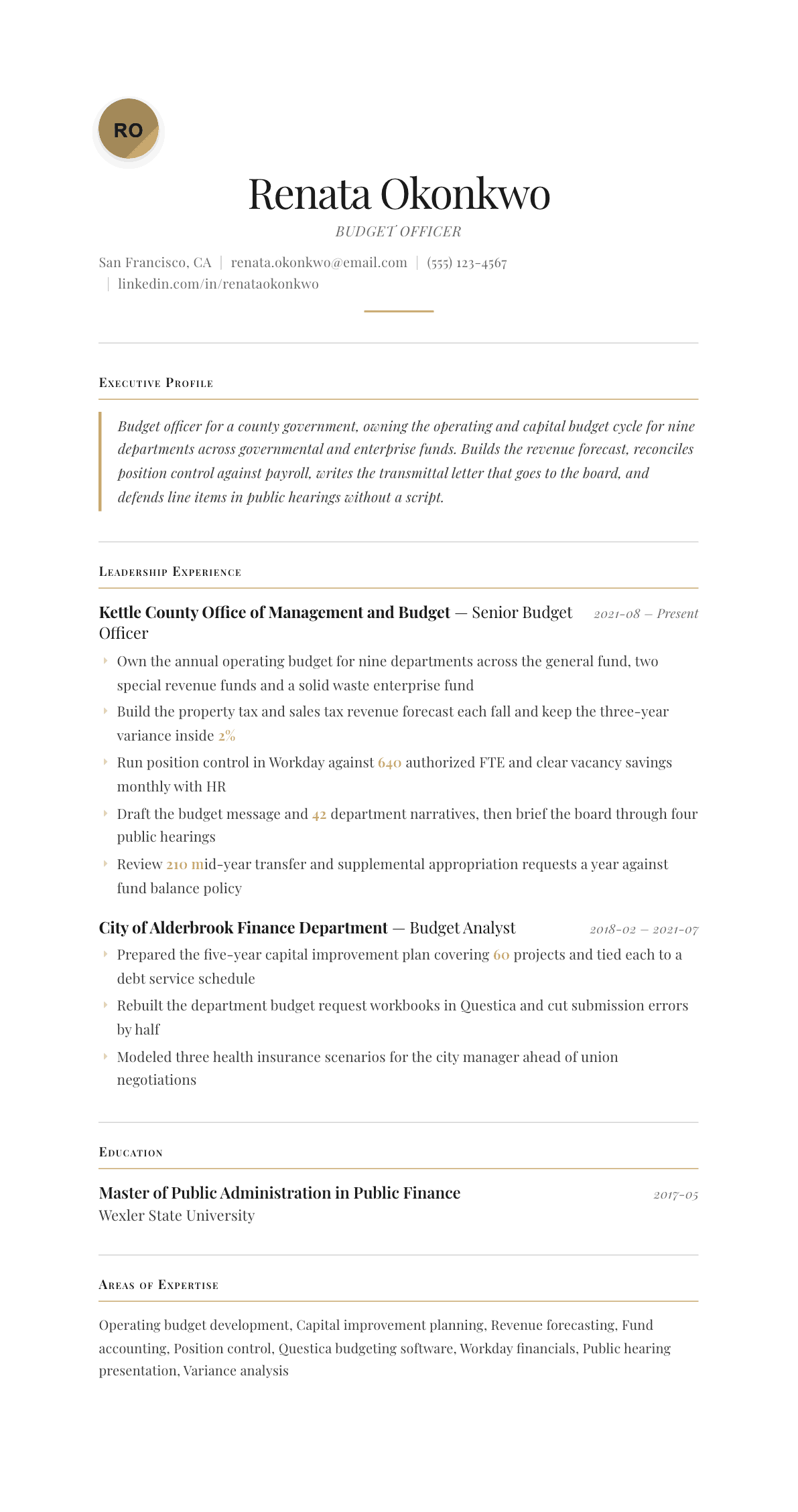
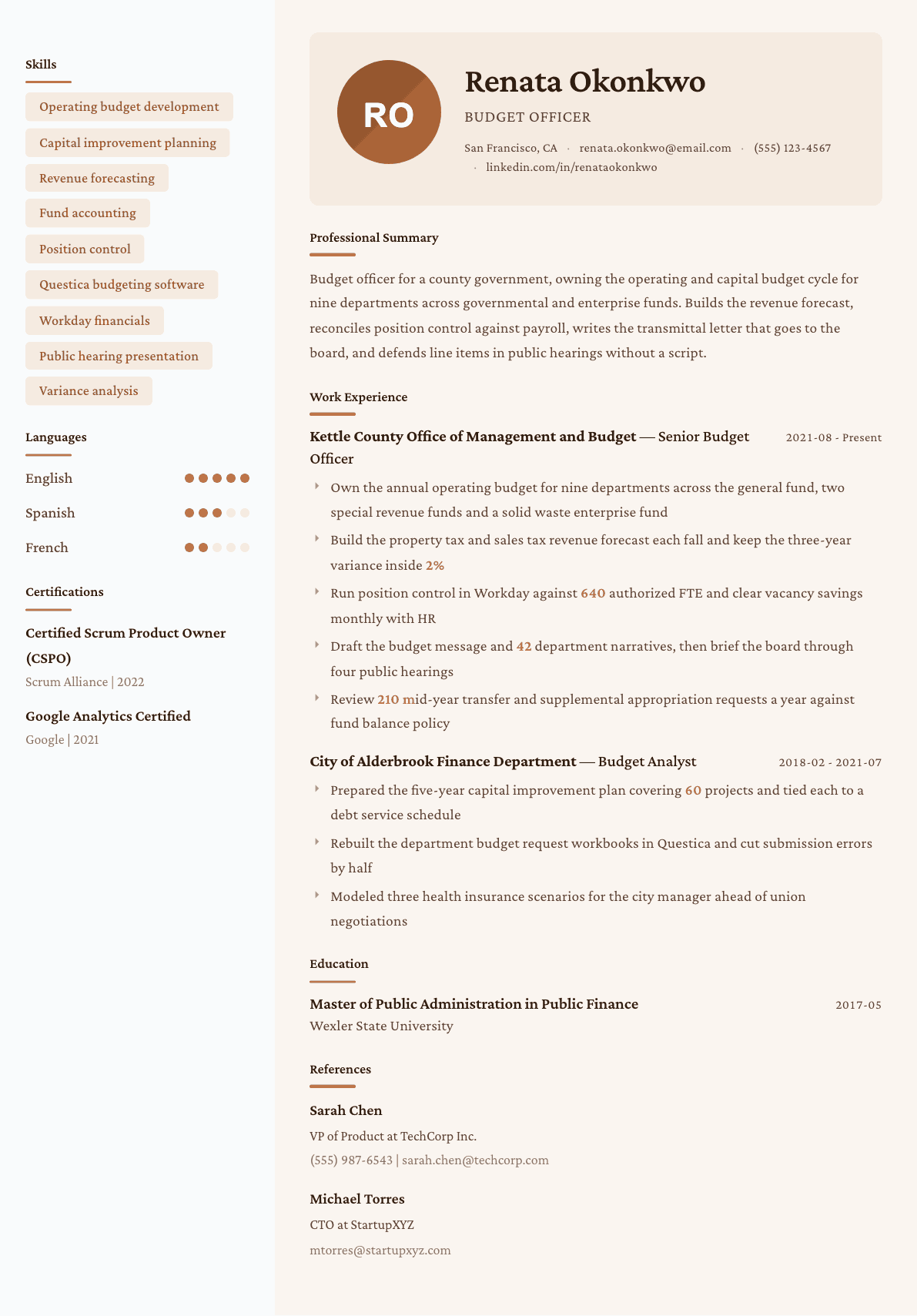
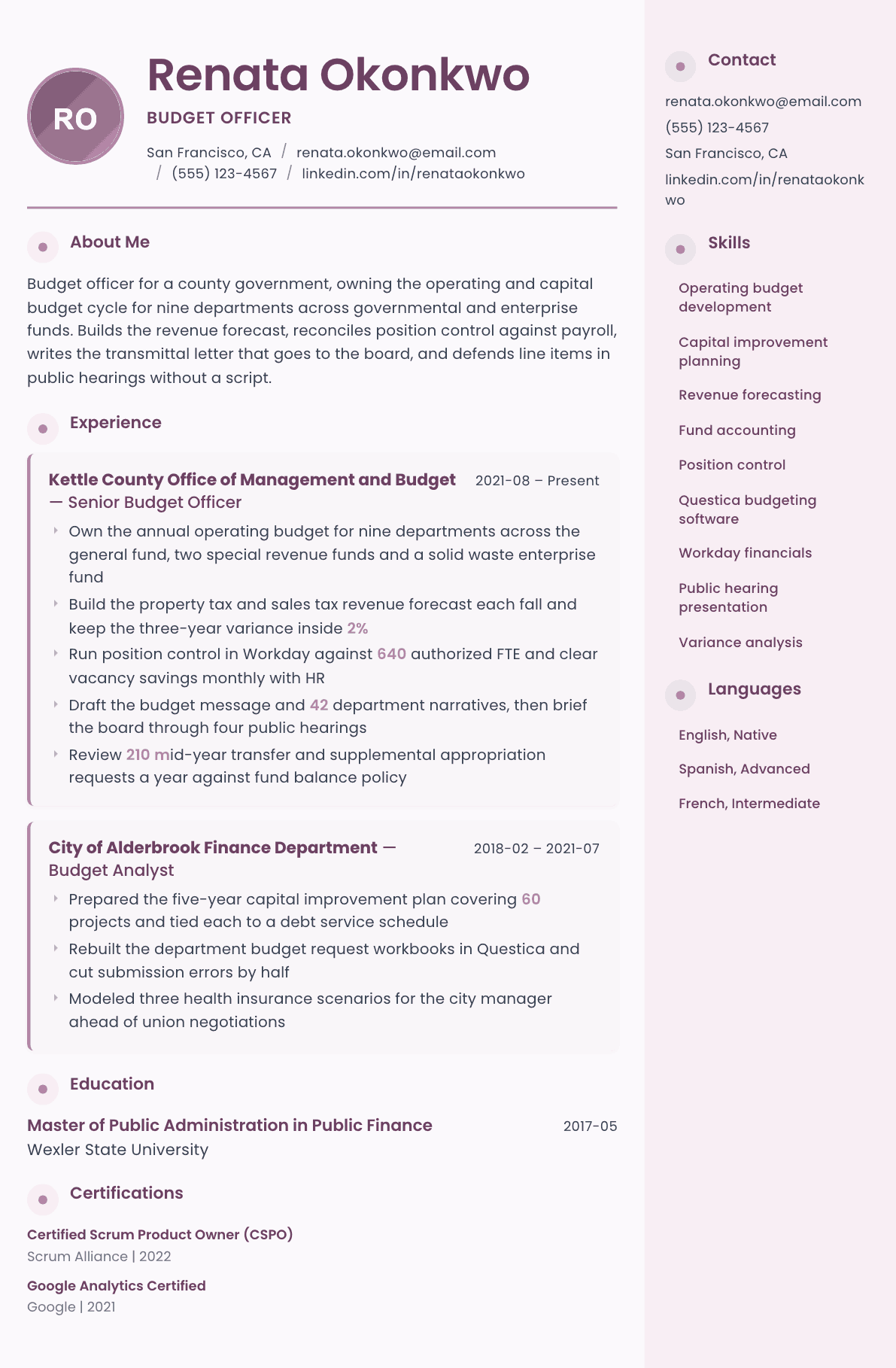
The same budget officer content laid out in three CVBooster templates, so you can see what the finished document looks like before you write a word.
Example Budget Officer summary
Budget officer with seven years across a city finance department and a county budget office, owning an operating budget spanning nine departments and four funds. Builds the property and sales tax forecast, runs position control against authorized FTE, drafts the budget message and department narratives, and briefs elected officials through public hearings. MPA in public finance, fluent in Questica and Workday.
Skills to list on a Budget Officer resume
- Operating budget preparation
- Capital improvement program
- Revenue forecasting
- Expenditure forecasting
- Fund accounting
- Governmental accounting standards
- Position control and FTE tracking
- Appropriation and transfer review
- Fund balance policy
- Debt service scheduling
- Cost allocation plans
- Grant budget monitoring
- Budget software administration
- Public hearing presentation
- Financial policy writing
- Multi-year financial planning
What actually gets this resume read
- Name the fund types you have worked, because general fund experience does not prove you can budget an enterprise fund.
- State the total operating budget you owned and how many departments reported into your cycle each year.
- Say which budgeting system you use, since a jurisdiction on Questica or Hyperion will not want to retrain you.
- Show the forecast you built and how close it landed, because accuracy is the number a finance director checks.
- Put public hearing and council briefing work on the page, since half the job is defending numbers out loud.
- List position control and vacancy savings work, which is where most of a government payroll variance actually lives.
- Mention the GFOA Distinguished Budget Presentation Award if your document earned it, and name your role in it.
How to write a budget officer resume
A finance director hiring a budget officer is filling a seat that has a calendar attached to it. Departments submit in the fall, the forecast has to hold, the recommended budget goes to the manager, and the board adopts before the fiscal year turns. The person in that seat cannot learn fund accounting during the cycle, so the resume has to prove the cycle has already been run somewhere else.
Most budget officer resumes read like a job description with the verbs changed: assisted with budget preparation, analyzed financial data, prepared reports. None of that tells a director whether you have built a property tax forecast, whether you know what happens to an appropriation when a department overspends in June, or whether you have stood at a podium while a council member asked why the parks line went up.
This guide covers the format a public finance office expects, how to write the summary and the experience section around funds and appropriations, three summaries for different career stages, before and after bullets, and the questions budget staff ask when they move between jurisdictions.
Format: one to two pages, funds and systems visible before the fold
Reverse chronological, one page early in a career and two once you have owned a full cycle in more than one jurisdiction. Public sector screening is often a scored process against minimum qualifications, so anything the posting names as required has to appear in words the reader can match without interpreting.
Put a short technical block under the summary listing fund types, budget systems and the financial ERP. A director scanning for enterprise fund experience should not have to read three job descriptions to find out whether you have it. If the recruitment is civil service, expect a rating panel that awards points against a checklist, and write so each checklist item has an obvious home.
- Jurisdiction line under each employer: government type, population served, number of funds and departments in your cycle.
- Technical block: budget software, financial ERP, forecasting tools, and the fund types you have prepared.
- A budget officer resume names the appropriation unit it worked at, whether department, program, fund or object level.
- Order the sections summary, technical block, experience, education, credentials, then public presentations if you have a list.
Summary: government type, budget scope, funds, and the cycle you own
Four facts belong in the first three lines: what kind of government you have worked in, how many departments and funds sit in your cycle, which parts of the cycle you own rather than support, and the systems you build in. A director reads that and knows whether you are a preparer, a reviewer or the person who owns the document.
Ownership language matters more here than in most fields. Assisting with the operating budget and owning it are different jobs with the same title, and a panel will ask you to describe the difference in the interview anyway. Say which one you did, then let the experience section carry the proof.
Experience: appropriations, forecasts, position control and the board
Structure each job around the four things a budget office actually produces: the revenue and expenditure forecast, the recommended budget document, the in-year appropriation control, and the analysis that goes to elected officials. If a bullet does not sit under one of those, ask whether it earns the line.
Forecast bullets should name the revenue stream and the method. Property tax built from assessed value and levy rate is a different exercise from a sales tax forecast tied to a regional economic series, and both are different from projecting ambulance fee collections. Where you can state how the forecast landed against actuals, do it, because forecast accuracy is the one number a finance director can check against the published report.
Position control is the piece candidates skip and directors care about. Personnel is the largest share of most operating budgets, and vacancy savings, step increases and benefit rate changes drive more variance than any supply line. A bullet on reconciling authorized FTE against payroll every month says more about your competence than a paragraph on analytical thinking.
Finish each job with the public-facing work: how many hearings, how many department briefings, what you wrote for the transmittal letter or budget message. Public finance is partly a communication job, and the resume should not hide that half.
Capital, debt and the multi-year view
Operating budget work alone will not qualify you for a senior seat. A budget officer is usually expected to touch the capital improvement plan, tie each project to a funding source, and understand what a bond issue does to the debt service line for the next two decades. Name the projects you scheduled and the funding mix behind them: pay as you go, general obligation, revenue bond, state revolving fund, grant match.
Multi-year financial planning is worth its own bullet. A five-year forecast that shows a structural gap and the options to close it is the kind of document that gets a budget officer promoted, and it is easy to describe concretely: the horizon, the assumptions, the scenarios and what the governing body did with it.
Keywords, credentials and the civil service application
Public postings recycle a narrow vocabulary: appropriation, encumbrance, fund balance, structural deficit, cost allocation, indirect cost rate, position control, capital improvement plan, transfer, supplemental. Use the exact terms the posting uses, once in the technical block and again inside a bullet where the work is visible.
Credentials carry real weight in this field. A master of public administration, the Certified Government Financial Manager designation, or a Government Finance Officers Association budget award on a document you helped produce all give a panel something to score. If your budget book earned the Distinguished Budget Presentation Award, say which sections you wrote rather than claiming the award as a personal one.
- Mirror the posting language for fund types instead of writing a generic phrase like all funds.
- Name the budget system: Questica, Hyperion, Adaptive, OpenGov or a workbook process built in Excel.
- Name the financial ERP: Tyler Munis, Workday, Oracle, Infor or SAP public sector.
- If the jurisdiction uses a supplemental questionnaire, answer it with the same numbers your resume carries.
Budget Officer resume summary examples
First budget job
Public administration graduate with an internship in a city budget office, building department request workbooks and tracking 90 line item transfers through the mid-year amendment. Comfortable with fund accounting basics, pivot table analysis and writing plain language narratives. Seeking a budget analyst seat in a municipal or county finance office.
Four years in
Budget analyst supporting nine departments across the general fund and two special revenue funds, preparing the annual request review, the mid-year forecast and the five-year capital improvement plan. Built the sales tax model that held within 2% for three consecutive years and rebuilt department workbooks in Questica.
Owns the budget cycle
Budget officer owning the full operating and capital cycle for a county with governmental and enterprise funds, from the department call letter to board adoption. Writes the budget message, runs position control against 640 authorized FTE, reviews all supplemental appropriations against fund balance policy, and presents at four public hearings each year.
Work experience bullets: before and after
Before: Assisted with the preparation of the annual budget.
After: Prepared the annual operating budget for nine departments across the general fund, two special revenue funds and a solid waste enterprise fund, from the department call letter through board adoption.
Naming the departments, the fund types and the span of the cycle turns vague assistance into a scope a director can price.
Before: Created revenue projections.
After: Built the property and sales tax revenue forecast from assessed value, levy rate and a regional retail series, and held three-year variance against actuals inside 2%.
The method and the accuracy make the forecast verifiable instead of asserted.
Before: Monitored department spending throughout the year.
After: Reviewed 210 transfer and supplemental appropriation requests a year against fund balance policy, and cleared monthly vacancy savings with human resources through position control in Workday.
It names the control mechanism and the volume, which is what in-year budget monitoring actually consists of.
Before: Presented budget information to leadership.
After: Drafted the budget message and 42 department narratives, then briefed the board of commissioners through four public hearings and answered line item questions on the record.
Writing the document and defending it in public are separate skills, and both are now visible.
Before: Worked on the capital plan.
After: Prepared the five-year capital improvement plan covering 60 projects, tied each to a funding source across pay as you go, general obligation debt and grant match, and modeled the resulting debt service line.
Project count and funding mix show capital literacy rather than participation in a document.
Hard skills
- Operating budget preparation
- Capital improvement program development
- Revenue and expenditure forecasting
- Fund accounting and fund structure
- Appropriation and transfer control
- Position control and FTE reconciliation
- Fund balance and reserve policy
- Debt service scheduling
- Cost allocation plans and indirect rates
- Grant budget setup and monitoring
- Multi-year financial planning
- Budget system administration
- Budget document and narrative writing
- Variance and trend analysis
Soft skills
- Explaining a fund structure to a department head who does not want to hear it
- Holding a deadline that cannot move
- Neutrality when a program has political support and weak numbers
- Composure at a podium during public comment
- Translating spreadsheet output into plain language
Certifications worth listing
- Certified Government Financial Manager (CGFM) (Association of Government Accountants)
- Certified Public Finance Officer (CPFO) (Government Finance Officers Association)
- Certified Public Accountant (CPA) (State Board of Accountancy)
Mistakes that cost budget officer candidates the interview
- Writing the total budget figure as the only measure of scope while leaving out the fund types and department count.
- Describing forecast work without naming the revenue stream or the method behind the projection.
- Leaving position control and vacancy savings off the page when personnel drives most of the variance.
- Claiming the Distinguished Budget Presentation Award as a personal credential instead of naming your sections.
- Ignoring the supplemental questionnaire in a civil service recruitment, which is often scored before the resume is read.
- Using private sector language like revenue growth targets in a role built on appropriations and legal spending limits.
Budget Officer resume questions
How long should a budget officer resume be?
One page for the first few years, two once you have owned a full cycle in more than one jurisdiction. Public sector panels read further than private recruiters do, so a second page that carries fund detail and hearing work is read rather than skipped.
Does private sector financial planning experience transfer to a budget officer role?
Partly. Forecasting and variance analysis carry over cleanly. What does not carry is fund accounting, appropriation law and the public adoption process, so translate your analytical work into fund language and take a governmental accounting course before you apply.
Should I list the total budget I managed?
Yes, but never alone. A total figure without the fund structure, department count and your actual role in the cycle tells a finance director nothing. Pair the number with how many funds it spanned and which parts of the process you owned.
How do I show budget work when my title was analyst rather than officer?
Describe the pieces you owned outright. If you built the forecast, wrote the narratives or ran position control, those are officer level tasks regardless of title, and a hiring panel scores tasks rather than job titles in most public recruitments.
What matters more, the MPA or an accounting credential?
It depends on where the budget office sits. A budget office inside a finance department leans toward accounting credentials and fund reporting, while one reporting to a city manager values policy analysis and public administration training. Read the posting and lead with the half it asks for.
Related resume examples
- Budget Analyst Resume example
- City Manager Resume example
- Government Accountant Resume example
- Public Administrator Resume example
- Community Development Manager Resume example
- Government Employee Resume example