Government Employee Resume Examples: what gets the call
Write a Government Employee Resume That Clears the HR Screen
By Mustafa Tarabya, founder of CVBooster · Published · Updated
Government employee resume example, keyword list and writing guide covering job announcements, specialized experience, grades and hiring paths.
Sample resumes for a government employee
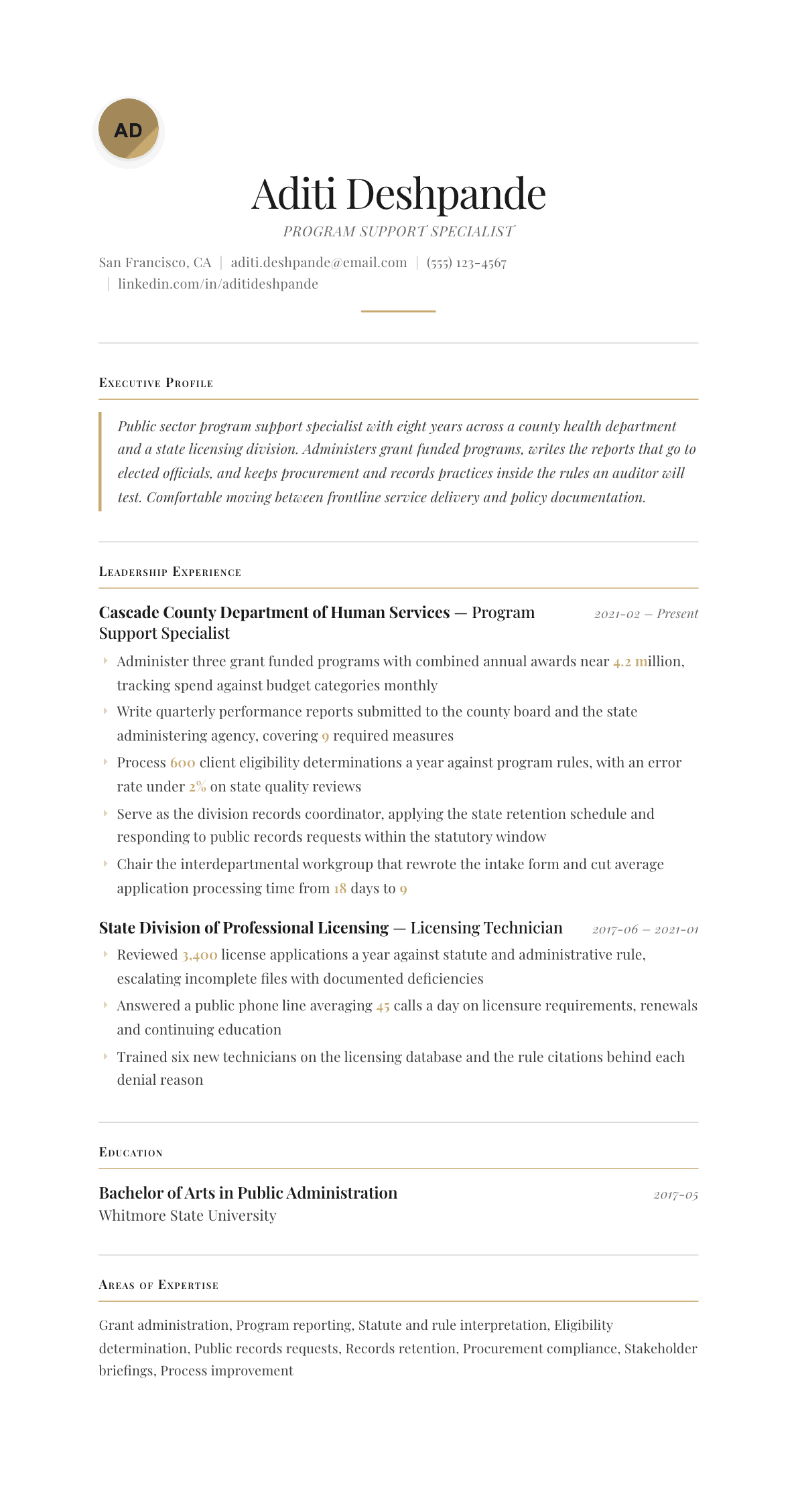
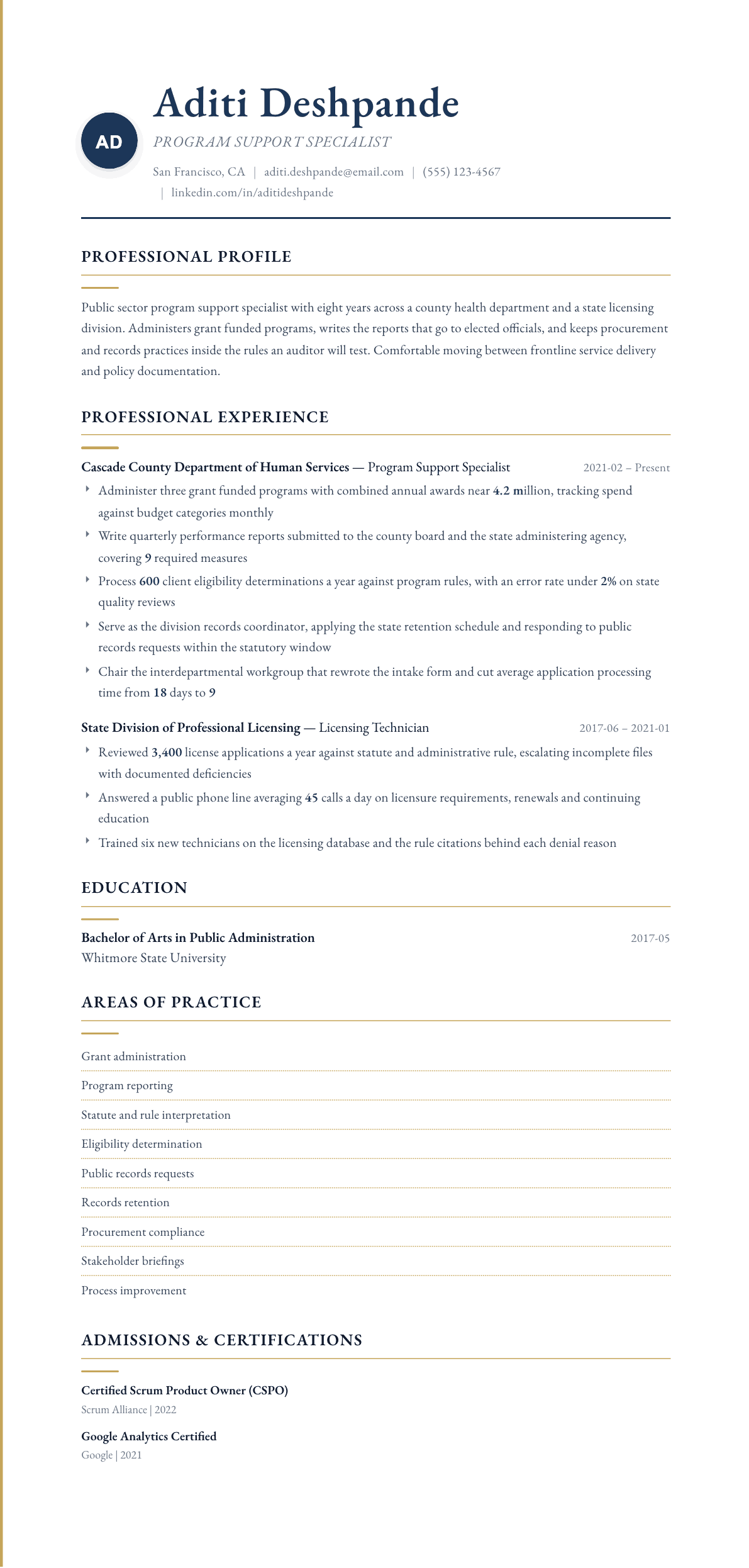
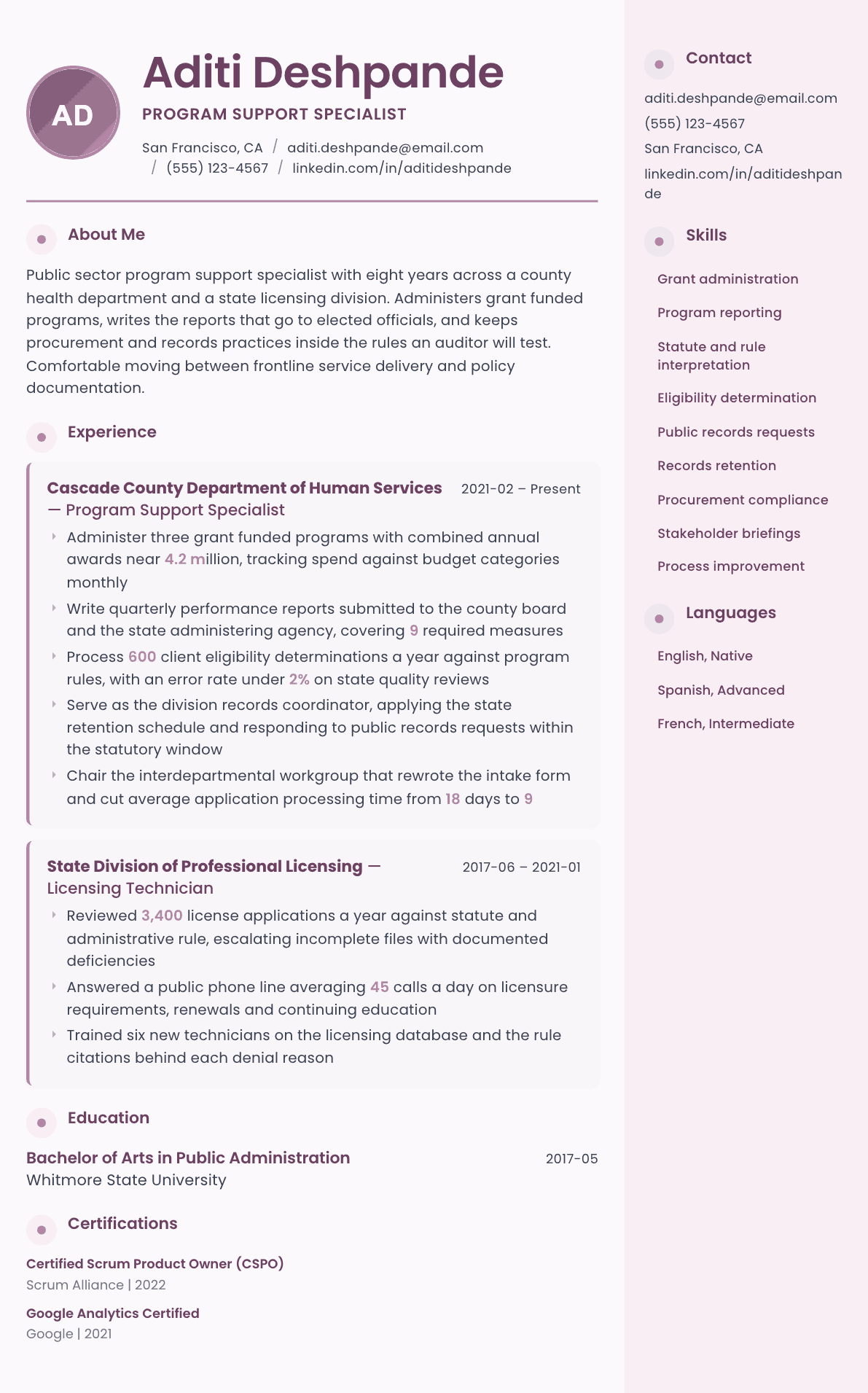
The same government employee content laid out in three CVBooster templates, so you can see what the finished document looks like before you write a word.
Example Government Employee summary
Public sector program support specialist with eight years across county human services and a state licensing division, administering grant funded programs and writing the performance reports that reach the county board. Determines eligibility against program rules with a low error rate on state quality reviews, serves as division records coordinator under the state retention schedule, and led the workgroup that halved application processing time.
Skills to list on a Government Employee resume
- Job announcement analysis
- Specialized experience narrative
- Grant funded program administration
- Budget tracking and reporting
- Statutory and regulatory interpretation
- Eligibility and case determination
- Public records and disclosure
- Records retention scheduling
- Procurement and contract compliance
- Performance measure reporting
- Interagency coordination
- Board and council briefings
- Policy and procedure writing
- Process improvement
- Constituent service
What actually gets this resume read
- Mirror the exact wording of the announcement, because public sector HR screens against the posted duty statement first.
- Write longer, denser entries than a private sector resume, since the reviewer scores content rather than skimming design.
- Give hours per week and the supervisor line for every position, which many public applications require to award credit.
- Name the statutes, rules or program manuals you work under, because that is how specialized experience is proven.
- State your current classification, grade or step and the eligibility you hold, so the screener can place you.
- Quantify caseloads, application volumes and processing times, since agencies score workload evidence over adjectives.
How to write a government employee resume
A government employee resume is scored before it is read. Whoever posted the vacancy wrote a duty statement, and a human resources analyst holds your document against that statement looking for evidence of each duty. Only after you clear that screen does the hiring supervisor read for judgment. Writing for the second reader while ignoring the first is how strong candidates get rated not qualified.
That is the opposite of private sector advice. A one page document with tight, clever phrasing loses points here, because the screener is counting demonstrated duties, not admiring economy. Length is allowed. Vagueness is not. Every duty you claim needs a volume, a rule you applied, a system you used, or a product you produced.
This guide covers how to read a vacancy announcement before writing a line, how to build the experience block a public sector screener can score, how to talk about statutes and program rules without sounding like a lawyer, three summaries by level, and rewritten bullets that convert routine duties into scoreable evidence.
Start with the announcement, not the resume
Print the vacancy announcement and mark the duty statement, the minimum qualifications and the desirable qualifications. Those three blocks are the scoring sheet. Every one of them needs a corresponding piece of evidence somewhere in your experience section, ideally using the announcement's own nouns.
Government postings reuse vocabulary across agencies because they are built from classification specifications. Terms such as administers, coordinates, analyzes, prepares reports, interprets policy, monitors compliance and provides technical assistance appear over and over. Mirroring them is not keyword stuffing, it is speaking the language the screener was handed.
- Highlight each duty in the announcement and write one bullet that proves it.
- Confirm you meet every minimum qualification and say so explicitly, including months of experience.
- Keep a master document with every duty you have performed, then cut it down per announcement.
Format: fuller than a private sector resume, still structured
Two to four pages is normal for a public sector application, and many agency systems accept more. Use a plain layout with clear headings, because agency application portals often strip formatting and a two column design will arrive scrambled.
Include employer name, your official classification title, the working title if it differs, dates by month and year, and hours worked per week. Several agencies will not credit experience without hours, and part time work is prorated. Supervisor name and whether they may be contacted belongs on each position when the application asks.
- Position heading: agency or department, division, official classification title, dates, hours per week.
- Sections in order: summary of qualifications, professional experience, education, training, licenses.
- Add a certificates and training block, since agencies credit completed courses that private employers ignore.
Experience: authority, volume, rules, product
A strong public sector bullet answers four questions at once. What authority did you exercise, how much of it did you handle, which rule or manual governed the work, and what came out the other end. A determination made under a program rule, a report submitted to a board, a contract monitored against deliverables, a records request answered inside a statutory deadline.
Volume matters more here than in most fields, because caseload is how a public agency measures capacity. Applications processed, determinations issued, calls answered, inspections conducted, requests fulfilled and reports produced all belong on the page with counts and cycles attached.
Governance work is undersold on almost every government resume. Chairing a workgroup, rewriting a form, retraining a division on a revised process and reducing a processing time are the achievements that distinguish an analyst from a technician, and they belong near the top of each position.
Money, grants and procurement
If you have touched public funds, say exactly how. Administering a grant award, tracking spend against budget categories, preparing a spend plan adjustment, reconciling obligations, or writing the performance report the funder requires are separate skills, and an agency hiring for budget adjacent work wants to know which ones you have.
Procurement is the same. Writing a scope of work, participating in an evaluation panel, monitoring a vendor contract against deliverables and documenting a performance problem before renewal are all distinct duties. Describe the ones you performed and name the threshold rules you worked under without inventing statute citations you cannot support.
Public records, transparency and the audit trail
Documentation discipline is a real qualification in public service. Applying a records retention schedule, logging and fulfilling public records requests inside the statutory window, preparing files that survive an audit and maintaining decision documentation are all worth their own bullets, and most candidates omit them entirely.
The same is true of constituent and stakeholder contact. Answering an elected official's inquiry, briefing a board or council, and handling a complaint that could escalate politically are duties that a supervisor screens for even when the announcement words them blandly.
Government Employee resume summary examples
First public sector role
Public administration graduate with an internship in a county clerk office and two years in a call center handling benefit inquiries. Applied written policy to 45 daily contacts, documented every determination in a case system, and completed the state records management training required for division staff.
Program support specialist
Program support specialist with eight years across county human services and a state licensing division. Administers three grant funded programs, writes the quarterly performance reports submitted to the county board, and chaired the workgroup that cut average application processing time from 18 days to 9.
Division manager
Public sector division manager supervising 14 staff across eligibility, records and constituent services. Owns the division budget and the annual internal control review, represents the department in interagency negotiations, and has carried three program rule changes from drafting through staff training.
Work experience bullets: before and after
Before: Processed applications for program eligibility.
After: Processed 600 client eligibility determinations a year against published program rules, documenting each determination in the case system with an error rate under 2% on state quality reviews.
Volume, the governing rule and an audited quality measure give the screener something scoreable.
Before: Prepared reports for management and the board.
After: Wrote quarterly performance reports covering 9 required measures, submitted to the county board and the state administering agency, and presented the findings at two public meetings.
Naming the measures, the recipients and the public presentation shows the product and its audience.
Before: Handled public records requests.
After: Served as division records coordinator, applying the state retention schedule and responding to 180 public records requests within the statutory window without a single late determination.
The role, the schedule and the deadline record demonstrate a compliance duty rather than a clerical task.
Before: Helped improve department processes.
After: Chaired the interdepartmental workgroup that rewrote the intake form and routing path, cutting average application processing time from 18 days to 9 across three offices.
Leading the group and reporting the before and after turns process talk into a documented improvement.
Before: Managed grant funds for several programs.
After: Administered three grant funded programs, tracking spend against budget categories monthly, preparing spend plan adjustments and filing every funder report on the required schedule.
Breaking grant work into its actual duties tells a budget office exactly what you can be handed.
Hard skills
- Vacancy announcement and duty statement analysis
- Grant funded program administration
- Budget tracking and spend plan adjustment
- Statute and administrative rule interpretation
- Eligibility and case determination
- Performance measure reporting
- Public records request response
- Records retention scheduling
- Procurement and contract monitoring
- Policy and procedure writing
- Case management systems
- Board and council briefing materials
- Internal control review
- Interagency coordination
Soft skills
- Impartial application of policy
- Written clarity for a public audience
- Patience with regulated processes
- Discretion with confidential records
- Working with elected officials
- De-escalation with frustrated constituents
Certifications worth listing
- Certified Public Manager (CPM) (National Certified Public Manager Consortium)
- Certified Government Financial Manager (CGFM) (Association of Government Accountants)
- Certified Records Manager (CRM) (Institute of Certified Records Managers)
- Project Management Professional (PMP) (Project Management Institute)
Mistakes that cost government employee candidates the interview
- Trimming a public sector application to one page, which strips out the very evidence the screener is counting.
- Ignoring the duty statement and submitting a general resume, the single most common cause of a not qualified rating.
- Omitting hours per week, which prevents several agencies from crediting the experience at all.
- Describing duties without volumes, so a caseload driven agency cannot judge whether you can carry the workload.
- Writing see resume in application fields, which many jurisdictions treat as an incomplete submission.
- Claiming familiarity with statutes you cannot discuss, since an interview panel will ask which rule governed a decision.
Government Employee resume questions
How long should a government resume be?
Longer than a private sector one. Two to four pages is normal because the screener scores demonstrated duties rather than skimming for impressions. Cut filler, not evidence, and let each position carry as many bullets as it takes to cover the announcement duties.
Do I need to tailor for every announcement?
Yes, and it is faster than it sounds. Keep one long master document with every duty you have performed, then for each vacancy delete what the duty statement does not ask for and reorder the rest so the first bullets match the first duties listed.
Should I include supervisor names and contact permission?
Include them when the application asks, and answer the contact question honestly. Marking a current supervisor as do not contact is common and rarely held against you, but leaving the field blank can stall a file while human resources follows up.
How do I move from the private sector into government work?
Translate your work into public sector duty language. Compliance, documentation, recordkeeping, budget tracking, vendor monitoring and constituent facing service all exist in private roles under different names, and naming them the way the announcement does is most of the work.
Are volunteer and unpaid roles worth listing?
Yes, when the duties match the announcement. Many jurisdictions credit relevant volunteer experience if you list the hours per week and the dates the same way you would a paid position, which is a real advantage for candidates changing fields.
Related resume examples
- Public Administrator Resume example
- City Employee Resume example
- Policy Analyst Resume example
- Budget Officer Resume example
- Housing Authority Specialist Resume example
- Federal Government Resume example