Sixth Form Personal Statement Examples: 6 Full Samples
By Mustafa Tarabya, founder of CVBooster · Published · Updated
10 min read
A good sixth form personal statement does four jobs in a few short paragraphs: it says why you want those courses, shows what in your GCSE studies prepared you, gives one or two things you have done outside lessons, and ends with where you hope the courses lead. The sixth form personal statement examples below do exactly that for A levels, a BTEC and a T level, plus a UCAS statement for when you are already in Year 13. The one constraint is honesty: UCAS warns that "you might be asked about what you have written" at an interview. The structure follows UCAS guidance for further education and for university. Written by Mustafa Tarabya, who hired for his own company, read every application himself and now writes CVBooster's guides.
You are fifteen or sixteen, you have mocks next week, and a form is asking you to explain your whole future in a box. Nobody expects a life plan. They expect a reason and some evidence.
A sixth form personal statement example for A level sciences
UCAS's further education guide tells you to "Explain why you want to do your chosen course(s)" and to write about how your current studies relate to them. Start with the subject, not with yourself.
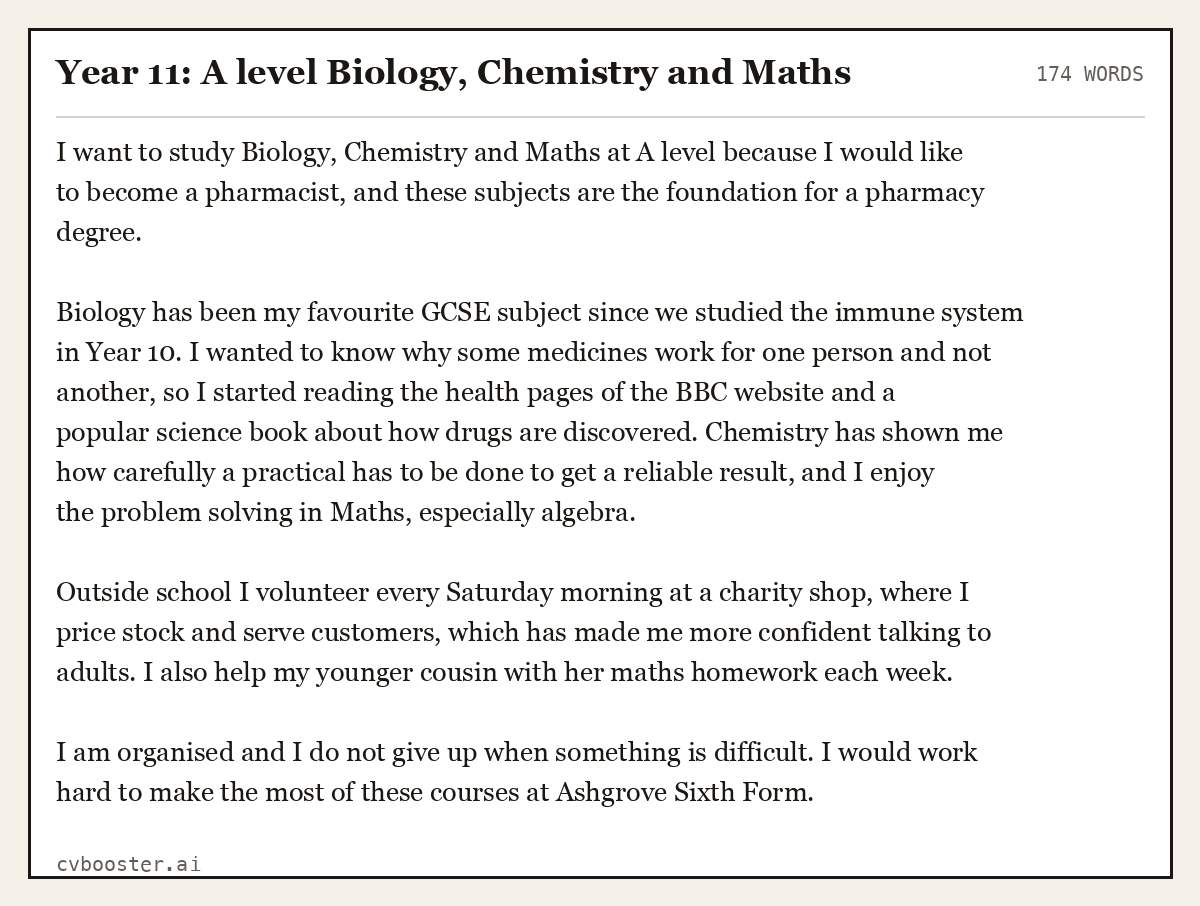
Year 11: A level Biology, Chemistry and Maths (174 words)
I want to study Biology, Chemistry and Maths at A level because I would like to become a pharmacist, and these subjects are the foundation for a pharmacy degree.
Biology has been my favourite GCSE subject since we studied the immune system in Year 10. I wanted to know why some medicines work for one person and not another, so I started reading the health pages of the BBC website and a popular science book about how drugs are discovered. Chemistry has shown me how carefully a practical has to be done to get a reliable result, and I enjoy the problem solving in Maths, especially algebra.
Outside school I volunteer every Saturday morning at a charity shop, where I price stock and serve customers, which has made me more confident talking to adults. I also help my younger cousin with her maths homework each week.
I am organised and I do not give up when something is difficult. I would work hard to make the most of these courses at Ashgrove Sixth Form.
What to include in a sixth form personal statement
Most sixth forms and colleges ask for a short statement on the application form. Check the form for a word or character limit and stick to it. Then cover these points, in this order:
- Why these courses. One clear reason per subject, or one reason for the combination.
- How your GCSEs connect. A topic you enjoyed, a project, a teacher's comment.
- Achievements. UCAS suggests writing about "anything you are proud of passing, for example, grade 2 in piano, or being selected for a sports team."
- Responsibilities and activities. Prefect, buddy scheme, sport, music, Duke of Edinburgh.
- Work experience or a part-time job. UCAS says to "Also include any part-time work you are still doing, like a Saturday job or babysitting."
- Your future plans. A career, a degree or simply the next step.
You do not have to stay at school after Year 11 in England, but GOV.UK explains when you can leave school and that "You must then do one of the following until you're 18," which includes full-time education, an apprenticeship, or working or volunteering while in part-time study. A sixth form application is one of those routes.
Personal statement for sixth form: humanities and English
For essay subjects, show that you read beyond the syllabus. A single book or documentary with one sentence on why it mattered is enough.
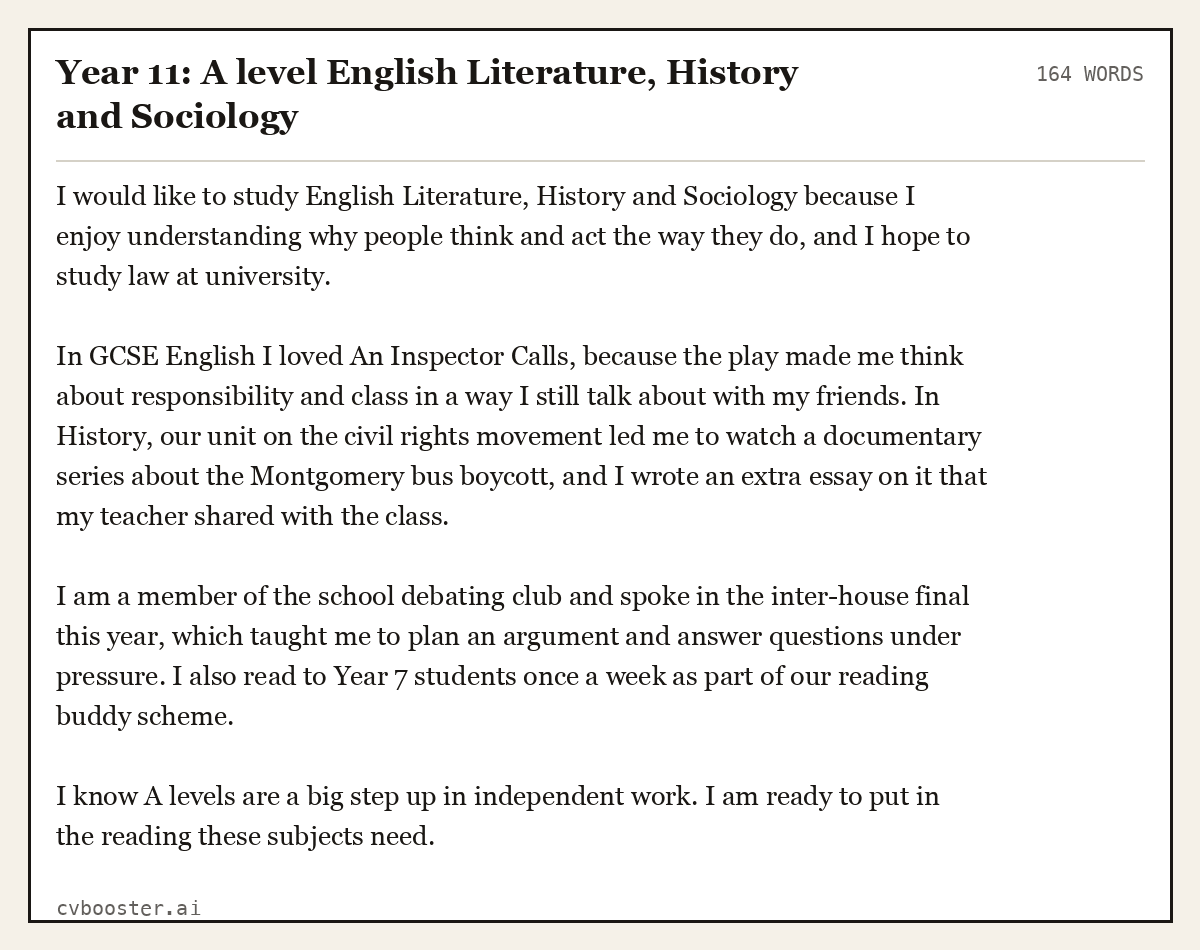
Year 11: A level English Literature, History and Sociology (164 words)
I would like to study English Literature, History and Sociology because I enjoy understanding why people think and act the way they do, and I hope to study law at university.
In GCSE English I loved An Inspector Calls, because the play made me think about responsibility and class in a way I still talk about with my friends. In History, our unit on the civil rights movement led me to watch a documentary series about the Montgomery bus boycott, and I wrote an extra essay on it that my teacher shared with the class.
I am a member of the school debating club and spoke in the inter-house final this year, which taught me to plan an argument and answer questions under pressure. I also read to Year 7 students once a week as part of our reading buddy scheme.
I know A levels are a big step up in independent work. I am ready to put in the reading these subjects need.
Sixth form application personal statement for a BTEC
For vocational courses, lean on experience: a placement, a job, a family business. UCAS says to "Try to show how this experience gave you new skills or made you think about your future plans."
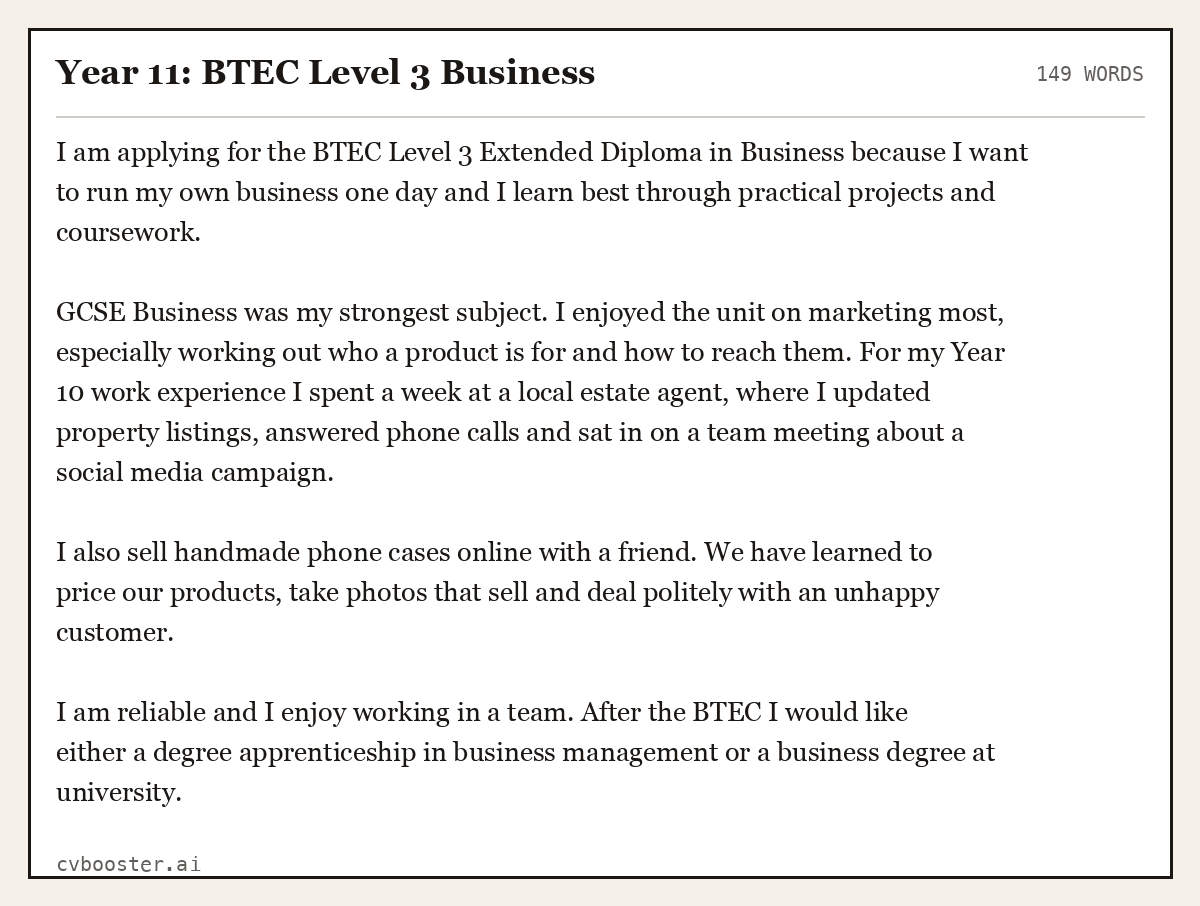
Year 11: BTEC Level 3 Business (149 words)
I am applying for the BTEC Level 3 Extended Diploma in Business because I want to run my own business one day and I learn best through practical projects and coursework.
GCSE Business was my strongest subject. I enjoyed the unit on marketing most, especially working out who a product is for and how to reach them. For my Year 10 work experience I spent a week at a local estate agent, where I updated property listings, answered phone calls and sat in on a team meeting about a social media campaign.
I also sell handmade phone cases online with a friend. We have learned to price our products, take photos that sell and deal politely with an unhappy customer.
I am reliable and I enjoy working in a team. After the BTEC I would like either a degree apprenticeship in business management or a business degree at university.
Sixth form personal statement example for a T level
T level applications go to colleges and some sixth forms. Show you understand the industry placement and that you are ready for it.
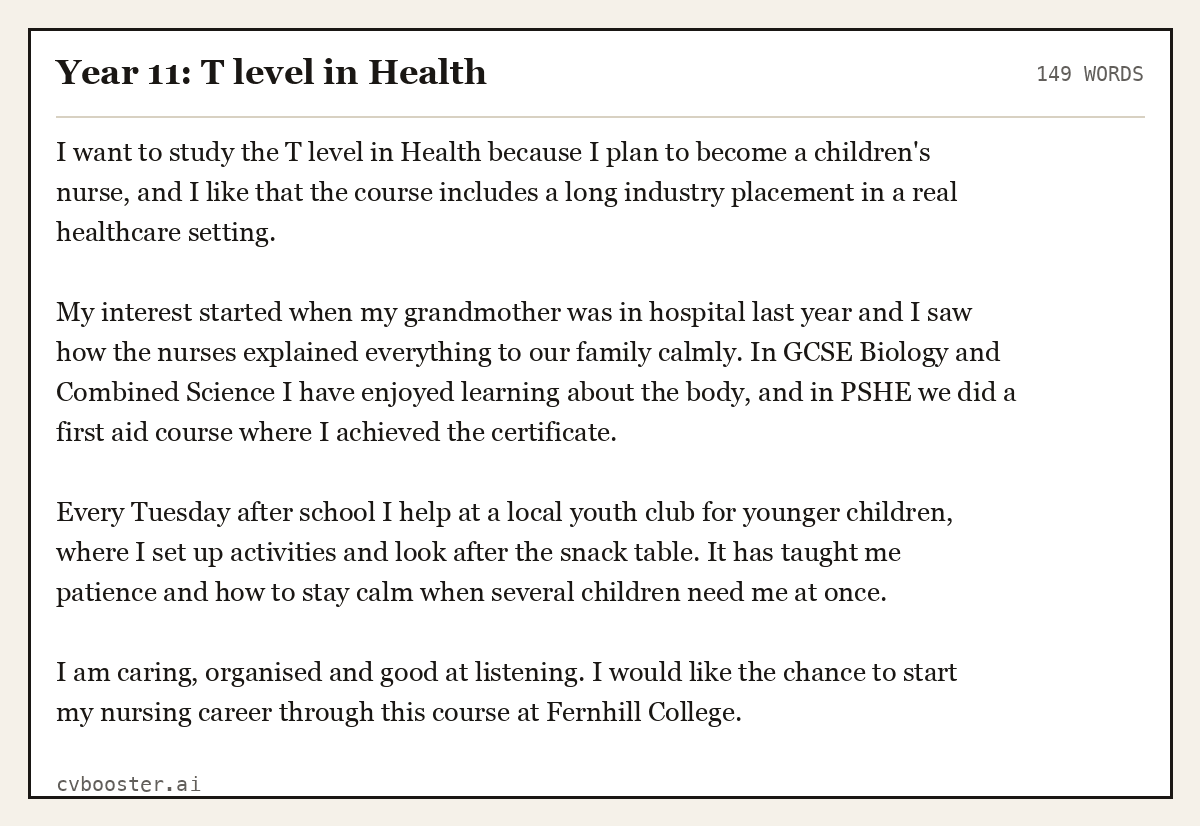
Year 11: T level in Health (149 words)
I want to study the T level in Health because I plan to become a children's nurse, and I like that the course includes a long industry placement in a real healthcare setting.
My interest started when my grandmother was in hospital last year and I saw how the nurses explained everything to our family calmly. In GCSE Biology and Combined Science I have enjoyed learning about the body, and in PSHE we did a first aid course where I achieved the certificate.
Every Tuesday after school I help at a local youth club for younger children, where I set up activities and look after the snack table. It has taught me patience and how to stay calm when several children need me at once.
I am caring, organised and good at listening. I would like the chance to start my nursing career through this course at Fernhill College.
Personal statement for sixth form: creative subjects
For art, media or music, point to work you have made. One piece described properly says more than a list of everything you have tried.
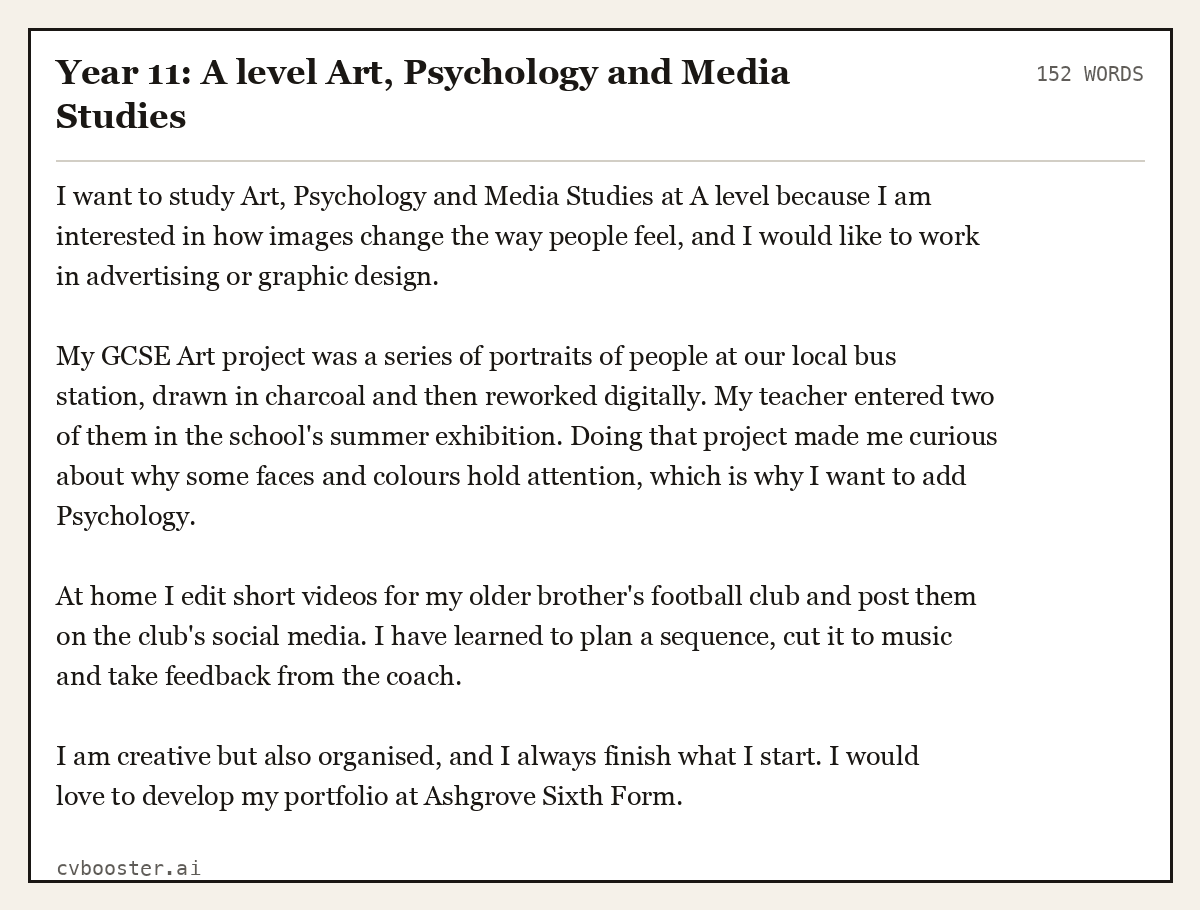
Year 11: A level Art, Psychology and Media Studies (152 words)
I want to study Art, Psychology and Media Studies at A level because I am interested in how images change the way people feel, and I would like to work in advertising or graphic design.
My GCSE Art project was a series of portraits of people at our local bus station, drawn in charcoal and then reworked digitally. My teacher entered two of them in the school's summer exhibition. Doing that project made me curious about why some faces and colours hold attention, which is why I want to add Psychology.
At home I edit short videos for my older brother's football club and post them on the club's social media. I have learned to plan a sequence, cut it to music and take feedback from the coach.
I am creative but also organised, and I always finish what I start. I would love to develop my portfolio at Ashgrove Sixth Form.
UCAS personal statement examples from sixth form students
If you searched this because you are in Year 12 or 13, you need the UCAS statement for university. UCAS's guide for 2026 entry onwards says it "has changed recently from one longer piece of text to three separate questions," and "Each answer will have a minimum character count of 350 characters." The total is 4,000 characters including spaces.
The three questions are: why do you want to study this course or subject; how have your qualifications and studies helped you to prepare; and what else have you done to prepare outside of education, and why are these experiences useful.
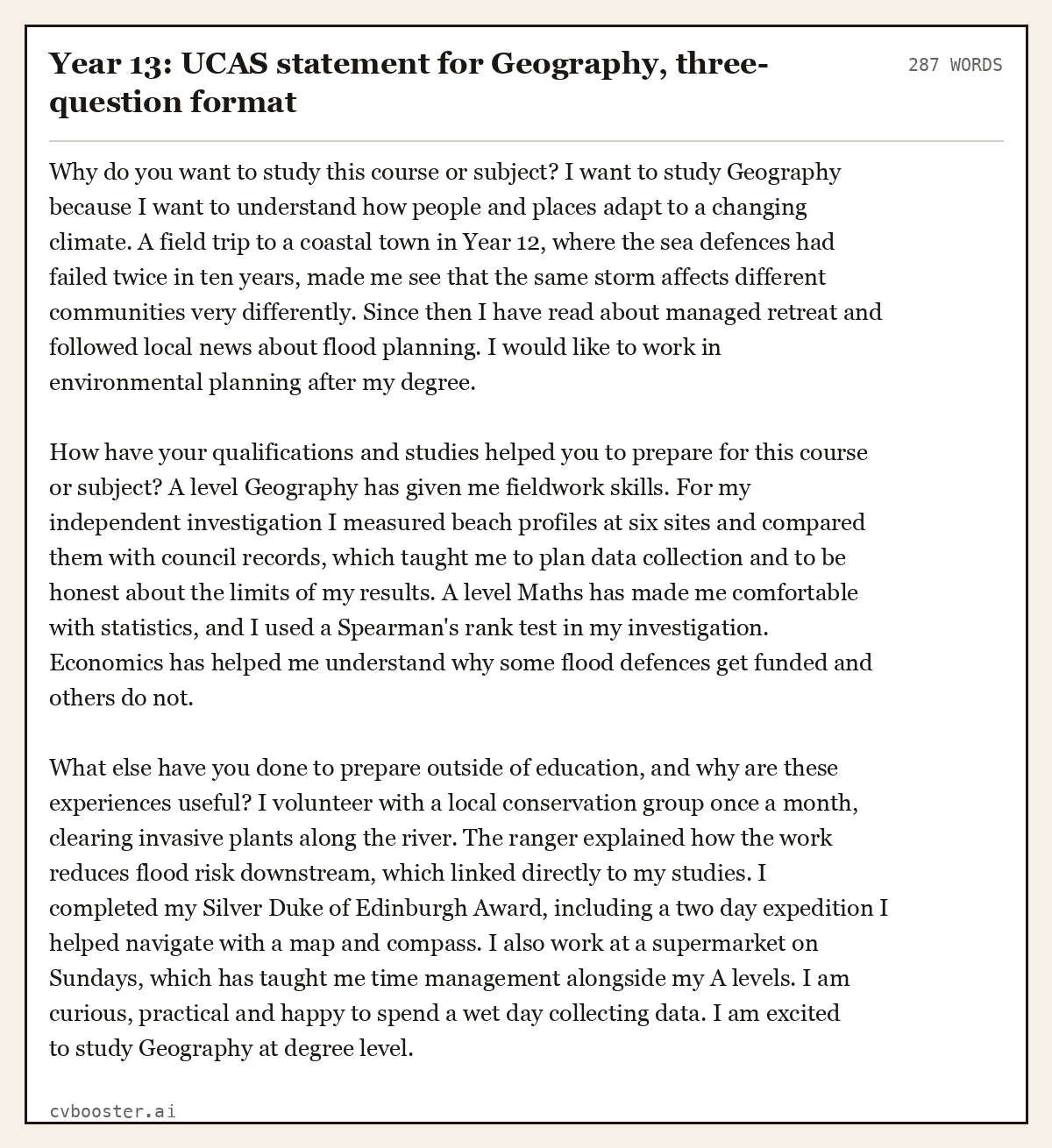
Year 13: UCAS statement for Geography, three-question format (287 words)
Why do you want to study this course or subject? I want to study Geography because I want to understand how people and places adapt to a changing climate. A field trip to a coastal town in Year 12, where the sea defences had failed twice in ten years, made me see that the same storm affects different communities very differently. Since then I have read about managed retreat and followed local news about flood planning. I would like to work in environmental planning after my degree.
How have your qualifications and studies helped you to prepare for this course or subject? A level Geography has given me fieldwork skills. For my independent investigation I measured beach profiles at six sites and compared them with council records, which taught me to plan data collection and to be honest about the limits of my results. A level Maths has made me comfortable with statistics, and I used a Spearman's rank test in my investigation. Economics has helped me understand why some flood defences get funded and others do not.
What else have you done to prepare outside of education, and why are these experiences useful? I volunteer with a local conservation group once a month, clearing invasive plants along the river. The ranger explained how the work reduces flood risk downstream, which linked directly to my studies. I completed my Silver Duke of Edinburgh Award, including a two day expedition I helped navigate with a map and compass. I also work at a supermarket on Sundays, which has taught me time management alongside my A levels. I am curious, practical and happy to spend a wet day collecting data. I am excited to study Geography at degree level.
Common mistakes in sixth form statements
- Copying an example. Use these to see the shape, then write your own. Teachers and admissions tutors read a lot of statements and notice copied ones.
- Listing grades. The form already asks for your predicted grades. UCAS makes the same point for university: grades appear elsewhere on your application.
- Leaving it late. UCAS advises: "Don't leave it until the last minute."
- Exaggerating. If you say you love reading, be ready to name a book.
Once you have a part-time job to go with your studies, the CV personal statement examples show how to turn the same material into a CV profile. Older applicants writing a statement for work rather than study can follow how to write a personal statement for a job, and a CV personal statement with no experience helps with a first Saturday job. Postgraduate applicants should see the master's personal statement guide instead.
Frequently asked questions
How long should a sixth form personal statement be?
Follow the limit on the application form, which varies between schools and colleges. Where none is given, a few short paragraphs is usually enough: one on why you chose the courses, one on your studies, one on activities and experience, and a closing line on your plans. Clear and specific beats long.
What do you write in a sixth form personal statement?
Write why you want your chosen courses, how your GCSE subjects connect to them, your achievements and responsibilities, any work experience or part-time job, and what you hope to do afterwards. UCAS's further education guide recommends exactly these areas, and asks you to link hobbies to skills you will need on the course.
Do sixth forms read personal statements?
Yes. Sixth forms and colleges use the statement to check that you have thought about your choices and to prepare questions for an interview or enrolment meeting if they hold one. Your predicted GCSE grades and school reference usually matter alongside it, so the statement supports your application rather than replacing them.
Is a sixth form personal statement the same as a UCAS personal statement?
No. A sixth form statement is written in Year 11 for A level, BTEC or T level courses and is usually short. A UCAS personal statement is written in Year 12 or 13 for university. For 2026 entry onwards it answers three set questions within 4,000 characters, with at least 350 characters for each answer.
Can I use the same personal statement for different sixth forms?
You can reuse most of it, but change the parts that name the school or college and adjust the course reasons if your choices differ. If one sixth form offers something specific, such as an extended project or a particular BTEC, mention it on that application.
Related articles
- Sample MBA Recommendation Letters: 6 Examples That Work
- Nanny Reference Letter: 7 Samples for Parents and Employers
- Acceptance Resignation Letter: 6 Samples for Employers
- How to Write Resignation Letter Email: 6 Canadian Examples
More articles
- Skills Based CV Template and Format: 6 UK Examples
- Skills to Put on a Job Application Form
- Skills to Put on a Resume (and What to Cut)
Looking for a worked example for your job title? Browse the resume examples by job title.