Operations Analyst Resume Examples: the lines they read
Make an Operations Analyst Resume That Shows the Analysis
By Mustafa Tarabya, founder of CVBooster · Published · Updated
An operations analyst resume guide with a sample profile, SQL and dashboard examples, the metrics hiring managers ask about, and a full keyword list.
Sample resumes for a operations analyst
The same operations analyst content laid out in three CVBooster templates, so you can see what the finished document looks like before you write a word.
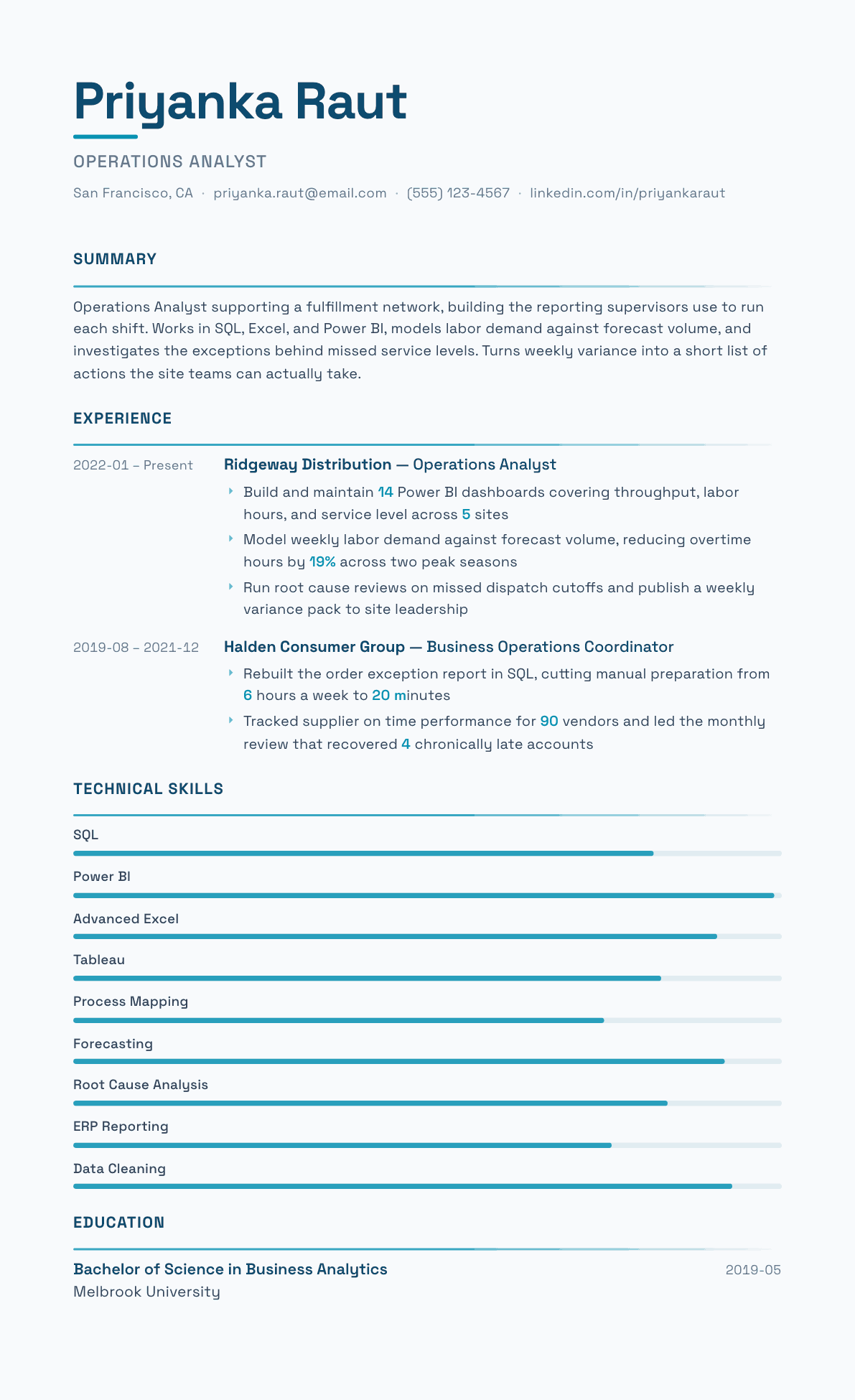
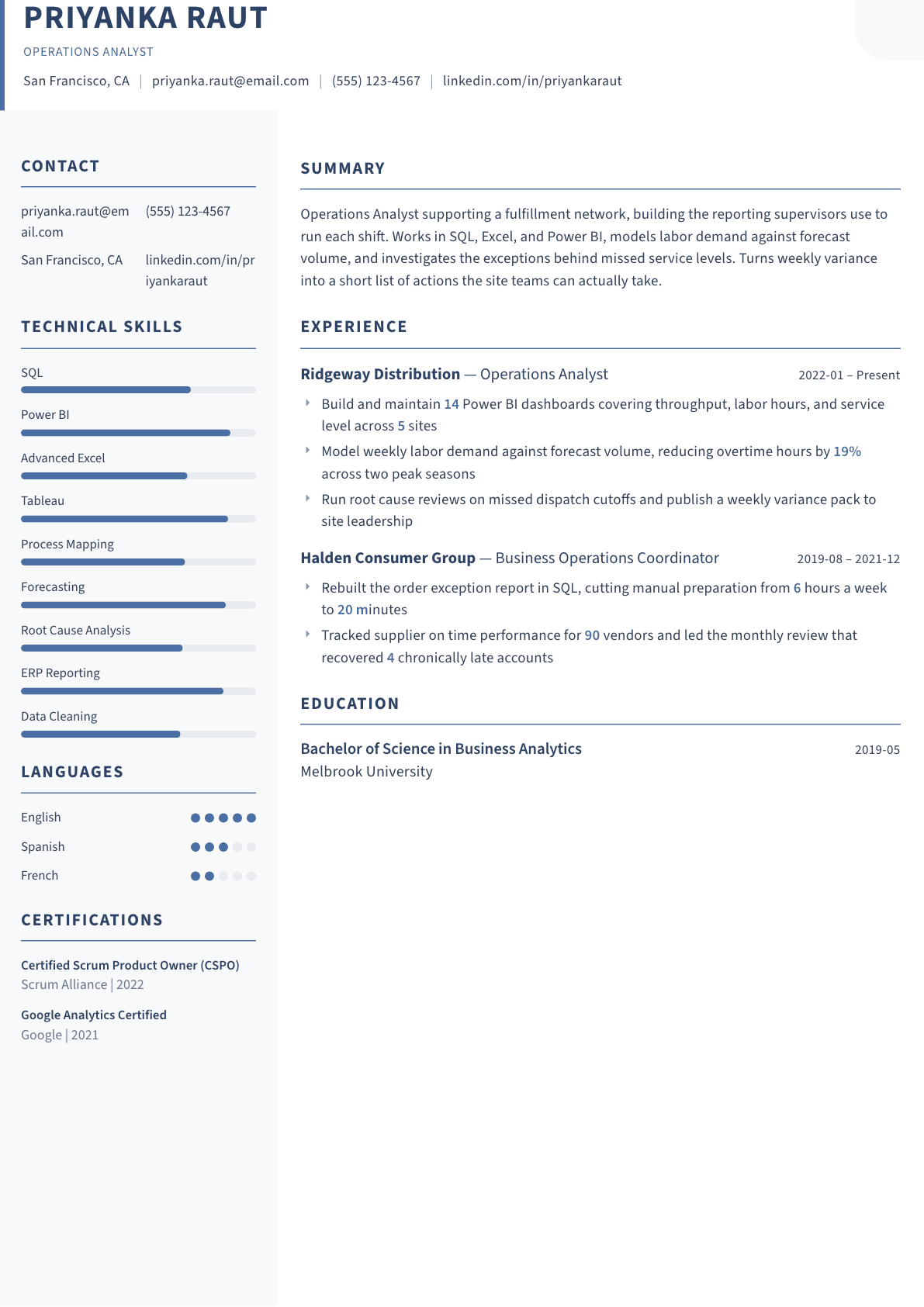
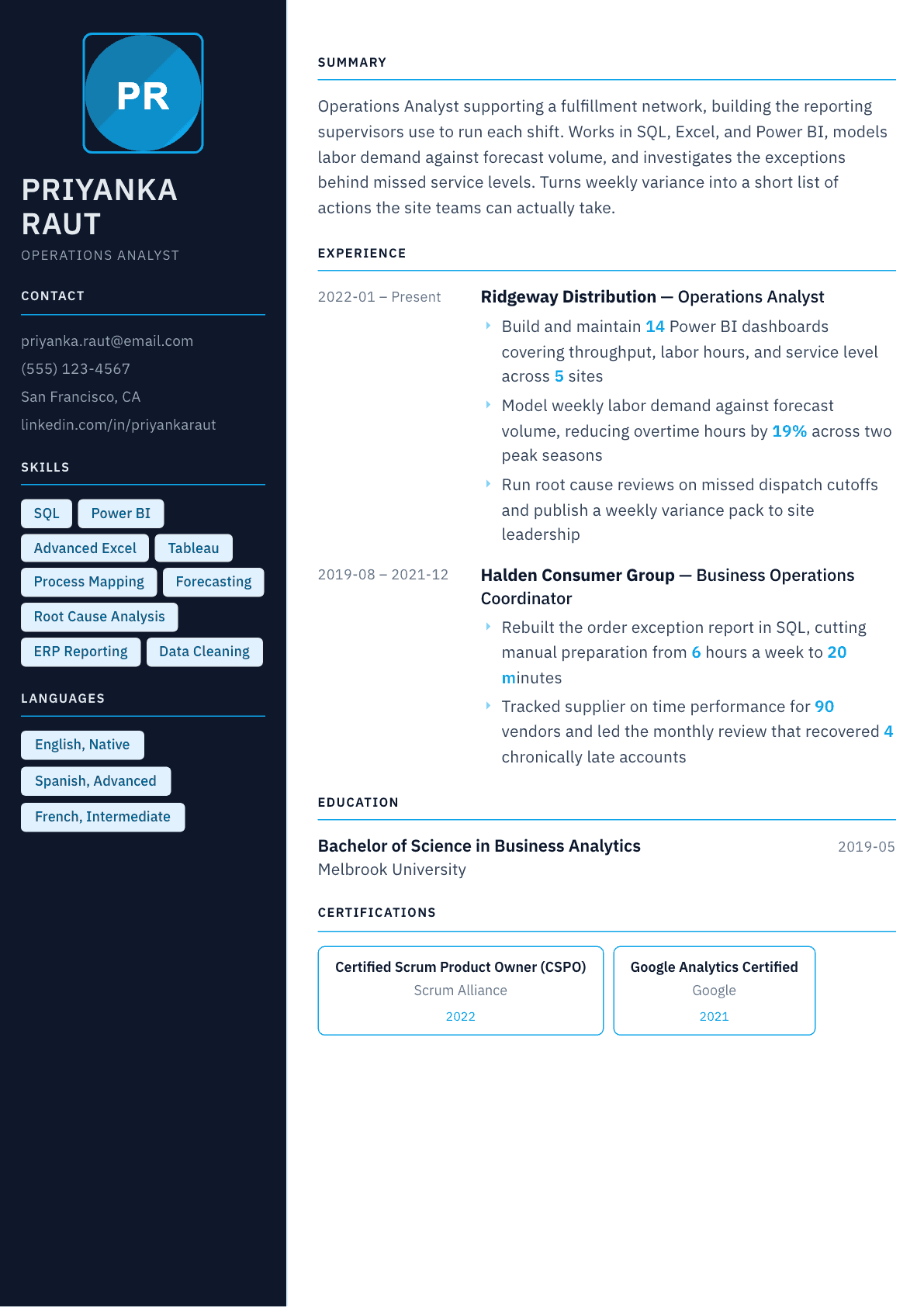
Example Operations Analyst summary
Operations Analyst with four years supporting fulfillment and distribution teams with the reporting they run shifts from. Builds Power BI dashboards on throughput, labor, and service level, models labor demand against forecast volume, and investigates the exceptions behind missed cutoffs. Rebuilt a manual exception report in SQL and cut hours of weekly preparation down to minutes for the planning team.
Skills to list on a Operations Analyst resume
- SQL
- Power BI
- Tableau
- Advanced Excel
- Data Modeling
- Forecasting
- Process Mapping
- Root Cause Analysis
- KPI Reporting
- ERP Reporting
- Python
- Capacity Planning
- Variance Analysis
- Data Cleaning
- Stakeholder Reporting
- Continuous Improvement
What actually gets this resume read
- Name your tools at the depth you actually have them, keeping SQL and Python separate from spreadsheet and dashboard work.
- Describe the decision each analysis supported, because operations managers hire analysts to change what happens on the floor.
- Show recurring reporting you own end to end, including who reads it and the cadence you publish it on.
- Quantify time saved through automation, since replacing a manual report is the most common first project in this role.
- Include process improvement work such as mapping, standardizing, or removing a step, rather than reporting alone.
- Use the metric names from the target industry, whether that is on time in full, cost per order, or cycle time.
How to write a operations analyst resume
An operations analyst resume is screened by an operations manager, not by a data team. She is not evaluating your modeling technique. She wants to know whether you can pull the right data out of a messy resource planning system, explain in one sentence why last week went wrong, and give her something a shift supervisor can act on before the next peak.
That changes what belongs on the page. Tools matter, because SQL and a dashboard platform are the entry ticket, but the differentiator is the decision each analysis supported. Two candidates can both list SQL, Excel, and a reporting tool, and only one of them can show that a labor model she built removed overtime from a site.
This guide covers the section order an operations hiring manager reads in, how to write about reporting you own, three summaries from first analyst role to senior, before and after bullets drawn from distribution and service operations, and the questions analysts ask when they move between industries.
Format: one page, tools visible near the top
One page is right for most operations analysts, two only after eight or more years. Use a single column and put a short technical line under the summary listing query languages, reporting platforms, spreadsheet depth, and the source systems you have pulled from. Managers scan for that line specifically.
Be precise about depth. Writing queries with joins, window functions, and common table expressions is a different skill from running a saved report someone else wrote, and inflating it is discovered in the first technical screen, which many operations teams now run as a short live exercise.
- Header: name, city, phone, email, and a link to a portfolio or public dashboard if you have one.
- Section order: summary, tools and systems, experience, then education and any Lean or Six Sigma training.
- Name the source systems you queried, since resource planning and warehouse system data is rarely clean.
Write about decisions, not deliverables
A dashboard is a deliverable. A dashboard that changed how a site allocates labor on a Monday is a result. Every strong bullet in this role follows the same arc: what you built, who used it, what they did differently, and what happened to the operating number afterward.
Where an analysis led to no change, that can still be a bullet if the finding mattered. Proving that a suspected cause was not the cause saves an operation from spending money on the wrong fix, and analysts who can show that reasoning stand out from those who only produce charts.
Own the recurring reporting and say who reads it
Most of this job is recurring: a daily performance pack, a weekly variance review, a monthly supplier scorecard. Name the reports you own end to end, the audience, and the cadence. A weekly variance pack read by site leadership carries far more weight than an unspecified set of reports.
Automation of that reporting is the fastest win to describe. Rebuilding a manual spreadsheet process into a query that refreshes on a schedule is the most common first project in this role, and the hours saved is a number every hiring manager understands immediately.
Forecasting, labor models, and capacity
The analytical work that gets an analyst promoted usually involves matching resource to demand. Volume forecasting, labor demand models, capacity planning, and scheduling scenarios all sit here, and they are the bridge from reporting into planning.
Describe the model inputs and how the output was used. A labor model built on forecast units, historical rates per hour, and absence assumptions, then used by the site planner to set the weekly roster, is a concrete piece of work. A statement that you supported workforce planning is not.
Speak the industry vocabulary correctly
Operations teams filter on their own metric names. Distribution uses on time in full, cost per order, units per labor hour, and dock to stock. Field service uses first time fix and mean time to repair. Contact centers use average handle time, service level, and shrinkage. Manufacturing uses schedule attainment and overall equipment effectiveness.
Use the terms from the posting, and keep a short line describing the operation you supported: the number of sites, the volume order of magnitude, and the shift pattern. Context makes every number on the page interpretable.
Operations Analyst resume summary examples
First analyst role
Business analytics graduate with a year of coordinator experience in a consumer goods operation. Rebuilt the order exception report in SQL, cutting manual preparation from 6 hours a week to 20 minutes, and tracked supplier on time performance for 90 vendors through a monthly review.
Four years in
Operations Analyst supporting a five site fulfillment network. Builds and maintains 14 Power BI dashboards covering throughput, labor hours, and service level, and models weekly labor demand against forecast volume, which reduced overtime hours by 19% across two peak seasons.
Senior analyst and planning partner
Senior Operations Analyst working directly with site leadership on capacity and labor planning. Owns the weekly variance pack, runs root cause reviews on missed dispatch cutoffs, and built the scenario model used to size the peak season labor plan across the network.
Work experience bullets: before and after
Before: Created dashboards to track operational performance.
After: Built and maintain 14 Power BI dashboards covering throughput, labor hours, and service level across 5 sites, reviewed by site managers in the daily operations meeting.
Count, coverage, and the meeting they are used in show the reporting is embedded rather than merely delivered.
Before: Helped with labor planning for the warehouse.
After: Modeled weekly labor demand against forecast volume and historical rates per hour, giving planners a roster recommendation that cut overtime hours by 19% across two peak seasons.
Naming the model inputs and the decision it fed makes the analysis concrete and its effect attributable.
Before: Automated reports to save time.
After: Rebuilt the order exception report in SQL with a scheduled refresh, cutting manual preparation from 6 hours a week to 20 minutes and removing a single point of failure during holidays.
The time saved plus the risk removed shows the improvement mattered operationally, not only to the analyst.
Before: Investigated the reasons for missed deliveries.
After: Ran root cause reviews on missed dispatch cutoffs across 5 sites, traced two thirds to late inbound receipts rather than pick rates, and moved the receiving cutoff two hours earlier.
Correcting a widely held assumption and changing a process is the highest value thing an analyst does.
Before: Worked with suppliers to improve their performance.
After: Tracked on time performance for 90 vendors and led the monthly supplier review, recovering 4 chronically late accounts to target within a quarter.
Owning the review and naming the recovered accounts turns supplier reporting into a measurable outcome.
Hard skills
- SQL including joins and window functions
- Power BI and Tableau
- Advanced spreadsheet modeling
- Python for data preparation
- Forecasting and demand modeling
- Labor and capacity planning
- Process mapping
- Root cause analysis
- Resource planning system reporting
- Variance and exception analysis
- Data cleaning and validation
- Key performance indicator design
Soft skills
- Explaining analysis to shift supervisors
- Questioning a number before publishing it
- Working across planning and finance
- Meeting a recurring reporting deadline
- Curiosity about how the operation runs
- Written clarity in a short summary
Certifications worth listing
- Microsoft Certified: Power BI Data Analyst Associate (Microsoft)
- Certified Six Sigma Green Belt (CSSGB) (American Society for Quality)
- Certified in Planning and Inventory Management (CPIM) (Association for Supply Chain Management)
- Tableau Certified Data Analyst (Tableau)
Mistakes that cost operations analyst candidates the interview
- Listing tools with no indication of depth, which fails the moment a manager runs a short live query exercise.
- Describing reports produced without naming the audience, the cadence, or what anyone did with them.
- Using generic analytics language instead of the operating metrics the target industry actually measures.
- Leaving out the source systems, so a manager cannot tell whether you have handled genuinely messy operational data.
- Presenting an analysis with no recommendation attached, which is the difference between a report writer and an analyst.
- Padding the resume with coursework projects once you have real operational reporting to point at instead.
Operations Analyst resume questions
Do I need to know Python to be an operations analyst?
Not usually. Strong SQL and advanced spreadsheet skills cover most of the work, with a dashboard tool on top. Python helps for forecasting and repetitive data preparation, so list it only if you have genuinely used it on a work problem.
How is an operations analyst different from a business analyst?
An operations analyst is embedded in a running operation, works with volume, labor, and service data, and answers questions on an operational clock. A business analyst more often works on requirements, process change, and systems projects with a longer horizon.
What should I put on the resume with no operations experience?
Lead with query and modeling skills, then find the closest operational content you have: a coordinator role, an internship with scheduling or inventory work, or a project using a public operational dataset with a clear recommendation at the end.
Should I include a portfolio link?
It helps if the work is genuinely yours and does not expose employer data. A short public dashboard or a written case study showing the question, the query approach, the finding, and the recommendation is more persuasive than an extra bullet of tool names.
How do I show analysis that leadership ignored?
Describe the finding and the recommendation without overstating the outcome. Hiring managers know that analysts do not control decisions, and a clear account of what you found and what you advised still demonstrates the reasoning they are hiring for.
Related resume examples
- Business Analyst Resume example
- Data Analyst Resume example
- Operations Coordinator Resume example
- Supply Chain Analyst Resume example
- Project Analyst Resume example
- Data Analytics Consultant Resume example