Business Manager Resume Examples: the lines they read
Build a Business Manager Resume That Shows Ownership of the Numbers
By Mustafa Tarabya, founder of CVBooster · Published · Updated
A resume for business management: a business manager resume example with a full work history, a graduate version, and the skills employers scan for.
Sample resumes for a business manager
The same business manager content laid out in three CVBooster templates, so you can see what the finished document looks like before you write a word.
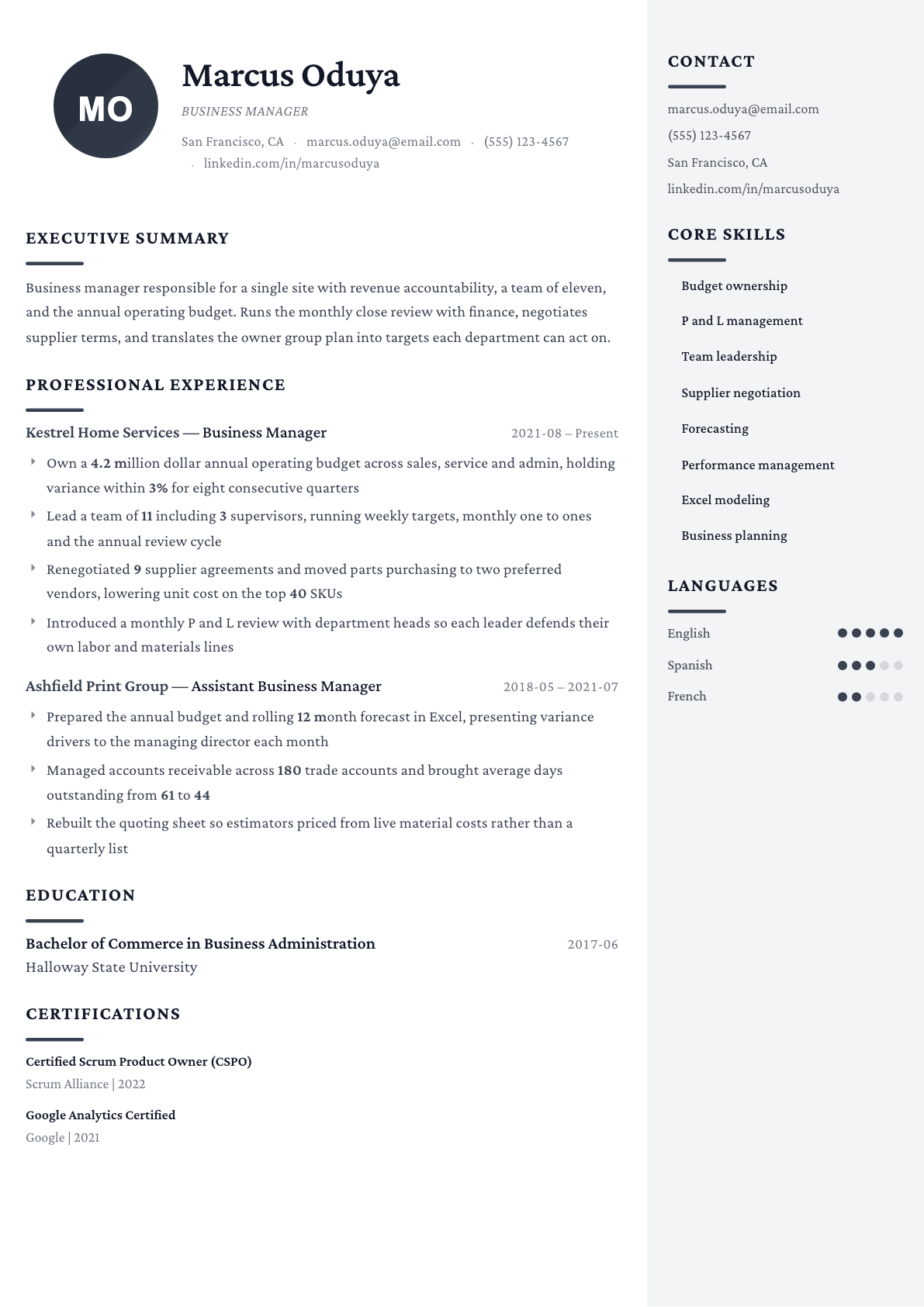
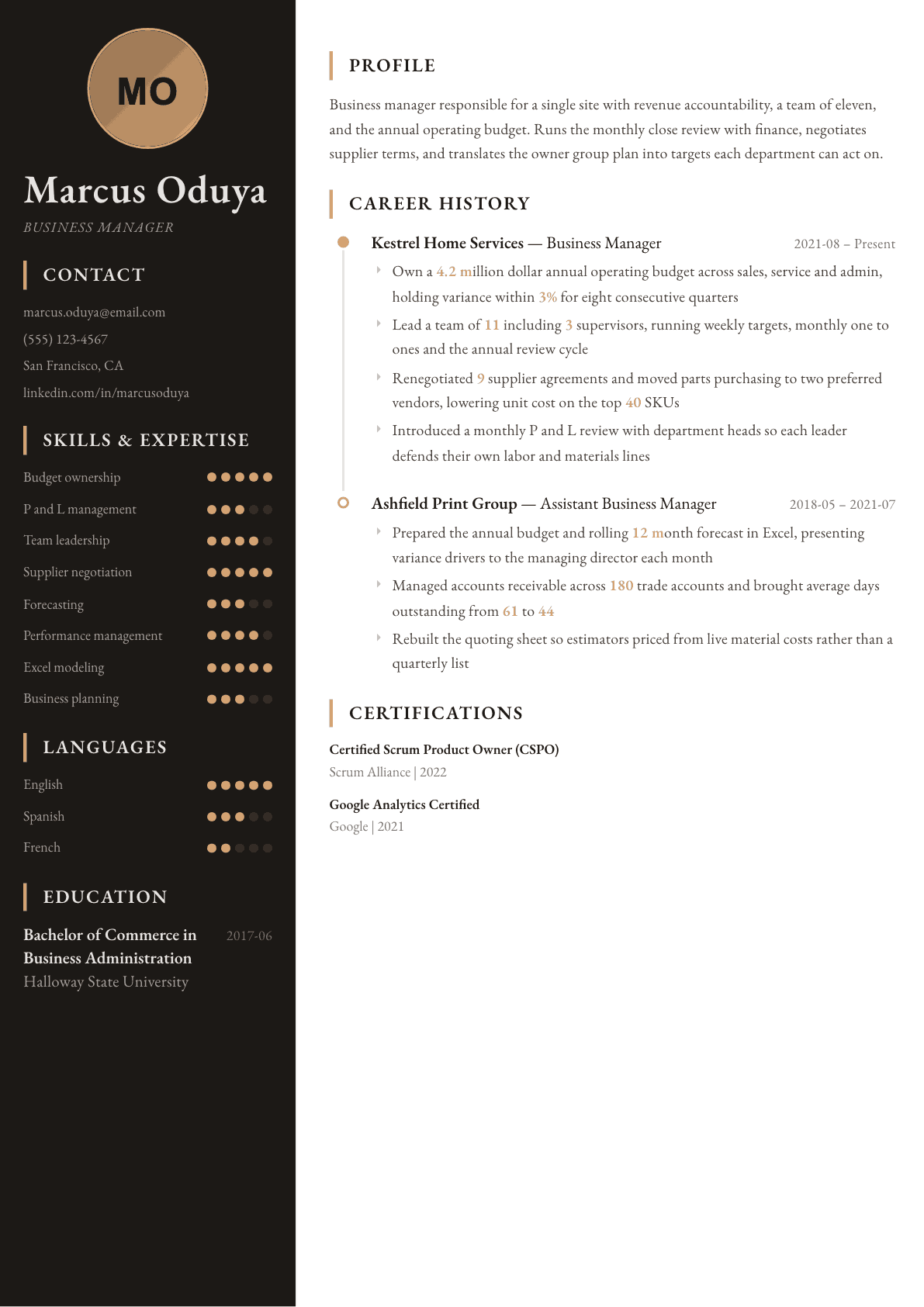
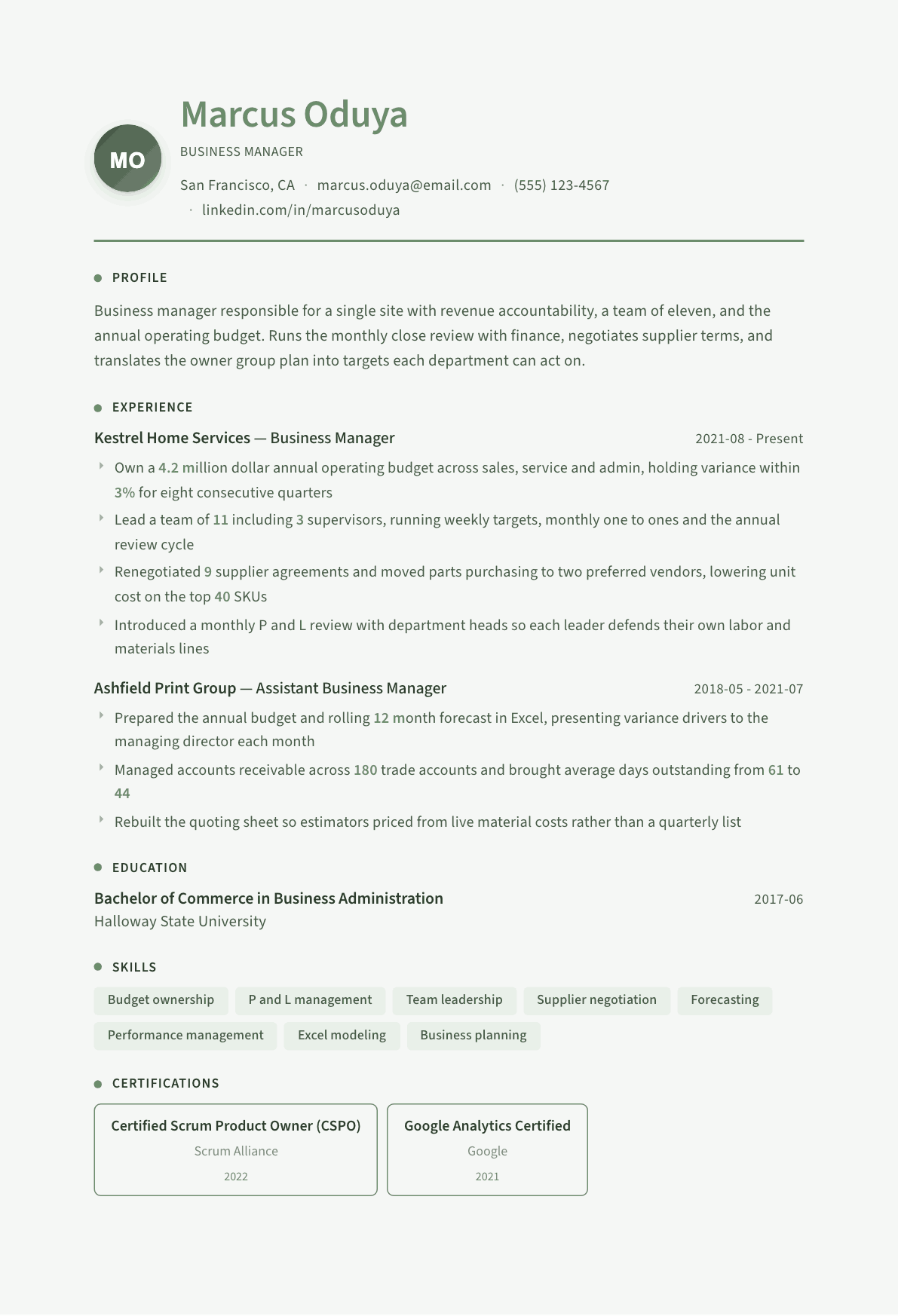
Example Business Manager summary
Business manager with seven years running site level operations against a full profit and loss, most recently a four million dollar budget and a team of eleven. Combines commercial negotiation with hands on people leadership: rebuilt supplier terms, brought receivables under control, and gave each department head visibility of the lines they own. Looking for a multi-site role with regional accountability.
Skills to list on a Business Manager resume
- P and L ownership
- Budgeting and forecasting
- Team leadership
- Performance management
- Supplier negotiation
- Contract management
- Business planning
- Cost control
- Financial reporting
- Excel modeling
- QuickBooks
- Sage
- Stakeholder communication
- Process improvement
- Hiring and onboarding
- Compliance oversight
What actually gets this resume read
- State the size of what you ran: revenue, budget, headcount and number of sites, in the first two lines of the summary.
- Show profit and loss ownership explicitly, because that single line separates a business manager from a senior coordinator.
- Quantify commercial wins such as supplier renegotiations, margin recovery, receivables improvement or cost per unit reductions.
- Describe the people side with structure: how many direct reports, how many indirect, and what you did about performance.
- Match the resume to the employer size, since a family business and a corporate branch want very different evidence.
- Put the finance systems you actually used, such as QuickBooks, Xero, Sage or NetSuite, in a clear skills block.
How to write a business manager resume
Business manager is one of the least standardized titles in hiring. In a family firm it means the person who runs everything except the trade itself. In a dealership group it means a finance and insurance role. In a corporate division it can mean a chief of staff. The first job your resume has to do is settle which of those you are, in the first two lines, before the reader guesses wrong and moves on.
The second job is to prove commercial accountability. What separates a business manager from a senior coordinator is a profit and loss line with your name on it. Screeners look for budget size, revenue, headcount and whether you were the one defending variance to an owner or a director. If none of that is on the page, the file reads as an administrator with an ambitious title.
This guide sets out how to frame the role for the employer you are targeting, how to write commercial and people bullets that survive an interview, which finance systems to name, and the questions business managers ask when they rewrite the file. The section headed Resume for business management writes one out twice, once for a graduate and once for a working manager.
Format: two pages once you have carried a budget
One page is fine for a first business manager role. After you have owned a budget across several years, two pages is normal and expected, because the reader wants the scope of each site and the commercial detail that goes with it. Three pages is not.
Use a clean single column layout. Business manager applications often land with a small firm using a low cost applicant tracking system or with a corporate parser that penalizes tables. Keep the numbers in the bullets where both a machine and a human will find them.
- Header: name, title, city and state, phone, email, and a link to a professional profile if it is current.
- Sections in this order: summary, core competencies, experience, education, certifications.
- Add a short scope line under each employer: revenue, budget, headcount, sites.
Summary: settle the definition, then give the size
Open by naming the kind of business manager you are. Single site with full profit and loss accountability. Divisional business manager supporting a sales director. Finance and insurance business manager in automotive retail. The word alone is ambiguous, so remove the ambiguity yourself.
Follow with the scale in one clause: budget, revenue, headcount and sites. Then one differentiator: turnaround, supplier renegotiation, systems change, or growth from a standing start. Three lines total. Everything else belongs in the experience section where it can be evidenced.
Experience: commercial results and people results, in that order
Give the commercial bullets first because that is what a hiring director scans for. Budget owned and variance held. Margin recovered and how. Supplier terms renegotiated with the cost effect named. Receivables brought down with the collection routine you introduced. Each of those is checkable in an interview, which is exactly why it carries weight.
Then the people bullets. State direct and indirect reports separately, because eleven direct reports is a different job from three supervisors who between them manage forty. Say what you did about performance, not that you managed it. Introducing a monthly review where department heads defend their own labor and materials lines is a specific management act.
Finish each job with one bullet on governance or control: an audit, a compliance obligation, an insurance renewal, a licensing requirement, a health and safety record. Small businesses live or die on those and larger employers assume you have never had to hold them alone unless you say so.
- Quantify the budget you owned and the variance you held it inside.
- Name the commercial lever you pulled: pricing, supplier terms, labor mix, product mix, collections.
- Separate direct reports from indirect, and say which people processes you ran yourself.
Skills and systems: finance tools carry more weight than adjectives
Name the accounting platform you actually worked inside: QuickBooks, Xero, Sage Intacct, NetSuite or a division of a larger enterprise system. Add the payroll and rostering tools, and the customer or job management platform if the business ran on one. A hiring owner reads that line as how quickly you can be useful.
Keep the competencies block to real capabilities rather than qualities. Budgeting and forecasting, cost control, supplier negotiation, performance management, hiring and onboarding, compliance oversight. Strategic thinker and results driven can be deleted without losing a single interview.
Keywords and tailoring for the employer size
A corporate posting wants governance vocabulary: budget cycle, forecast accuracy, headcount planning, stakeholder reporting, policy compliance. An owner managed business wants practical vocabulary: cash flow, supplier terms, quoting, stock, staffing and the day the wages run. Read the posting and mirror the register you find, because the same career can be told either way.
Where the posting names a metric, use that exact metric in a bullet. If it says gross margin, do not write profitability. Applicant tracking systems match the phrase, and the hiring manager reading afterward wants to see their own words come back.
Resume for business management: a graduate and a manager version
Searches for a resume for business management come from two very different people: a graduate with a business management degree looking for a first role, and a working manager whose job is running a business unit. Both are written out below as plain text. The names and employers are invented; keep the order of the lines and replace the content with your own.
The graduate version leads with the degree and the projects where you handled real money, staff or customers, because that is the evidence a first employer can check. The manager version leads with the scope you owned, then the result, then the people.
- Graduate summary: Business management graduate with a placement year in a regional retail group, building the weekly sales and staffing report for six stores and covering the store manager on two closing shifts a week. Comfortable with Excel, basic bookkeeping and supplier calls.
- Graduate bullets: ran the stock count and reorder list for one store during the placement; wrote the final year project on reducing supplier lead times for a local bakery, using the owner's real order data; treasurer of the student business society, handling the budget and reporting it at each general meeting.
- Manager summary: Business manager for an owner managed engineering services firm with forty staff, accountable for the budget, cash flow, supplier terms and office operations, reporting monthly to the two owners.
- Manager bullets: prepared the annual budget and monthly management accounts with the external accountant and presented the variances to the owners; renegotiated payment terms with the three largest suppliers; hired and managed a team of four covering finance, HR administration and reception.
- Skills line for either version: budgeting, cash flow forecasting, management reporting, supplier negotiation, staff scheduling, Excel, accounting software, HR administration.
Business Manager resume summary examples
Stepping up from supervisor
Operations supervisor moving into business management, with three years running a nine person team and two years preparing the branch budget and monthly variance pack. Renegotiated two consumables contracts and reduced overtime spend by 12% while holding output. Seeking a single site business manager role.
Five years in
Business manager for a home services firm with a 4.2 million dollar operating budget, eleven staff and three supervisors. Holds budget variance within 3%, renegotiated nine supplier agreements, and introduced a monthly profit and loss review where each department head defends their own labor and materials lines.
Multi-site
Business manager across four sites with combined revenue above nine million dollars and a headcount of sixty-two. Rebuilt the quoting model against live material costs, recovered four points of gross margin, and cut average receivable days from 61 to 44 through a structured collections routine.
Work experience bullets: before and after
Before: Managed the budget for the business.
After: Owned a 4.2 million dollar annual operating budget across sales, service and administration, holding variance within 3% for eight consecutive quarters.
The budget value, the departments covered and a sustained variance figure convert a claim into an audited-sounding fact.
Before: Negotiated with suppliers to reduce costs.
After: Renegotiated nine supplier agreements and consolidated parts purchasing to two preferred vendors, lowering unit cost across the top forty stock lines.
Counting the agreements and naming the consolidation shows a strategy rather than a round of phone calls.
Before: Improved cash flow.
After: Brought average receivable days from 61 to 44 across 180 trade accounts by introducing a weekly aged debt review and a hold rule at 60 days.
A before and after plus the mechanism lets an interviewer test the claim, which is why it is believed.
Before: Led a team and handled performance issues.
After: Led eleven staff including three supervisors, running weekly target reviews, monthly one to ones and two formal performance improvement plans that both ended in retained employees.
Structure and outcome show real people management, where handled performance issues hides whether anything worked.
Before: Prepared reports for the director.
After: Prepared the monthly board pack covering profit and loss by department, forecast against budget, and headcount, and presented variance drivers to the managing director.
Naming the contents and the audience shows the reporting was decision grade, not a spreadsheet emailed on a Friday.
Hard skills
- Profit and loss ownership
- Budgeting and forecasting
- Variance analysis
- Cost control
- Supplier negotiation and contract management
- Accounts receivable management
- Financial reporting
- Pricing and quoting models
- Headcount and labor planning
- QuickBooks
- Xero
- Advanced Excel
- Compliance and insurance administration
Soft skills
- Commercial judgment
- Difficult conversations
- Prioritizing under cash pressure
- Coaching supervisors
- Negotiation
- Translating strategy into targets
Certifications worth listing
- Certified Management Accountant (CMA) (Institute of Management Accountants)
- Project Management Professional (PMP) (Project Management Institute)
- Certified Manager (CM) (Institute of Certified Professional Managers)
- Certified Six Sigma Green Belt (CSSGB) (American Society for Quality)
- QuickBooks Online ProAdvisor (Intuit)
Mistakes that cost business manager candidates the interview
- Leaving the reader to guess which kind of business manager you are, so the file is screened against the wrong job.
- Omitting budget value, revenue and headcount, which makes the title look inflated rather than earned.
- Filling the competencies block with adjectives such as dynamic and results driven instead of capabilities.
- Describing team management without saying how many people reported to you or what you did about performance.
- Using corporate governance language for an owner managed business that cares about cash, stock and staffing.
- Claiming growth without the lever behind it, when the interview will open with how exactly you achieved it.
Business Manager resume questions
Is business manager a finance role or an operations role?
It is usually both, weighted by employer. Smaller firms want budget ownership plus daily operational control. Larger firms often split the two, so read the posting and lead with the half it emphasizes while keeping evidence of the other half visible.
How do I write the resume if I ran a business without a formal title?
Give yourself an accurate descriptive title such as Business Manager, Owner Operated Firm, and evidence it the same way: revenue, headcount, budget and the commercial decisions you made. Screeners accept this when the numbers and the duties line up.
Should I include the revenue of the business I worked for?
Include what you were accountable for rather than the whole company figure. A branch budget you owned is credible evidence. A group revenue number you had no influence over reads as borrowed scale and interviewers usually probe it.
What certifications help a business manager resume?
A recognized management or accounting credential adds most, such as a management accounting qualification or a project management certification. Ensure the issuing body is named on the resume, because unnamed acronyms are treated with suspicion in commercial hiring.
How do I write a resume for business management with no management experience?
Lead with the degree, then the placement, part-time job or society role where you handled money, stock, staff rotas or customers, and give each one a concrete duty. Employers hiring graduates into business management roles check for evidence that you have already carried some responsibility.
Related resume examples
- General Manager Resume example
- Operations Manager Resume example
- Branch Manager Resume example
- Business Consultant Resume example
- Healthcare Consultant Resume example
- Administrative Director Resume example